Translate

Showing posts with label guillotine. Show all posts

Thursday, September 6, 2012

1794: Lucile Duplessis and Marie Hebert, friends at the end


Lucille Duplessis                                    


April 13th, 2008 Headsman
On this date in 1794, two women whose husbands had been deadly enemies in the French Revolution followed them to the guillotine.
The radical Jacques Hebert had been beheaded on March 24; Camille Desmoulins, the acerbic Dantonist journalist who had often savaged Hebert, followed him on April 5. Between the two, Robespierre had destroyed the principle remaining factions to his left and his right, respectively.
In Desmoulins’ last days, a supposed plot involving his wife formed part of the charge against him, and he became frantic that a bride he loved tenderly (he died clutching a lock of her hair) would follow him to the scaffold. It was barely a week later that it came to pass, when Lucile shared a tumbril with an unlikely friend: the widow of Hebert.
In this postcard, Desmoulins (dandling his son) and Lucile are warned of their danger, while Lucile’s doting mother looks on. (Source)
Their fate was nothing to the Revolution, but it remains an affecting personal portrait amid the tempest of factional massacres. Here is their end, sketched by the (markedly anti-Revolutionary) Paris in the Terror:
As Camille Desmoulins had foreseen, his wife soon followed his footsteps to the guillotine … Lucile was arrested immediately after Camille’s execution. It suited the Committee [of Public Safety] to support St. Just’s story of a “dangerous conspiracy in the prisons.” Along with having been seen in the vicinity of the Luxembourg (carrying the baby Horace in her arms in the hope that Camille might catch a glimpse of him),* Lucile had gone to Robespierre’s house and tried to gain admittance in order to plead with the Incorruptible on her husband’s behalf. No man was less accessible to the pleas of wailing women than Robespierre, and his door remained adamantly closed. Such manifestations of despair conveniently lent themselves to St. Just’s contention that revolt was afoot, and Lucile was accordingly arrested.
(Robespierre, in fact, had been the chief witness at Camille’s wedding and was actually godfather of little Horace.)
Lucile was condemned to death on April 13, along with eighteen other victims. She accepted her sentence with serenity. “In a few hours I shall see my Camille again,” she declared to her judges. “I am therefore less to be pitied than you, for at your death, which will be infamous, you will be haunted by remorse for what you have done.” At the same trial, the widow of Hebert was also condemned. The two women whose husbands had so bitterly hated each other struck up a friendship in the last few days of their life. “You are lucky,” Mme. Hebert said to Lucile as they departed for the scaffold. “Nobody speaks ill of you. There is no shadow upon your character. You are leaving life by the grand staircase.”
Upon hearing the news of her daughter’s sentence [Lucile's mother] sent a frantic letter to Robespierre. “It is not enough for you to have murdered your best friend [Camille],” she cried. “You must have his wife’s blood as well. Your monster Fouquier-Tinville has just ordered Lucile to be taken to the scaffold. In less than two hours’ time she will be dead. If you aren’t a human tiger, if Camille’s blood hasn’t driven you mad, if you are still able to remember the happy evenings you once spent before our fire fondling our Horace, spare an innocent victim. If not — then hurry and take us all, Horace, myself and my other daughter Adele. Hurry and tear us apart with your claws that still drip with Camille’s blood … hurry, hurry so that we can all sleep in the same grave!”
* This particular of strolling outside the prison in hopes of giving the doomed man a glimpse is echoed by Dickens in A Tale of Two Cities in the person of Charles Darnay‘s wife — Lucie:
“[T]here is an upper window in the prison, to which Charles can sometimes gain access at three in the afternoon. When he can get to it — which depends on many uncertainties and incidents — he might see you in the street, he thinks, if you stood in a certain place that I can show you.”
In all weathers, in the snow and frost of winter, in the bitter winds of spring, in the hot sunshine of summer, in the rains of autumn, and again in the snow and frost of winter, Lucie passed two hours of every day at this place; and every day on leaving it, she kissed the prison wall.


A letter from Paris to the provinces…

17MAY
I have been waiting so long for happiness, but at last it has come, and this day sees me as happy as Mortal Man can be. Lucile, of whom I have so often written to you, and whom I have loved for eight years, has promised her hand, and her parents have finally approved. A moment ago her mother, weeping for joy, came to give me the wonderful tidings. She escorted me to her daughter’s room and I went on my knees to Lucile. Hearing her laugh, I looked up, surprised. But, like me, she was shedding tears of happiness, and she wept as she laughed. I have never seen anything so lovely.’
Camille Desmoulins, breaking the news of his engagement to Lucile Duplessis-Laridon to his father.

Monday, July 23, 2012

The Guillotine


http://www.angelfire.com/ca6/frenchrevolution89/guillotine.html


It is most unfortunate but true that the guillotine has become the most famous icon of the French Revolution. "the Louisette" did indeed symbolize many of its aspects; its passionate egalitarianism, its demand for common standards, its humanistic tendencies,...and its moloch mercilessness. Here then is a brief history of the most evocative lethal instrument ever.
Headless History 
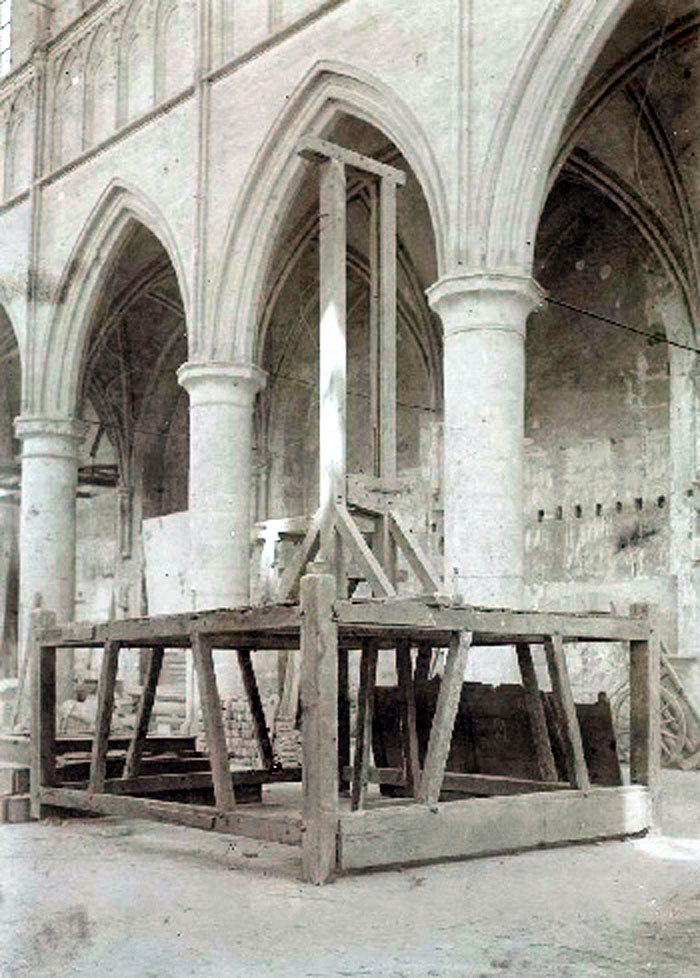
The Guillotine's predecessors included the Scottish Maiden, the Italian Mannaia and the English Halifax Gibbet which were in irregular use In the Middle Ages. These machines, like all forms of decapitation were an aristocratic privilege.
In 1790, National Assembly delegate Dr. Joseph Guillotin proposed that torture be abolished and a humane and equal death penalty be applied in the form of a decapitation machine.
Such a machine had been designed by Dr. Louis and was built by a harpsichord maker named Thomas schmidt
The first execution was of Jacques-Louis Pelletier, a thief. The audience is disappointed by the lack of spectacle.
During the Reign of Terror, 17,000 people were guillotined. Most of the estimated 40,000 who perished in the Terror did so by mass drowning or shooting. Not a la Madame Guillotine.
During the Age of Imperialism, the guillotine was taken wherever the French Empire extended---- to the Caribbean, and Asia especially.

in 1870s, Berger redesigned the guillotine to make it smaller, more portable and scaffold-less. The Guillotine now functioned seldomly in France. Most execution were of underworld criminals.
The Last Public Guillotining in france Took Place in 1939 The Nazis revived use of Guillotine and around 17,000 executions took place in Hitler's Europe.
The Last Guillotining, taking place in 1977, was of Algerian murderer Hamida Djandoubi
The death penalty abolished in France in 1981. Its abolition was declared "In the spirit of the Revolution."
Tete A Tete 
During the Reign of Terror, fear of the guillotine reached cult-like status. Popular Names for the Guillotine Included "The National Razor," The Hungry Lady" The She-wolf." Louisette" Madame Guillotine," and "The Widow"
During The Reign of Terror, Men wore their cravats increasingly high. There were women's earrings made of the guillotine. In the Thermidorean Reaction, cravats came to cover much of the face, women wore dresses a la guillotine
During the Thermidorean Reaction, balls were hosted on the cemeteries of he Terror. To get in, you had to have lost one close relative in the Terror. Young men would wear shirts so high their heads were invisible sometimes and women wore red ribbons around their throats. To signal to a partner, the man would make a slitting gesture across his throat and the woman would reply with a dropping gesture.
The Guillotine exerted a powerful influence well into the twentieth century due to the interest that writers and the general public showed in the Machine.
A Day in the Life of the Condemned 
the roll call of the condemned-A representative would call the names of prisoners to be executed that day
the Toilette of the condemned-the prisoner would have their hair cut to the back of their neck and their shirt ripped to make the guillotine's work easier.
the tumbrel ride-Prisoners were loaded into rough-hewn carts with many other prisoners-at the height of the Terror in Paris there might be 80 to 90 people to be executed every day. The Ride was long and painful. All the way, jeering crowds laughed, joked and threw things at the prisoners. These rides from the various prisons could take hours--- Robespierre's took 3.
at the scaffold-the prisoners were expected to take a calm, stoic and brave approach to their own deaths. Most prisoners did show this, but Madame Du Barry for example died screaming for help. The crowd sympathized with her whereas they jeered the brave victims.
Could you have been guillotined and not died of it? Yes, the Republic beheaded people who were already dead- I.e. Charles Valaze
The Guillotine was constantly being moved because of stench and fear of disease
After the execution---- Head and Body were put into a ditch with head between legs and then covered with quicklime.
A Heady Business 
When the executioner's assistant slapped Charlotte Corday's head after her guillotining, the crowd swore they saw her blush.
Antoine Lavoisier, the famous chemist, had a friend record the times he blinked after he was beheaded-the friend recorded 11.
It is true that for a few seconds if the head is not properly shaken, blood remains going to the brain the person is still alive after they have been guillotined. This was one of the reasons why the death penalty was abolished in France.

Tuesday, June 26, 2012

The Guillotine


"Terror is nothing other than justice, prompt, severe, inflexible" Maximilien Robespierre


The Guillotine http://www.historywiz.com/guillotine.htm
Although the guillotine's fame dates from its extensive use during the Reign of Terror of the French Revolution, the first guillotine-like instrument was used as early as 1307. It may have been used earlier but the first solid evidence is its use in Ireland in 1307. It was not used much until it became the official instrument of execution for the French revolution. It was named for Dr. Louis Guillotin, who proposed that such a machine be used for official executions. It was actually constructed by others, though his name was forever associated with the machine. 
It was adopted because it was an egalitarian and humanitarian form of capital punishment. Previously the form of execution depended in part on a person's class. A noble might merit a quick blow from the headsman's axe (the custom was to offer a tip to the executioner to ensure a swift death), but if you were a commoner, you might suffer the torture of a drawing and quartering or some equally painful death. 
The official executioner of the French Revolution, Charles-Louis Sanson, said on April 25, 1792:
Today the machine invented for the purpose of decapitating criminals sentenced to death will be put to work for the first time. Relative to the methods of execution practised heretofore, this machine has several advantages. It is less repugnant: no man's hands will be tainted with the blood of his fellow being, and the worst of the ordeal for the condemned man will be his own fear of death, a fear more painful to him than the stroke which deprives him of life.
Some have speculated that these very virtues made it easier and more efficient to use it as an instrument to kill in large numbers. Would Maximilien Robespierre and his followers have been so quick to remove those citizens who failed to measure up in order to create his perfect "republic of virtue" if it were not so efficient and humane? It certainly would have been more difficult.
In spite of its efficiency, an execution by guillotine was still a sickening spectacle. When the head was severed, blood poured from the body as the heart continued to pump. When it was used frequently (as it was during the revolution), the stench from the place of execution was horrible. There is also some evidence to suggest that the head retained some life for a moment after the head was severed and so the death might not be as quick as has been supposed.


Although the guillotine is most closely associated with the French, the Nazis guillotined more people than were killed during the French Revolution. Hitler considered it a demeaning form of punishment and used it for political executions. 20,000 had a date with Madame la Guillotine in 1942 and 1943. 


The last use of the guillotine was in 1977. Capital punishment has been abolished in France.