The House of Bernadotte has reigned in Sweden since 1818 when Jean Baptiste Jules Bernadotte, a Marshal of France, assumed the throne as King Carl XIV John (Karl XIV Johan). His predecessor King Carl XIII was childless and the House of Holstein-Gottorp was becoming extinct. On August 21, 1810, the Riksdag (Swedish Parliament) made the decision to appoint Bernadotte as heir to the throne. The first four Bernadotte kings were Kings of Norway until 1905 when the union between Sweden and Norway was dissolved.
Wikipedia: House of Bernadotte
Royal Court: The Bernadotte Dynasty
House of Bernadotte
Carl XIV John, reigned February 5, 1818 – March 8, 1844
Oscar I, reigned March 8, 1844 – July 8, 1859
Carl XV, reigned July 8, 1859 – September 18, 1872
Oscar II, reigned September 18, 1872 – December 8, 1907
Gustaf V, reigned December 8, 1907 – October 29, 1950
Gustaf VI Adolf, reigned October 29, 1950 – September 15, 1973
Carl XVI Gustaf, reigned September 15, 1973 – present
All photos of Riddarholmen Church and its tombs were taken by Susan Flantzer in August, 2011. Please do not copy any photos that I have taken. If you wish to use a photo please contact me.

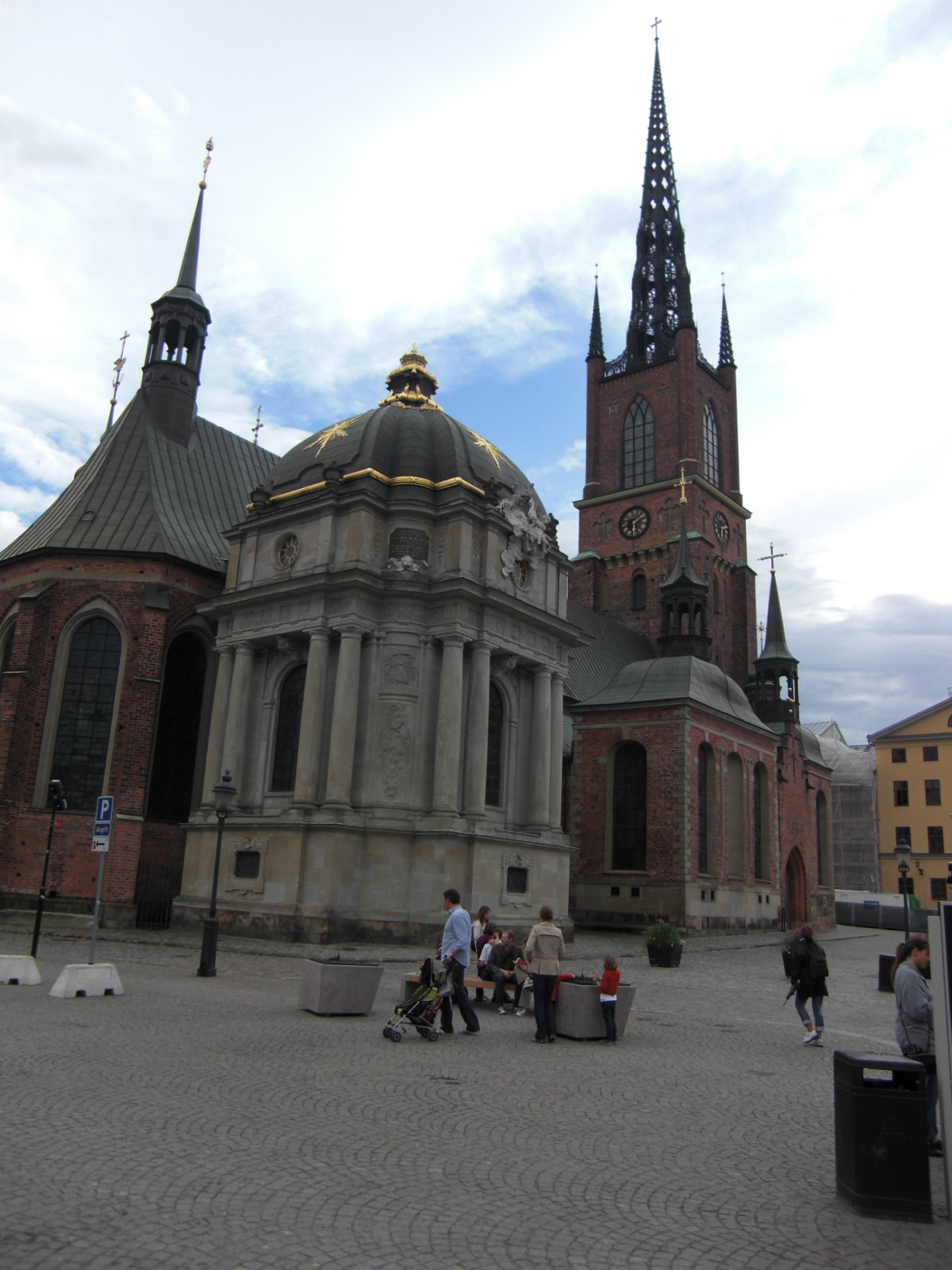
Riddarholmen Church – photo by Susan Flantzer
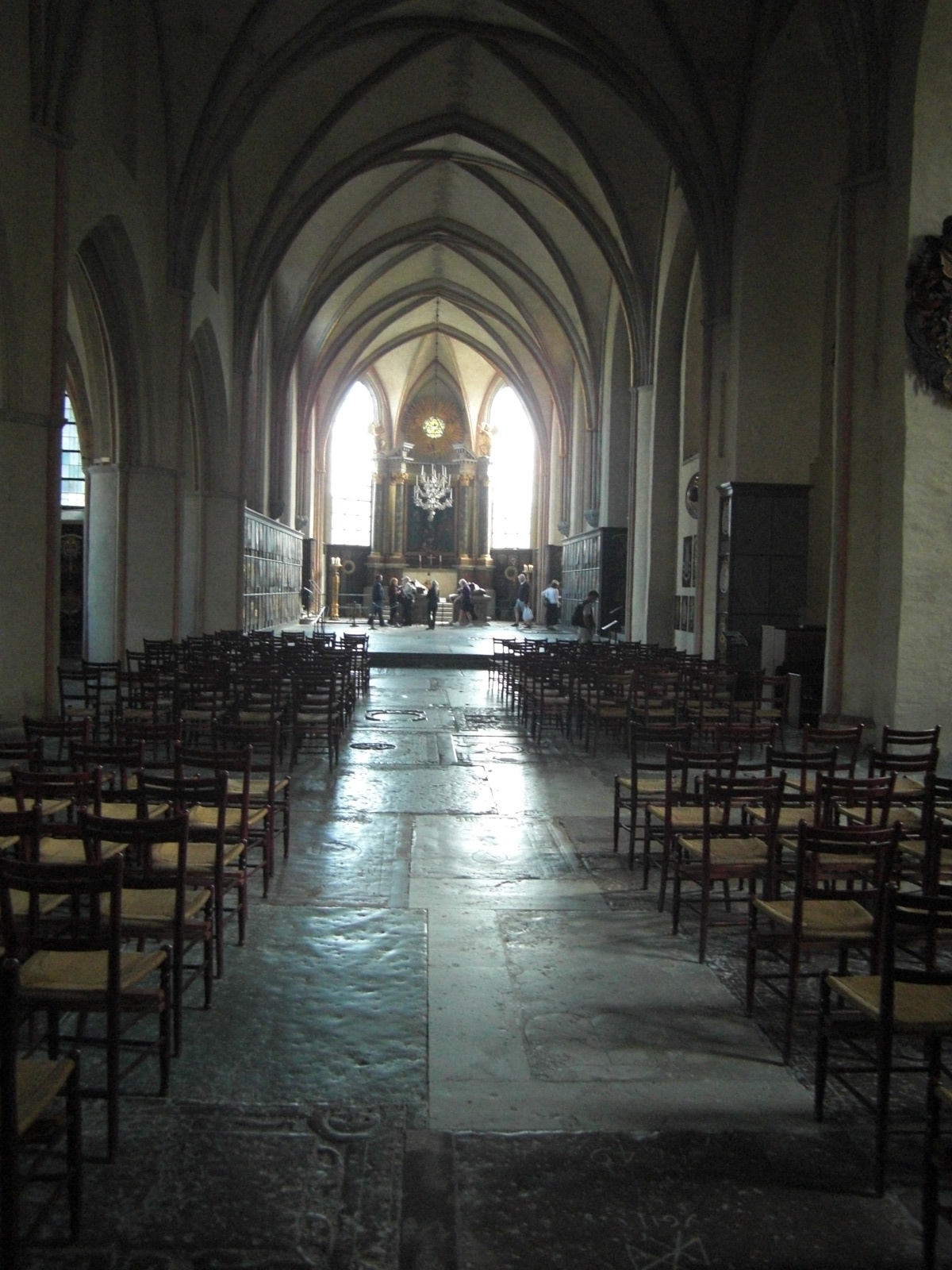
Swedish monarchs from Gustavus Adolphus (died 1632) to Gustaf V (died 1950) are buried at Riddarholmen Church in Stockholm except Queen Christina who converted to Roman Catholicism, abdicated, and was buried at St. Peter’s Basilica in Rome. King Gustaf VI Adolf who died in 1973 is buried at the Royal Burial Grounds in Haga. Riddarholmen is one of the oldest buildings in Stockholm. It was originally built as a monastery in the late 13th century. During the Reformation, it was transformed into a Protestant church. Now it is used only as a burial place and a place for commemorative services.

Interior of Riddarholmen Church – Photo by Susan Flantzer
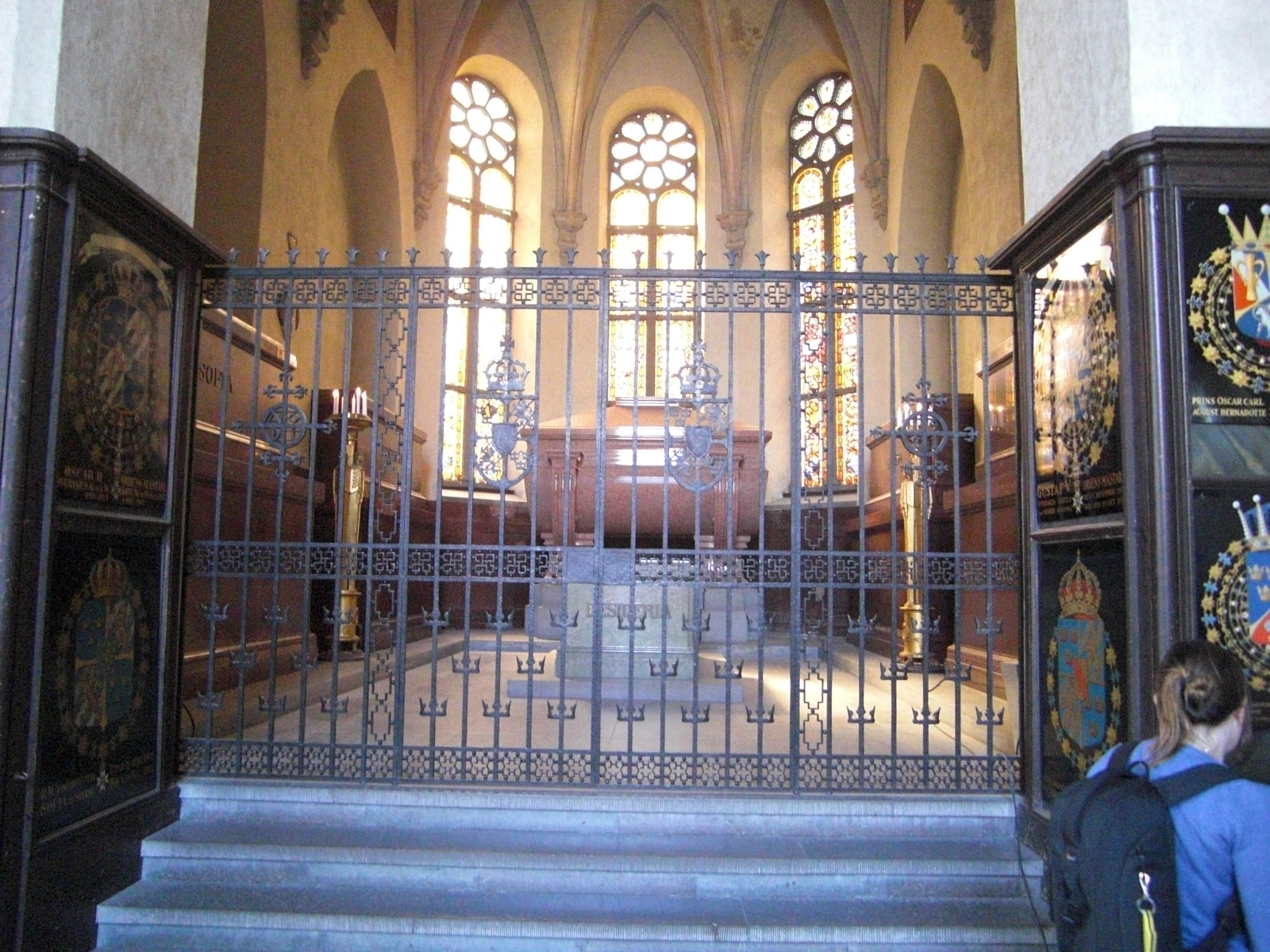
The Bernadotte Chapel within Riddarholmen Church contains the tombs of the Bernadotte kings and their wives from Carl XIV John through Gustav V.

Bernadotte Chapel – Photo by Susan Flantzer

photo: Wikipedia
Carl XIV John, King of Sweden and Norway (reigned February 5, 1818 – March 8, 1844)
Jean Baptiste Bernadotte was born on January 26, 1763 in Pau, France. His parents were Jean Henri Bernadotte, a tax collector, and Jeanne de Saint-Vincent. Bernadotte joined the French army as a private in 1780 and by 1794, he was a general. He distinguished himself in Napoleon Bonaparte’s army and served as Minister of War. When Napoleon became Emperor of the French, he created Bernadotte a Marshal of France. In 1810, just as he was about to start a new position as governor of Rome, the Swedish Riksdag elected him heir to the childless King Carl XIII. The Riksdag wanted a soldier as king because of their worries over Russia. In addition, Bernadotte was popular in Sweden because of his considerate treatment of Swedish prisoners during the recent war with Denmark. Bernadotte became king on February 5, 1818 upon the death of King Carl XIII and reigned as King Carl XIV John.
On August 16, 1798, Bernadotte married Bernhardine Eugénie Désirée Clary, the sister of Joseph Bonaparte’s wife Julie Clary. His wife was known as Désirée and had previously been engaged to Napoleon. Bernadotte and Désirée had one child, King Oscar I of Sweden and Norway.
King Carl XIV John died on March 8, 1844 in Stockholm, Sweden at age 81 and was buried at Riddarholmen Church.

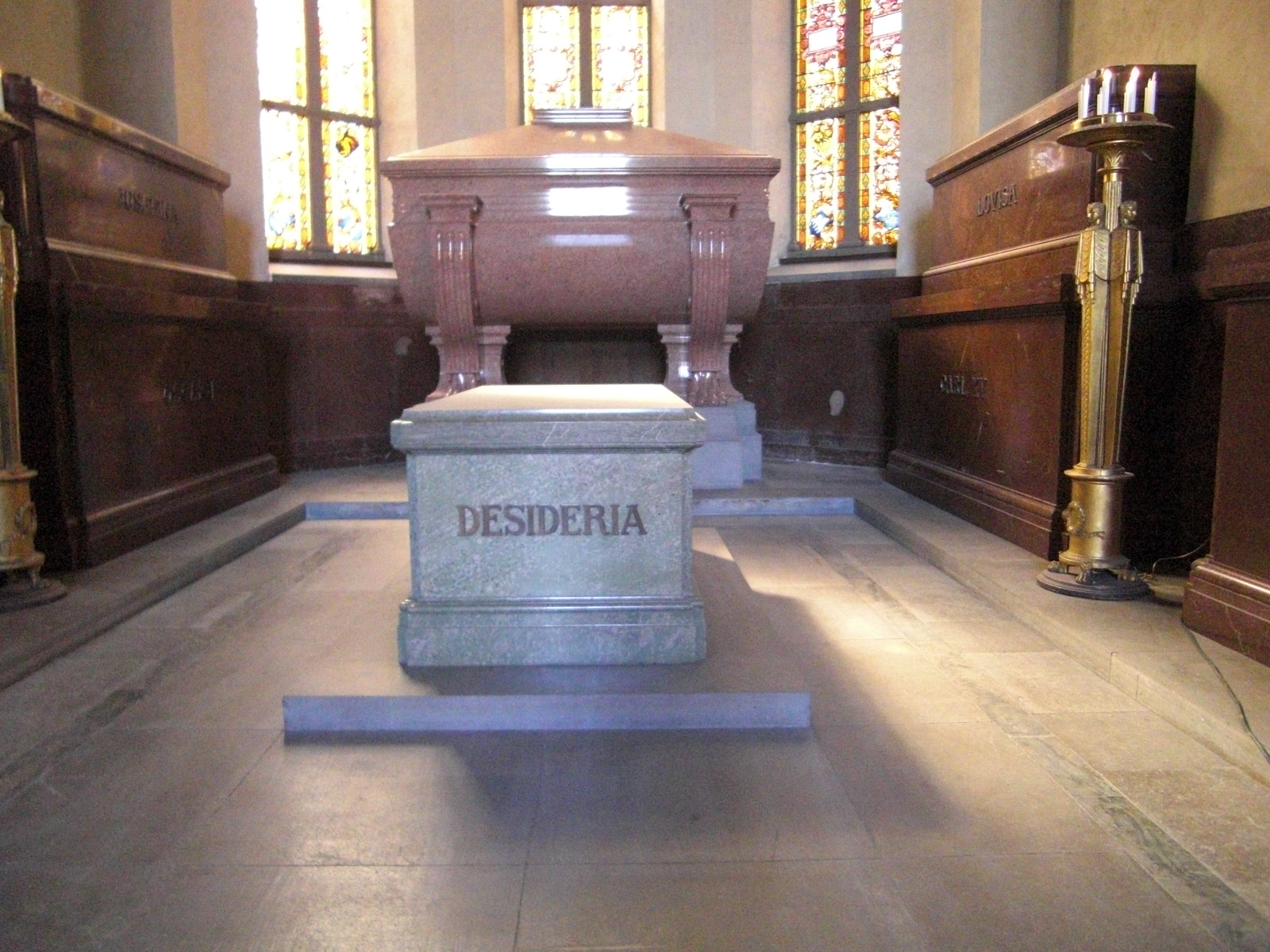
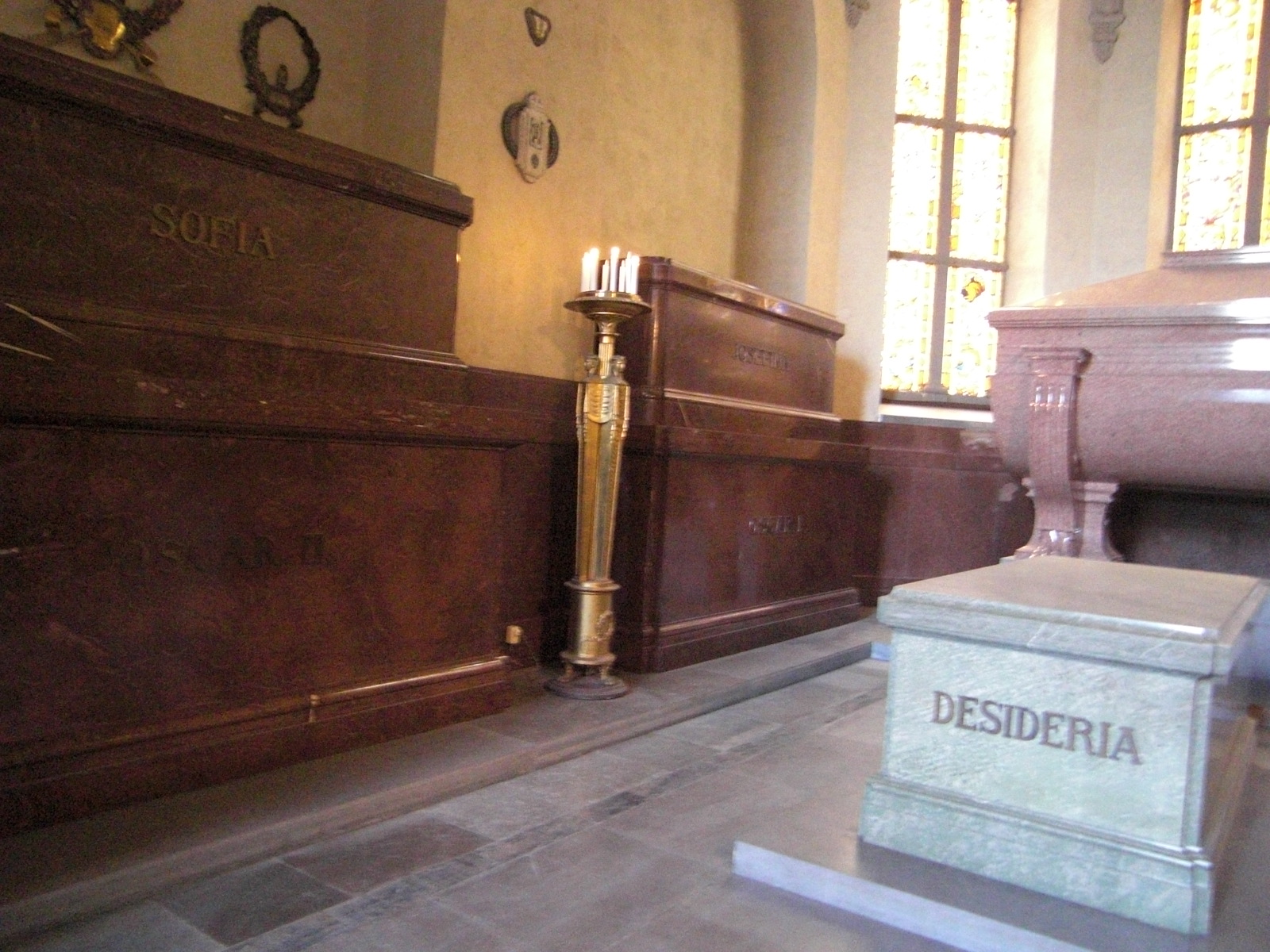
Tombs of King Carl XIV John and his wife Désirée Clary – Photo by Susan Flantzer

photo: Wikipedia
Désirée Clary, Queen Consort of Sweden and Norway from 1818 – 1844
Born on November 8, 1777 in Marseille, France, Bernardine Eugénie Désirée Clary was the daughter of François Clary, a wealthy silk manufacturer and merchant, and Françoise Rose Somis. Originally engaged to marry Napoleon Bonaparte, Désirée married Jean Baptiste Bernadotte in 1798. The couple were often separated due to Bernadotte’s military duties. At times, Désirée did live with her husband in foreign countries during his military duties, but she loved Paris and always returned there. As Crown Princess, Désirée had difficulty adjusting to the Swedish court and despised the weather in Stockholm. She left Sweden in 1811 and did not return until 1823, five years after her husband became king. When she became Queen Consort of Sweden, she officially changed her name to Desideria, but she did not like the name and never used it personally. She did not learn to speak Swedish and was never happy in Sweden.
Désirée died at age 83 in Stockholm on December 17, 1860 and was buried at Riddarholmen Church.

photo: Wikipedia
Oscar I, King of Sweden and Norway (reigned March 8, 1844 – July 8, 1859)
King Oscar I was born Joseph François Oscar Bernadotte on July 4, 1799 in Paris, France. Napoleon Bonaparte was his godfather. When he was 11, his father Jean Baptiste Bernadotte was elected Crown Prince of Sweden and he moved to Stockholm with his mother Désirée Clary. Oscar was given the title Duke of Södermanland, and, unlike his mother, quickly learned Swedish and adapted to life in Sweden. In 1823, Oscar married Princess Joséphine of Leuchtenberg. The couple had five children, including two kings of Sweden, Carl XV and Oscar II.
King Oscar I died on July 8, 1859 at age 60 in Stockholm, Sweden and is buried at Riddarholmen Church.

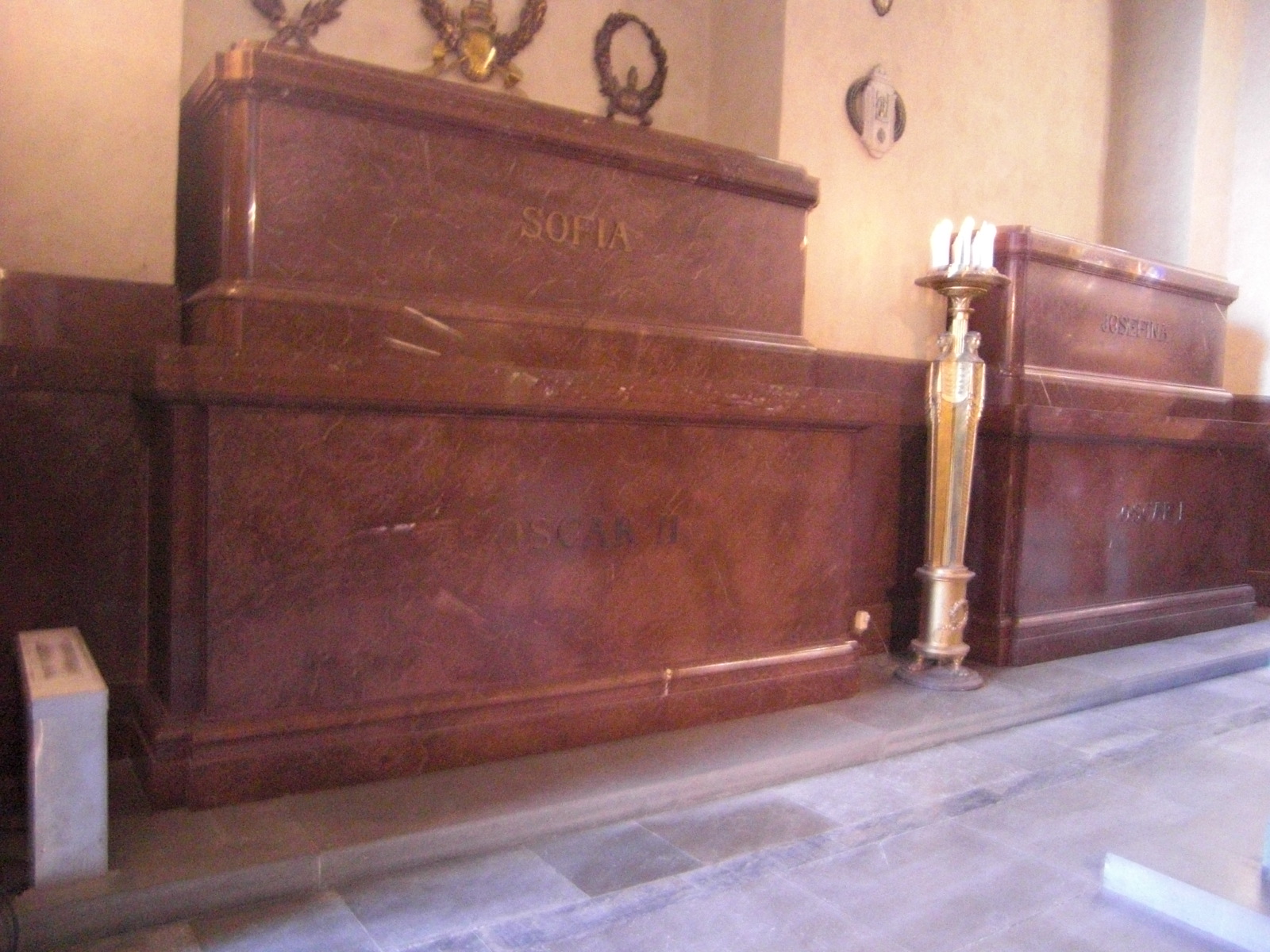
Tombs of Oscar I and his wife Josephine of Leuchtenberg to the left of the window – Photo by Susan Flantzer
 Joséphine of Leuchtenberg, Queen Consort of Sweden and Norway from 1844 – 1859
Queen Josefina is wearing the Cameo Tiara which was originally made for grandmother Joséphine, Empress of the French, and was worn by her descendant Crown Princess Victoria of Sweden at her wedding in 2010.
Princess Joséphine of Leuchtenberg was born on March 14, 1807 in Milan, Italy. Her father was Eugène de Beauharnais, the son of Empress Joséphine (who was Napoleon’s first wife) from her first marriage to Alexandre, Vicomte de Beauharnais who had been guillotined during the French Revolution. Her mother was Princess Augusta of Bavaria, a descendant of Gustav I of Sweden and Charles IX of Sweden, thereby insuring that future members of the House of Bernadotte were descendants of the House of Vasa which ruled Sweden from 1523-1654. Joséphine of Leuchtenberg brought to Sweden jewelry that had belonged to her grandmother Empress Josephine which is still worn members of the Swedish and Norwegian royal families. She is known by the Swedish form of her name Josefina.
Queen Josefina died in Stockholm on June 7, 1876 at age 69. She remained Roman Catholic, was given a Catholic funeral, and buried at Riddarholmen Church.

photo: Wikipedia
Carl XV, King of Sweden and Norway (reigned July 8, 1859 – September 18, 1872)
King Carl XV was born at Stockholm Palace on May 3, 1826, the eldest son of King Oscar I and Joséphine of Leuchtenberg. On June 19, 1850, he married Louise of the Netherlands, niece of King William II of the Netherlands through her father and niece of William I of Prussia, German Emperor, through her mother. The couple had two children, Prince Carl Oscar who died at age 1 and Louise who married King Frederick VIII of Denmark. Although no subsequent monarchs of Sweden have been his descendant, Carl XV’s descendants occupy or have occupied the thrones of Denmark, Luxembourg, Greece, Belgium and Norway.
King Carl XV died in Malmö, Sweden on September 18, 1872 at age 46 and was buried at Riddarholmen Church. He was succeeded by his brother King Oscar II.

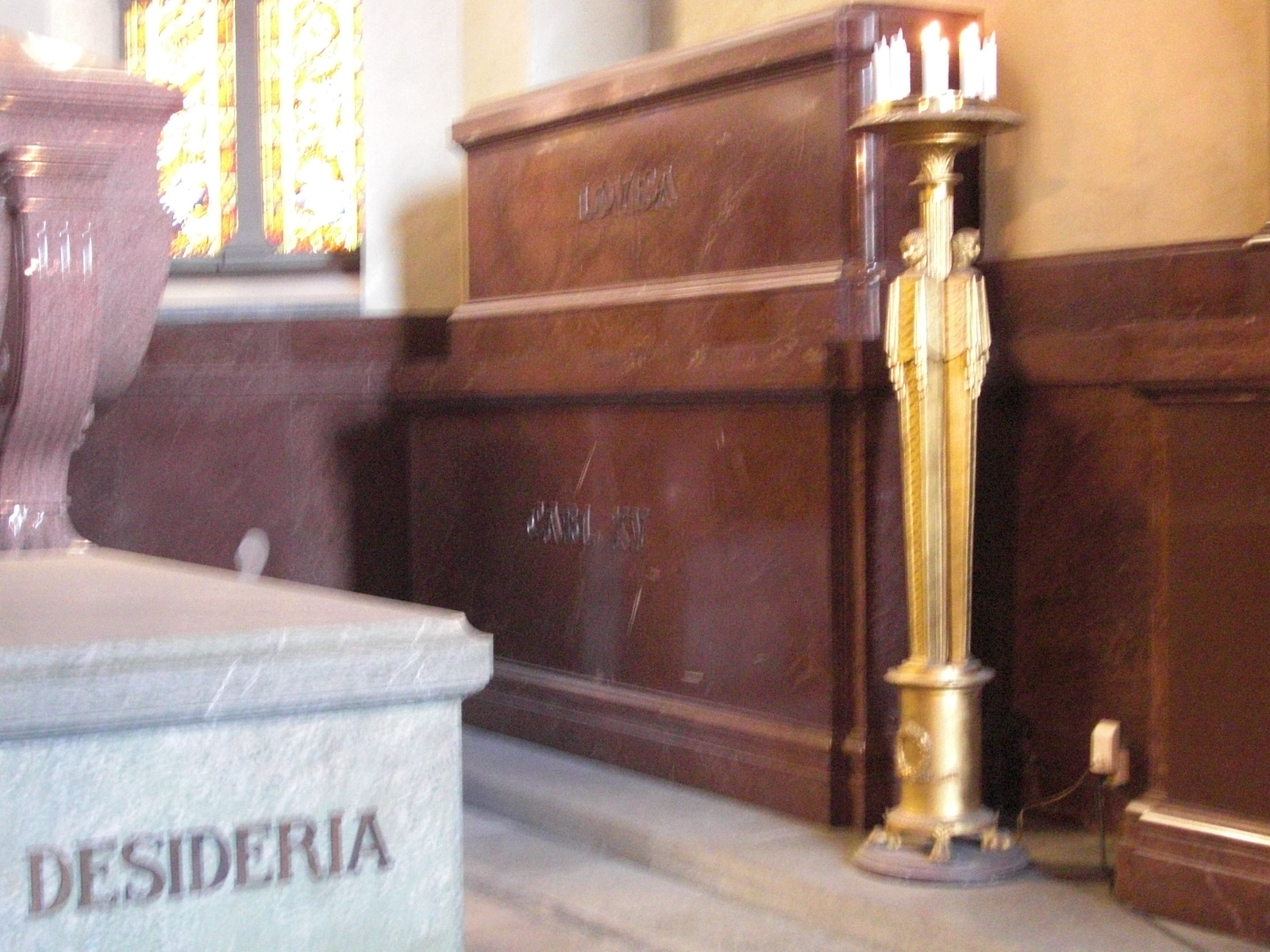
Tombs of Carl XV and his wife Louise of the Netherlands – Photo by Susan Flantzer

photo: Wikipedia
Louise of the Netherlands, Queen Consort of Sweden and Norway from 1859 – 1872
Princess Louise of the Netherlands was born on August 5, 1828 in The Hague, The Netherlands. Louise’s father was Prince Frederik of the Netherlands, the second son of King Willem I of the Netherlands, and her mother was Princess Louise of Prussia, daughter of King Friederich Wilhelm III of Prussia. In 1850, she married the future Carl XV and adopted the use of the Swedish equivalent of her name, Lovisa. The marriage was an unhappy one. Her husband found Lovisa shy and unattractive and was frequently unfaithful to her. The birth of her son Carl Oscar, who died when he was a year old, left Lovisa unable to have any more children and therefore unable to provide an heir to the throne.
Lovisa died in Stockholm on March 30, 1871 at age 42 and was buried at Riddarholmen Church.

photo: Wikipedia
Oscar II, King of Sweden (and Norway until 1905), reigned September 18, 1872 – December 8, 1907
King Oscar II was born on was born at Stockholm Palace on January 21, 1829, the third son of King Oscar I and Joséphine of Leuchtenberg. On June 6, 1857 in Wiesbaden-Biebrich, Germany, he married Princess Sophia Wilhelmina of Nassau. The couple had for sons, including King Gustaf V who succeeded his father. Oscar was a writer, amateur musician, and a great supporter of Arctic exploration. His name and picture has been used on King Oscar brand sardines since 1902.
King Oscar II died on December 8, 1907 at age 78 at Stockholm Palace and was buried at Riddarholmen Church.

Tombs of Oscar II and his wife Sophia Wilhelmina of Nassau (on left) – Photo by Susan Flantzer

photo: Wikipedia
Sophia Wilhelmina of Nassau, Queen Consort of Sweden (and Norway until 1905) from 1872 – 1907
Sophia of Nassau was born on July 9, 1836 at Biebrich Palace in Wiesbaden-Biebrich, Germany. She was the daughter of Wilhelm, Duke of Nassau and Princess Pauline of Württemberg. Sophia married the future Oscar II in 1857 and was received enthusiastically in Sweden because Oscar’s older brother and wife could not have any more children.
Queen Sophia died at Stockholm Palace on December 30, 1913 at age 77 and was buried at Riddarholmen Church.

photo: Wikipedia
Gustaf V, King of Sweden (reigned December 8, 1907 – October 29, 1950)
King Gustaf V was born on June 16, 1858 at Drottningholm Palace, the eldest son of King Oscar II of Sweden and Sophia of Nassau. On September 20, 1881, Gustaf married Princess Victoria of Baden in Karlsruhe, Germany. Victoria and Gustav had three sons, including King Gustaf VI Adolf who succeeded his father. Gustaf V became king in 1907 and reigned for nearly 43 years.
At age 92, King Gustaf V died on October 29, 1950 in Drottningholm Palace due to complications of the flu and was buried at Riddarholmen Church.

Crown Prince Carl Gustaf of Sweden (behind him are his sisters Christina and Birgitta) at the funeral of their great grandfather King Gustaf V holding the hands of Queen Louise (left) and his mother Princess Sibylla (right) – Photo Credit: Wikipedia

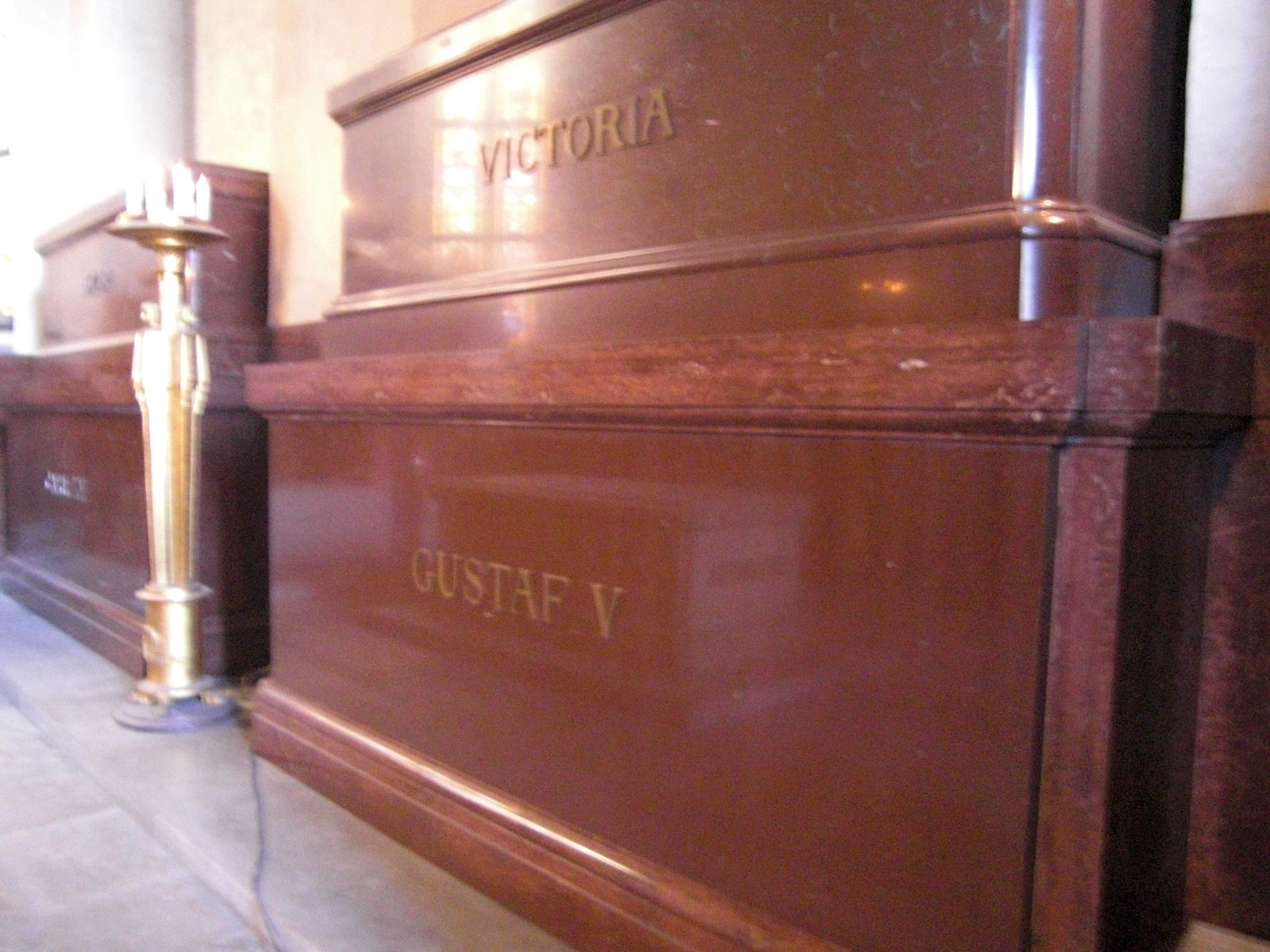
Tombs of Gustav V and his wife Victoria of Baden – Photo by Susan Flantzer

photo: Wikipedia
Victoria of Baden, Queen Consort of Sweden from 1907 – 1930
Victoria of Baden was born at Karlsruhe Castle in Karlsruhe, Germany on August 7, 1862. Her parents were Grand Duke Friedrich I of Baden and Princess Sophie of Sweden. Sophie’s father was the deposed King Gustav IV Adolf of Sweden from the House of Holstein-Gottorp. With this marriage, future members of the House of Bernadotte now had descent from the two previous houses, Vasa and Holstein-Gottorp. Victoria suffered from poor health and spent much time away from Sweden in warmer climates. Her last trip to Sweden was in 1928 for her husband’s 70th birthday.
On April 4, 1930, Queen Victoria died at the age of 67 in her home, Villa Svezia, in Rome, Italy. She was buried at Riddarholmen Church.

photo: Wikipedia
Gustaf VI Adolf, King of Sweden (reigned October 29, 1950 – September 15, 1973)
King Gustaf VI Adolf was born November 11, 1882 at the Royal Palace in Stockholm. His parents were King Gustaf V and Victoria of Baden. On June 15, 1905, Gustaf married Princess Margaret of Connaught at St. George’s Chapel at Windsor Castle. Gustaf and Margaret had five children, including Prince Gustaf Adolf who is the father of the present King of Sweden, Carl XVI Gustaf, and Ingrid who married King Frederik IX of Denmark. Another child, Count Carl Johan Bernadotte of Wisborg who was born in 1916, is still alive and is the only surviving great grandchild of Queen Victoria of the United Kingdom. Margaret died in 1920 and three years later Gustaf married Lady Louise Mountbatten, but this marriage was childless.
King Gustaf VI Adolf died on September 15, 1973 at age 90 at Helsingborg Hospital, Sweden. He was buried at the Royal Burial Grounds in Haga, the official burial place of the Swedish Royal Family since 1922, alongside his two wives. King Gustaf VI Adolf was succeeded by his grandson, Sweden’s present king, King Carl XVI Gustaf.

xGrave of King Gustaf VI Adolf and his two wives, Crown Princess Margaret and Queen Louise. Photo: Wikipedia

Close-up of the grave of King Gustaf VI Adolf and his two wives, Crown Princess Margaret and Queen Louise. Photo: Wikipedia

photo: Wikipedia
Margaret of Connaught, Crown Princess of Sweden from 1907 – 1920
Princess Margaret of Connaught was born on January 15, 1882 at Bagshot Park near Windsor in the United Kingdom. Her father was Queen Victoria’s third son, Prince Arthur, Duke of Connaught and her mother was Princess Louise Margaret of Prussia. She married the future King Gustaf VI Adolf in 1905. The marriage was a happy one, but was tragically cut short when Margaret died from an infection after a mastoid operation. She was eight months pregnant with her sixth child. Margaret was buried at the Royal Burial Grounds in Haga.

Funeral Procession of Crown Princess Margaret – her husband and some of her children can be seen in the middle.
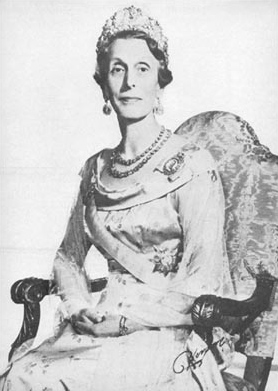
photo: Wikipedia
Lady Louise Mountbatten, Queen Consort of Sweden from 1950 – 1965
Lady Louise Mountbatten was born on July 13, 1889 at Heiligenberg Palace, Seeheim-Jugenheim in the Grand Duchy of Hesse. Her father was Prince Louis of Battenberg and her mother was Princess Victoria of Hesse and by Rhine, daughter of Princess Alice who was Queen Victoria of the United Kingdom’s second daughter. At the time of her birth, Louise was Her Serene Highness Princess Louise of Battenberg. During World War I, when King George V of the United Kingdom changed the family name from Saxe-Coburg-Gotha to Windsor, he requested family members with Germanic names also change their names. Louise’s father had a successful career in the British Royal Navy and had been the First Sea Lord who is the professional head of the Royal Navy. Battenberg was changed to Mountbatten and Louis was created Marquess of Milford Haven in the peerage of the United Kingdom, and Louise came to be known as Lady Louise Mountbatten. Louise was a sister of Louis Mountbatten, 1st Earl Mountbatten of Burma, an aunt of Prince Philip, Duke of Edinburgh, and was also a niece of Empress Alexandra Feodorovna of Russia (Tsar Nicholas II’s wife).
Queen Louise, aged 75, died on March 7, 1965 at St. Göran Hospital in Stockholm, following emergency surgery. She had been severely ill for some time. Louise was buried at the Royal Burial Grounds in Haga.

photo: Wikipedia
Prince Gustaf Adolf, Duke of Västerbotten
Prince Gustaf Adolf would have been King had he not tragically died in an airplane crash at age 40. He was born on April 22, 1906 at Stockholm Palace, the son of the future King Gustaf VI Adolf and Princess Margaret of Connaught. In 1931, Prince Gustaf Adolf married Princess Sibylla of Saxe-Coburg and Gotha. The couple had five daughters and one son, King Carl XVI Gustaf, the current king.

Grave of Prince Gustaf Adolf and Princess Sibylla – Photo Credit: Wikipedia

photo: Wikipedia
Sibylla of Saxe-Coburg and Gotha, Princess Sibylla of Sweden, Duchess of Västerbotten
Princess Sibylla of Saxe-Coburg and Gotha was born on January 18, 1908 in Gotha in the Grand Duchy of Saxe-Coburg and Gotha. Her father was Charles Edward, Duke of Saxe-Coburg and Gotha, posthumous son of Prince Leopold, Duke of Albany, the hemophiliac son of Queen Victoria of the United Kingdom. Her mother was Princess Victoria Adelaide of Schleswig-Holstein. Sibylla married Prince Gustaf Adolf in 1931 and became a widow at age 39 when her husband died in an airplane crash. Her youngest child of her five children, the future King Carl XVI Gustaf, was only nine months old.
Princess Sibylla died of cancer on November 28, 1972 in Stockholm, Sweden at age 64. She was buried with her husband at the Royal Burial Grounds in Haga.