Translate

Sunday, January 26, 2014

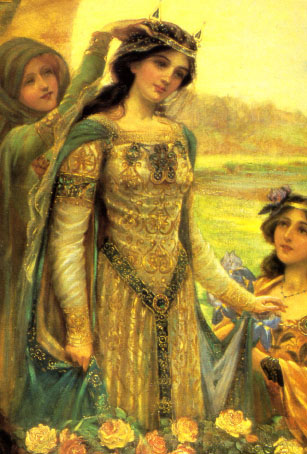
Sir Lancelot and Queen Guinevere by Lord Alfred Tennyson


Like souls that balance joy and pain,
With tears and smiles from heaven again
The maiden Spring upon the plain
Came in a sunlit fall of rain.
In crystal vapor everywhere
Blue isles of heaven laugh'd between,
And far, in forest-deeps unseen,
The topmost elm-tree gather'd green
From draughts of balmy air.
Sometimes the linnet piped his song;
Sometimes the throstle whistled strong;
Sometimes the sparhawk, wheel'd along,
Hush'd all the groves from fear of wrong;
By grassy capes with fuller sound
In curves the yellowing river ran,
And drooping chestnut-buds began
To spread into the perfect fan,
Above the teeming ground.
Then, in the boyhood of the year,
Sir Launcelot and Queen Guinevere
Rode thro' the coverts of the deer,
With blissful treble ringing clear.
She seem'd a part of joyous Spring;
A gown of grass-green silk she wore,
Buckled with golden clasps before;
A light-green tuft of plumes she bore
Closed in a golden ring.
Now on some twisted ivy-net,
Now by some tinkling rivulet,
In mosses mixt with violet
Her cream-white mule his pastern set;
And fleeter now she skimm'd the plains
Than she whose elfin prancer springs
By night to eery warblings,
When all the glimmering moorland rings
With jingling bridle-reins.
As she fled fast thro' sun and shade,
The happy winds upon her play'd,
Blowing the ringlet from the braid.
She look'd so lovely, as she sway'd
The rein with dainty finger-tips,
A man had given all other bliss,
And all his worldly worth for this,
To waste his whole heart in one kiss
Upon her perfect lips.

The Right to Bear Arms


Margaret of Anjou was a woman. Obvious I know, but critical to the understanding of her place in 15th centry society. The right to bear arms and thus the accompanying heraldry was exclusively reserved for the males. A woman's only entitlement to arms was therefore from her father or husband.
Margaret of Anjou was the second eldest daughter of René of Anjou. Until her marriage to Henry VI, her arms (strictly speaking, arms belonged to a family rather than a surname) would be those of Anjou
picture
From the time of her marriage to Henry, and thus becoming Queen of England, her arms would be those of Henry
link
Livery was often (but not always) associated with the main colours of the coat of arms. We have very little information about livery colours (as opposed to coats of arms) so often liveries are "best guess". Given the predominant colours are red and blue then you could probably use those for any Lancastrian household troops.
Bear in mind also that the wearing of livery was part of the "livery and maintenance" scheme whereby a man would contract to serve a lord in return for the right to wear the lord's livery and the provision of food and accommodation (maintenance). As a woman, Margaret of Anjou was not empowered to issue such contracts, so she would not have had a retinue of her own. Any troops she might have indirect authority over would be those loyal to Henry VI or one of the noble lords loyal to him.

Louisiana Purchase, 1803

The Louisiana Purchase refers to the 530,000,000 acres of territory in North America that the United Statespurchased from France in 1803 for US $15 million.
The Louisiana Purchase
As the United States spread across the Appalachians, the Mississippi River became increasingly important as a conduit for the produce of America’s West (which at that time refered to the land between the Appalachians and the Mississippi). Since 1762, Spain had owned the territory of Louisiana, which included 828,000 square miles, and which now makes up all or part of fifteen separate states between the Mississippi River and the Rocky Mountains. Friction between Spain and the United States over the right to navigate the Mississippi and the right for Americans to transfer their goods to ocean-going vessels at New Orleans had been resolved by thePinckney treaty of 1795. With the Pinckney treaty in place and the weak Spanish empire in control of Louisiana, American statesmen felt comfortable that the United States’ westward expansion would not be restricted in the long run.
This situation was threatened by Napoleon Bonaparte’s plans to revive the French empire in the New World. He planned to recapture the valuable sugar colony of St. Domingue from a slave rebellion, and then use Louisiana as the granary for his empire. France acquired Louisiana from Spain in 1800 and took possession in 1802, sending a large French army to St. Domingue and preparing to send another to New Orleans. Westerners became very apprehensive about having the more-powerful French in control of New Orleans; President Thomas Jefferson noted“There is on the globe one single spot, the possessor of which is our natural and habitual enemy. It is New Orleans.”
James Monroe
James Monroe
In addition to making military preparations for a conflict in the Mississippi Valley, Jefferson sent James Monroe to join Robert Livingston in France to try to purchase New Orleans and West Florida for as much as $10 million. Failing that, they were to attempt to create a military alliance with England. Meanwhile, the French army in St. Domingue was being decimated by yellow fever, and war between France and England still threatened. Napoleon decided to give up his plans for Louisiana, and offered a suprised Monroe and Livingston the entire territory of Louisiana for $15 million. Although this far exceeded their instructions, they agreed.
When news of the sale reached the United States, the West was elated. President Jefferson, however, was in a quandary. He had always advocated strict adherence to the letter of the Constitution, yet there was no provision empowering him to purchase territory. Given the public support for the purchase and the obvious value of Louisiana to the future growth of the United States, however, Jefferson decided to ignore the legalistic interpretation of the Constitution and forgo the passage of a Constitutional amendment to validate the purchase. This decision contributed to the principle of implied powers of the federal government.

    Wednesday, January 22, 2014

    Nicole’s Story: The Recording of American Gods Public Post

    https://intersect.com/stories/0n59KKcNS1zH


    I was able to locate Nicole Quinn, the Grand Prize winner of the Neil Gaiman Audiobook contest, via Facebook. I had only hoped to hear a few tidbits from her experiences on the day of recording, but to my pleasure and surprise she sent quite a detailed account. She graciously agreed to let me reprint it here in total. – Js. Rapson
    I ran into the studio just on time, after a 3 hour drive that normally takes 2 from upstate NY. I was having a hot flash, sheesh, 55 and feeling like a school girl running in sweaty from the play yard. We were all nervous. It’s a risk to add an unknown to 20 carefully cast voices.
    In the room – Karen (exec dir), Beth (marketing), Barbara (engineer), and Paula (American Gods director). More would come later.
    I had four small parts to read, sweet gems really. I met with Paula Parker, the director, who was, I found out at lunch later, not excited about the contest, and worried that whoever won might be mediocre. She’s a great actor, because I didn’t have a clue.
    I wanted to put her at ease quickly, so I told her that I’m a classically trained actor turned writer turned filmmaker (http://www.racingdaylightthemovie.com/shameless self-promotion, and yes I did pass out dvds like business cards, which I always forget to carry). I explained that I had rehearsed the sides to the punctuation, but that should she want me to blow through the commas and periods just to let me know.
    She smiled, such a lovely smile. I calmed a bit more. We talked about my road to reading on the bookperk site: birth, adoption, boarding school, Berkeley, London, Berkeley again, then on to NY. We talked about my life as an actor, which was, after all, the most important bit in the room. I think I’m a pretty good actor. You have to feel that way to stay in it this long. I got my AEA card in 1978 and my SAG and AFTRA cards in the early 1980s (WAGE in 1993). I belong to a company upstatehttp://www.actorsandwriters.com/, and its offshoot Denny Dillon’s Improv Nation. And as my friend Melissa Leo says – “I’d do this naked on a street corner for no money.” I have to agree.
    And yes, I did shamelessly name drop famous actors as friends, hoping to bathe my unknownness in stellar light. Its something I’m not proud of, but nerves make my gums flap.
    Paula led me to the booth, and just as the door was about to close I remembered I’d brought a plastic bin of sliced apples. I have done some voice work before – computer games (Space Colony and Stonghold 2), and apples are the best way to quickly wet your whistle. Paula was almost beatific at the apples, and so was I, dry-mouth that I am.
    We laid down the tracks, the shortest first. Paula gave great direction – attitude, atmosphere, she set the scene. Maybe 3-5 takes on each segment, and we were done with the recording. The relief in the room was palpable.
    We waited around for a bit to speak with Neil himself via Skype. He was in England, I think, post Dr. Who airing of his episode. He was charming and I was tongue-tied, having a HUGE professional crush on both he and A.F.P. I love how accessible they are to their fans. The conversation was a bit anti-climactic, and short, I mean I had an audience of engineers and producers, so I reigned in my gush and ….
    Then out to lunch with Producers and directors and Harper Audio folks. Tuna Steak Nicoise is what I ate. I think we were all relieved that it worked out to everyone’s satisfaction. Everyone was delightful. They all encouraged me to take a Narrator’s workshop, skill-building, which I have since signed on to do.
    We talked about audio books, and Harry Potter, of which Harper exec. Chrissie and I are huge fans. The Audies, the state of the art, etc…
    Many warm handshakes later I checked into the Omni Berkshire Hotel (on Harper’s dime) where I jumped on beds, ate junk food and drank very good wine with my 25 year old incredibly gorgeous daughter (who lives in the city) and my hunky husband (who works there).
    I’m back in a 1964 Tradewind Airstream, (my office), in the middle of a meadow, now all yellows and soft greens. I can see the tin gambrel roof of the blue barn-home in which I live, cresting the berm. I’m deep in the nightmare world of the novel I’m writing, hoping only to make the one we live in a little less frightening.
    ps – I listened to all twenty finalists, and I am honored to be among you.
    Keep dreaming, they do come true,
    Nicole
    (Nicole Quinn May 19 at 4:39am via Facebook)

    Sunday, January 19, 2014

    Napoleon Bonaparte letter auction could fetch upto $100,000


    A rare letter written in English by Napoleon Bonaparte ‘Napoleon I’, one of the greatest and the most celebrated military leaders in history of West and first emperor of France, who rose to prominence during the latter stages of the French Revolution, will now be auctioned by the France’s auction house Osenat in the French town of Fontainebleau, south of Paris on Sunday. However, it’s not new when items associated with Napoleon Bonaparte went on sale. Earlier, the little chair that this diminutive dictator is said to have sat on before his army was defeated at the battle of Waterloo went on auction, besides his lock of hair and a lithograph of his body soon after his death and his upper permanent canine tooth, fetched top bids in the auction.
    Napoleon Bonaparte letter auction could fetch upto $100,000

    Described as the very first letter written in English by French emperor on St. Helena, after he was defeated and exiled to the British island to live under military guard, this rare letter is expected to fetch a handsome price of $100,000 in the auction.


    Napoleon Bonaparte letter auction could fetch upto $100,000
    As said by Jean-Christophe of auction house Osenat, learning English behind the backs of his captors “was a sort of revenge, a historical revenge” for Napoleon. The auctioneer also said that Napoleon picked up English language relatively quickly, in about two to three years. The letter is described to be relatively well-written in comparison to the French people who learn English today.
    Other of item associated with Napoleon Bonaparte that earlier went on sale includes:-
    The remarkable, small wooden chair on which the most celebrated military leaders in history of West is said to have rested on in year 1815 at Courcelles in Belgium, 22 miles from the battlefield was expected to fetch a price of $18,540.
    Napoleon's chair
    In June 2010, a lock of hair cut from Napoleon’s head the day after he died in May 1821 went for $15,500 and a lithograph and watercolor image of Napoleon soon after his death got auctioned for 12,880.
    Lock of Napoleon's hair
    Also, Napoleon’s upper right permanent canine tooth believed to have been extracted from his mouth in year 1817, was sold for $13,590 in an auction held in Wiltshire in November 2005, and is the one of the weirdest celebrity memorabilia to go on auction.
    Napoleon’s upper right permanent canine tooth

    Helen E. Maurer: Margaret of Anjou: Queenship and Power in Late Medieval England


    ImageMuch has been written lately about Shakespeare’s influence on the posthumous reputation of Richard III, but Shakespeare’s history plays have had other victims as well – Margaret of Anjou among them. Shakespeare’s Margaret is a haughty, stubborn, aggressive, divisive, vindictive, violent, bitter, malicious, adulterous, unnatural and vile woman – the ‘she-wolf’ who herself kills Richard, Duke of York on the battlefield. Even in serious history, the description I’ve most often seen applied to Margaret is ‘aggressively partisan’. The (extremely simplified) traditional view is that Margaret and the Duke of York hated each other, and that’s why the Wars of the Roses happened. (She was a woman, you see: she was so swayed by her emotions she couldn’t help treating the Duke badly, used her womanly wiles to make the King treat him equally badly, so the proud Duke’s resentment grew, and voilà! War.)
    Well, sure, the Duke’s head did end up impalled over a gate in York . . . but Margaret herself was in Scotland at the time, negotiating with the Scottish Queen Regent, Mary of Guelders, for military aid. (Is it just me, or is the fact actually far more interesting than the fiction? Here we have two strong queens negotiating about military and territorial matters, which was quite extraordinary, no matter how you look at it. And why isn’t there a book written about Mary of Guelders, I wonder?)
    The Shakespearean view of Margaret of Anjou was endorsed by centuries of misogyny, and now it – or a slightly modified version of it – is endorsed by our yearning for the life-stories of strong women in history. Before, being labelled a ‘she-wolf’ would have been a mark of disapproval; now it’s an honour. But it’s still not the whole truth about Margaret of Anjou. The truth is actually not more boring, just more truthful – and Maurer’s evenhanded treatment takes us much closer to it.
    How to summarise a Queen in one paragraph? Let’s see. As the 15-year-old niece of Charles VII of France, Margaret came to England not only as the future wife of King Henry VI but as the symbol of peace negotiations between England and France. Needless to say, the peace didn’t work out; Henry – never a strong king – eventually lost England’s last remaining territories in France, except for Calais, and then had a complete mental breakdown in 1453. (What exactly his condition was, we cannot know; but he was in a catatonic state for over a year.) In this time Margaret, now in her twenties, made a bid for regency but lost to Richard, Duke of York, who was named as Lord Protector. Henry VI eventually recovered, but his hold on his realm weakened further over the following years. York and his followers began to be seen as a threat to the King’s authority, and Margaret began to take action to protect the interests of his husband and their only son. The conflict culminated in 1460, when York presented his claim to the throne (arguably better than Henry’s) and a civil war ensued – with Margaret taking the lead on the other side. Henry was officially deposed in 1461, York’s son Edward was crowned as the new King, and for Margaret, Henry and their young son, the following years were full of drama: for Henry, narrow escapes and eventual imprisonment, and for Margaret, exile and indefatigable activism for their cause from the Continent. In 1470-71 Margaret made another serious effort to claim the English throne back for her husband and son. It didn’t work out, and said husband and son both ended up dead. Margaret spent the last seven years of her life in France, treated with contempt by Louis XI. The End.
    No one can deny that Margaret of Anjou was ‘a great and strong-laboured woman’, as she was described by a contemporary. She was undeniably the leader of the Lancastrians after her husband’s deposition, and her position was certainly that of a ferocious she-wolf fighting for the rights of her son and husband. But Maurer’s careful and balanced approach is a welcome take on the existing evidence, and it reminds us it is important to neither overstate nor understate what Margaret actually did. While Maurer’s Margaret does come across as a woman with strong views and the courage of her convictions, to see her as a transgressor with a lust for power, or as some kind of a pioneering feminist icon, does not do her position justice. She wasn’t in the shoes of Elizabeth I. She derived her authority from her husband the King, and her son the Prince of Wales, and Maurer persuasively argues that she never (well: almost never) forgot to acknowledge that.
    It was a difficult balancing act, as Maurer well describes. The role of a queen consort was one of intercession and intermediation – in short, that of a skilled PR professional. This book is fascinating in its analysis of the symbolism inherent in that role, and of the indirect channels of power that would have been available to a mediaeval queen; the influence that a conventional queen consort might have in her own right, as well as the extent to which a strong-willed, intelligent, well-educated and politically astute queen might influence the policies of the King and his advisors. (But there are some intriguing occasions when this isn’t quite so clear-cut: for instance, Margaret’s bid to be her husband’s regent was not completely unheard of, but it was bold, nonetheless. There were also instances of what Maurer calls ‘perceptual slippage’ in Margaret’s symbolic role, and how it was viewed by the public, which make you wonder about its overtly political implications. One such case is the bizarre ‘loveday’ spectacle of 1458 in which the reconciliation was clearly presented as being between the Duke of York and the Queen.)
    At any rate, Maurer argues that instead of being ‘aggressively partisan’, Margaret was, in fact, quite balanced and successful in her queenly role – until it was no longer possible.
    In my opinion, this is the best kind of biographical writing: Maurer binds herself to known facts and sources and lets them speak for themselves, but still manages to make a thoroughly engrossing book out of them. For a short book that contains so much information, it’s also surprisingly readable, though inevitably something of a nightmare for anyone who hates keeping track of an endless flow of dates and names. That said, this is not a biography of Margaret of Anjou, the woman. Her strong personality does emerge from the known facts, but at a remove. Someone looking for a more ‘personal’ biography would be disappointed – this is more like observing someone fascinating at a distance. Maurer refuses to go off on speculative flights of fancy, and even says at one point, ‘Efforts in our own time to diagnose Henry’s malady can only be speculative and are really relevant only to us’; and one feels that this is her take on speculation in general.
    ‘But speculation is such fun,’ I found myself whining. At its most fascinating, mediaeval history is like a DIY mystery for an enthusiastic amateur detective. And there are such tantalising glimpses of personality – for example, the small but endearing point that Margaret was a connoisseur of horses. Oh, if only we had more access to her private self!
    It must also be said that I was reading the book for the facts, not for the ‘story’; someone who’s simply looking for an entertaining read might not find it equally engrossing. In many places Maurer also assumes a certain pre-existing familiarity with the subject matter on the reader’s part. She refers to ‘the events of the past year’ without spelling out what exactly happened in the past year, and writes about the aftermath of Jack Cade’s rebellion without an explanation of the rebellion itself and its origins.
    Personally, my only disappointment with this book was that arguably the most interesting part of Margaret’s life – the time period when she was no longer a queen, but fighting on her husband’s and son’s behalf – wasn’t its focus at all. The actual Wars of the Roses are dealt with in two chapters. The time period from 1460 to the bloody Battle of Towton in 1461 gets one chapter; the rest gets only a few paragraphs in a short chapter, more of a postscript. But the explanation for this lies in the subtitle: Queenship and Power in Late Medieval England. This book doesn’t claim to be the story of Margaret’s life; it analyses Margaret as a queen consort, and her role in the events that led to the Wars of the Roses. For the large part, the analysis of Margaret’s personality and behaviour rests on her letters, most of them written before 1455 – from her teens to her mid-twenties. Which one of us is the same person from her teens to her thirties, I wonder? Might not experience have hardened a fair and balanced personality into something more unyielding, a strong will into stubbornness, and a desire for justice into a lust for bloody revenge? Maurer doesn’t comment on that. She is more interested in challenging the traditional view of Margaret’s queenship, and as such, this is an important book. The book ends on a thought-provoking note: Margaret’s authority as the Queen was dependent on her husband the King, but after the Lancastrian defeat, she, not Henry, was viewed as the enemy leader. Partly, of course, this was because Henry was such a weak ruler, but partly it was to justify the Yorkist cause by emphasising the Lancastrian claim to the throne as illegitimate and unnatural, something devised by a ‘malicious wymman’ who wanted the crown for her bastard son and brought the country in a state of disorder because of it. History, as we know, is written by the winners; so this would become the basis of Margaret’s posthumous reputation.
    In conclusion, it doesn’t seem that Margaret sought power for herself, but was simply determined that things should go the way she believed to be the right way. Big difference, isn’t it? Oh, I think it is . . .
    Frankenstein on Orkney


    Among the earlier literary visitors to Orkney are Victor Frankenstein and his Creature, in Mary Shelley’s novel of 1818.
    At this point in the novel, Victor is trying to put behind him the horror and guilt of having created his ‘monster’, and with his friend Henry Clerval, he sets off on a tour of Britain. These kind of domestic tours were very popular in the early nineteenth century and Victor’s account starts like a guidebook or memoir, describing the picturesque sights. But as he moves further north, his descriptions of the landscape and people become interspersed with very different feelings as he cannot shake off the idea that he has ‘drawn down a terrible curse’ on himself. At Perth, he and Clerval split up when Victor realises he cannot shake off his Creature and decides to grant him his wish for a female companion. The best place for this work, Victor decides, is Orkney.
    Why does Mary Shelley choose Orkney? She had not visited the islands and they were not represented in literature (Walter Scott’s novel The Pirate would not be published until 1821). Shelley doesn’t want local colour; Victor choses an island simply because it is remote and featureless so Shelley picks somewhere no one is likely to know much about. Although the Western Islands were well-known through poems, novels and travel books at this time, the Northern Islands were not. Victor wants a place that will stop him thinking about what he’s doing—just as the few inhabitants of the island seem to him ‘benumbed by want and squalid poverty’ so he imagines he will be psychologically ‘benumbed’ as he fashions a second Creature.
    But just as thoughts of horror permeated Victor’s picturesque tour of Scotland, so the landscape of Orkney takes on a horrifying aspect. The ‘sublime’ at this time was thought of as a way of experiencing the outside world through our emotions and imagination. This frequently meant the effects of spectacular mountains and ravines, as in Victor’s native Switzerland. But Edmund Burke, who wrote the best-known theory of the sublime in 1757, points out that it includes ideas of what he calls ‘privation’, defined as ‘vacuity, darkness, solitude, and silence’. So Orkney represents a horrifying sublimity, or as Victor puts it, a ‘monotonous, yet ever-changing scene’ and a ‘desolate and appalling landscape’. And soon Victor is himself overtaken by the horror of what he is doing. When he realises that his first creation has followed him to the island, he violently destroys his female Creature before she is even finished and leaves Orkney.
    Read more!
    Mary Shelley, Frankenstein: 1818 Text, ed. M. Butler (Oxford, 1993)
    Edmund Burke, A Philosophical Enquiry into the Origin of our Ideas of the Sublime and Beautiful, ed. A. Phillips (Oxford, 1990)


    http://www.writingthenorth.com/uncategorized/frankenstein-on-orkney/