Translate

Showing posts with label royals. Show all posts

Thursday, August 2, 2012

The Rosenberg Palace


 visit to Rosersberg Palace means taking a step back into an authentic royal milieu from the turn of the 19th century. The permanent interiors have been untouched since 1860.
In the 1760s the palace became a royal palace when Duke Karl (XIII) moved in and modernized the palace in late Gustavian style.
The modernization was lead by the architect Jean Erik Rehn and an important series of new interiors were introduced, typified by the Orange and Red drawing rooms.
The interiors at Rosersberg Palace differ from the Gustavian style interiors of other royal palaces in Sweden. At Rosersberg the friviolous vein in the Gustavian style has been replaced by a more serious and romantic ideal that is often called Karl XIII Empire style.
Karl XIV Johan and Queen Desideria, the first Bernadottes, were the last royalties to reside at the palace. Karl Johan's bedchamber is one of Sweden's finest examples of an interior from the early 1800s.

http://jeaninasnotebook.blogspot.com/2011/07/king-and-grouch-at-rosersberg-palace.html

I wrote about an ongoing exhibit in Rosersberg Palace, or Rosersbergs slott - the wedding gifts to the Crown princess Victoria and Daniel. Not an impressive exhibit, but it gives an idea as to what people give for gifts to the monarchy. 

As I was there, I also went through a guided tour of the palace. I got dizzy during the tour. I was almost afraid I would swoon. But I didn't. Could it be the heat? Or that I had not yet taken  my daily dose of Coca Cola?

Anyway, Rosersberg slott was built in the 1630s by Gabriel Bengtsson Oxenstierna, a count. 

(This is the hierarchy when it comes to royal titles: King, duke, count or earl, viscountand then baron
A count however does not need  to be a hereditary title. One could have acquired it by earning favor, or property. And even if one had inherited the title, it did not mean that a count had wealth and property. A count is the equivalent of the British title earl. Counts, or earls, are titles inherited by the oldest son of a duke.
The title baron was introduced in England by William I, to distinguish men who pledged loyalty to him))

Anyway, the count - Gabriel Bengtsson Oxienstierna - named the palace after his mom, who belonged to the prestigious Tre Rosor, or Three Roses, family. The property later was acquired by a baron. And then the state. And then a duke, Karl XIII, the youngest brother of the king, Gustav III. Through this duke, the palace became a royal palace.

Later on, the palace would become a favorite palace of King Karl XIV Johan and Queen Desideria. Now this pair was not Swedish, but French. The former was a general of Napoleon Bonaparte, the latter was a daughter of a rich textile merchant. Desideria - or Desirée as her name was in french - was an ex-fiancé of Napoleon, but she got dumped. 
Anyway, the french general - whose original name was Jean Bernadotte - was adopted by a Swedish  monarch, Karl XIV. Adoption became an option because the swedish king had no sons and the royal family was dying out. And since Jean Bernadotte was a skillful general - and had a prestigious title, considering Napoleon's success - he was considered a good alternative to become a king.
So the french general-turned-swedish king and his wife resided in Rosersberg in the summer. She didn't like Sweden though. She hated the climate, the snow and the snobbish royalty. So she left the country and was separated from the king for 12 years.

Here was the couple's summer palace:


After the death of queen Desideria, it was handed to the Swedish infantry and was a school for musktery until the 1960's. Civil Defense took over, and now some parts are used by Räddningstjänsten, or the Rescue services agency.

Tuesday, July 24, 2012

Memoirs and Correspondence of Madame Recamier


Okay, so after reading the few letters from Jean Baptiste/Charles Jean included in this memoir, I can understand that Desiree might have had reasons to be jealous of this relationship.  Sex is one thing, infidelity in love is another.

Decide for yourself!

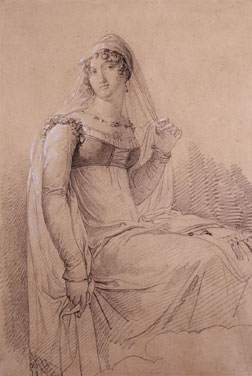
Madame Recamier by Jacques Louis David
Madame Recamier by Jacques Louis David 1800

 Gerard painting

Monday, July 23, 2012

Another e-book! Jean Baptiste's official letters and speeches

Update:  I couldn't get the book to load today from the link below, so let's try this -- CLICK HERE


Memorials of Charles John King of Sweden and Norway

What an articulate man!  The first part is a profile of Sweden and the man.  Page 89 the speeches and letters of King Charles XIV John begin.  I especially liked his statements about "universal peace: to be found on page 358.


Sunday, July 22, 2012

Bernardine Eugénie Désirée Clary

 (8 November 1777 – 17 December 1860), one-time fiancée of Napoleon Bonaparte, was a Frenchwoman who became Queen of Sweden and Norway as the consort of King Charles XIV John, a former French General. She officially changed her name there to Desideria, a Latin version of her original name. Désirée herself, however, did not like the name Desideria and never used it.

Early life and family


Désirée Clary was born in Marseille, France, the daughter of François Clary (Marseille, St. Ferreol, 24 February 1725 – Marseille, 20 January 1794), a wealthy silk manufacturer and merchant, and his second wife (m. 26 June 1759) Françoise Rose Somis (Marseille, St. Ferreol, 30 August 1737 – Paris, 28 January 1815). He had been previously married at Marseille, 13 April 1751 to Gabrielle Fléchon (1732 – 3 May 1758), without issue. Her sister, Julie Clary, married Joseph Bonaparte, and later became Queen of Naples and Spain. Her brother, Nicholas Joseph Clary, was created 1st Count Clary and married Anne Jeanne Rouyer, by whom he had Zénaïde Françoise Clary (Paris, 25 November 1812 – Paris, 27 April 1884), wife of Napoléon Berthier de Wagram, 2nd duc de Wagram (10 September 1810 – 10 February 1887), son of Marshal Berthier, and had issue.

Désirée received the convent schooling usually given to daughters of the upper classes in pre-revolutionary France, but, during the Revolution of 1789, convents were closed and Désirée returned to live with her parents. Her education was described as shallow. She was to be very devoted to her birth-family her entire life. In 1794, her father died. Her brother was arrested by the revolutionary government, and she was later to say that he was released by Joseph Bonaparte on her intervention, after which Joseph was presented to her family and married her sister. Désirée was presented to Napoleon Bonaparte, to whom she became engaged on 21 April 1795; but upon becoming involved with Joséphine de Beauharnais, whom he married on 9 March 1796, Bonaparte broke off his engagement with Désirée.

In 1795–1797, Désirée lived with her mother in Genoa in Italy. In 1797, she went to live with her sister Julie and her brother-in-law Joseph, who was the French ambassador to Rome. Her relationship with Julie was always to be very intense and deep. She was briefly expected to marry the French General Léonard Duphot, but he was killed in a riot in Rome in December 1797, on the eve of their marriage.

Madame Bernadotte


After her return to France, she met her future husband, the French General Jean Baptiste Jules Bernadotte. They were married at Sceaux on 17 August 1798. In the marriage contract, Désirée was given economic independence. In 1799, she gave birth to their only child, a son, Oscar, but the couple lived more or less separate lives afterward.

Her husband was a leading general in the French Napoleonic army, and normally absent from Paris. Désirée had a good relationship with the Bonaparte Imperial family, as well as with the Empress Joséphine, and declined taking sides in the conflicts between Joséphine and the Bonaparte siblings. She had a place in the coronation ceremony in 1804. Désirée lived a comfortable social life in Paris during her husband's long absences, though she preferred an informal family life to that of the Imperial court. It is believed that she may have had a romantic relationship with the Corsican Ange Chaippe, who often acted as her escort. In 1804–1805, Bernadotte was made governor of Hanover, and Désirée and her son moved to Hamburg; but she soon returned to Paris. She was not happy living anywhere but Paris. When her spouse was made Prince ofPontecorvo in 1806, Désirée worriedly asked if she would be forced to leave Paris, but was happy when she was assured that she would not. In 1807, she visited Bernadotte in Spandau.

Désirée was not interested in politics, but her good connections made her a puppet in the hands of her husband and Napoleon, who both used her to influence the other and to communicate with each other with her as a messenger.

In 1810, Bernadotte was elected heir to the throne of Sweden. Désirée initially thought this was to be similar to the position of Prince of Pontecorvo, and was depressed when she found out that this time she was expected to leave Paris.

Crown Princess


Désirée visited Sweden for the first time in 1810 but could not adapt to the demands of formal court etiquette. She was said to have been treated with a certain snobbery by the court and especially the Queen, though the Dowager Queen was kind to her. The climate was also a shock; she arrived during the winter, and she hated the snow so much that she cried. She had never wished to be a queen and did not want to move so far away from her family. The queen found her spoiled and undignified, and Désirée's French entourage, especially Elise la Flotte, made her unpopular by encouraging her to complain about everything. The Queen described her as good-hearted, generous and pleasant when she chose to be and not one to plot, but also as immature and a "spoiled child", who hated all demands and was unable to handle any form of representation. She described Desiree as "a French woman in every inch," who disliked and complained about everything which was not French, and "consequently, she is not liked."

She left Sweden in 1811 under the name of "Countess of Gotland", officially because of her health, and returned to Paris. There she stayed for twelve years, leaving her husband and her son behind. She herself said that the Swedish nobility had treated her as if they were made of ice: "Do not talk with me of Stockholm, I get a cold as soon as I hear the word." She resided incognito in Paris, thereby avoiding politics during the difficult period when Sweden was at war with France. However, her house at rue d'Anjou was watched by the secret police, and her letters were read by them. When Napoleon was defeated in 1814, her house was a refuge for her sister Julie. Bernadotte met her in Paris, but returned to Sweden without her. She was ridiculed by the court of Louis XVIII of France as an upstart, but had her own little court where she held receptions. In 1816, she made plans to return to Sweden, but she wished to bring her sister, Julie; her husband thought this unwise, as Julie was a member of the Bonaparte family and her presence might be taken as a sign that he sided with the deposed Napoleon, and in the end, this came to nothing.

Désirée's husband had employed a Count de Montrichard at her household (1817) as his spy to report to him if she did anything which could affect him.

Queen


In 1818, her husband became king of Sweden; but she remained in Paris, officially for health reasons, which was discussed in the papers in Paris and by her visitors. In Sweden, her husband took a mistress, the noble Mariana Koskull. Désirée held receptions in Paris as the queen of Sweden on Thursdays and Sundays, though she still used the title of countess. She fell in love with the French minister, the duc de Richelieu, and followed him on his travels until his death in 1822. In 1822, she met her son in Aachen.


Armand Emmanuel Sophie Septimanie du Plessis, duc de Richelieu, by Etienne Frederic Lignon, after  Sir Thomas Lawrence, 1824 - NPG  - © National Portrait Gallery, LondonArmand Emmanuel Sophie Septimanie du Plessis, duc de Richelieu


In 1823, Désirée returned to Sweden together with her son's bride, Josephine of Leuchtenberg; the visit was initially to be but a short one. On 21 August 1829, she was crowned Queen at her own request. She also talked about a coronation in Norway, but the Norwegians found it impossible because of her religion. She was, in fact, not religious, but was forced to attend mass and confession by her daughter-in-law. She was the first commoner to be a queen since Karin Månsdotter in 1568. The 1830s were a period when she did her best to be active as a queen, a role she had never wanted to play. The decade is described as a time of balls and parties, more than had been seen at the Swedish court since the days of King Gustav III, but Désirée soon grew tired of her royal status and wanted to return to France. However, her husband did not allow it.

There is nothing to indicate that she ever had any political influence. She spent her summers at Rosersberg Palace, and often visited Swedish spas, such as Ramlösa spa. She visited Norway a couple of times, the first time in 1825. The court was astonished by her informal behaviour. Every morning, she visited her husband in her nightgown, which was seen as shocking, because her husband usually conferred with members of the council of state in his bed chamber at that time. Otherwise, they met only on formal occasions: because she was always late at dinner, he stopped having his meals with her after 1826: and as her consort also preferred to have his meals alone, it was not uncommon for the nobles of the court to sit alone at the dinner table, without the royal couple present. She went to bed late, and woke up late.

She never became very popular at the royal court and never learned to speak Swedish, and there are many anecdotes of her attempts to speak the language. She kept her French personal staff: during the first years, her niece, countess Marcelle Tascher de la Pagerie, was her lady-in-waiting. Among her other more known ladies-in-waiting were the Norwegians Kathinka Falbe and Jana Falbe; because of Desiree's eccentric habits, they were known as "Strapatsfröknarna" (approximately "Mlles. Calamity"). During her stays at Rosersberg Palace, she took walks in the parc by night, and as she had a fear of being attacked by bats, she instructed her ladies-in-waiting to walk in front of her dressed in white to attract the bats from her.

Queen Dowager


In 1844, her husband died. In 1853, she wished to return to Paris, but her fear of sea travel made it impossible. After becoming a widow, she grew more and more eccentric. She went to bed in the morning, got up in the evening, ate breakfast at night, and drove around in a carriage through the streets, in the courtyard, or wandered around the corridors of the sleeping castle with a light. An anecdote illustrates this: in 1843, a palace guard saw the queen fully dressed on the palace balcony in the middle of the night. When he came home to his wife, he told her that she was lazy in comparison to the queen, who had gotten up hours before sunrise. He thought Queen Désirée was up earlier than anyone else in town, but in fact, she had not yet gone to bed-–she would eventually get up from bed at three or four in the afternoon. She enjoyed making unannounced visits, and sometimes she would take in children from the streets to the palace and give them sweets; she was not able to engage in any real conversation, but she would say "Kom, kom!", which is Swedish for "Come come!"

There are other stories about people having been awakened by her carriage when she drove through the streets at night; the carriage sometimes stopped. She would sleep for a while, and then she would wake and the carriage would continue on its way. Sometimes she drove in circles around the royal palace: this habit was called "Kring Kring", one of the few Swedish words she learned, which means "around and around". On the last day of her life, she entered her box at the Royal Swedish Opera just after the performance had ended. Désirée died in Stockholm on 17 December 1860.

Ancestry


Her paternal grandparents were Joseph Clary (Marseille, 22 November 1693 – Marseille, 30 August 1748), son of Jacques Clary and his wife Catherine Barosse, paternal grandson of Antoine Clary and wife Marguerite Canolle, and maternal grandson of Angelin Barosse and his wife Jeanne Pélissière, and wife (m. in Marseille, 27 February 1724) Françoise-Agnès Ammoric (Marseille, 6 March 1705 – Marseille, 21 December 1776), daughter of François Ammoric and his wife Jeanne Boisson.

Her maternal grandparents were Joseph Ignace Somis (c. 1710 – Marseille, 29 April 1750), son of Jean Louis Somis and his wife Françoise Bouchard, and wife (m. in Marseille, 27 May 1736) Catherine Rose Soucheiron (Marseille, 11 January 1696 – Marseille, 18 February 1776), daughter of François Soucheiron and his wife Anne Cautier.

Friday, July 20, 2012

The Kingdom of Sweden


Swedish arms


KONUNGARIKET SVERIGE
(The Kingdom of Sweden)


Swedish flag


BERNADOTTE


Royal family of Sweden

Sovereign: Carl XVI Gustaf King of Sweden (Haga Castle, Sweden, April 30th, 1946).
Son of Gustaf Adolf Prince of Sweden (1906-1947) and Sibylla Princess of Saxe-Coburg and Gotha (1908-1972).
Succeeds his grandfather Gustaf VI Adolf King of Sweden (1882-September 15th, 1973).
Inauguration: Dining Room, Royal Palace, Stockholm, Sweden, September 19th, 1973.
Motto: För Sverige i tiden (For Sweden- in our time).
Religion: Lutherian Evangelic.

Married (1976): Silvia Sommerlath (1943).

Children:


Daniel & Victoria


  • Victoria Crown Princess of Sweden (Karolinska Hospital, Stockholm, Sweden, July 14th, 1977). Married (2010): Daniel Westling (1973). They have a daughter: Estelle (2012)
  • Carl Philip (1979), Crown Prince in 1979.
  • Madeleine (1982).


  • Titles:
    The King is Majesty, King of Sweden. The heir to the throne is Crown Prince(ss) of Sweden. All members of the royal family are Royal Highness, Prince(ss) of Sweden. All dynasts bear a ducal courtesy title.

    Succession:
    The throne is hereditary in the descendance of Karl XIV Johan Bernadotte, until January 1st, 1980, according to male right of the first-born. After that date Princess Victoria followed her younger brother Carl Philip as heir. A dynast can't marry without permission of the King, who needs to be advised by the ministers. A dynast who doesn't ask for permission looses all rights to the throne, for himself and his descendance.


    Address:
    Royal Palace
    11130 Stockholm
    Sweden

    Residences:
    The official residence of the Swedish monarch is the Royal Palace in Stockholm, where most official engagements take place. It is also the office for royals and staff. The royal family however lives in the southern wing of the Drottningholm Palace. More information: The Royal Palaces and Sights.


    History
    Sweden is already a kingdom since more than 1000 years. There are legends about a kingdom named Svea from the 9th century. The kings are all known since 980. In the beginning the kings were chosen by the nobility from their own ranks. This changed in 1523 when Gustaf I Eriksson Wasa managed to free Sweden from the Danish domination. Sweden had been united with Denmark and Norway in the Union of Kalmar since 1397. In 1544 he made Sweden a hereditary monarchy. Well-known is his grandson King Gustaf II Adolf who made of Sweden one of the most important countries of northern Europe. He was killed in the war in 1632. Heir to the throne was his daughter Christina. She became a catholic and left the country in 1654 after haven given the throne to her cousin Karl X. The next kings were originally from German houses as Bavaria, Hessen-Kassel and Holstein-Gottorp.

    The last Holstein-Gottorp King Karl XIII had to agree that the French marshal Jean Baptiste Bernadotte was made the new crown prince of Sweden. Marshal Bernadotte was born in Pau in an ordinary French family, and became a marshal under the Emperor Napoleon I of the French. He was asked to become crown prince of Sweden by the two Swedes (Mörner and Anckarsvärd) who had to bring the news of the death of the former crown prince of Sweden, Prince Christian August of Denmark, to France. Although they had no instruction to search for a new crown prince in France they asked some famous war heroes if they were interested. Bernadotte was popular because of his human behaviour during the war, the way he represented the Emperor and his talent to organize. The case was not solved yet as other Swedes more liked another Prince Christian August of Denmark as the crown prince. On August 21st 1810 Bernadotte officially was made crown prince of Sweden and in November the old King Karl XIII and his wife Queen Hedvig Elisabeth Charlotta adopted Bernadotte, who afterwards was called Karl Johan. On October 20th 1810 Bernadotte arrived in Helsingborg, Sweden, without his wife Désirée (a former fiancée of Napoleon) and their son Oscar, who stayed in Paris. In December they also arrived in Sweden. Princess Désirée left the country she didn't like in June 1811 and didn't return back until 1823. Crown Prince Karl Johan became a regent for the old king in March 1811 and stayed that until the death of Karl XIII in 1818. He was proclaimed the new king on February 6th 1818 and was crowned King Karl XIV Johan on May 11th 1818 in the cathedral of Stockholm. In 1814 he had won Norway for Sweden and thus also became King of Norway.

    King Karl XIV Johan died in 1844 and was followed by his only child Oscar I who died in 1859 and in 1823 had married Joséphine Princess of Leuchtenberg, daughter of Napoleon's steph son Eugène de Beauharnais. Their sons Karl XV and Oscar II followed each other as King of Sweden. Oscar II had to give up Norway, which became independent in 1905. The next king was Gustaf V who reigned between 1907 and 1950. His son Gustaf VI Adolf reigned until 1973. His oldest son Gustaf Adolf had died in an air-crash at the airport of Copenhagen, Denmark, in 1947, not even one year after the birth of his son Carl Gustaf, who now became heir to the throne. In 1973 the unmarried Carl XVI Gustaf ascended the throne. In 1976 he married the commoner Silvia Sommerlath and they got three children: Victoria (1977), Carl Philip (1979) and Madeleine (1982). Carl Philip was crown prince in the year of his birth, but after a changing of the law his sister Victoria became the crown princess. Prince Bertil, uncle of the king, had always been ready to become a regent for Carl XVI Gustaf if that had been necessary. He even gave up his wedding plans with Lilian Craig, a commoner who wouldn't be accepted by the Swedish royal family. In 1976 they finally married each other after a long, long relationship.

    The Kings of Sweden
    Karl XIV Johan (1763-1844)1818-1844
    Oscar I (1799-1859)1844-1859
    Karl XV (1826-1872)1859-1872
    Oscar II (1829-1907)1872-1907
    Gustaf V (1858-1950)1907-1950
    Gustaf VI Adolf (1882-1973)1950-1973
    Carl XVI Gustaf (1946- )1973-

    Marie Louse's Diadem


    The Marie-Louise diadem, now part of the Smithsonian Collection, was a wedding gift from Napoleon I to his second wife, Empress Marie-Louise in 1810. The diadem was originally part of a set that also included a necklace, comb, belt buckle, and earrings, all made of emeralds and diamonds set in silver and gold. They were all made by French Jeweler Etienne Nitot et Fils of Paris.


    Monday, July 16, 2012

    Amethysts


    Amethysts


    Amethysts are well represented in the royal families of Europe; with hues ranging from light purple to deep, vibrant purple. The most magnificent set of amethysts, at least according to this humble author, belongs to the Swedish royal family. The amethysts, which are part of the Bernadotte Family Foundation, date to the first French Empire. They were originally the property of the Empress Josephine, who in turn gave them to Princess Augusta Amalia of Bavaria when she married Josephine’s son, Eugene de Beauharnais, Duke of Leuchtenberg. 
    heir daughter Josephine of Leuchtenberg married Crown Prince Oscar of Sweden, later becoming Queen of Sweden. Incidentally, Oscar was the son of King Charles XIV John of Sweden and his wife Désirée, who was originally engaged to Napoleon Bonaparte; she had broken it off upon meeting the man she would eventually marry, becoming the Queen Consort of Sweden and Norway. 


    Upon her marriage to Crown Prince Oscar, Josephine brought with her an astounding collection of jewels, which included the Swedish sapphire parure, the emeralds which are now part of the Norwegian royal jewel collection, and the amethysts. The original demi-parure consisted of a necklace, pendant earrings, two bracelets, a brooch, and a corsage ornament. Queen Silvia later had the necklace mounted on a tiara frame, and the two bracelets combined with the corsage ornament to create a necklace. This provided the Swedish royal family with an amethyst tiara, necklace, pendant, brooch, and earrings. This set comprises exquisitely large amethysts of the deepest and most desirable shades of purple which are set in gold, surrounded by diamonds set in silver. Queen Silvia wore the amethysts to the wedding of the Crown Prince of Denmark (here) and to the 1984 Nobel Prize award ceremony (here);  


    Crown Princess Victoria  has also worn them (she is seen here wearing the tiara and earrings, and here wearing the necklace without the drop pendant, together with the brooch and earrings).

    Saturday, July 14, 2012

    Napoléonic Women and the Intellectual Salon


    The Brogan Museum will host an exhibition about women from the Napoléonic era and the intellectual salons of the day. The word salon first appears in French in 1664 (from the Italian word sala, or room). A salon is a gathering of stimulating people of intellectual curiosity. Meetings frequently took place in the home of an inspiring hostess. Guests came partly to amuse one another and partly to refine their taste and increase their knowledge through conversation and readings. Salons commonly are associated with French literary and philosophical salons of the 17th and 18th centuries, but have been carried on to the present day in urban settings among like-minded people.
    The 18th-century Paris salons brought together people from Parisian society and the progressive thinkers, or philosophes, who were producing the first encyclopedia.
    The following describes one woman’s famous salon in French culture:
    "The circle was formed of persons who were not bound together. She had taken them here and there in society, but so well assorted were they that once there they fell into harmony like the strings of an instrument touched by an able hand."
    Such a woman in German circles, inspiring to writers and artists, perhaps without an artistic bent herself, was called a "muse."
    Cynthia Hollis
    The Mary Brogan Museum of Art and Science

    Thursday, July 12, 2012

    Desiree's shoes, coronation gown, and others

    http://pinterest.com/source/emuseumplus.lsh.se/

     Wedding outfits of Oscar I and Joséphine of Leuchtenberg, 1823 in Munich


    Courtesy of The Royal Armoury (emuseumplus.lsh.s...). Queen Desideria's Coronation gown made of cloth-of-silver with applied embroidered gold-crown motifs, broad god-and-silver lace and fringes.
    Shoes for Queen Desideria's Coronation were ordered from the German shoemaker Schenck in Paris. They are made of white satin and decorated with pailettes, embroidered in the form of crowns.

    Gown Worn at Napoleon I's Court.

    Empress Josephine's Court Dress, c. 1800.


    Court Dress & Train Worn by a Lady of Napoleon I's Court, French, c. 1809.