e-book and audiobook, coming soon!
A month in the
country, it sounded restful to Adelaide. A month out of the city, just
she and the kids. Farmers, the salt of the earth, good food, anonymity.
It was hot that August, when racial tempers flared and lust flamed
across the corn fields. It was a summer that altered many lives
connected by the Farm Stand.
Translate
Showing posts with label fiction. Show all posts
Wednesday, May 18, 2016
Saturday, March 9, 2013
The Queen of Last Hopes now available on audible, amazon, and itunes!
Tuesday, August 14, 2012
Next up...The Queen of Last Hopes: The Story of Margaret of Anjou
If the most accurate history of repressive cultures is to be found in the novels of its peoples, then I contend that the most accurate history of women is also to be found in novels.
I've been corresponding with Anna Landa of Sourcebooks about -- The Queen of Last Hopes: The Story of Margaret of Anjou -- for several months. Last week Anna got the greenlight to produce this book with me on ACX!
I look forward to being in the world of Margaret of Anjou for the next few months.
If you're not familiar with Susan Higginbotham's work(s) -- historical fiction that takes you into the day to day of the era, and into the hearts and minds of the people, find out more about her work HERE!
The Queen of Last Hopes: The Story of Margaret of Anjou -- When fifteen-year-old Margaret of Anjou journeys from France to marry England’s Henry VI, she hopes that her wedding will mean a lasting peace between England and France. Instead, England’s losses of French territory infuriate the people, resulting in the horrific murder of Margaret’s first friend in England, William de la Pole.
Pregnant at last after eight years of marriage, Margaret places her hopes in her coming child. Then the worst happens: the gentle, ineffectual Henry suddenly goes mad and cannot even recognize his longed-for son. As feuding nobles rush to exploit the situation, Margaret determines to protect the rights of her husband and her child.
Undaunted by exile, poverty, danger, and the slanders of her enemies, Margaret remains loyal to her cause even as those around her falter in their allegiances. For the man and the boy she loves best, she will risk everything—her reputation, her safety, and the future of England itself.
Saturday, July 28, 2012
Thursday, July 26, 2012
The Oath of the Tennis Court (June 20, 1789)

The Oath of the Tennis Court Document

The Oath of the Tennis Court
http://library.thinkquest.org/C006257/revolution/tennis_court_oath.shtml
The Tennis Court Oath was a result of the growing discontent of the Third Estate in France in the face of King Louis XVI's desire to hold onto the country's history of absolute government. The deputies of the Third Estate were coming together for a meeting to discuss the reforms proposed by Necker, the Prime Minister. These reforms called for the meeting of all the Estates together, and to hold a vote by head instead of by estate. This would have given the Third Estate, at least nominally, a stronger voice in the Estates General. The men of the Third Estate were ardent supporters of the reforms, and they were anxious to discuss these measures. When the members of the Third Estate arrived at their assigned meeting hall, Menus Plaisirs, they found it locked against them. The deputies believed that this was a blatant attempt by Louis XVI to end their demands for reform and they were further incensed at the King's duplicity. Refusing to be held down by their King any longer, the deputies did not break up. Instead they moved their meeting to a nearby indoor tennis court.
A debate quickly ensued as to how the Third Estate could protect themselves from those in positions of authority; those who wanted to destroy them. Some deputies believed that they should retreat to Paris where the people would be more likely to protect them from the King's army. Mounier warned that such a step would be blatantly revolutionary and politically dangerous. Therefore, Mounier proposed that the Third Estate adopt an oath of allegiance. The proposed oath was to read that they would remain assembled until a constitution had been written, meeting wherever it was required and resisting pressures form the outside to disband. The proposal was a success. It was promptly written and signed by 577 members of the Third Estate. Later, the document was named the Tennis Court Oath.
The Tennis Court Oath was an assertion that the sovereignty of the people did not reside with King, but in the people themselves, and their representatives. It was the first assertion of revolutionary authority by the Third Estate and it united virtually all its members to common action. Its success can be seen by the fact that a scant one week later, Louis XVI called for a meeting of the Estates General for the purpose of writing a constitution.
Wednesday, July 25, 2012
Umbrellas at Waterloo
Captain Mercer of the British Horse Artillery described the miserable night he and his troop spent on the field of Waterloo before the battle: “My companion (the troop’s second captain) had an umbrella, which by the way afforded some merriment to our people on the march, this we planted against the sloping bank of the hedge, and seating ourselves under it, he on the one side of the stick, me on the other side, we lighted cigars and became-comfortable”.
The Duke, who was indifferent to the way his officers chose to dress, drew the line at umbrellas. “At Bayonne, in December 1814,” writes Captain Gronow of the First Foot Guards, “His Grace, on looking round, saw, to his surprise, a great many umbrellas, with which the officers protected themselves from the rain that was then falling. Arthur Hill came galloping up to us saying, Lord Wellington does not approve of the use of umbrellas during the enemy’s firing, and will not allow the “gentlemen’s sons” to make themselves ridiculous in the eyes of the army.”
Colonel Tynling, a few days afterwards, received a wigging from Lord Wellington for suffering his officers to carry umbrellas in the face of the enemy; His Lordship observing, “The Guards may in uniform, when on duty at St. James’, carry umbrellas if they please, but in the field it is not only ridiculous but unmilitary.”
Standing orders for the army in the Peninsula and in the Waterloo campaign stated categorically “Umbrellas will not be opened in the presence of the enemy.”
However the surgeon of Captain Mercer’s troop of Horse Artillery was seen to be sheltering under the forbidden item during the early part of the Battle of Waterloo.

Tuesday, July 24, 2012
Waterloo part one

The Duke of Wellington and officers and soldiers of the Allied army at the end of the Battle of Waterloo. Prince William of Orange lies wounded on the stretcher: picture by Jan Willem Pieneman in the Rijksmuseum in Amsterdam

British Cavalry Charge Background to the battle

The Emperor Napoleon at Waterloo

The Emperor Napoleon addresses his Guard during the Battle of Waterloo
Napoleon resolved to attack the British, Prussian, Belgian and Dutch armies before the other powers could come to their assistance. He marched into Belgium.
Vivien Hussey’s British Hussar Brigade attacking French infantry at the Battle of Waterloo

Battle of Waterloo 18th June 1815 : Order of Battle at the Outset of the Battle
Map 1 of 3 by John Fawkes

French Cuirassiers attacking a Highland square

King's Dragoon Guards attacking French Dragoons

"The Battle of Waterloo at 2pm : D'Erlon's infantry attack past La Haye Sainte"
(this map appears in the best selling book, The Dangerous Book for Boys
Gonn Iggulden and Hal Iggulden, in the section Famous Battles-Part Two)

Marshall Ney's massed cavalry attack on the Allied line during the Battle of Waterloo

French Cuirassiers fight it out with a Highland Regiment by John Atkinson

Ney's massed cavalry attack on the Allied line at the Battle of Waterloo


French Cuirassiers, during Ney's cavalry attack, tumbling
into the sunken road that ran along the allied position
http://www.britishbattles.com/waterloo/waterloo-june-1815.htm
The Victim's Ball
By Kallisti on November 29, 2007 7:00 AM
Or, les Bal des Victimes...The celebratory atmosphere following the "Reign of Terror" gave way to a number of frivolous yet gruesome fashions and pastimes, one of which was the Victim's Ball. In order to qualify for admittance in one of these sought after soirees one had to to be a close relative or spouse of one who had lost their life to the guillotine. Invitations were so coveted that papers proving your right to attend had to be shown at the door, and some were even known to forge this certificate in their eagerness. All the rage at these grand balls was to have the hair cut high up off the neck, in imitation of "le toilette du condamne" where the victim's hair is cut so as not to impede the efficiency of the blade. There were several popular hairstyles including cheveux à la titus or à la victime for both women and men, where the hair is given very short and choppy cut, and the "dog ears" worn by Muscadins, where long flops of hair are left on either side of the face, but cut right up to the hairline on the back of the neck. And for the ladies, a thin red velvet ribbon worn round the neck, or red ribbons worn croisures à la victime, a kind of reverse fichu, or ceinture croisée, across the back of the bodice forming a symbolic "x marks the spot" across the upper back.
Sources:
Will posterity believe that persons whose relatives died on the scaffold did not institute days of solemn and common affliction during which, assembled in mourning clothing, they would attest to their grief over such cruel, such recent losses, but instead [instituted] days of dancing where the point was to waltz, drink and eat to one's heart's content.Like most fads, these reactionary styles and those of the Incroyable et Merveilleuse crowd that ruled Paris the days after 9 Thermidor, this one was over before it began. By the end of the decade once mutually exclusive sartorial insignia such as knee breeches (monarchist) and the tricoloure were sported together with verve, irrespective of their once pertinent symbolism. It's just fashion! The short and sassy hair cut à la titus never caught on outside of France for women, but lasted in France into the next century. Men's hair never recovered. From the unpowdered long locks of the revolutionary sympathizer, to the dashingly short titus, men have endeavored to look unfussed ever since, even if it took a whole lot of fussing to achieve.
—Mercier
Sources:
- Gothic Thermidor: The Bals des victimes
- Journal des Dames et des Modes (Costume Parisien): [source] [source] and eBay ^_^
- The Art of Louis-Leopold Boilly: Modern Life in Napoleonic France
- Fashion in the French Revolution by Aileen Ribeiro
1796 Les Incroyables
by Jean-Louis Darcy after Carles Vernet
Muscadin on the left wears his hair in the "dog eared" style
1796 The Painter in her Studio
by Louis-Leopold Boilly
subject wears red or violet ribbon à la croisures
1797
Chignon à la Grecque, entrelacé avec un Fichu de couleur, Bandeau en Cheveux, Collier de Perles, Ceinture à la Victime
Portrait de femme, à mi-corps, robe blanche, rubans violets et turban
by Jean Baptiste Jacques Augustin
Monday, July 23, 2012
Noire Gloire: 18th Century Mourning Customs in a time of Revolution
Up until the 18th century mourning was a luxury enjoyed (sic) mainly by royalty and those with sufficient aristocratic pedigrees. When Sir Henry Unton, a mere Ambassador, MP and civil servant extraordinaire, died of bubonic plague while in the queen's service in 1596 he was accorded a baron's funeral for services rendered, a full two stations higher than his own of Knight.
Certain mourning customs that were familiar to the Victorians, the worlds best mourners, would have seemed equally at home four-hundred years earlier. While the 16th century was awash in black, the upper class women (and by that we mean aristocratic) draped themselves in various veils and bauble-free headgear, usually in black, sometimes in white if you were Marie Stuart (please clip those "r"s like a proper scot). Men donned a hooded cloak, seen quite clearly in Sir Henry's funeral procession. These are not monks, but friends and family, who would be expected to wear the garment up to six months depending on their relation to the deceased. Male mourning would later lose the mourning cloak and cowl, and substitute darker, more somber versions of au current fashion.
Prior to Et in Arcadia ego (Nicolas Poussin, 1637-1638) death iconography was quite literal, and consisted mostly of deaths heads and crossbones, reapers, and uniquely animated cadavers out to pay a call.
During the enlightenment era a fundamental change occured. While mourning goods became more affordable by the middle classes, mourning customs began to be sentimentalized as the enlightenment philosphies began to change the very basis of family life and family feeling. Rousseauian ideals and neoclassical motifs collided so that by the second half of the 18th century every grieving mother envisioned herself a stoic Roman matron mourning her Brutus while posing attractively on the lawn with an obelisk. Early on it was primarily in mourning iconography that women played out these neo-classical fashion fantasies, long before they appeared draped over the heaving bosoms of the demi-monde at the Palais Royale.
Mourning Jewelry and Portraiture
It was common custom for a person to stipulate in their will to have memorial jewelry made for loved ones (rings, brooches, lockets) either using macerated hair to paint with, or locks of hair woven to create a pleasing pattern or design, with a sentimental phrase, pertinent names, dates etc. The to-be-deceased would have set aside some locks of hair for this purpose. So it is with little surprise that (especially) during the Terror, when people were certain of their own demise, we find the condemned preparing for death, and their own remembrances there-after. Locks of hair and other tokens are exchanged frequently, bequeathed, and smuggled out of prisons by sympathetic, and sometimes merely pecuniary, opportunists. This was especially the case for the royal family. Despite thorough efforts by the revolutionary government to deter the traffic in royal relics, there were reports of locks Louis XVI hair being sold in little boxes, and "large silver rings, which have secret openings, containing in their upper part, made convex for this purpose a small piece of the coat of Monsieur Veto..." [source: The Politics of Appearance - Wrigley]
Royalist Sympathies
Le Comte Pierre-Jean de Bourcet et sa famille
Charles Paul Landon 1791
Inscription: Landon--officier de la maison
de feu Mgr le Dauphin--1791
The year is 1791 and Bourcet, as an official in the house of the Dauphin, is displaying his royalist sympathies with a lack of subtlety that does him credit. Upon the table to the left are marble busts of the king and queen, one white lily (of france) lies dying upon the table, while a second remains in a french blue vase. I speculate that the lilies are the two dauphins of france, the elder of the two perished just before the fall of the bastille in July of 1789. The Bourcet family seems to be mourning their own loss. M. de Bourcet's downward gaze falls upon the fallen lily, hand empty and outstretched, while the other holds his eldest affectionately to his side. The four children stand between their parents. The eldest, father's little soldier, gazes forlornly at the portrait on the floor, a toddler on Maman's lap reaches towards the portrait upon the wall, too young to understand where his deceased brother has gone, while the young girl watches pensively by her youngest sibling's cradle, the infant turns away, perhaps ready to join the elder sibling who went before, and take her place in the empty frame above. Madame and Mlle. are the only two who gaze at the viewer. Who is the painting beneath the table?
The Victim's Ball
Will posterity believe that persons whose relatives died on the scaffold did not institute
days of solemn and common affliction during which, assembled in mourning clothing,
they would attest to their grief over such cruel, such recent losses, but instead [instituted]
days of dancing where the point was to waltz, drink and eat to one's heart's content.
--Mercier
Tuesday, July 17, 2012
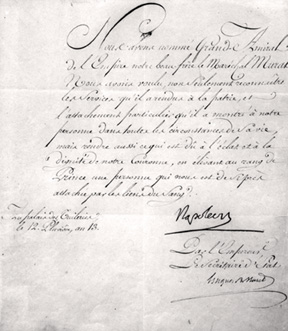
Murat’s appointment as Prince and Grand Admiral of the Empire

- 1805
Once Emperor, Napoléon began to create an Imperial nobility. Through the end of his reign, he was to name 31 dukes, 452 counts, 1,500 barons and 1,474 chevaliers. Among them, his brother-in-law Joachim Murat, a superb cavalry officer, was surprised to be made Grand Admiral of the Empire.
Ink on paper
ps - Murat was married to Caroline (Bonaparte)
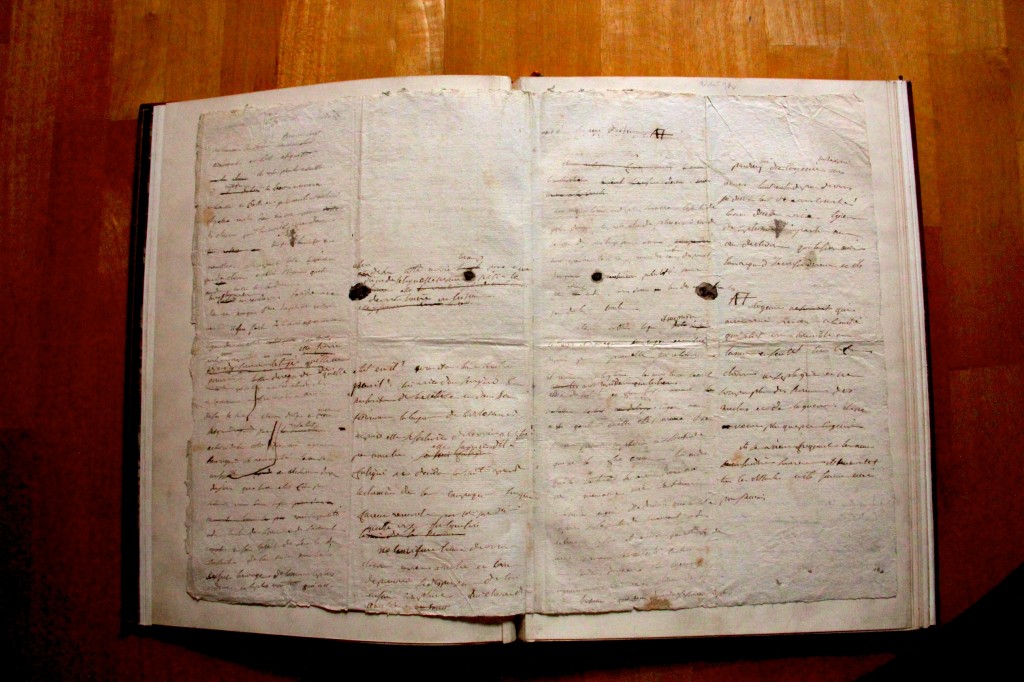
Napoleon's prose

These pages, written in Napoleon’s hand, are not on display in any museum. Property of Dr. Karpeles,Santa Barbara, California. Dr. David Karpeles owns the world’s largest private collection of historical documents. Dr. Karpeles and his wife, Marsha, maintain twelve Karpeles Manuscript Museums around the country where they share their incredible documents and artifacts with the public. Among those documents are four pages of prose young Napoleon Bonaparte drafted in 1795.
Subscribe to:
Posts (Atom)