Translate

Showing posts with label Susan Higgenbotham. Show all posts

Monday, December 3, 2012

The Chamber of Demonstrations

Reconstructing the Jacobean Indoor Playhouse
http://www.bristol.ac.uk/drama/jacobean/research3.html


ARTIFICIAL LIGHTING IN THE EARLY MODERN ENGLISH COMMERCIAL PLAYHOUSE
Martin White
In the same way that illustrations of theatres in which the source of illumination was candle-light regularly fail to include the source of that illumination, so too do discussions of plays intended for indoor performance rarely accord the lighting any significant part in the dramatic or theatrical experience.

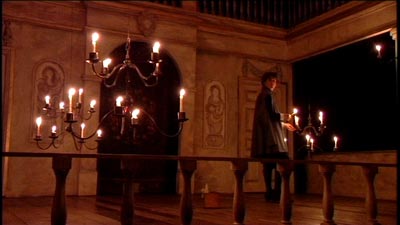
This research project sought to provide a greater degree of understanding of the nature, organisation and impact of artificial light in the early modern playhouse, first by creating a full-scale reconstruction, illuminating it as closely as possible in line with contemporary documentation, and through the use of new High Definition film technology capture the results. These are disseminated via DVD, a unique feature of which is the ability to move between different viewpoints in the auditorium and so witness the changing nature of the light.

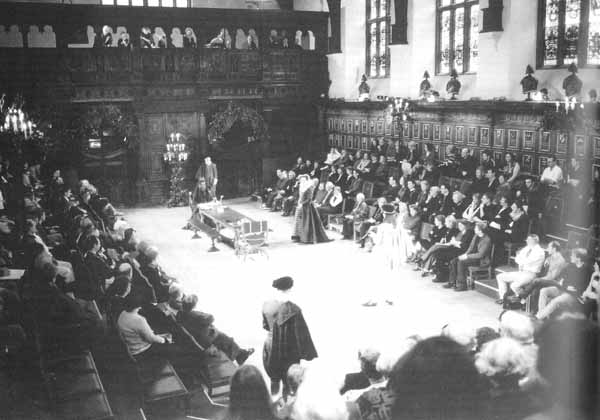
Discussions of light in the indoor playhouses invariably argue that the windows would have made the use of candles necessary only at the very end of winter afternoons. The photograph of the Globe company's production of Twelfth Night at Middle Temple in 2002 shows the large windows there that would have helped illuminate performances.


12th Night at Middle Temple
However, while the Worcester College drawings of the playhouse on which the experiment was based show a number of windows at gallery level, once the seats in front of them were occupied the light would be reduced by half, while the gallery itself significantly reduces even further the spill of that already reduced light to the stage. Robert Graves calculates that the windows, even unobstructed, would admit only 7-8 foot candles on bright afternoons (see details of light measurement below), dropping to only under one foot candle on a dim or overcast day. Moreover, Dekker's reference to playhouses with their windows shuttered suggests, even though the paucity of further evidence means there is no proof, that the playhouses might have had some device to reduce the light levels even further. We know, too, that windows were shuttered for afternoon performances in Oxford and Cambridge colleges, for example.

It is also significant that plays designed for indoors frequently stage 'dark scenes' and that, unlike in the open air playhouses where such changes in the stage state was effected through language and – presumably – appropriately mimetic performance, indoor plays clearly rely on the fact that the audience can see for themselves that it's dark.

Candles
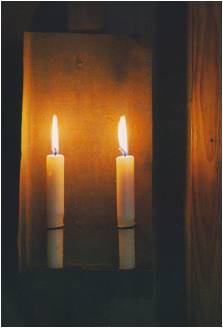
The predominant form of general lighting in the indoor playhouse was candlelight. However, experiments that use modern candles give very misleading results. Playhouses were lit by a mixture of tallow and beeswax candles. We had our candles made by Mary Fisher, a chandler in Leeds, who dipped them, rather than rolling them, and we used a loose rather than a woven flax wick (contemporary candles also sometimes had rush wicks). The tallow was sheep's tallow, and was completely unrefined.

Measuring candlelight
Bleached Beeswax
fig. Bleached beeswax candles, the most refined of all, the most expensive and so used rarely, such as in John Ford's stage direction in 'Tis Pity She's A Whore calling for 'wax lights' which, placed on a table, clearly indicate it is an altar.
  • The amount of light produced by a light source is known as Luminous Flux, and is measured in Lumens. The power that a light source emits in a given direction is known as Luminous intensity, and is measured in Candela: 1 Candela = 1 Lumen per steradian (= unit solid angle)
  • The brightness of a surface is known as Illuminance, and is measured in Lux (Lumens per square metre), or Footcandles (Lumens per square foot): 1 Footcandle = 10.76 Lux
  • A modern candle produces around 1 Candela (12.57 Lumens); a similar sized beeswax candle produces less than half a Candela (5 Lumens). Tallow candles and oil lamps produce even less. Wax candles burn 30% brighter than tallow.

    How many candles?
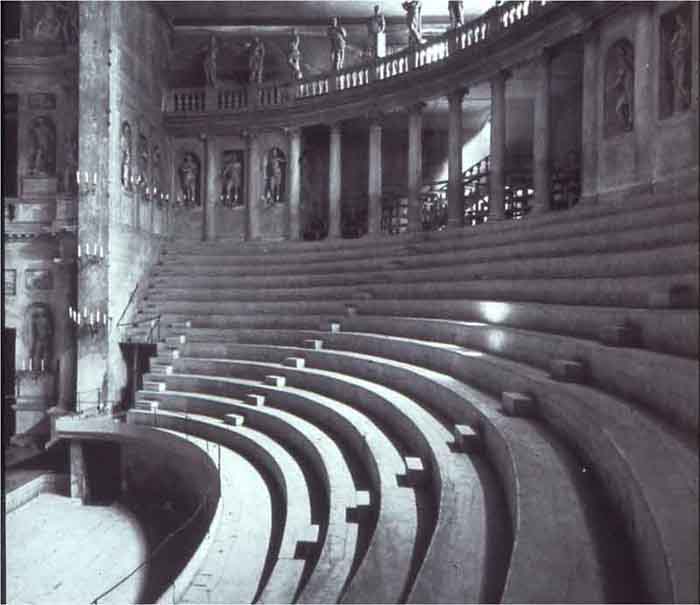
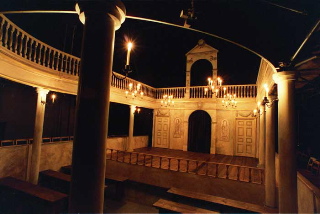
    The records of the Salisbury Court playhouse (which has in the past been associated with the Worcester College drawings) indicate that a mix of wax and tallow was used, possibly one quarter wax to three quarters tallow, resulting in a total of around 40 candles. In my experiment we burned 32 in the chandeliers above the stage, with a further ten in sconces on the pillars at the side of the stage and in the pit, rather like those employed at the Teatro Olimpico in Vicenza which might itself be a possible influence on the WC designs.
Teatro Olimpico, Vicenza
It is important to remember, however, that there is no evidence before the eighteenth century of a chandelier hung over the pit.
For a comparison of the illumination provided, we can look at a later playhouse, but one that still exists – the Drottningholm Court Theatre in Sweden.
Drottningholm Court Theatre
This theatre has the following lighting positions:
  • 12 candles in the footlights
  • 6 pairs of wings, 10 candles behind each wing = 120 candle
  • 1 pair of wings with 6 candles behind each wing = 12 candles
  • 4 chandeliers in the auditorium, perhaps with 12 candles in each = 48 candles
  • Probably some bracket candlesticks on the walls, say 12 candles
  • Probably 2 chandeliers above the forestage, say 24 candles
This produces the following illumination:
  • 12 candles as Footlights = 100 Lumens
  • 24 candles in advance bar chandeliers = 200 Lumens
  • 60 candles in auditorium chandeliers and brackets = 480 Lumens
  • 132 candles on poles in wings = 1060 Lumens
In practical terms, while the face of an actor standing 1 m upstage of 5 floor-mounted beeswax candles is lit at 0.66 lux (0.06 Fc), the face of an actor standing 1 m upstage of a single floor-mounted 50 W birdie at 10% intensity is lit at 50 lux (4.6 Fc). In other words, lighting levels today are approximately 70 times greater than at Drottningholm in 1766.

Our eyes react differently to candlelight than to other forms of illumination. What is known as the Purkinje Effect means that the tendency of the peak sensitivity of the human eye is to shift toward the blue end of the spectrum at low illumination levels. This effect introduces a difference in color contrast under different levels of illumination. In bright sunlight, geranium flowers appear bright red against the dull green of their leaves, but in the same scene viewed at dusk, the contrast is reversed, with the petals appearing a dull red against paler green leaves. The eye has 2 systems of detecting light: Rods and Cones. Cone cells in the retina give us the impression of colour, and are most sensitive to yellow light; Rod cells, which are more light-sensitive (and thus more important under low levels of illumination) do not distinguish colours and respond best to green-blue light.

This can be seen clearly in the extracts on the DVD, and demonstrate in action Sir Francis Bacon's observations on the effect of candlelight on fabrics of different colours.
One thing in particular remains unresolved, however. I had expected the wax candles to smoke and smell more than they did, in line with a number of contemporary references. Indeed, I asked Mary Fisher for a second batch of tallow candles to be as unrefined as possible, just animal suet in effect, but they still failed to create a smelly fug. Guttering, however, was a problem, and demonstrated the need for attention in the act breaks.

Chandeliers
Lighting the candles
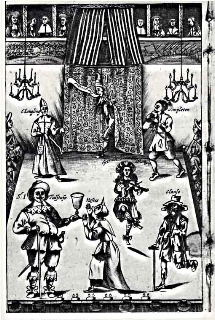
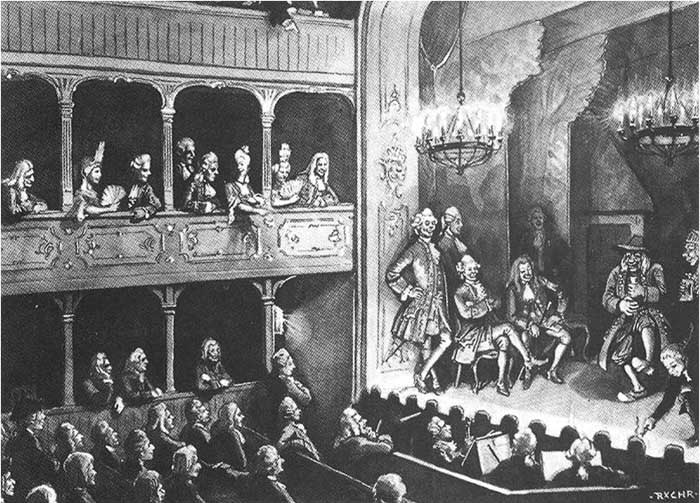
We created four elegant, branched chandeliers modelled on those shown in the Wits frontispiece (fig. 1), as, although later in date, I considered these more in line with the neoclassical nature of the playhouse than the more traditional cartwheel design, similar to those in the illustration (of a later playhouse) below (fig. 2).
The Wits
fig 1 The Wits
Candle light performance
fig 2 Theatre with cartwheel chandeliers
Each of our chandeliers held eight candles. The height above the stage is crucial. We hung ours ten feet above the stage.
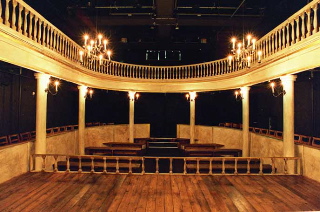
Reconstruction showing height of candles

Samuel Pepys complained of having to look through the candles when sitting on the upper seating level, and you do precisely that in the reconstruction.
View from Upper Level
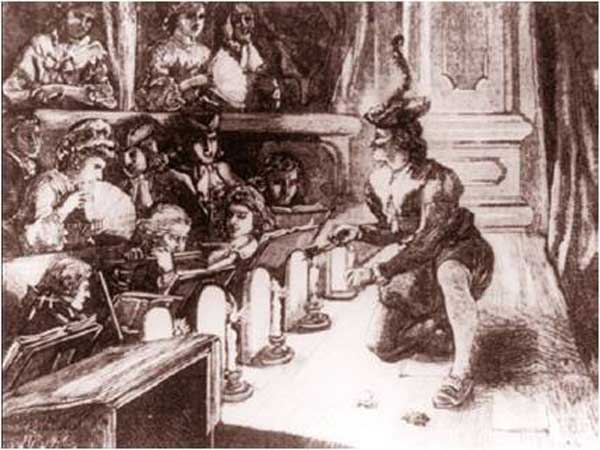
Although from a later period and from France, the following illustration gives a good indication of the relationship of performer to the overhead chandeliers.
Commedia mid 18th Century France
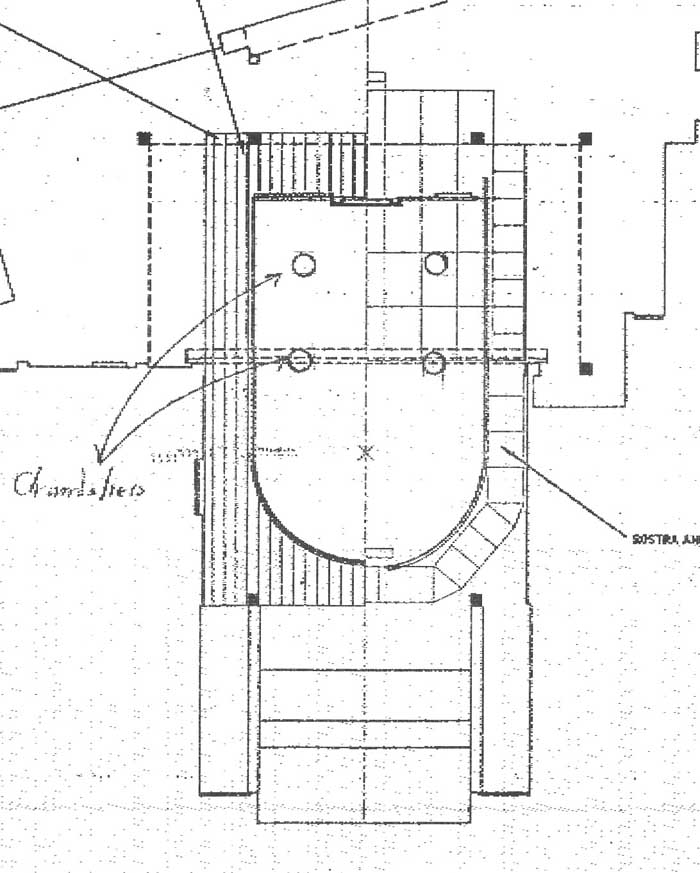
The diagram below shows the positions of the chandeliers in our reconstruction.
Candelabra positions on reconstruction
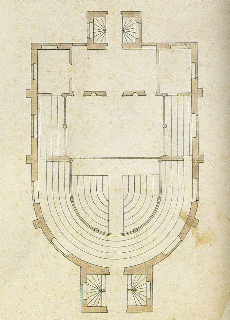
Worcester college drawings - plan

The purpose of the space shown on the original drawing between the front edge of the stage and the seating unit became clear to me as I realised that actors are illuminated by chandeliers that hang in front of, rather than above, them, and allowed the chandeliers to be suspended slightly forward of the stage rail, but with no audience beneath.
View from stage

The chandeliers were lowered to the stage and, when all the candles were alight, raised to the playing position (shown on The Changeling extract). However, there is evidence from the Restoration period that chandeliers were raised higher than their normal position during the action in order to further dim the stage, and we also did this in our Duchess of Malfi extract (they are raised as Bosola, extinguishing the stage candles, informs the Duchess that her brother will only see her in the dark). We raised them too in preparation for the murder of Bergetto in Tis Pity She's A Whore. Above about twelve feet the impact of the chandeliers in terms of lighting the actors was significantly reduced.

It is significant, given the time it takes to effect changes of candlelight, that scenes in which light plays a particular role in setting mood or a key factor in the narrative are frequently grouped together in a specific sequence. In 'Tis Pity She's A Whore for example the first intimations of impending darkness are given in 3.5 with various references to 'this very night' (8), 'this night' (13), etc. The following scene (3.6) is specific in its lighting: 'Enter the Friar sitting in a chair, Annabella kneeling and whispering to him; a table before him and wax lights'. The removal of these (particularly bright) candles will make the stage appear to darken (modern lighting designers still raise the light level before dark scenes to effect a greater contrast), while raising the chandeliers and extinguishing the stage candles will produce a significant change for 3.7 (see DVD extract). 3.8 is a short scene (possibly played above with a lantern to pull focus and illuminate faces) before returning to the main stage for the last scene of the act. Significantly, in my view, the scene that opens the fourth act is a feast to celebrate the marriage of Soranzo and Annabella, in which Ford (who knew the playhouse and its resources well) provides full opportunity to relight candles and, if necessary, unshutter any windows. In the study of scenes in which changes of light play a significant role (the extract from The Duchess of Malfi is another) it is essential to examine exactly where they come in the structure of the performance.
Footlights

Footlights
Although the Wits frontispiece shows a row of (oil) lamps along the front edge of the stage there is no evidence of their use before the Restoration playhouses (as shown above). At the WC playhouse a rail along the front edge of the stage occupies their position, and references to performers moving between stage and auditorium at the Blackfriars (The Knight of the Burning Pestle) for example, suggests they were not employed their either.


Mobile Lighting
Although, as I think the extracts on the DVD illustrate, raising and lowering the chandeliers effects a significant lighting change, the state remains overall the same across the stage. This makes the use of mobile lighting instruments particularly necessary and effective. We worked with three main forms of mobile lighting: candles, lanterns and torches, but as Robert Graves points out:

'...the major obstacle in attempting to reconstruct the artificial illumination of the early drama is that nearly every light could be and was confused with others. Torches and tapers were sometimes called candles, large candles were called torches, and even tapers [usually single, thin ropes dipped in tallow and used mainly in bedrooms] were called lanterns. Moreover, all of these instruments were frequently identified simply by the general term 'light' (Lighting the Shakespearean Stage, 1567-1642, Southern Illinois University Press, 1999, p. 23. Graves' book is essential reading.)

The DVD extracts are designed to be largely self-explanatory, but there are one or two specific points to make:

Candles

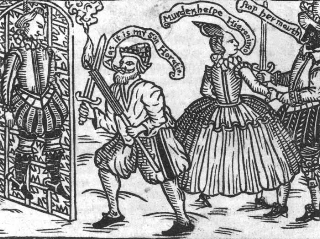
Arden of Faversham
Frontispiece from Arden of Faversham

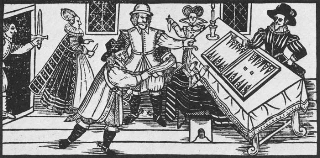
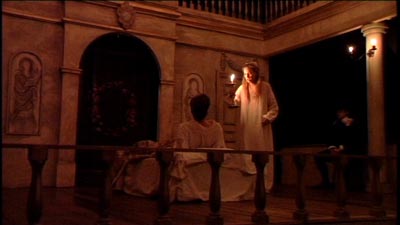
Candles are the most common hand-held light, and, though not as unstable as a taper, still susceptible to being extinguished by drafts from curtains or doors. Used as a signifier in scenes, but also, as is particularly evident in the extracts from Love's Sacrifice (in Use of the Stage, and illuminating the chess board and providing stage focus) and The Guardian (in Use of Light, illuminating crucial moments in the scene) candles enabled aspects of the action to be emphasised, or parts of the stage to be given greater significance.
Love's Sacrifice on the reconstruction
Love's Sacrifice
The Guardian on the reconstruction
The Guardian

Lanterns
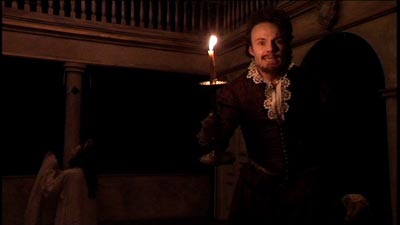
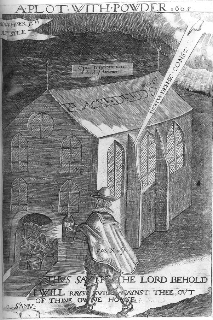
Their use commonly denotes an exterior, as in the street scene we have chosen from 'Tis Pity She's A Whore. The 'dark lantern' that the murderer, Grimaldi, carries at the opening of the scene was designed so that the user could by closing a door over the horn window block out the light from the candle inside without extinguishing it completely. Ours was made by David Fisher and modelled directly on the lantern said to have been carried by Guy Fawkes when he was arrested.
Dark Lantern
A Plot with Powder

The use of lanterns in this particular scene (played with the chandeliers raised to their highest level) allows the discovery of the mortal wound to Bergetto (the scene is clearly based on the death of Mercutio) to be delayed until the closely held lantern reveals that it is blood, not sweat or urine, on Richardetto's hands, and that prompts the cold realisation that Bergetto has been murdered.

The lantern (or a candle) was also useful in calling focus to an actor using the upper level. The extract from Love's Sacrifice (in Use of the Stage) demonstrates this.

Torches
Spanish Tragedy Frontispiece
Frontispiece from Kyd's The Spanish Tragedy
These are the most dramatic hand-held instruments, as the scene from The Duchess of Malfi demonstrates. Here, as well as providing vivid contrast with the overall darkness on stage (chandeliers at full height, side candles extinguished) they allow Bosola to illuminate the hand dropped by the Duchess – that as many of the audience as possible must see – and to take our attention to the figures (as she believes them to be) of her dead husband and children, placed in the recess at the rear of the stage.
For further detailed analysis that can be set alongside the extracts on the DVD, see my Renaissance Drama in Action (Routledge, 1998), especially pp. 148-151 and 170-176.

The White Rose Bled Red: Was Henry VI to Blame for the Fifteenth Century English Civil Wars?


http://mylifeishistory.wordpress.com/2012/07/05/the-white-rose-bled-red-was-henry-vi-to-blame-for-the-fifteenth-century-english-civil-wars/

(Author’s note: This post is based on research conducted at my time at Lancaster University in the U.K. Note that no primary sources were consulted given the nature of the assignment.)
The fifteenth century saw a period of civil wars in Britain, later termed the Wars of the Roses. Most history books tell us that these series of battles occurred between the cadet branches of the English royal family, both Plantagenets but one descended from the duchy of Lancaster and one from the duchy of York. Victories volleyed back and forth between both families but ultimately led to the rise of the House of Lancaster after the battle of Bosworth Field in 1485. In this, Richard III lost his life and Henry Tudor (later Henry VII), the last son of Lancaster with an at best tenuous claim to the the throne, won the day. Many people, including B.P. Wolffe, argue that the wars’ causes primarily stem from the “personal failings of Henry VI”. I would argue, however, that although Henry’s deficient personality definitely aided the civil wars’ progression, by no means did it contribute solely to them. Instead, his personal failings, so to speak, did little to relieve other internal and external pressures such as a severe financial crisis, the loss of English-held lands in France, and domestic rivalries and feuding.
At the time of his birth in 1422, Henry VI appeared to have had an auspicious beginning. He was the son of Henry V, arguably the greatest British monarch in history, and Catherine of Valois, the French king’s daughter. Henry V had succeeded in conquering most of France and quite possibly would have been crowned king of France had he not died of dysentery in 1422, leaving his son the infant monarch of both England and France.  A dual monarchy was eventually set up to govern both of the young king’s dominions. Both his uncles, John, duke of Bedford, and Humphrey, duke of Gloucester, received protectorates, in France and England respectively. Bedford held the predominant protectorate in both England and France; Gloucester had to renounce authority in favour of Bedford upon his return from France.  Bedford achieved some military success in France, continuing Henry V’s policies. In England, however, factions began to form between Gloucester and his rival for power and court influence, Henry Beaufort, bishop of Winchester and eventually Cardinal. Tensions over authoritative and ecclesiastical rights almost erupted into civil war twice, and Bedford was called back from France to mediate between the rival parties. Things on the international scene played out in even more violent ways. France was embroiled in a civil war between the Armagnacs and the Burgundians that began in 1407. England traditionally allied with Burgundy, but with French grants of land to the English and the enticing promise of Henry’s claim to the throne, England enjoyed playing one against the other. Although the seeds of future discord were sown during Henry VI’s minority, his future seemed ready for the taking at his coronation in 1429.

Handsome chap, ain’t he?
It became clear as his reign continued, nevertheless, that Henry did not live up to England’s expectations of him. His personality was not at all suitable for handling the rigors of being a monarch. Much has been said of his piety (to such a point that Henry VII tried to persuade a number of popes to canonise him), and while that may be admirable, this also led to an increasing amount of suspicion of others’ behaviours. Henry held his servants to the same strict moral code he held himself to. It has been said that he spied on his own servants to ensure that they were acting in an acceptable manner. Henry also enjoyed the rights of patronage; this had been one of the few powers granted to him as a youth. Indeed, his first grant had been to Cardinal Beaufort in 1436. Unfortunately, he took generosity to the extreme. Henry granted many crown lands to his favorites and followers to the point of limiting the amount of internal crown revenue and potentially isolating those who did not benefit as much. This helped to contribute to the financial crisis later on in his reign.
Henry VI’s malleable mind and great stubbornness combined to form his greatest fault. Henry paid too much heed to his favourites and also often acted independently of his own council. Furthermore, his generosity favored his relatives including William de la Pole, earl and soon duke of Suffolk and the Staffords. This favoritism split the royal court into two factions, the royalists who supported the monarch and Suffolk and those who threw their lot in with the closest relative, Richard of York. Those nearest Henry had the opportunity to influence him to their own ends, and this often proved detrimental.

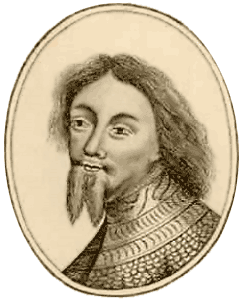
Richard, duke of York. Another handsome chap, eh? Image courtesy of Luminarium.org.
Henry’s marriage also provided another major authoritative figure in his life. In 1445, he married Margaret of Anjou, niece by marriage to the French king, Charles VII. A proud and willful woman, Margaret soon became the ‘man’ in her marriage. She used her influence as an intermediary between England and France to further Louis’ French interests rather than Henry’s English ones. She would also be a primary instigator in the ensuing civil war that began less than ten years after her marriage. He may have been easily influenced, but Henry was no fool. If there was a course of action he had decided on, he went about it secretly and would not be told otherwise.

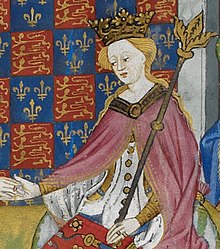
Portraiture really wasn’t that flattering back then, was it? Margaret of Anjou looks anything but sexy. Image courtesy of Wikimedia commons.
In probably the most injurious action to his early reign, Henry attempted to negotiate peace with Charles independently of Parliament. The Lancastrian king ceded his lands of Maine and Anjou to France, granting away a great deal of his birthright. This came as a shock to the English who had been struggling for almost a hundred years to extend and defend their monarchs’ territorial birthrights on the Continent. The loss took a toll on morale, and many of the English settlers in the ceded territories refused to leave until Charles’ armed forces threatened them. Although Henry had the authority to keep or release his French territories at his will, his blatant disregard for Parliament’s counsel  wasted decades of war. He may have meant it as a peace offering (for in return, England received a 20-year truce), but Margaret probably convinced Henry also since her own father René of Anjou received Maine. The English people suffered as a whole, but it was Suffolk who bore the brunt of the blame. The loss of English-held lands ultimately led to Suffolk’s demise at the hands of his own men.
The cost of ‘peace’, as it were, was astronomical. Firstly, he did not have the base of income his own father had. Henry granted away large tracts of lands as well as wardships early in his reign and did not expect payment in return; indeed, Suffolk had obtained the wardship of the wealthy heiress, Margaret Beaufort, kin of the king who would be the mother of Henry VII. Second, the constant losses in France caused Parliament to be less lenient in granting subsidies with no promise of return. Finally, Henry V’s excursions in France had caused a backlog of debt that the Exchequer could barely handle. Attempts to obtain foreign loans often failed as well since the English had bad credit abroad. They could hardly afford to make more payments. This heavily influenced the entire loss of France because not enough funding could be secured to supply desperately needed troops and supplies to the remaining areas in France that the English controlled, Normandy and Gascony. In the end, the loss of Normandy and Gascony with only Calais remaining in English hands precluded the fighting that led to the War of the Roses.

English holdings in France under Angevin and later Plantagenet rule. Image courtesy of the History of England podcast.
It would be easy to blame Henry’s personal attributes to the start of the war, but one cannot discredit the role personal feud, bastard feudalism, and factionalism played. A number of small feuds often involved larger, more important magnates who intervened on their family’s, tenants’, or servants’ behalves. This led to the corruption of local justice; lords often stacked juries with those favourable towards them in order for a case to be decided one way or another. Also, local authorities were willing to overlook certain indiscretions done by their fellows so long as they were able to line their pockets as well. ‘Victims’ went back to their lords for justice, and feuds began. It was an ongoing cycle. Feuds generally occurred as a result of inheritance, estate, or money issues. These feuds, coupled with an increasing sense of factionalism, helped to determine sides in the war.
People often split the noble groups that fought in the War of the Roses into either Lancastrians or Yorkists. These two groups originated in the ‘peace-favouring’ and ‘war-favouring’ groups of the war with France. During Henry’s minority, Gloucester favoured war while Cardinal Beaufort and Suffolk desired peace. Gloucester grew increasingly outnumbered, but Richard, duke of York, was known to have been on good terms with him. Suffolk and Beaufort, on the other hand, kept themselves close to the king. Cardinal Beaufort’s nephew, Edmund Beaufort, earl and later duke of Somerset, came to be York’s chief rival prior to the start of the war. Somerset, favoured by Henry, ousted York from his lieutenancy in France in 1444. York, slighted by this and his lack of payment in arrears owed him for his soldiers’ maintenance, began the process of trying to rid the king of Somerset’s and Suffolk’s influence. His growing sense of discontent at how Henry ran the country and how his favourites influenced him made York decide to press his own claim to the throne. York’s claim to the throne arguably matched if not overruled Henry’s. He was descended from Edward III’s second son whereas Henry was descended from John of Gaunt, Edward III’s third son. York succeeded in the smooth running of the government when he reigned as Protector of the Realm during Henry’s sickness in 1453-1454, and in his mind, he deserved the throne.
Most of the nobles, however, did not feel the same way. They swore fealty and loyalty to Henry as an anointed monarch, needed his simple mind to further their own ends, and were probably afraid of a stronger personality restricting and replacing their power behind the English crown. Although Henry succeeded in alienating many of his followers and did not act as a proper mediator between feuding nobles, his own periods of indisposition could not be controlled. It was during these times that York came to know his ruling capabilities and how the public reacted to them. There is no doubt that York ruled fairly and implemented many positive reforms. He did, however, attempt to usurp the throne of an anointed monarch for his own gain, something many nobles could not stomach. Thus, they probably fought against York nominally for the protection of the monarchy but actually to prevent another from stealing their influence and livelihood. The Lancastrians’ private ambitions could not be controlled by the king, only monitored and restricted.
Without a doubt, Henry VI’s personal faults cost him much, the respect of his subjects, his territorial inheritance in France, his family, England’s credibility abroad, and much more besides. His incompetence in ruling and politics may be blamed partly on his own simplicity but also partly on his upbringing. Henry grew up depending on others to run his country and did not know how to enforce his own will. This cannot explain the loss of France or the crippling domestic situation at home, but it does shed a more sympathetic light on his failures. Much of Henry’s financial, diplomatic, and domestic problems began as a result of his malleable and weak personality, and so Wolffe’s critique that the primary cause of the War of the Roses is quite accurate, but one cannot forget to factor in the personal rivalries and feuds that helped deteriorate local authority as well.

Works Cited: (Note, these are not Chicago-style but rather Turabian…)
Griffiths, R.A. ‘Henry VI (1421–1471)’, Oxford Dictionary of National Biography, Oxford
University Press, 2004; online edn, Sept 2010 [http://www.oxforddnb.com/view/article/12953, accessed 14 Dec 2010]
Keen, M.H., England in the Later Middle Ages, (London, 2003)
Pollard, A.J., North-Eastern England During the War of the Roses, (Oxford, 1990)
Thomson, John A.F., The Transformation of Medieval England, 1370-1559 , (New York, 1983)
Tuck, A., Crown and Nobility, 1272-1461: Political conflict in late medieval England,
(London, 1985)
Wolffe, B.P., ‘The Personal Rule of Henry VI’, in Fifteenth-Century England (ed.) S.B. Chrimes,
(Manchester, 1972)

The Other Joan of Arc - Margaret's Grandmother


Print this article   Email this article
Beautiful, clever and determined, Yolande of Aragon was at the heart of the diplomatic and military campaigns that united 15th-century France. Margaret L. Kekewich charts her career.
Traditionally the turning point in the reconquest of France from the English is believed to have coincided with the career of Joan of Arc. The relief of Orleans in May 1429 and the subsequent coronation of the Dauphin as Charles VII of France at Reims in July were principally the achievements of this devout peasant maiden. She inspired the indecisive Charles, uncertain of his own legitimacy, to embark on a series of campaigns that led to the capture of Paris and parts of Normandy. But an alternative account sees Queen Yolande of Aragon (1380-1442), mother-in-law of the Dauphin, as a more important and longer-term source of emotional, financial and diplomatic support. She was beautiful, clever and determined to defend the interests of her own Angevin family, interests, which she saw as synonymous with those of France.
In 1425 Yolande of Aragon almost certainly received an anonymous treatise addressed to her in which she was urged to recall the Dauphin (by then actually Charles VII) to his duty to save France from ruin. The treatise declared that he should obey the Church, consider the ‘common good’, avoid lowly born advisers and excessive taxation. His parlement(supreme court) should promote religious and economic rule by ensuring that justice was maintained. All this was to be achieved by the King but the fact that it was sent to his mother-in-law shows where the real power was thought to lie. 
How did a Spanish princess, already widowed with five young children, achieve such a position? Yolande was the daughter and sister to the last in a line of kings of Aragon, her mother was a French princess from the duchy of Bar. In 1400 Yolande, described by the chronicler Jean Juvenal des Ursins as ‘one of the most beautiful creatures that one could see’, married Louis II of Anjou, the cousin of Charles VI of France. Louis held the duchy of Anjou and county of Maine and took precedence over the other princes of the royal blood because he also claimed the kingdom of Naples. He possessed the northern part, the county of Provence, and from time to time, both before and after his marriage, ruled much of southern Italy (apart from Sicily, although the Angevins used the title ‘King of Sicily’). The defence of this realm was one great conflict in which Yolande became involved. The other was the fierce rivalry for influence at court between the factions of Burgundy and Armagnac that raged, filling the power vacuum left by the periodic fits of insanity suffered by Charles VI.
The absences left by Louis II while he was fighting in Italy initially preserved the house of Anjou from commitment to either side but they were gradually drawn in. The house of Orleans and the Count of Armagnac led the faction that bore the latter’s name, the Armagnacs. John the Fearless, Duke of Burgundy, the richest and most powerful of the princes of royal blood, wished to dominate the political destinies of France. Louis of Anjou, the eldest son of Louis II and Yolande, was betrothed to Duke John’s daughter Catherine; as they were also friendly with Orleans they hoped to mediate between the factions. In 1413, however, the Angevins became alarmed by the way in which Duke John (who had already murdered the previous Duke of Orleans) dominated the royal government and they broke off the engagement between Louis of Anjou and John’s daughter, thereby making John a bitter enemy.
In the same year the Queen of France, Isabeau of Bavaria, who took most decisions on behalf of her sick husband, agreed to betroth their third son, Charles, Count of Ponthieu, to Marie, the eldest daughter of Louis II and Yolande. Charles had been born while the queen was thought to be having an affair with the Duke of Orleans, so his legitimacy as heir to the throne could be questioned by his enemies.
The accession of the vigorous king Henry V in England led to the revival of his family’s claim to Normandy, Anjou and Maine; it was derived from his Norman and Plantagenet forebears. His victory at Agincourt in 1415 introduced England as a player in the vicious power struggle that was raging round Charles VI and his self-seeking queen. Their two eldest sons died, leaving Charles of Ponthieu as Dauphin. In 1417 Yolande’s husband, Louis II, also died, worn out by disease contracted on his last Italian campaign. On his deathbed he advised Charles and his own sons not to trust the Duke of Burgundy but to avoid his enmity.
Yolande was faced with a choice; she could either ally with the Armagnac faction (its natural leader, the Duke of Orleans, remained in captivity in England for twenty-five years after Agincourt) or throw in her lot with the Duke of Burgundy, who dominated Paris, Charles VI and Isabeau. Yolande, always preferring diplomacy to violence, tried to temporise and made a truce with Henry V. But when it became clear that, with the support of Burgundy and Isabeau, he wished to disinherit the Dauphin and eventually make himself King of France, Yolande made an irrevocable decision to assist the Dauphin. In 1418 the Dauphin escaped from Paris with the assistance of several Angevin servants, including one Tanneguy du Chastel. Charles set up an alternative government in Poitiers, well away from the Anglo-Burgundian sphere of influence and close to his mother-in-law Yolande in Anjou. He effectively became the leader of the Armagnac faction. For nearly twenty years from his base in the Loire valley, known as the kingdom of Bourges, he was to resist the English occupation of France.
In 1419, once Charles was in the relative security of the Loire, Yolande could consider the needs of her two eldest sons, Louis III (1403-34), and René, Count of Guise (1409-80). She made an excellent settlement for the ten-year-old René by persuading her uncle, the elderly cardinal and Duke of Bar, to make him his heir. René was also married in 1420 to Isabelle, the daughter and heiress of the neighbouring Charles, Duke of Lorraine; eventually the couple would inherit that duchy as well. These arrangements gave the house of Anjou, already a formidable power in France and Italy, influence in the Holy Roman Empire. Lorraine was to be weaned away from the Burgundian sphere of influence, a step that would lead to further conflict for the Angevins.
In 1419 Yolande travelled with her eldest son Louis III to Provence to negotiate with Joanna, the childless queen of Naples, and her nobles for Louis’s recognition as her heir. The Dauphin was engaged in peace talks with the Duke of Burgundy and Yolande believed that she could safely leave him. Charles and John arranged to meet on the bridge at Montereau on September 10th but, instead of making an agreement, some of the Dauphin’s followers, including Tanneguy du Chastel, murdered the duke. This was the worst thing that could have happened; it shocked European opinion and John was succeeded by an able, adult son, Duke Philip the Good. He immediately broke off relations with Charles and allied with the English and Queen Isabeau in Paris. The following year, 1420, the treaty of Troyes recognised Henry V as the heir to Charles VI and sealed the agreement with the marriage of Charles’ daughter Catherine to the English king. The Dauphin, disgraced, disinherited and bereft of good advice, was confined to the Loire valley, Dauphiné and Languedoc with only the unreliable support of the Duke of Brittany and a few other nobles.  
Yolande of Aragon was probably horrified by the news from the north of France. She reached an agreement in 1419-20 with the Neapolitans, prudently taking hostages for the safety of Louis III, and dispatched him to Italy with a small company. Anjou was attacked by the English and saved by forces loyal to the Dauphin, led by Scots mercenaries, at the battle of Baugé on March 21st, 1421.
The Dauphin became King of France theoretically in October 1422 when his father died, although Henry VI, the infant son of Henry V (who had also died in 1422), was proclaimed king in Paris and recognised there, as well as in Normandy, Calais and Guyenne. 
Yolande returned to the Loire from Provence in 1423 to be welcomed by Charles with the title of Duchess of Touraine. She seldom let him out of her sight in the following years: many of his edicts, assemblies and parlements bore the joint names of Charles and his mother-in-law ‘the Queen of Sicily’. She was mostly based in her dower town of Saumur and in Angers, the main city of Anjou. Charles sometimes ventured away from her to his castles near Tours and Bourges and his wife’s residence at Chinon.
Throughout the remainder of the decade Charles managed to hold most of his territory although the Angevins lost Maine to the English in 1425. Both sides were roughly equal in strength and Yolande realised that diplomacy would be the most effective way of gaining an advantage. Her first target was Brittany, historically an Angevin ally. She achieved a double coup in attracting Arthur of Richemont, the younger brother of its duke, away from his alliance with Burgundy and betrothing her eldest son Louis III to the duke’s daughter Isabelle of Brittany. Richemont, however, had first to be persuaded to change sides, which he would not do until those responsible for the murder of Duke John at Montereau and other acts distasteful to Brittany were disgraced. Tanneguy and another Angevin, Jean Louvet, were therefore sent from court to a comfortable exile ‘by the means and with the support of the high and mighty Queen of Sicily’.
Richemont changed sides and became Constable, the most senior commander in France. He, together with military leaders such as Count Dunois, bastard of Orleans, and Pierre de Brézé, Lord of La Varenne – Yolande’s men – started to turn the tide against the English.
Yolande and her daughter Marie (who had given birth to a son, Louis, in 1423) led the Angevin faction at court. The other major faction was led by Georges, Lord of La Tremoïlle, Charles’s favourite and a former companion of his mother Queen Isabeau. Initially Yolande and Richemont thought that La Tremoïlle would be useful since he had Burgundian connections and shared their aim of opening negotiations with Philip the Good. But La Tremoïlle turned Charles against Richemont and concentrated on lining his own pockets rather than placating Burgundy. He probably changed the king’s mind about the union of Louis III (absent in Italy) with Isabelle of Brittany. Instead she married Guy, Count of Laval, a noble from Maine. Yolande was furious, for this was a sign that her influence was waning.
These tensions at the court of Bourges were the context for the emergence of a new force in the power game with England, Burgundy and the court of Queen Isabeau. Joan of Arc came from a prosperous peasant family in Domrémy in the marches of Lorraine so she was a subject of its duke and his heirs, René and Isabelle. Joan went first to the old Duke of Lorraine’s court at Nancy early in 1429 to proclaim her holy mission to liberate France from the English. The Duke was more concerned to discover whether or not she could cure his gout and was brusquely told by the Maid that he should seek God’s pardon by putting away his mistress and returning to his wife. Joan asked him to send Duke René with her to the Dauphin but had to be content with a few knights and squires. Yet she was sheltered and encouraged by a number of Angevin servants on her way to Chinon where she encountered Charles. He and Yolande were fearful that Orleans would be captured by the English besiegers and that the Loire valley, including Touraine and Anjou, would be opened to them. Philippe Contamine, a great authority on the period, doubts that Joan received much support from the Angevins. It is certain, however, that Yolande headed the ladies who examined the Maid and confirmed that she was truly a virgin and therefore a credible conduit for God’s will. Yolande also gathered together the supply convoy for the relief of Orleans that Joan accompanied to gain her great victory over the English on May 8th. 
The coronation of Charles VII took place shortly afterwards at Reims on July 17th, 1429. An Angevin servant sent an enthusiastic account of the occasion to the queens Yolande and Marie. The latter was absent perhaps because she was pregnant. Yolande’s son, Duke René, was one of the lords who wished to press the attack on Paris. When Joan was wounded he sheltered her in his hotel in the suburbs. This stage in the campaign appears to have been opposed by La Tremoïlle, who was still the King’s favourite, and it came to a halt for lack of finance. The next spring, Joan was captured by the Burgundians who sold her to the English. No attempt was made by King Charles or the Angevins to rescue or ransom her and she was burnt at Rouen in May 1431. It has been suggested that the King and the Angevins saw her trial as an attempt to discredit the resurgent monarchy through charges of witchcraft and heresy and wished to distance themselves from her. In a devout age, Joan’s defeat and capture had called into question her credentials as God’s messenger. Queen Yolande was not responsible for the phenomenon of Joan but, recognising her purity and charismatic quality, she was prepared to use her as a tool in the reconquest of France and against her rival La Tremoïlle. When Joan failed, Yolande and the King did not hesitate to abandon her.
Yolande’s hopes for one branch of her family were shattered when her second son, René, was defeated at Bulgnéville in 1431, soon after he and his wife had inherited Lorraine. The rival candidate for the duchy, Antoine, Count of Vaudemont, was supported by a force of English and Burgundians. René began a period of captivity in Burgundy, which lasted a number of years. Meanwhile Louis III died in Italy without heirs. The claim to the kingdom of Naples devolved onto René but it fell to his wife Isabelle to make it good. By 1435 she had confirmed the loyalty of Lorraine and was able to leave it to go to Naples. She ruled effectively there as René’s lieutenant for two-and-a-half-years, managing to keep the rival claimant, the formidable Alfonso of Aragon, at bay.
In 1433, La Tremolile was attacked in his bedroom in Chinon by a group of young nobles led by Pierre de Brézé. The favourite was wounded in several places but his extreme girth saved him from the potentially fatal result of a blow to his stomach. He was driven into exile while Queen Marie calmed her husband's indignation. She and her mother had adroitly introduced Yolande's youngest son, Charles of Anjou, into the King's company. The latter was charmed: 'A brave prince, a true man of war endowed with a remarkable beauty', he enthused of the young Anjou, whom he showered with titles and gifts. They were to remain almost inseparable, at court and on campaign, for the rest of the reign. Yolande, supreme again, supported by her daughter and youngest son, could concentrate on the major goal of her diplomacy, a settlement with Burgundy. Another of her thwarted ambitions had also been fulfilled by the marriage of her remaining daughter, Yolande, to the son of the Duke of Brittany. 
The English position in France was dealt a double blow in 1435. The Duke of Bedford, a friend of Burgundy who had proved a successful regent and war leader for his nephew, Henry VI, died. Yolande had been making overtures to Philip the Good for years but, while the English prospered, he had no incentive to respond positively. Now, with increasingly aggressive French campaigns ravaging up to the gates of Paris, Philip could see no future for his alliance with England.
A congress was called at Arras attended by delegates from France, England and Burgundy. Yolande and Charles of Anjou were represented. Duke Philip’s terms were high, including demanding cringing acts of penance by King Charles for the murder of John the Fearless, but the price was worth paying. The English left Arras with nothing and Paris fell to Charles VII the following year. Philip at last released René who had to agree to a high ransom, the loss of towns in Flanders and the marriage of two of his children to Burgundian allies.
None of this seemed to trouble Yolande – one of her daughters was queen of a resurgent France and another would be Duchess of Brittany (though she died before her husband succeeded). René was free to go and make good his claim to be King of Naples and Yolande and her youngest son enjoyed influence and prestige at the court of Charles VII.
In 1440, King Charles and Queen Marie visited Yolande in Saumur, where she was living with her granddaughter, Margaret of Anjou, the second daughter of René. Now sixty, Yolande was deemed to be an old woman but she was aware of the potential of her attractive young granddaughter for a politically advantageous match. Two years later, when she was twelve, Margaret was bought rich fabrics and furs so that she could be displayed to visiting ambassadors from the German emperor. This was to be Yolande’s last act of diplomacy for she died at Saumur in November 1442.
In her will she left various precious objects, tapestries and jewels to René, Marie, Charles of Anjou (who also received her lands in Provence) and Margaret. She declared that she had no money to bequeath as she had spent it all in the service of the kings of France and Sicily. She was modestly interred in the Angevins’ traditional burial place, the church of St Maurice, Angers.
King Charles wrote her epitaph in 1443 when he gave Charles of Anjou various lordships:
The late Yolande, of good memory, Queen of Jerusalem and Sicily, in our youth did us great services in many ways that we hold in perpetual memory. Our said mother-in-law, after we were excluded from our city of Paris, received us generously in her lands of Anjou and Maine, and gave us much advice, support and many services using her goods, people and fortresses to help us against the attacks of our adversaries of England and others.
In 1445 Henry VI of England married Yolande’s granddaughter Margaret of Anjou. The only male in the direct Lancastrian line, he was in need of a wife and well disposed towards a peaceful settlement with France. Henry settled for a meagre dowry and a short truce in return for Margaret’s hand. The new queen and her advisers managed to persuade the malleable Henry that Maine should be surrendered, which was achieved in 1448.
Yolande had been at the heart of the military and diplomatic campaigns, governing France until death overtook her. She left a great legacy to France in two of her grandchildren: Margaret of Anjou promoted French interests both by her marriage and the subsequent weakening of the English government by her ill-judged policies. Louis XI, the son of Charles and Marie, was to preside over the demise of many of the great noble houses of France. By 1500, principally through marriage and the operation of the laws of succession rather than warfare, Brittany, Orleans, Anjou, Maine, Provence and the old duchy of Burgundy had all been united to the crown of France.
Timeline
1415Battle of Agincourt and the rise of Henry V of England as a major power in France.
1418Yolande rescues the Dauphin, Charles (VII), from Paris and the clutches of Burgundy, and sets him up in Poitiers/Bourges.
1419
John the Fearless, Duke of Burgundy, assassinated by Charles’s men.
1420Treaty of Troyes, recognises Henry V as heir to French king Charles VI; Louis III goes to Naples.
1421Anjou saved from the English in the Battle of Baugé. Henry VI of England born in December.
1422Charles VI dies; Henry V dies, succeeded by infant Henry VI.
1429Joan of Arc defeats the English at Orleans in May; coronation of Charles VII in Reims in July.
1433La Tremoille, King Charles’ favourite, overthrown by Yolande’s men.
1435Treaty of Arras; Philip the Good of Burgundy makes peace with King Charles VII.
1436Charles takes Paris.
1442Yolande dies at Saumur.
1444-49Truce of Tours gives Charles VII the upper hand over Henry VI of England.
1445
Margaret of Anjou, Yolande’s granddaughter, marries Henry VI.
1449King Charles invades Normandy, ending the truce. After the fall of Guyenne in 1453, the English hold only Calais.
Margaret L. Kekewich was Senior Lecturer, Faculty of Arts, The Open University.
Further reading: 
  • Philippe Contamine, De Jeanne d’Arc aux Guerres d’Italie: figures, images et problèmes du xve siècle (Paradigme, 1994)
  • Jeanne d’Orliac, Yolande d’Anjou: la reine des quatre royaumes (Librairie Plon, 1933)
  • Margaret L.Kekewich, The Good King: René of Anjou and Fifteenth-Century Europe(Palgrave/Macmillan, 2008)
  • Roger Little, The Parlement of Poitiers: War, Government and Politics in France, 1418-1436 (Royal Historical Society, 1984)
  • Malcolm Vale, Charles VII (University of California Press, 1974)

Sunday, December 2, 2012

Who’s Who - Henry VI


The Royal Family
Henry VI – the King!
John, 1st Duke of Bedford – Henry VI's uncle, a capable soldier and statesman who is appointed regent in France and Normandy for the minority.
Humphrey, 1st Duke of Gloucester – Henry VI's second uncle and Protector of the Realm in England. Popular with the public but falls out with the Beaufort figures on the regency council in his opposition to peace with France.
Margaret of Anjou – Henry VI's wife and ultimately the leader of Henry VI's Lancastrian court in the Wars of the Roses. A controversial woman who takes the lead when her husband proves incapable.
Prince Edward – the son of Henry VI and Margaret of Anjou. Perhaps a more capable figure than his father, but is forced to fight for the right to be heir.
The Dead (featured in previous episodes but relevant to this one too!)
Henry V – Henry VI's father and one of England's legendary kings. His great successes leave Henry VI as King of England and France, but it is a difficult legacy to maintain.
The Lancastrians (Henry VI's supporters)
Duke of Suffolk (William de la Pole) – Henry's favourite through the 1440s-50 and the major proponent of peace with France, in opposition to Humphrey, Duke of Gloucester.
Edmund Beaufort (2nd Duke of Somerset) – another favourite of Henry VI and in particular of Margaret of Anjou. Edmund was the major rival to Richard Duke of York and their personal conflict was one of the immediate causes of the Wars of the Roses.
The Yorkists (Henry VI's opponents)
Richard, Duke of York – the most powerful noble in England and, for a time, the technical heir to the throne. Richard's enemies at the Lancastrian court (Somerset and Margaret of Anjou) sought to sideline him during the 1440s but from 1450s he sought to have Somerset removed and restore himself as a major figure.
Edward of March (later Edward IV) – son of Richard Duke of York who fought with his father against the Lancastrians before coming to lead the Yorkist forces and become Edward IV.
Earl of Salisbury (Richard Neville) – powerful northern lord who led the Nevilles against the powerful Percy family in northern England, leading to an alliance with Richard Duke of York.
Earl of Warwick ('the Kingmaker') – son of Salisbury and a legendary figure in English medieval history. A powerful soldier and commander as well as an expert propagandist, he fought with Richard Duke of York and later his son, Edward of March, against the Lancastrians. Dubbed the Kingmaker due to his helping both Edward IV and Henry VI to take the throne at different times.
The French
Charles VII – the French dauphin and rival to the French throne who was able to win his kingdom back from Henry VI thanks to the help of a formidable peasant girl.
Joan of Arc – a legendary French peasant girl whose saintly visions inspired her to spearhead the French recovery in the Hundred Years War and oversee a remarkable English decline.
Louis XI – a cunning French king later in the reign who intervened in the Wars of the Roses to further his own cause against the Burgundians in France.
Family Fortunes – Wars of the Roses
The Lancastrians
Henry VI loses his throne and his only son, Prince Edward, is killed in the Battle of Tewkesbury, meaning that the royal Lancastrian line has ended.
The Beaufort’s (pseudo-Lancastrian)
During Henry VI's reign there are four Dukes of Somerset who all hail from the Beaufort line, most famous among whom is Edmund Beaufort. However, all four of these Dukes are killed during the Wars of the Roses and ultimately leave no male heirs, meaning that the male line of the Beaufort’s has ended.
The Yorkists
Although Richard Duke of York is killed during the Wars of the Roses, his eldest son, Edward of March, is victorious and becomes Edward IV. What's more, he has two brothers (George, Duke of Clarence and Richard, Duke of Gloucester) as well as numerous children. The Yorkists are now in control and looking strong,
The Neville's
Both Salisbury and Warwick die without leaving significant male issue, significantly limiting the family's powerful standing. Instead it is the women of the family who hold prominent positions at court: Cecilly is the mother of Edward IV, while Isabel and Anne are married to Edward's brothers, George and Richard.
The Tudors
The final major rival to the Yorkists are the Tudors, who finally come to play a major role in English history. Firm supporters of Henry VI, Owen Tudor is executed after the Battle of Mortimer's Cross but his sons Edmund and Jasper continue the fight. Edmund dies young, but not before marrying Lady Margaret Beaufort, whose son from the marriage, Henry Tudor, now has a claim to the throne through the Beaufort side of the family. Henry Tudor ends the period in exile with Jasper in Brittany, the last Lancastrian rival to the throne.