http://www.studentmidwife.net/fob/a-brief-history-of-midwifery.662/
From an unpublished work: Author unknown - Circa 1992
Midwives date back to references in the old testement (Genesis 24).
Egypt:
In Egypt midwives jealously guarded the secrets of their profession - therefore very little of practical value was handed down in writing.
Greece:
In ancient Greece midwives were required by law to have had children themselves.
1500:
The "Sloan Manuscript No. 2463" was one of the earliest works on midwiferey.
Echarius Roesslin (Frankfurt) published “Rosegarten” a guide for midwives and physicians.
In the 1500s, childbirth was viewed as one of the “diseases of women”.
1600:
One of the first schools for midwives was in the early 16 century at the Hotel-Dieu, Paris. The first woman to write a text on midwifery was Louise Bourgeois (1563 - 1636). She was the wife of an army surgeon.
1720:
Maubray gave criteria for requirements of a midwife - not fat, considerate, grave, patient, pleasant and follows advice.
Edmund Chapman (1680-1756) the second public teacher (after Maubray), who wrote:
“ ... one of the most noble ... operations ... requires judgment for there is generally one and often two lives snatched from the jaws of death ...”.
1731:
William Giffard published “Cases of Midwifery”, surgeon and man-midwife, which gave accounts of practical experiences, including the use of forceps. There were also district advances around this time.
1735:
William Smellie (1698-1763) believed to be a single individual with most profound effect on midwifery. Around 1735 recorded the use of forceps in France. 1742 and Smellie became an instructor of midwifery. His published works include:
1751 A treastie on the theory an practice of midwifery
1754 A collection of cases and observations in midwifery
1764 A collection of peternatural cases and observations in midwifery.
1752:
Sir Richard Manningham (1690-1759) established General Lying-in Hospital and later, Queen Charlotte’s Hospital. Previously he had supplied beds in a rented house next door to his own house. he taught by using a manikin.
During the 18th century midwifery became respectable as a profession for men, due to William Hunter (1718-83). Before the end of the 18th century there were six or seven maternity hospitals as well as maternity wards attached to General hospitals.
Also around this time Alexander Gordon (1752-99), of Aberdeen (Scotland), made the discovery that it was Doctors and Midwives that actually carried infection from one patient to another and declared that if the patient’s clothing and bed linen were burned and Midwives and Doctors carefully washed themselves, changed their clothing and fumigated the infected clothing, this would contain infection. Many doctors and Midwives took exception to this advice.
The history of Midwifery has been a long struggle between firstly, a male dominated priesthood and, subsequently a system of organised medicine also controlled by men, and a women’s community-based network of helping and healing.
In the 19th century the rising middle classes came to prefer obstetric care to the traditional care from midwives. Right through the century, however, the poor had recourse to midwifery amongst the working class. There was a resistance to attempt to organise midwifery and make it a profession in case it affected the lucrative middle class doctor’s pracises.
1830:
Augustus Granville - founder of the Obstetrical Society of London said that women were “unsuited by nature for all scientific mechanical employment”.
1840:
Several medical schools and colleges added midwifery to the curriculum.
1850:
Royal College of Physicians and Surgeons award diplomas in midwifery for the first time. Many obstitricians believed they would never receive rightful status and many were still untrained.
1862:
Nightingale Ward, King’s College Hospital opened to train nurses in midwifery.
First Health Visitors were appointed by Manchester and Salford Ladies Health Society. The aim was to popularise sanitary knowledge in the home.
1881:
Midwives institute (later became the Royal College of Midwives) was founded and began arguing for increased and better training.
1892:
Buckingham County Council appointed three ‘Lady Missionaries’ to go into the community and give instruction on child welfare and hygiene. This was based on Florence Nightingale’s views.
1902:
Midwives Act becomes law. Midwifery became an established profession in Britain. Midwives had to undergo supervised training and registration.
At the turn of the century there was very littel antenatal care of the pregnant woman. A woman was rarely examined until labour was underway. Although she was given information about general health, diet, clothing etc.
1915:
Compulsory notification of births. There was also the appointment of a lot more Health Visitors as Medical Officers of Heatlh. They were essential in teaching the proper feeding and care of children. Improvements in living standards of families with young children were sought.
1919:
Newly established Ministry of Health and the Board of Education made conditions for the training and appointment of Health Visitors.
1946:
The National Service Act opened a new chapter in the history of public health. Here was the promise of a comprehensive medical service for the whole population. It was a service that provided a new look not merely at the hospitals, private practitioners and dentists, but nurses, midwives and health visitors. Also in 1946 a working party was appointed to consider the position of general nurse training. Its report was revolutionary and highly contriversal. A year later a similiar report was appointed to consider the recruitment and training of midwives. Its report was less arresting but some of its recommendations proved acceptable to the ministry.
1959:
For those who wanted to go further than the rest a new conception of nurse training had been evolved as a result of collaboration between Hammersmith Hospital, Battersea College of Technology and the Queen’s Institute. This was a four year integrated course of nurse education.
1967:
Teachers of Nursing Act - allowed qualified teachers who were also registered nurses to be admitted to the register of nurse tutors. A pilot study for new midwifery training course was set up. It replaced the previous two part courses by about 1970.
In mid 1975 training was offered at 116 schools. The course lasted for one year for RSN and RSCN and eighteen months for enrolled nurses and two years for those without previous training.
1975:
The number of midwives was reported to be 16,550. The training and practice is controlled by the Central Midwives Board on behalf of the Government.
1976:
Contraception became an inegral part of the NHS and contraceptive treatment, advice and supplies now available to women irrespective of age or marital status.
1979:
The Nurses, Midwives and Health Visitors Acts of 1979 and 1992 established the UKCC and the four National Boards to regulate nursing, midwifery and health visiting professions.
1983:
Three statutory bodies controlled the practice, education and training of midwives prior to the handover of functions to the new statutory bodies on 1st July 1983. They were:1989:
- The Central Midwives Board.
- The Central Midwives Board for Scotland.
- The Northern Ireland Council for Nurses and Midwives.
The strategy for Nursing produced the first major changes in nurse and midwifery education for over fourty years. Project 2000, and the implemention of a new career structure for nurses, midwives and health visitors which would reward clinical skills they acquired in relation to the responsibilities they take. It concentrates on five main issues.and was formulated to assist the professions in meeting changes in helath and health care.
- Nursing practice.
- Manpower.
- Education.
- Leadership.
- Management.
1989:
White paper Working for patients. There were three other key policy initiatives1991:
- Caring for people (1989)
- Health of the Nation (1992)
- Patient’s charter (1991)
The Midwives Rules, UKCC.1992:The scope of Pprofessional practice, UKCC. The code of conduct for the nurse, midwife and health visitor, UKCC.
Bibliography
Clader J M 1954 The story of nursing Methuen, London.
DoH 1993 A vision for the future HMSO, London.
Kitzinger S 1988 Midwife challenge London.
Radcliffe W 1967 Milestones in midwifery Wright.
Stocks M A hundred years of district nursing.
UKCC 1992 The scope of professional practice UKCC, London.
UKCC 1992 The code of conduct for the nurse, midwife and health visitor UKCC, London.
UKCC 1992 A guide for students of nursing and midwifery UCKK, London.
Translate
Showing posts with label henry VI. Show all posts
Thursday, December 27, 2012
Margaret of Anjou
Margaret of Anjou was born on the 23 of March 1429 in the province of Lorraine. She was the daughter of René, Duke of Anjou and a neice of Charles VII. Margaret spent her early years living in the Rhone Valley and in Naples, where she was given a full education by her mother and the scholar, Antoine de la Salle.

In 1444, England made peace with France and Margaret was betrothed to King Henry VI ; she married him in April of the next year at Titchfield Abbey, Hampshire. The marriage was unpopular, Margaret being French, and became more so with time as no heirs were born. When the royal couple’s first, and only child, was born in 1453 it was even claimed that Henry was not the father. Margaret clearly dominated the couple and also tried to dominate politics. Unfortunately she wielded a very French view on most things and would never truly understand English politics – something that led her to make some grave mistakes.
When King Henry fell ill in 1453, a seven-month pregnant Margaret tried to claim the regency, but found no support forthcoming, even from her allies. By the time she gave birth to a son, Edward, in October at Westminster Palace, the question regarding the regency had still not been settled. Then in 1454, Margaret’s mortal enemy, the Duke of York became regent and she was placed out of the way at Windsor Castle.
When the King was captured at the Battle of Northampton in 1460, Margaret did not submit, but instead became the real impetus behind the Lancastrian cause. The Queen raised an army and killed York, who was pushing his claim to the throne, at Wakefield along with several other prominent Yorkists. She then defeated the infamous Earl of Warwick at the battle of St. Albans where she was reunited with her husband.
In 1461, Henry and Margaret’s army was crushed at Towton. In 1462, she went to France where she persuaded Louis XI to finance an invasion. The invasion failed and Margaret and her supporters were forced to withdraw to Scotland. The Lancastrians suffered several more defeats and in 1465, Henry was captured.
Margaret lived in exile with her son until 1470 when her old enemy, Warwick arrived to make his peace with her and bring new hope to the Lancastrian cause. An alliance was formed between the two, and sealed with marriage of Edward, Prince of Wales to Warwick’s daughter Anne. The ‘Kingmaker’ soon restored Henry to the throne, but the Earl was defeated and killed at Barnet, before Margaret could join her husband.
Nevertheless, Margaret invaded with her own army the same year, but Edward in turn defeated her at Tewkesbury where her son was slain, along with many of the Lancastrian nobility. Her husband Henry was murdered in the Tower, just two weeks later leaving no figurehead for the remaining Lancastrians to follow.
After Tewkesbury, Margaret spent some time in the Tower, where she was eventually ransomed by the French King Louis. She died in her native province of Anjou, a poor and broken woman on August 25, 1482.
Monday, December 17, 2012
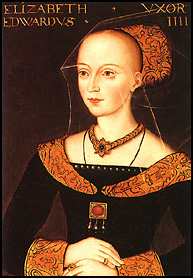
Elizabeth Woodville


Excerpted from:
Strickland, Agnes. Lives of the Queens of England.
London: Bell and Daldy, 1867. 154-165.
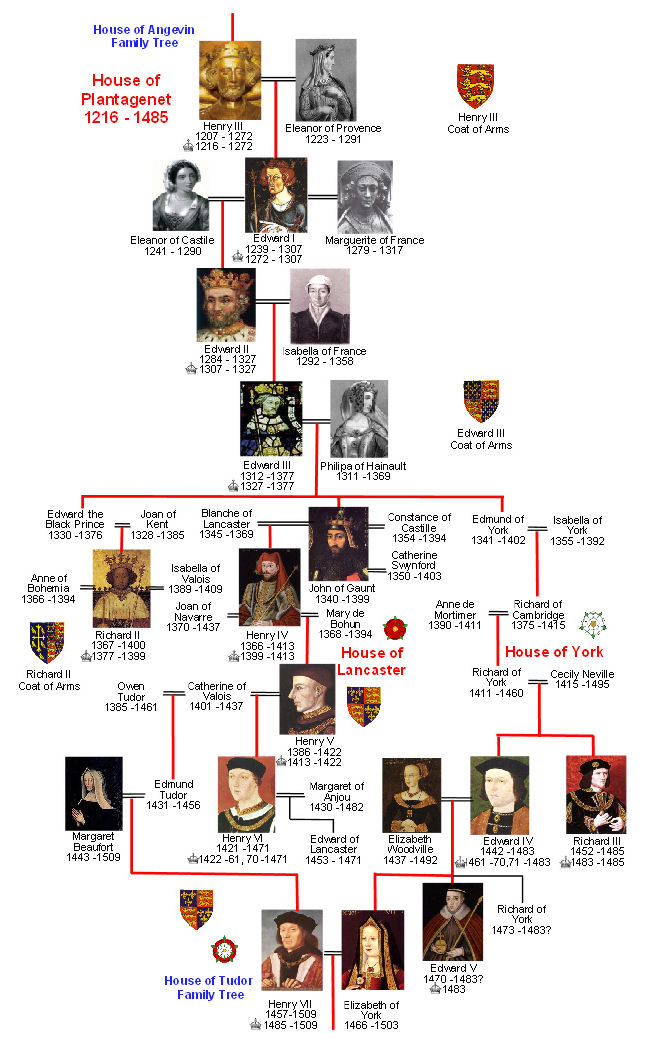
QUEEN ELIZABETH WOODVILLE or WYDVILLE (1437-1492)
Jacquetta of Luxemburg, the fair young widow of the old warlike Duke of Bedford, took for her second spouse his favourite knight, the brave and handsome Sir Richard Woodville, when she came to England in 1435 to claim her dower. The time of the birth of her eldest child Elizabeth, the issue of marriage kept secret for fear of parliament, probably occurred in 1436. The matter burst out with great scandal the year after. Sir Richard was arrested and imprisoned in 1437; but as the king's mother had married in lower degree to Owen Tudor, the young king was glad to pardon the second lady in his realm, as an excuse for showing mercy to his dying queen-mother. Jacquetta's knight was therefore pardoned and sent home. They settled very happily at Grafton Castle, where they became the parents of a large family of handsome sons and beautiful daughters, among whom Elizabeth was fairest of the fair.
The Duchess of Bedford kept the rank of the King's aunt. His royal mother had died miserably in 1437, as shown in her life. Duchess Jacquetta, on occasions of ceremony, was the first lady in the land until the marriage of the king. Her daughter Elizabeth, took high rank among the maids of honour of Margaret of Anjou, and was the belle of her court, as two letters extant from Richard Duke of York and his friend the Earl of Warwick prove, recommending a Welsh hero, one of their knights-marshal, sir Hugh Johns, as a husband, they dwell on his great love inspired by her beauty and sweet manners; the letters show familiar acquaintance with Elizabeth, but they were of no avail. The court beauty had no fortune but her face, the Welsh champion none but his sword. She made a better match the same year with the heir of lord Ferrers of Groby, John Gray, rich, valiant, and years younger than the rejected Sir Hugh. Lord Ferrers was possessor of the ancient domain of Bradgate, which was afterwards to derive lustre as the birthplace of his descendant, lady Jane Grey. Elizabeth was appointed one of the fourt ladies of the bedchamber to Margaret of Anjou. John Gray held military command in the queen's army. His death left Elizabeth with two infant sons, in 1460.
Rancour so deep pursued the memory of John lord Gray, that his harmless infants, Thomas and Richard, were deprived of their inheritance of Bradgate. Elizabeth herself remained mourning and destitute at Grafton the two first years of Edward IV's reign. Hearing that the young king was hunting in the neighbourhood of her mother's dower castle at Grafton, Elizabeth waited for him beneath a noble tree known in the traditions of Northamptonshire, as "the queen's oak," hold a fatherless boy in either hand; and when Edward, who must have been well acquainted with her previously at the English court, paused to listen to her, she threw herself at his feet, and pleaded for the restoration of her children's lands. Her downcast looks and mournful beauty not only gained her suit, but the heart of the conqueror. He was unwilling to make her his queen, but she left him to settle the question; knowing that he had betrayed others, her affections still clave to the memory of the husband of her youth. Her indifference increased the love of the young king. The struggle ended in his offering her marriage, which took place May 1, 1464. The marriage gave great offence to the mother of Edward IV. This lady, who, before the fall of her husband, Richard duke of York, at Wakefield, had assumed the state of a queen, had to give place to the daughter of a knight. It was on Michaelmas day, 1464, that Edward IV finally declared to Elizabeth to be his wedded wife, at Reading palace.
The queen's eldest daughter, Elizabeth, was born at Westminster palace about five months afterwards. The royal physicians, by means of their foolish studies of astrology, had assured king Edward that his expected child by his queen would prove a prince. The king, who was deep in the same kind of lore, had persuaded himself that his expected infant would wear the crown of England. One of these physicians, Dr. Dominic, obtained leave to station himself in the queen's withdrawing-room, leading to her bed-chamber, in order that he might be the first to carry the tidings of the heir to Edward IV. Hearing the child cry, he called to one of the queen's ladies, asking, "What her grace had?" The ladies were not in the best humour, being unwilling to answer "only a girl." So one of them replied, "Whatsoever the queen's grace hath here within, sure 'tis a fool that standeth there without." Poor Dr. Dominic, being much confounded by this sharp answer, dared not enter the king's presence.
Elizabeth was crowned May 16, 1465, with great solemnity, in Westminster abbey, the young duke of Clarence officiating as high-steward. Elizabeth and Warwick were on friendly terms, as he stood godfather to her eldest daughter. The baptism of this princess for a while conciliated her two grandmothers, Cicely duchess of York, and Jacquetta duchess of Bedford, who were likewise her sponsors. The christening was performend with royal pomp, and the babe received her mother's name of Elizabeth,—a proof that Edward was more inclined to pay a compliment to his wife than to his haughty mother. As prime-minister, relative, and general of Edward IV, the earl of Warwick had, from 1460 to 1465, borne absolute sway in England; yet Edward at that time so far forgot gratitude and propriety as to offer some personal insult to Isabel, his eldest daughter, who had grown up a beauty. Warwick had certainly been in hopes that, as soon as Isabel was old enough, he would have made her his queen, a speculation for ever disappointed by the exaltation of Elizabeth; so he gave his daughter Isabel in marriage to the duke of Clarence, and England was soon after in a state of insurrection. As popular fury was especially directed against the queen's family, the Woodvilles were advised to retire for a time.
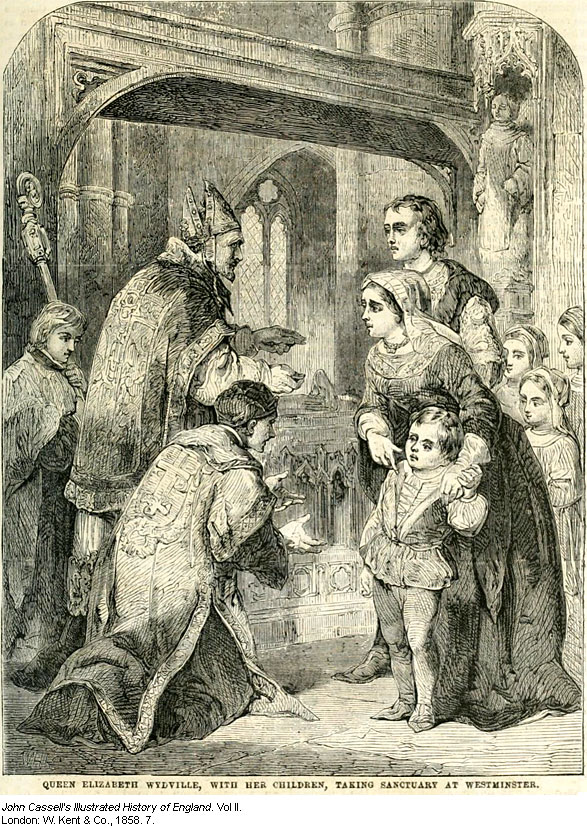
The first outbreak of the muttering storm was a rebellion in 1468, in Yorkshire, under a freebooter called Robin of Redesdale, declared by some to have been a noble, outlawed for the cause of the Red rose. The murder of the queen's father and brother followed in 1469. When the king advanced to suppress these outrages, he was seized by Warwick and his brother Montague, and kept at Warwick castle, where an experiment was tried to shake his affection to Elizabeth by the insinuation that her whole indluence over him proceeded from her mother's skill in witchcraft. The Yorkist king escaped speedily to Windsor, and was soon once more in his metropolis, which was perfectly devoted to him, and where, it appears, his queen had remained in security during these alarming events. Again England was his own; for Warwick and Clarence, in alarm at his escape, betook themselves to their fleet, and fled. Then the queen's brother, Anthony Woodville, intercepted and captured the rebel ships, but not that in which Warwick and Clarence, with their families, were embarked, which escaped with difficulty to the coast of France. The queen was placed by the king in safety in the Tower, before he marched to give battle to the insurgents. She was the mother of three girls but had not borne heirs-male to the house of York. Edward IV narrowly escaped being once more thrown into the power of Warwick, who had returned to England; but being warned by his faithful sergeant of minstrels. Alexander Carlile, he fled half-dressed from his revolting troops in the dead of night, and embarked at Lynn with a few faithful friends. Elizabeth was thus left alone, with her mother, to bide the storm. She was resident at the Tower, where her party still held Henry VI prisoner. While danger was yet at a distance, the queen's resolutions were remarkably valiant; yet the very day that Warwick and Clarence entered London, she betook herself to her barge, and fled up the Thames to Westminster,—not to her own palace, but to a strong, gloomy building called the Sanctuary, which occupied a space at the end of St. Margaret's churchyard. Here she registered herself, her mother, her three little daughters,—Elizabeth, Mary, and Cicely, with the faithful lady Scrope, her attendant, as sanctuary-women; and in this dismal place, November 1, 1470, the long-hoped-for heir of York was born. The queen was most destitute; but Thomas Milling, abbot of Westminster, sent various conveniences from the abbey close by. Mother Cobb, resident in the Sanctuary, charitably assisted the distressed queen, and acted as nurse to the little prince. Nor did Elizabeth, in this fearful crisis, want friends; for master Serigo, her physician, attended herself and her son; while a faithful butcher, John Gould, prevented the whole Sanctuary party from being starved into surrender. The little prince was baptized, soon after his birth, in the abbey, with no more ceremony than if he had been a poor man's son.
Early in March the queen was cheered by the news that her husband had landed, and soon after, that his brother Clarence had forsaken Warwick. The metropolis opened its gates to Edward IV, who hurried to the Sanctuary to embrace his wife and new-born son. The very morning of this joyful meeting, Elizabeth, accompanied by her royal lord, left Westminster palace, but soon after retired to the Tower of London, while her husband gained the battles ofBarnet and Tewkesbury. The news of his success had scarcely reached her, before the Tower was threatened with storm by Falconbridge; but her valiant brother, Anthony Woodville being there, she, relying on his aid, stood the danger this time without running away.
After Edward IV had crushed rebellion by almost exterminating his opponents, he turned his attention to rewarding the friends to whom he owed his restoration, and bestowed princely gratuities on those humble friends who had aided "his Elizabeth," as he calls her, in that fearful crisis.
When Edward IV fled in the preceding year from England, he landed with a few friends at Sluys, the most distressed company of creatures ever seen; for he pawned his military cloak, lined with marten fur, to pay the master of his ship, and was put on shore in his waistcoat. The lord of Grauthuse received, fed, and clothed him, lending him besides money and ships, without which he would never have been restored to his country and queen. Edward invited his benefactor to England. Lord Hastings received him, and led him to the far side of the quadrangle of Windsor castle, to three chambers. These apartments were very richly hung with cloth of gold arras; and when Grauthuse had spoken with the king in the royal suite, he presented him to the queen's grace, they then ordered the lord chamberlain Hastings to conduct him to his chamber, where supper was ready for him. After refreshment, the king had him brought immediately to the queen's own withdrawing-room, where she and her ladies were playing with little balls like marbles, and some of her ladies were playing with ninepins. Also king Edward danced with Elizabeth, his eldest daughter. In the morning the king came into the quadrant, the prince also, borne by his chamberlain, called master Vaughan, bade the lord Grauthuse welcome. The innocent little prince, afterwards the unfortunate Edward V, was then only eighteen months old. Then the queen ordered a grand banquet in her own apartments, at which her mother, her eldest daughter, the duchess of Exeter, the king, and the lord of Grauthuse all sat with her at one table.
Elizabeth, in January, 1477, presided over the espousals of her second son, Richard duke of York, with Anne Mowbray, the infant heiress of the duchy of Norfolk. St. Stephen's chapel, Westminster, where the ceremony was performed, was splendidly hung with arras of gold on this occasion. The queen led the little bridegroom, who was not five, and her brother, Earl Rivers, led the baby bride, scarcely three years old. They afterwards all partook of a rich banquet, laid out in the Painted-chamber. Soon after this infant marriage, all England was startled by the strange circumstances attending the death of the duke of Clarence. The queen had been cruelly injured by Clarence. Her father and her brother had been put to death in his name; her brother Anthony, the pride of English chivalry, had narrowly escaped a similar fate: moreover, her mother had been accused of sorcery by his party. She did not soothe her husband's mind when Clarence gave him provocation. In fact, on the first quarrel, his arrest, arraignment, and sentence followed. He was condemned to death, and sent to the Tower. In his dismal prison a butt of malmsey was introduced one night, where he could have access to it. The duke was found dead, with his head hanging over the butt. Gloucester was certainly absent from the scene of action, residing in the north. On St. George's day succeeding this grotesque but horrible tragedy, the festival of the Garter was celebrated with more than usual pomp; the queen took a decided part in it, and wore the robes as chief lady of the order. Her vanity was inflated excessively by the engagement which the king of France had made for his son with her eldest daughter.
In the last years of king Edward's life he gave the queen's place in his affections to the beautiful Jane Shore, a goldsmith's wife in the city, whom he had seduced from her duty. His death was hastened by the pain of mind he felt at the conduct of Louis XI, who broke the engagement he had made to marry the dauphin to the princess Elizabeth of York, but an intermittent fever was the cause. When expiring, he made his favourites, lords Stanley and Hastings, vow reconciliation with the queen and her family. He died with great professions of penitence, at the early age of forty-two, April 9, 1483. Excepting the control of the marriages of his daughters, his will gave no authority to the queen. She was left, in reality, more unprotected in her second than in her first widowhood.
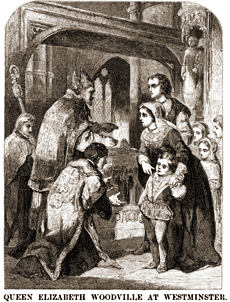
The Duke of Gloucester had been very little at court since the restoration. He was now absent in the north, and caused Edward V to be proclaimed at York, writing letters of condolence so full of kindness and submission, that Elizabeth thought she should have a most complying friend in him. Astounding tidings were brought to the queen at midnight, May 3, that the duke of Gloucester had intercepted the young king with an armed force on his progress to London, had seized his person, and arrested her brother, Earl Rivers, and her son, lord Richard Gray. In that moment of agony she, however, remembered, that while she could keep her second son in safety the life of the young king was secure. With the duke of York and her daughters she left Westminster palace for the Sanctuary; and she, and all her children and company, were registered as Sanctuary persons. Dorset, the queen's eldest son, directly he heard of the arrest of his brother, weakly forsook his trust as constable of the Tower, and came into sanctuary to his mother. The archbishop of York brought her a cheering message, sent him by lord Hastings in the night. "Ah!" replied Elizabeth, "it is he that goeth about to destroy us." — "Madam," said the archbishop, "be of good comfort; if they crown any other king than your eldest son, whom they have with them, we will on the morrow crown his brother, whom you have with you here. And here is the great seal, which in like wise as your noble husband gave it to me, so I deliver it to you for the use of your son." And therewith he handed to the queen the great seal, and departed from her in the dawning of the day.
With the exception of the two beautiful and womanly maidens, Elizabeth and Cicely, the royal family were young children. The queen took with her into sanctuary Elizabeth, seventeen years old at this time, afterwards married to Henry VII. Cicely was in her fifteenth year. These princesses had been the companions of their mother in 1470, when she had formerly sought sanctuary. Richard duke of York, born at Shrewsbury in 1472, was at this time eleven years old. Katherine, born at Eltham about August 1479, then between three and four years old. Bridget, born at Eltham 1480, Nov. 20th, then only in her third year; she was afterwards professed a nun at Dartford.
Gloucester's chief object was to get possession of the duke of York, then safe with the queen. As the archbishop of Canterbury was fearful lest force should be used, he went, with a deputation of temporal peers, to persuade Elizabeth to surrender her son, urging "that the young king required the company of his brother, being melancholy without a playfellow." To this Elizabeth replied, "Troweth the protector—ah! pray God he may prove a protector!—that the king doth lack a playfellow? Can none be found to play with the king but only his brother, which hath no wish to play because of sickness? as though princes, so young as they be, could not play without their peers—or children could not play without their kindred, with whom (for the most part) they agree worse than with strangers!" According to the natural weakness of her character, she nevertheless yielded to importunity, and taking young Richard by the hand, said, "I here deliver him, and his brother's life with him, and of you I shall require them before God and man. Farewell! mine own sweet son. God send you good keeping! God knoweth when we shall kiss together again!" And therewith she kissed and blessed him, then turned her back and went, leaving the poor innocent child weeping as fast as herself. When the archbishop and the lords had received the young duke, they led him to his uncle, who received him in his arms with these words: "Now welcome, my lord, with all my very heart!" He then took him honourably through the city to the young king, then at Ely house, and the same evening to the Tower out of which they were never seen alive, though preparations went on night and day in the abbey for the coronation of Edward V.
It is possible that Hasting's death had some influence in the imprudent surrender of young York. If Elizabeth had any secret joy in the illegal execution of her brother's rival and enemy, very soon she had to lament a similar fate for that dear brother, and for her son, lord Richard Gray, who were beheaded by sir Richard Radcliffe, June 24th, when the northern army, commanded by that general, commenced its march to London.
When the massacre of every friend to the rights of his brother's children was completed, and the approach of 9000 dreaded northern borderers intimidated the Londoners, the false protector entirely took off the mask. Buckingham induced Edward IV's confessor, Dr. Shaw, who was brother to Gloucester's partizan, the lord mayor, to preach a sermon against Edward V's title, on pretence that Edward IV's betrothment with lady Eleanor Butler had never been dissolved by the church. Shaw likewise urged the immediate recognition of the duke of Gloucester as sovereign, putting aside the children of Clarence on pretence of his attainder by parliament. Faint acclamations of "Long life Richard III" were raised by hired partizans, but the London citizens angrily and sullenly dispersed. Ratcliffe's forces approached Bishopsgate on the 26th, and Richard III was proclaimed king. The unhappy queen Elizabeth Woodville and her daughters witnessed the proclamation of the usurper from the abbot's house in the abbey. Richard then made his state visit to the Tower and city. Elizabeth and her daughters must perforce have been witnesses of his coronation, July 6, 1483.
Soon after, the usurper, his wife, and son, now called Edward prince of Wales, made a grand progress to Warwick castle. The unfortunate sons of Elizabeth meantime were closely imprisoned under the care of sir Robert Brakenbury, one of Richard III's northern commanders, who had been given the lieutenancy, under the notion that he would obey implicitly the usurper's orders. Accordingly, Richard sent one of this gentlemen of the bedchamber, John Greene, ordering him to kill Edward IV's sons forthwith. Brakenbury returned for answer "he would die first." A midnight consultation took place between Richard III and his master of the horse, Sir James Tyrell, who left Warwick castle August 2, with commands to Brakenbury from king Richard that he was to surrender the keys of the Tower to sir James Tyrell for one night. On his ride from Warwickshire the master of the horse was attended by two retainers, one his squire, Miles Forrest, a northern champion of immense strength, the other his horsebreaker, John Dighton, a big, broad, square knave. Sir James had requested his own brother, Tom Tyrell, a brave gentleman, to aid him, but met with positive refusal, by which, if he lost the usurper's favour, he gained from his country the appellation of "honest Tom Tyrell."
The three murderers reached the Tower of London after dark, August 3. Sir James Tyrell demanded the Tower keys; and in the very dead of the night when sleep weighs heaviest on young eyelids, one of the Tower wardens who waited on the hapless princes, Will Slaughter by name, guided the assassins through the secret passages, which still may be traced, from the lieutenant's house to the portcullis gateway. There is a little dismal bedchamber hidden in the space between that tower and the Wakefield tower, approached with winding stone stairs, and which has leads on the top and an ugly recess in the walls, reaching to the ground and even beneath it. The leads communicated by a door to the Wakefield tower leaded roof, and thence to the water-stairs by a bricked-up doorway, still plainly to be seen. No spot could be more convenient for secret murder. Tradition has pertinaciously clung to it and called this fatal prison lodging the Bloody tower.
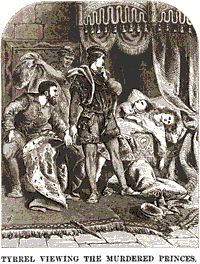
Sir James Tyrell did not enter the chamber where the poor victims were sleeping, but his strong ruffians crept silently in, and oppressing the princes with their great strength and weight, stifled them with the bed-clothes and pillows. When the murders were completed Forrest and Dighton laid out the royal corpses on the bed, and invited sir James Tyrell to view their work. Tyrell ordered them to thrust them down the hole in the leads, which they did, and threw heavy stones upon them. Edward IV had lately strengthened that part of the Tower, little thinking the use to be made of it, as a poet born in his time makes him say—
Jacquetta of Luxemburg, the fair young widow of the old warlike Duke of Bedford, took for her second spouse his favourite knight, the brave and handsome Sir Richard Woodville, when she came to England in 1435 to claim her dower. The time of the birth of her eldest child Elizabeth, the issue of marriage kept secret for fear of parliament, probably occurred in 1436. The matter burst out with great scandal the year after. Sir Richard was arrested and imprisoned in 1437; but as the king's mother had married in lower degree to Owen Tudor, the young king was glad to pardon the second lady in his realm, as an excuse for showing mercy to his dying queen-mother. Jacquetta's knight was therefore pardoned and sent home. They settled very happily at Grafton Castle, where they became the parents of a large family of handsome sons and beautiful daughters, among whom Elizabeth was fairest of the fair.
The Duchess of Bedford kept the rank of the King's aunt. His royal mother had died miserably in 1437, as shown in her life. Duchess Jacquetta, on occasions of ceremony, was the first lady in the land until the marriage of the king. Her daughter Elizabeth, took high rank among the maids of honour of Margaret of Anjou, and was the belle of her court, as two letters extant from Richard Duke of York and his friend the Earl of Warwick prove, recommending a Welsh hero, one of their knights-marshal, sir Hugh Johns, as a husband, they dwell on his great love inspired by her beauty and sweet manners; the letters show familiar acquaintance with Elizabeth, but they were of no avail. The court beauty had no fortune but her face, the Welsh champion none but his sword. She made a better match the same year with the heir of lord Ferrers of Groby, John Gray, rich, valiant, and years younger than the rejected Sir Hugh. Lord Ferrers was possessor of the ancient domain of Bradgate, which was afterwards to derive lustre as the birthplace of his descendant, lady Jane Grey. Elizabeth was appointed one of the fourt ladies of the bedchamber to Margaret of Anjou. John Gray held military command in the queen's army. His death left Elizabeth with two infant sons, in 1460.
Rancour so deep pursued the memory of John lord Gray, that his harmless infants, Thomas and Richard, were deprived of their inheritance of Bradgate. Elizabeth herself remained mourning and destitute at Grafton the two first years of Edward IV's reign. Hearing that the young king was hunting in the neighbourhood of her mother's dower castle at Grafton, Elizabeth waited for him beneath a noble tree known in the traditions of Northamptonshire, as "the queen's oak," hold a fatherless boy in either hand; and when Edward, who must have been well acquainted with her previously at the English court, paused to listen to her, she threw herself at his feet, and pleaded for the restoration of her children's lands. Her downcast looks and mournful beauty not only gained her suit, but the heart of the conqueror. He was unwilling to make her his queen, but she left him to settle the question; knowing that he had betrayed others, her affections still clave to the memory of the husband of her youth. Her indifference increased the love of the young king. The struggle ended in his offering her marriage, which took place May 1, 1464. The marriage gave great offence to the mother of Edward IV. This lady, who, before the fall of her husband, Richard duke of York, at Wakefield, had assumed the state of a queen, had to give place to the daughter of a knight. It was on Michaelmas day, 1464, that Edward IV finally declared to Elizabeth to be his wedded wife, at Reading palace.
The queen's eldest daughter, Elizabeth, was born at Westminster palace about five months afterwards. The royal physicians, by means of their foolish studies of astrology, had assured king Edward that his expected child by his queen would prove a prince. The king, who was deep in the same kind of lore, had persuaded himself that his expected infant would wear the crown of England. One of these physicians, Dr. Dominic, obtained leave to station himself in the queen's withdrawing-room, leading to her bed-chamber, in order that he might be the first to carry the tidings of the heir to Edward IV. Hearing the child cry, he called to one of the queen's ladies, asking, "What her grace had?" The ladies were not in the best humour, being unwilling to answer "only a girl." So one of them replied, "Whatsoever the queen's grace hath here within, sure 'tis a fool that standeth there without." Poor Dr. Dominic, being much confounded by this sharp answer, dared not enter the king's presence.
Elizabeth was crowned May 16, 1465, with great solemnity, in Westminster abbey, the young duke of Clarence officiating as high-steward. Elizabeth and Warwick were on friendly terms, as he stood godfather to her eldest daughter. The baptism of this princess for a while conciliated her two grandmothers, Cicely duchess of York, and Jacquetta duchess of Bedford, who were likewise her sponsors. The christening was performend with royal pomp, and the babe received her mother's name of Elizabeth,—a proof that Edward was more inclined to pay a compliment to his wife than to his haughty mother. As prime-minister, relative, and general of Edward IV, the earl of Warwick had, from 1460 to 1465, borne absolute sway in England; yet Edward at that time so far forgot gratitude and propriety as to offer some personal insult to Isabel, his eldest daughter, who had grown up a beauty. Warwick had certainly been in hopes that, as soon as Isabel was old enough, he would have made her his queen, a speculation for ever disappointed by the exaltation of Elizabeth; so he gave his daughter Isabel in marriage to the duke of Clarence, and England was soon after in a state of insurrection. As popular fury was especially directed against the queen's family, the Woodvilles were advised to retire for a time.
The first outbreak of the muttering storm was a rebellion in 1468, in Yorkshire, under a freebooter called Robin of Redesdale, declared by some to have been a noble, outlawed for the cause of the Red rose. The murder of the queen's father and brother followed in 1469. When the king advanced to suppress these outrages, he was seized by Warwick and his brother Montague, and kept at Warwick castle, where an experiment was tried to shake his affection to Elizabeth by the insinuation that her whole indluence over him proceeded from her mother's skill in witchcraft. The Yorkist king escaped speedily to Windsor, and was soon once more in his metropolis, which was perfectly devoted to him, and where, it appears, his queen had remained in security during these alarming events. Again England was his own; for Warwick and Clarence, in alarm at his escape, betook themselves to their fleet, and fled. Then the queen's brother, Anthony Woodville, intercepted and captured the rebel ships, but not that in which Warwick and Clarence, with their families, were embarked, which escaped with difficulty to the coast of France. The queen was placed by the king in safety in the Tower, before he marched to give battle to the insurgents. She was the mother of three girls but had not borne heirs-male to the house of York. Edward IV narrowly escaped being once more thrown into the power of Warwick, who had returned to England; but being warned by his faithful sergeant of minstrels. Alexander Carlile, he fled half-dressed from his revolting troops in the dead of night, and embarked at Lynn with a few faithful friends. Elizabeth was thus left alone, with her mother, to bide the storm. She was resident at the Tower, where her party still held Henry VI prisoner. While danger was yet at a distance, the queen's resolutions were remarkably valiant; yet the very day that Warwick and Clarence entered London, she betook herself to her barge, and fled up the Thames to Westminster,—not to her own palace, but to a strong, gloomy building called the Sanctuary, which occupied a space at the end of St. Margaret's churchyard. Here she registered herself, her mother, her three little daughters,—Elizabeth, Mary, and Cicely, with the faithful lady Scrope, her attendant, as sanctuary-women; and in this dismal place, November 1, 1470, the long-hoped-for heir of York was born. The queen was most destitute; but Thomas Milling, abbot of Westminster, sent various conveniences from the abbey close by. Mother Cobb, resident in the Sanctuary, charitably assisted the distressed queen, and acted as nurse to the little prince. Nor did Elizabeth, in this fearful crisis, want friends; for master Serigo, her physician, attended herself and her son; while a faithful butcher, John Gould, prevented the whole Sanctuary party from being starved into surrender. The little prince was baptized, soon after his birth, in the abbey, with no more ceremony than if he had been a poor man's son.
Early in March the queen was cheered by the news that her husband had landed, and soon after, that his brother Clarence had forsaken Warwick. The metropolis opened its gates to Edward IV, who hurried to the Sanctuary to embrace his wife and new-born son. The very morning of this joyful meeting, Elizabeth, accompanied by her royal lord, left Westminster palace, but soon after retired to the Tower of London, while her husband gained the battles ofBarnet and Tewkesbury. The news of his success had scarcely reached her, before the Tower was threatened with storm by Falconbridge; but her valiant brother, Anthony Woodville being there, she, relying on his aid, stood the danger this time without running away.
After Edward IV had crushed rebellion by almost exterminating his opponents, he turned his attention to rewarding the friends to whom he owed his restoration, and bestowed princely gratuities on those humble friends who had aided "his Elizabeth," as he calls her, in that fearful crisis.
When Edward IV fled in the preceding year from England, he landed with a few friends at Sluys, the most distressed company of creatures ever seen; for he pawned his military cloak, lined with marten fur, to pay the master of his ship, and was put on shore in his waistcoat. The lord of Grauthuse received, fed, and clothed him, lending him besides money and ships, without which he would never have been restored to his country and queen. Edward invited his benefactor to England. Lord Hastings received him, and led him to the far side of the quadrangle of Windsor castle, to three chambers. These apartments were very richly hung with cloth of gold arras; and when Grauthuse had spoken with the king in the royal suite, he presented him to the queen's grace, they then ordered the lord chamberlain Hastings to conduct him to his chamber, where supper was ready for him. After refreshment, the king had him brought immediately to the queen's own withdrawing-room, where she and her ladies were playing with little balls like marbles, and some of her ladies were playing with ninepins. Also king Edward danced with Elizabeth, his eldest daughter. In the morning the king came into the quadrant, the prince also, borne by his chamberlain, called master Vaughan, bade the lord Grauthuse welcome. The innocent little prince, afterwards the unfortunate Edward V, was then only eighteen months old. Then the queen ordered a grand banquet in her own apartments, at which her mother, her eldest daughter, the duchess of Exeter, the king, and the lord of Grauthuse all sat with her at one table.
Elizabeth, in January, 1477, presided over the espousals of her second son, Richard duke of York, with Anne Mowbray, the infant heiress of the duchy of Norfolk. St. Stephen's chapel, Westminster, where the ceremony was performed, was splendidly hung with arras of gold on this occasion. The queen led the little bridegroom, who was not five, and her brother, Earl Rivers, led the baby bride, scarcely three years old. They afterwards all partook of a rich banquet, laid out in the Painted-chamber. Soon after this infant marriage, all England was startled by the strange circumstances attending the death of the duke of Clarence. The queen had been cruelly injured by Clarence. Her father and her brother had been put to death in his name; her brother Anthony, the pride of English chivalry, had narrowly escaped a similar fate: moreover, her mother had been accused of sorcery by his party. She did not soothe her husband's mind when Clarence gave him provocation. In fact, on the first quarrel, his arrest, arraignment, and sentence followed. He was condemned to death, and sent to the Tower. In his dismal prison a butt of malmsey was introduced one night, where he could have access to it. The duke was found dead, with his head hanging over the butt. Gloucester was certainly absent from the scene of action, residing in the north. On St. George's day succeeding this grotesque but horrible tragedy, the festival of the Garter was celebrated with more than usual pomp; the queen took a decided part in it, and wore the robes as chief lady of the order. Her vanity was inflated excessively by the engagement which the king of France had made for his son with her eldest daughter.
In the last years of king Edward's life he gave the queen's place in his affections to the beautiful Jane Shore, a goldsmith's wife in the city, whom he had seduced from her duty. His death was hastened by the pain of mind he felt at the conduct of Louis XI, who broke the engagement he had made to marry the dauphin to the princess Elizabeth of York, but an intermittent fever was the cause. When expiring, he made his favourites, lords Stanley and Hastings, vow reconciliation with the queen and her family. He died with great professions of penitence, at the early age of forty-two, April 9, 1483. Excepting the control of the marriages of his daughters, his will gave no authority to the queen. She was left, in reality, more unprotected in her second than in her first widowhood.
The Duke of Gloucester had been very little at court since the restoration. He was now absent in the north, and caused Edward V to be proclaimed at York, writing letters of condolence so full of kindness and submission, that Elizabeth thought she should have a most complying friend in him. Astounding tidings were brought to the queen at midnight, May 3, that the duke of Gloucester had intercepted the young king with an armed force on his progress to London, had seized his person, and arrested her brother, Earl Rivers, and her son, lord Richard Gray. In that moment of agony she, however, remembered, that while she could keep her second son in safety the life of the young king was secure. With the duke of York and her daughters she left Westminster palace for the Sanctuary; and she, and all her children and company, were registered as Sanctuary persons. Dorset, the queen's eldest son, directly he heard of the arrest of his brother, weakly forsook his trust as constable of the Tower, and came into sanctuary to his mother. The archbishop of York brought her a cheering message, sent him by lord Hastings in the night. "Ah!" replied Elizabeth, "it is he that goeth about to destroy us." — "Madam," said the archbishop, "be of good comfort; if they crown any other king than your eldest son, whom they have with them, we will on the morrow crown his brother, whom you have with you here. And here is the great seal, which in like wise as your noble husband gave it to me, so I deliver it to you for the use of your son." And therewith he handed to the queen the great seal, and departed from her in the dawning of the day.With the exception of the two beautiful and womanly maidens, Elizabeth and Cicely, the royal family were young children. The queen took with her into sanctuary Elizabeth, seventeen years old at this time, afterwards married to Henry VII. Cicely was in her fifteenth year. These princesses had been the companions of their mother in 1470, when she had formerly sought sanctuary. Richard duke of York, born at Shrewsbury in 1472, was at this time eleven years old. Katherine, born at Eltham about August 1479, then between three and four years old. Bridget, born at Eltham 1480, Nov. 20th, then only in her third year; she was afterwards professed a nun at Dartford.
Gloucester's chief object was to get possession of the duke of York, then safe with the queen. As the archbishop of Canterbury was fearful lest force should be used, he went, with a deputation of temporal peers, to persuade Elizabeth to surrender her son, urging "that the young king required the company of his brother, being melancholy without a playfellow." To this Elizabeth replied, "Troweth the protector—ah! pray God he may prove a protector!—that the king doth lack a playfellow? Can none be found to play with the king but only his brother, which hath no wish to play because of sickness? as though princes, so young as they be, could not play without their peers—or children could not play without their kindred, with whom (for the most part) they agree worse than with strangers!" According to the natural weakness of her character, she nevertheless yielded to importunity, and taking young Richard by the hand, said, "I here deliver him, and his brother's life with him, and of you I shall require them before God and man. Farewell! mine own sweet son. God send you good keeping! God knoweth when we shall kiss together again!" And therewith she kissed and blessed him, then turned her back and went, leaving the poor innocent child weeping as fast as herself. When the archbishop and the lords had received the young duke, they led him to his uncle, who received him in his arms with these words: "Now welcome, my lord, with all my very heart!" He then took him honourably through the city to the young king, then at Ely house, and the same evening to the Tower out of which they were never seen alive, though preparations went on night and day in the abbey for the coronation of Edward V.
It is possible that Hasting's death had some influence in the imprudent surrender of young York. If Elizabeth had any secret joy in the illegal execution of her brother's rival and enemy, very soon she had to lament a similar fate for that dear brother, and for her son, lord Richard Gray, who were beheaded by sir Richard Radcliffe, June 24th, when the northern army, commanded by that general, commenced its march to London.
When the massacre of every friend to the rights of his brother's children was completed, and the approach of 9000 dreaded northern borderers intimidated the Londoners, the false protector entirely took off the mask. Buckingham induced Edward IV's confessor, Dr. Shaw, who was brother to Gloucester's partizan, the lord mayor, to preach a sermon against Edward V's title, on pretence that Edward IV's betrothment with lady Eleanor Butler had never been dissolved by the church. Shaw likewise urged the immediate recognition of the duke of Gloucester as sovereign, putting aside the children of Clarence on pretence of his attainder by parliament. Faint acclamations of "Long life Richard III" were raised by hired partizans, but the London citizens angrily and sullenly dispersed. Ratcliffe's forces approached Bishopsgate on the 26th, and Richard III was proclaimed king. The unhappy queen Elizabeth Woodville and her daughters witnessed the proclamation of the usurper from the abbot's house in the abbey. Richard then made his state visit to the Tower and city. Elizabeth and her daughters must perforce have been witnesses of his coronation, July 6, 1483.
Soon after, the usurper, his wife, and son, now called Edward prince of Wales, made a grand progress to Warwick castle. The unfortunate sons of Elizabeth meantime were closely imprisoned under the care of sir Robert Brakenbury, one of Richard III's northern commanders, who had been given the lieutenancy, under the notion that he would obey implicitly the usurper's orders. Accordingly, Richard sent one of this gentlemen of the bedchamber, John Greene, ordering him to kill Edward IV's sons forthwith. Brakenbury returned for answer "he would die first." A midnight consultation took place between Richard III and his master of the horse, Sir James Tyrell, who left Warwick castle August 2, with commands to Brakenbury from king Richard that he was to surrender the keys of the Tower to sir James Tyrell for one night. On his ride from Warwickshire the master of the horse was attended by two retainers, one his squire, Miles Forrest, a northern champion of immense strength, the other his horsebreaker, John Dighton, a big, broad, square knave. Sir James had requested his own brother, Tom Tyrell, a brave gentleman, to aid him, but met with positive refusal, by which, if he lost the usurper's favour, he gained from his country the appellation of "honest Tom Tyrell."
The three murderers reached the Tower of London after dark, August 3. Sir James Tyrell demanded the Tower keys; and in the very dead of the night when sleep weighs heaviest on young eyelids, one of the Tower wardens who waited on the hapless princes, Will Slaughter by name, guided the assassins through the secret passages, which still may be traced, from the lieutenant's house to the portcullis gateway. There is a little dismal bedchamber hidden in the space between that tower and the Wakefield tower, approached with winding stone stairs, and which has leads on the top and an ugly recess in the walls, reaching to the ground and even beneath it. The leads communicated by a door to the Wakefield tower leaded roof, and thence to the water-stairs by a bricked-up doorway, still plainly to be seen. No spot could be more convenient for secret murder. Tradition has pertinaciously clung to it and called this fatal prison lodging the Bloody tower.
Sir James Tyrell did not enter the chamber where the poor victims were sleeping, but his strong ruffians crept silently in, and oppressing the princes with their great strength and weight, stifled them with the bed-clothes and pillows. When the murders were completed Forrest and Dighton laid out the royal corpses on the bed, and invited sir James Tyrell to view their work. Tyrell ordered them to thrust them down the hole in the leads, which they did, and threw heavy stones upon them. Edward IV had lately strengthened that part of the Tower, little thinking the use to be made of it, as a poet born in his time makes him say—| "I made the Tower strong; I wist not why— Knew not for whom." |
When Tyrell returned the keys to the lieutenant Brakenbury, the latter found his young prisoners had vanished. The murderous trio rode back to Warwick castle to report their doings to the head assassing. Richard III approved of everything his unscrupulous favorite and master of horse had done, excepting the disposal of his nephews' corpses. He insisted that they should be raised from that niche and buried in consecrated ground with burial service. The averseness of sir Robert Brakenbury to have aught to do with the murders, threw great difficulty in the way of the usurper's commands, prompted by the first twinge of conscience. It is from the confession of sir James Tyrell, put to death twenty years after for conspiring with the de la Poles, that these particulars are gathered, but he could not say where the poor children were ultimately buried: all he heard was that Richard III's orders had been issued to the priest of the Tower, who had in the dead of night taken the bodies whither no one knew, as the old man died two or three days after.
The secret was not guessed for two centuries; but when in 1674 King Charles II altered the White tower into a record office, under the flight of stairs leading up to the beautiful Norman chapel, was discovered a chest containing the bones of two children of the age of the murdered heirs of York. The orders of the usurper being fulfilled to the letter, the ground was consecrated as pertaining to the sacred place above; and deeply secret the interment was. Charles II had the poor remains of the heirs of York buried among their ancestors in Westminster abbey, where our young readers may remark the monument and inscription near Henry VII's chapel.
We must now return to the life of their unfortunate mother, Elizabeth Woodville, who being in sanctuary, early heard when and where her sons were murdered, which, says sir Thomas More, struck to her heart like the sharp dart of death: she swooned, and fell to the ground, where she lay long insensible. After she was revived and came to her memory again, with pitiful cries she filled the whole mansion. Her breast she beat, her fair hair she tore, and calling by name her sweet babes, accounted herself mad when she delivered her younger son out of sanctuary, for his uncle to put him to death. She kneeled down and cried to God to take vengeance; and when Richard unexpectedly lost his only son, for whose advancement he had steeped his soul in crime, Englishmen declared that the agonized mother's prayer had been heard. The wretched queen's health sank under the anguish inflicted by these murders, which had been preceded by the illegal execution of her son, lord Richard Gray, and of her brother, at Pontefract. She was visited in sanctuary by a priest-physician, Dr. Lewis, who likewise attended Margaret Beaufort, mother to Henry Tudor, Earl of Richmond, then an exile in Bretagne. The plan of uniting the princess Elizabeth with this last scion of the house of Lancaster, was first suggested to the desolate queen by Dr. Lewis. She eagerly embraced the proposition. The duke of Buckingham, having been disgusted by Richard, his partner in crime, rose in arms; but after the utter failure of his insurrection, Elizabeth was reduced to despair, and finally was forced to leave sanctuary, and surrender herself and daughters into the hands of the usurper, in March. She was then closely confined, with her daughters, in obscure apartments in the palace of Westminster. From thence she wrote to her son Dorset at Paris to put an end immediately to the treaty of marriage between Richmond and the princess Elizabeth. The friends who had projected the marriage were greatly incensed; but these steps were the evident result of the personal restraing the queen was then enduring.
The successful termination of the expedition undertaken by the earl of Richmond, to obtain his promised bride and the crown of England, at once avenged the widowed queen and her family on the usurper, and restored her to liberty after the battle of Bosworth. Instead of the despotic control of Richard III's swuire Nesfield, the queen, restored to royal rank, joyfully welcomed her eldest daughter, who was brought to her at Westminster from Sheriff-Hutton, remaining with her till the January following the battle of Bosworth, when she saw her united in marriage to Henry of Richmond, the acknowledged king of England.
One of Henry VII's first acts was to invest the mother of his queen with the privileges befitting the widow of an English sovereign. Unfortunately Elizabeth had not been dowered on the lands anciently appropriated to the queens of England, but on those of the duchy of Lancaster. However, a month after the marriage of her daughter to Henry VII she received possession of some of the dower-palaces, among which Farnham, of 102l. per annum, was by her son-in-law added to help her income. The Parliamentary Act, whereby she was deprived of her dower in the preceding reign, was ordered by the judges to be burnt. Much is said of her ill-treatment by Henry VII. However, at the very time she is declared to be in disgrace for patronizing the impostor who personated the young earl of Warwick, she was chosen by the king, in preference to his own beloved mother, as sponsor to his dearly-prized heir, prince Arthur. The last time the queen-dowager appeared in public was in a situation of the highest dignity. At the close of the year 1489 she received the French ambassador in great state; the next year Henry VII presented her with an annuity of 400l. Soon after she retired to the royal apartments at Bermondsey abbey.
Elizabeth Woodville expired the Friday before Whitsuntide, 1492. Her will shows that she died destitute of personal property; but no wonder, for the great possessions of the house of York were chiefly in the grasp of the old avaricious duchess Cicely of York, who survived her hated daughter-in-law several years. Edward IV had endowed his proud mother as if she were a queen-dowager; while his wife was dowered on property to which he possessed no real title. On Whit Sunday the queen dowager's corpse was conveyed by water to Windsor, and thence privately, as she requested, through the little part, conducted unto the castle. Her three daughters, the lady Anne, the lady Katharine, and the lady Bridget [the nun-princess] from Dartford, came by way of the Thames, with many ladies. And her son lord Dorset, who kneeled at the head of the hearse, paid the cost of the funeral.
In St. George's chapel, north aisle, is the tomb of Edward IV. On a flat stone at the foot of this monument are engraven, in old English characters, the words—
The secret was not guessed for two centuries; but when in 1674 King Charles II altered the White tower into a record office, under the flight of stairs leading up to the beautiful Norman chapel, was discovered a chest containing the bones of two children of the age of the murdered heirs of York. The orders of the usurper being fulfilled to the letter, the ground was consecrated as pertaining to the sacred place above; and deeply secret the interment was. Charles II had the poor remains of the heirs of York buried among their ancestors in Westminster abbey, where our young readers may remark the monument and inscription near Henry VII's chapel.
We must now return to the life of their unfortunate mother, Elizabeth Woodville, who being in sanctuary, early heard when and where her sons were murdered, which, says sir Thomas More, struck to her heart like the sharp dart of death: she swooned, and fell to the ground, where she lay long insensible. After she was revived and came to her memory again, with pitiful cries she filled the whole mansion. Her breast she beat, her fair hair she tore, and calling by name her sweet babes, accounted herself mad when she delivered her younger son out of sanctuary, for his uncle to put him to death. She kneeled down and cried to God to take vengeance; and when Richard unexpectedly lost his only son, for whose advancement he had steeped his soul in crime, Englishmen declared that the agonized mother's prayer had been heard. The wretched queen's health sank under the anguish inflicted by these murders, which had been preceded by the illegal execution of her son, lord Richard Gray, and of her brother, at Pontefract. She was visited in sanctuary by a priest-physician, Dr. Lewis, who likewise attended Margaret Beaufort, mother to Henry Tudor, Earl of Richmond, then an exile in Bretagne. The plan of uniting the princess Elizabeth with this last scion of the house of Lancaster, was first suggested to the desolate queen by Dr. Lewis. She eagerly embraced the proposition. The duke of Buckingham, having been disgusted by Richard, his partner in crime, rose in arms; but after the utter failure of his insurrection, Elizabeth was reduced to despair, and finally was forced to leave sanctuary, and surrender herself and daughters into the hands of the usurper, in March. She was then closely confined, with her daughters, in obscure apartments in the palace of Westminster. From thence she wrote to her son Dorset at Paris to put an end immediately to the treaty of marriage between Richmond and the princess Elizabeth. The friends who had projected the marriage were greatly incensed; but these steps were the evident result of the personal restraing the queen was then enduring.
The successful termination of the expedition undertaken by the earl of Richmond, to obtain his promised bride and the crown of England, at once avenged the widowed queen and her family on the usurper, and restored her to liberty after the battle of Bosworth. Instead of the despotic control of Richard III's swuire Nesfield, the queen, restored to royal rank, joyfully welcomed her eldest daughter, who was brought to her at Westminster from Sheriff-Hutton, remaining with her till the January following the battle of Bosworth, when she saw her united in marriage to Henry of Richmond, the acknowledged king of England.
One of Henry VII's first acts was to invest the mother of his queen with the privileges befitting the widow of an English sovereign. Unfortunately Elizabeth had not been dowered on the lands anciently appropriated to the queens of England, but on those of the duchy of Lancaster. However, a month after the marriage of her daughter to Henry VII she received possession of some of the dower-palaces, among which Farnham, of 102l. per annum, was by her son-in-law added to help her income. The Parliamentary Act, whereby she was deprived of her dower in the preceding reign, was ordered by the judges to be burnt. Much is said of her ill-treatment by Henry VII. However, at the very time she is declared to be in disgrace for patronizing the impostor who personated the young earl of Warwick, she was chosen by the king, in preference to his own beloved mother, as sponsor to his dearly-prized heir, prince Arthur. The last time the queen-dowager appeared in public was in a situation of the highest dignity. At the close of the year 1489 she received the French ambassador in great state; the next year Henry VII presented her with an annuity of 400l. Soon after she retired to the royal apartments at Bermondsey abbey.
Elizabeth Woodville expired the Friday before Whitsuntide, 1492. Her will shows that she died destitute of personal property; but no wonder, for the great possessions of the house of York were chiefly in the grasp of the old avaricious duchess Cicely of York, who survived her hated daughter-in-law several years. Edward IV had endowed his proud mother as if she were a queen-dowager; while his wife was dowered on property to which he possessed no real title. On Whit Sunday the queen dowager's corpse was conveyed by water to Windsor, and thence privately, as she requested, through the little part, conducted unto the castle. Her three daughters, the lady Anne, the lady Katharine, and the lady Bridget [the nun-princess] from Dartford, came by way of the Thames, with many ladies. And her son lord Dorset, who kneeled at the head of the hearse, paid the cost of the funeral.
In St. George's chapel, north aisle, is the tomb of Edward IV. On a flat stone at the foot of this monument are engraven, in old English characters, the words—
King Edward and his Queen, Elizabeth Widville.
Sunday, December 16, 2012
A brief history of Midwifery

Portrait of Mme Annabel Tatsu.
(Paris, 1775 - 1821, Paris)(Paris, 1775 - 1821, Paris)
Read more: A brief history of Midwifery http://www.studentmidwife.net/fob/a-brief-history-of-midwifery.662/#ixzz263y9IJy9
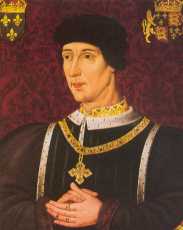
Portraits of Henry VI
Henry VI, oil painting by an unknown artist; in the National Portrait Gallery, London


Thursday, December 13, 2012
Westminster Abbey
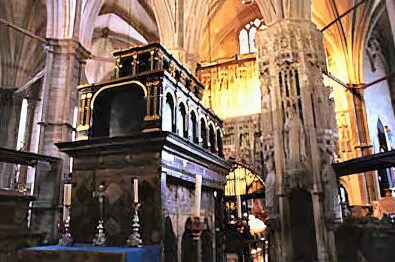
One of England's finest Gothic buildings and the country's national shrine, Westminster Abbey was founded by the Saxon king, Edward the Confessor (1042-65) and consecrated on 28th December, 1065, a few days before his death. Known as the Abbey of St. Peter on Thorney Island, named due to the brambles that then covered the area, it was built on the misty low lying marshes which then edged the River Thames. Several churches, dedicated to St. Peter had previously occupied the spot. Tradition states that a shrine was first established at the site in in 616 following reports from a fisherman on the Thames, who claimed to have seen a vision of Saint Peter. The pious King Edward was buried at the newly completed abbey and his posthumous reputation came to be revered.
Edward's succesor, the Saxon King Harold II became the first King of England to be crowned at the abbey in January, 1066. Following his victory over the Harold at the Battle of Hastings in 1066, the NormanWilliam the Conqueror was also crowned at the abbey on Christmas Day, 1066. Every subsequent English monarch, with the exception of Edward V, Edward VIII and Lady Jane Grey have since been crowned there.
The Plantagenet King Henry III (1216-72) revered and venerated St. Edward the Confessor, who had been canonised in 1161, even having a mural painted of him in his bedchamber. He possessed a mania for building and his life's work was the rebuilding of the abbey in the Anglo-French Gothic style. The three master masons supervising the work were Henry of Reyns, John of Gloucester and Robert of Beverley. Building work continued after the death of Henry III, being finally completed by the architect Henry Yevele in the reign of Richard II.
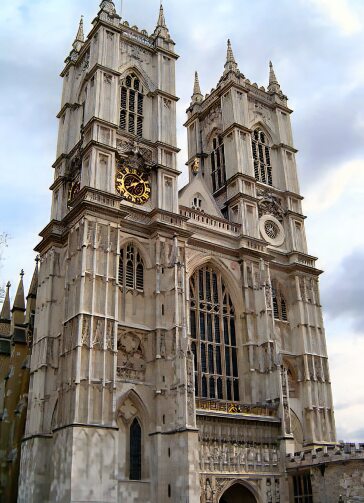
Westminster Abbey, the West Front

The magnificent shrine of St. Edward the Confessor at the heart of the abbey, was constructed by Henry III in 1241. The Confessor's body was carried in stately procession to its new resting place by Henry III himself, along with his younger brother, Richard, Earl of Cornwall. The chest which housed the relics of the saint was composed of precious metal, with a gabled roof. The shrine was to become a popular place of pilgrimage throughout the Middle Ages. Subsequent monarchs made costly offerings at the shrine. Edward I donated the crown of the Welsh prince, Llywelyn along with the rich spoils of his Scottish wars. Richard II made a gift of a silver table enamelled with impressions of the Confessor and the pilgrim. The ionoclasm of the Reformation saw the shrine stripped of its costly offerings by Henry VIII and the Confessor's body was reinterred beneath the stone base. The shrine was later restored by Henry's devout Catholic daughter, Mary I. The abbey was eventually commissioned as a "Royal Peculiar" by Queen Elizabeth I.
The shrine of St. Edward the Confessor

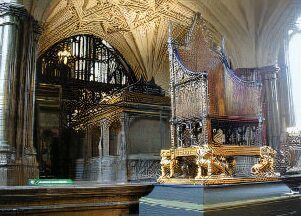
Henry III was buried in the Confessor's Chapel at the abbey in 1272, a magnificent bronze effigy of the king, by William Torel, adorns his tomb, previously his predecessors had been buried at the Abbey of Fontevrault in the Plantagenet lands in France but Westminster Abbey was later to become the mausoleum of English Kings. Henry's son Edward I and daughter-in-law, Eleanor of Castille, lie nearby, the place where Edward I lies is marked by a simple stone slab which bears the epitaph 'Here lies Edward, the Hammer of the Scots', while Eleanor's tomb is adorned by a beautiful bronze effigy of the queen by William Torel. Edward I captured the Stone of Scone in 1296, a venerated relic, which Scottish Kings had been crowned on since the Dark Ages, and removed it to Westminster. It was incorporated in a coronation chair specially built for this purpose at the abbey and has only recently been returned to Scotland.
During the reign of Edward I, many of the Crown Jewels were stored at Westminster Abbey. However, following a daring and successful robbery at the Abbey, when thieves escaped with much of the crown's treasure, a decision was reached that the Royal Treasury should be transferred to the greater security of the Tower of London. It has remained there ever since.
Also within Edward the Confessor's Chapel are the tombs of Edward I's grandson, Edward III and that of his queen, Phillipa of Hainault, Richard II and his first wife, Anne of Bohemia, as well as Margaret of York, the daughter of Edward IV. The abbey also contains the magnificent tomb of Henry V, conqueror of France, in accordance with the terms of his will a lavishly sculptured chantry chapel, designed by John Thirske, was built over the tomb.

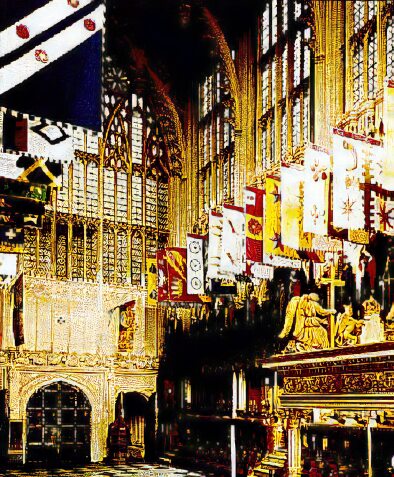
Henry VII, the first Tudor monarch, added a Perpendicular style chapel with a beautiful fan vaulted ceiling, which was dedicated to the Blessed Virgin Mary, in 1503, which became known as the Henry VII Chapel. In the chapel lie the tombs of Henry VII, Elizabeth of York, and his mother, Margaret Beaufort, their magnificent effigies were made by the Rennaissance sculptor, Pietro Torrigiano. Their grand-daughter, Elizabeth I was buried in the chapel along with her half-sister, Mary I, deeply antagonistic to each other in life they were to lie together eternally in death. Elizabeth's succesor, James I erected a fine effigy over Elizabeth's tomb, the Latin inscription at its base translates 'Partners both in throne and grave, here rest we two sisters, Mary and Elizabeth, in the hope of one resurrection.'
Also in the Henry VII Chapel stands a white marble container, which contains the reputed remains of the so called Princes in the Tower, Edward V and his brother Richard, Duke of York, who disappeared in 1483, amidst rumours that they had met their deaths in the Tower of London. Nearly two centuries later, in 1674, workmen employed in demolishing a staircase within the Tower , leading to the chapel of the White Tower, made the discovery of the bones of two children in an elm chest, at around a depth of ten feet. Charles II, then the reigning monarch, asked the architect Sir Christopher Wren to design a white marble container and they were reverently placed in the Abbey, close to the tomb of their sister, Elizabeth of York.
The Henry VII Chapel

By way of reparation for his earlier neglect of her, James I had the body of his mother, Mary Queen of Scots, executed on the orders of her cousin Elizabeth, translated to the Henry VII Chapel at Westminster Abbey, from Peterborough Cathedal, where it was reinterred close to the tomb of his paternal grandmother, Margaret Countess of Lennox, he provided a costly and majestic white marble monument to the memory of his mother. In 1867 a search was made by Dean Stanley within the royal tombs for the final resting place of James I, which had gone unrecorded, the first Stuart King was found to share the tomb of the first Tudor King, Henry VII and his consort, Elizabeth of York. The abbey is the final resting place of seventeen of England's monarchs in total.
The abbey suffered damage when it was attacked by Puritan iconoclasts in the 1640s. The Lord Protector, Oliver Cromwell (1599 - 1658) was buried in the abbey in 1658 but on 30th January, 1661, the twelfth anniversary of the execution of Charles I, the body of Oliver Cromwell was exhumed from Westminster and posthumously executed. His corpse was hanged in chains at Tyburn. The body was eventually thrown into a pit, while Cromwell's severed head was exhibited on a pole outside Westminster Abbey until 1685.
No major building has occured at the abbey since 1734, which saw the completion of the west front towers under the direction of Nicholas Hawksmoor, who used a design by Sir Christopher Wren, previously the towers were lower.
At Poet's Corner, in the abbey's South Transept a number of the nation's great poets, playwrights and writers are commemorated. Geoffrey Chaucer was the first to be buried there on 24th December, 1399, and was followed by a long list of others including Alfred Lord Tennyson, Robert Browning, Thomas Hardy, Charles Dickens and the actor Laurence Olivier. William Shakespeare, although buried at Stratford upon Avon, was honoured with a monument in Poet's Corner in 1740.
The abbey also serves as the burial ground for numerous politicians, scientists and artists, including Benjamin Disraeli, Charles Darwin and Sir Isaac Newton. The windows in the nave are dedicated to famous Britons including the engineers Isambard Kingdom Brunel and Robert Stevenson.
Those who died in the First World War are commemorated by a black slab, the Tomb of the Unknown Warrior, which is set into the pavement near the west door. Nearby stands a monument to Sir Winston Churchill, which was unveiled by the Queen in 1965.
Opening times
The Abbey is open to visitors from Monday to Saturday all year. On Sundays and religious holidays such as Easter and Christmas, it is open only for worship.
GUNS

Leonard da Vinci´s organ gun
Konrad Kyeser, Bellifortis, Clm 30150, Tafel 13, Blatt 74v
http://en.wikipedia.org/wiki/Organ_gun
A Ribauldequin, also known as a rabauld, ribault, ribaudkin, infernal machine or organ gun, was a late medieval volley gun with many small-caliber iron barrels set up parallel on a platform, in use during the 14th and 15th centuries. When the gun was fired in a volley, it created a shower of iron shot. They were employed, specifically, during the early fifteenth century, and continued serving, mostly, as an anti-personnel gun. The name organ gun comes from the multiple barrels with the likeness of pipe organ.
As an early type of multiple barrel firearm, the ribauldequin is sometimes considered the predecessor of the 19th century mitrailleuse.[1]
The first known ribauldequin was used by the army of Edward III of England in 1339 in France during theHundred Years' War.[citation needed] Edward's ribauldequins had twelve barrels which fired salvoes of twelve balls. Nine-barreled ribaults were used by Milan and other participants in the Italian Wars.[citation needed] Ribauldequins were also used in the Wars of the Roses. During the Second Battle of St Albans, Burgundian soldiers underYorkist control utilized the weapon against the Lancastrian Army led by Queen Margaret of Anjou.[2] In Eastern Europe, a heavier version of the organ gun was used by Stephen the Great of Moldavia as late as 1475, as attested to by Polish chronicler Bieski.[citation nee
Subscribe to:
Posts (Atom)