Translate

Showing posts with label art. Show all posts

Friday, December 7, 2012

Saturday, November 3, 2012

Laws forbidding women to fight:


These provide evidence that women were definitely fighting immediately before each law was passed, and probably in reasonably large numbers, otherwise there'd be no need for the law. Also, the fact that a law exists doesn't mean that it is universally obeyed, or that those disobeying it would be social outcasts. (consider: traffic laws such as speed limits and parking restrictions, dog licencing in the UK, pirate videos and computer software, and so on)

Emperor Alexander Severus issued an edict prohibiting women combatants in the arena in 200 AD
Women were barred from military participation in a law passed at the synod of Druim Ceat in 590 A.D. The law proved to be unenforceable when the women warriors refused to lay down their arms.
Papal Bull of 1189 prohibited women from joining the Third Crusade
In 1644 King Charles issued a proclamation banning women who were with the armies during the English Civil War from wearing men's clothing.

In 1795 the French revolutionary government ordered Frenchwomen to return to their homes and prohibited them from attending political meetings, or gathering in groups of more than five.
Women were ordered out of the front lines of the Israeli Army by David Ben Gurion in 1950 (the last one left in the mid 1960s)

Napoleon Bonaparte Writings


(1796-1817)The excerpts below come from a compilation of Napoleon Bonaparte's writings compiled by R.M. Johnston (in The Corsican: A Diary of Napoleon's Life in His Own Words, 1910).

April 22, 1796 (to the army.)
Soldiers! In fifteen days you have won six victories, captured twenty-one flags, fifty-five guns, several fortresses, conquered the richest part of Piedmont; you have made 15,000 prisoners; you have killed or wounded nearly 10,000 men.
Until now you have fought for barren rocks. Lacking everything, you have accomplished everything. You have won battles without cannon, crossed rivers without bridges, made forced marches without boots, bivouacked without brandy, and often without bread. Only the phalanx of the Republic, only the soldiers of Liberty, could endure the things that you have suffered.
But, soldiers, you have really done nothing, if there still lies a task before you. As yet, neither Milan nor Turin is yours. Our country has the right to expect great things of you; will you be worthy of that trust? There are more battles before you, more cities to capture, more rivers to cross. You all burn to carry forward the glory of the French people; to dictate a glorious peace; and to be able, when you return to your villages, to exclaim with pride: "I belonged to the conquering army of Italy!"
Friends, that conquest, I promise, shall be yours; but there is a condition you must swear to observe: to respect the people you are liberating; to repress horrible pillage. All plunderers will be shot without mercy.
People of Italy, the French army is here to break your chains; you may greet it with confidence.


June 17, 1800 (on observing prisoners of war who recognized him)
Many began to shout, with apparent enthusiasm: "Vive Bonaparte!"
What a thing is imagination! Here are men who don't know me, who have never seen me, but who only knew of me, and they are moved by my presence, they would do anything for me! And this same incident arises in all centuries and in all countries! Such is fanaticism! Yes, imagination rules the world. The defect of our modern institutions is that they do not speak to the imagination. By that alone can man be governed; without it he is but a brute.


July 4, 1800
I! a royal maggot! I am a soldier, I come from the people, I have made myself! Am I to be compared with Louis XVI? I listen to everybody, but my own mind is my only counsellor. There are some men who have done France more harm than the wildest revolutionaries, - - the talkers, and the rationalists. Vague and false thinkers, a few lessons of geometry would do them good!
My policy is to govern men as the great number wish to be governed. That, I think, is the way to recognise the sovereignty of the people.


March 21, 1804 (on the execution of the Duke d'Enghien for treason)
I will respect the judgment of public opinion when it is well founded; but when capricious it must be met with contempt. I have behind me the will of the nation and an army of 500,000 men. With that I can command respect for the Republic. I could have had the Duke d'Enghien shot publicly; and if I have not done so, I held back not from fear, but to prevent the secret adherents of his House from breaking out and ruining themselves. They have kept quiet; it is all I ask of them.


March 22, 1804
These people wanted an upheaval in France, and by killing me to kill the Revolution; it has been for me to defend and to avenge it. I have shown what it can do. The Duke d'Enghien was a conspirator just like any other, and it was necessary to treat him as any other might be treated.


May 14, 1804 (a month before he made himself Emperor)
The General Councils of Departments, the Electoral Colleges, and all the great Bodies of the State, demand that an end should be made of the hopes of the Bourbons by securing the Republic from the upheavals of elections and the uncertainty attending the life of an individual.


May 15, 1804
It is not as a general that I rule, but because the nation believes I have the civilian qualifications for governing. My system is quite simple. It has seemed to me that under the circumstances the thing to do was to centralize power and increase the authority of the Government, so as to constitute the Nation. I am the constituent power.
I can best compare a constitution to a ship; if you allow the wind to fill your sails, you go you know not whither, according to the wind that drives you; but if you make use of the rudder, you can go to Martinique with a wind that is driving you to San Domingo. No constitution has remained fixed. Change is governed by men and by circumstances. If an overstrong government is undesirable, a weak one is much worse.


November 4, 1804
To reign in France, one must be born great, have been seen in childhood in a palace, surrounded with guards, or else be a man capable of raising himself above all others.
My mistress is power; I have done too much to conquer her to let her be snatched away from me. Although it may be said that power came to me of its own accord, yet I know what labour, what sleepless nights, what scheming, it has involved.


December 27, 1804
Deputies of the Departments to the Legislative Body, Tribunes, and Members of the Council of State,
I have come among you to preside over your opening session. I have sought to lend a more imposing dignity to your labours. Prince, magistrates, soldiers, citizens, each in his own sphere, will have but one aim, the interests of the country. If this throne, to which Providence and the will of the people have called me, is precious in my eyes, it is for the sole reason that by it alone can the most precious rights of the French nation be preserved. Without a strong and paternal government, France would have to fear a return of the evils from which she once suffered. Weakness in the executive power is the greatest calamity of nations. As soldier, or First Consul, I had but one purpose; as Emperor, I have none other: the prosperity of France.


May 22, 1805 (to Count Fouché, Minister of Police)
Have some articles written against Princess Dolgorouki, who is spreading scandalous and ridiculous reports in Rome. You probably know that she long lived with an actor, and that the diamonds she displays so ostentatiously were given her by Potemkin and are the price of her dishonour. You can get information about her, and make her a laughingstock. She poses for a clever woman; she is on friendly terms with the Queen of Naples, and, which is equally surprising, with Mme. de Sta�l.


May 30, 1805 (to Count Fouché, Minister of Police)
Have some caricatures made: an Englishman, his purse in his hand, begging the various Powers to accept his money, etc. That is the note to strike. Have printed in Holland that advices from Madeira state that Villeneuve met a convoy of 100 English merchantmen bound for India, and captured it.


June 1, 1805 (to Count Fouché, Minister of Police)
I read in a paper that a tragedy on Henry IV is to be played. The epoch is recent enough to excite political passions. The theatre must dip more into antiquity. Why not commission Raynouard to write a tragedy on the transition from primitive to less primitive man? A tyrant would be followed by the saviour of his country. The oratorio "Saul" is on precisely that text, - - a great man succeeding a degenerate king.


March 3, 1817 (during his final years as an exile on the island of St. Helena)
In spite of all the libels, I have no fear whatever about my fame. Posterity will do me justice. The truth will be known; and the good I have done will be compared with the faults I have committed. I am not uneasy as to the result. Had I succeeded, I would have died with the reputation of the greatest man that ever existed. As it is, although I have failed, I shall be considered as an extraordinary man: my elevation was unparalleled, because unaccompanied by crime. I have fought fifty pitched battles, almost all of which I have won. I have framed and carried into effect a code of laws that will bear my name to the most distant posterity. I raised myself from nothing to be the most powerful monarch in the world. Europe was at my feet. I have always been of opinion that the sovereignty lay in the people. In fact, the imperial government was a kind of republic. Called to the head of it by the voice of the nation, my maxim was, la carrière est ouverte aux talens without distinction of birth or fortune.


Imperial Catechism of 1806From the Original Electronic Text at the Modern History Sourcebook.

The excerpt below is an example of Napoleon's efforts to control public opinion. French public school students were required to memorize and recite this catechism.
Question: What are the duties of Christians toward those who govern them, and what in particular are our duties towards Napoleon I, our emperor?
Answer: Christians owe to the princes who govern them, and we in particular owe to Napoleon I, our emperor, love, respect, obedience, fidelity, military service, and the taxes levied for the preservation and defense of the empire and of his throne. We also owe him fervent prayers for his safety and for the spiritual and temporal prosperity of the state.
Question: Why are we subject to all these duties toward our emperor?
Answer: First, because God, who has created empires and distributes them according to his will, has, by loading our emperor with gifts both in peace and in war, established him as our sovereign and made him the agent of his power and his image upon earth. To honor and serve our emperor is therefore to honor and serve God himself. Secondly, because our Lord Jesus Christ himself, both by his teaching and his example, has taught us what we owe to our sovereign. Even at his very birth he obeyed the edict of Caesar Augustus; he paid the established tax; and while he commanded us to render to God those things which belong to God, he also commanded us to render unto Caesar those things which are Caesar's.
Question: Are there not special motives which should attach us more closely to Napoleon I, our emperor?
Answer: Yes, for it is he whom God has raised up in trying times to re-establish the public worship of the holy religion of our fathers and to be its protector; he has re-established and preserved public order by his profound and active wisdom; he defends the state by his mighty arm; he has become the anointed of the Lord by the consecration which he has received from the sovereign pontiff, head of the Church universal.
Question: What must we think of those who are wanting in their duties toward our emperor?
Answer: According to the apostle Paul, they are resisting the order established by God himself and render themselves worthy of eternal damnation.

Friday, November 2, 2012

Désirée – Is This a Portrait of Napoleon’s First Fiancée?

http://www.thecultureconcept.com/circle/desiree-is-this-a-portrait-of-napoleons-first-fiancee

BY   MARCH 6, 2012  

Image of a beautiful young woman by French artist Robert Lefévre, courtesy David Roche Foundation, South Australia
The image of a previously ‘un-identified’ sitter, in 1st Empire style dress, showing off a gold finger band and superb pearl earrings, seated on a green silk velvet bench, is one of the great works of art in the celebrated David Roche Collection of Regency/Empire furniture and decorative arts. It was recently published, as part of a 2008 Exhibition – Empires and Splendour, which was held at the Art Gallery of South Australia. The portrait, an oil on canvas signed lower left R Lefévre Fecit, will be displayed in the first exhibition to be held at the David Roche Gallery in Adelaide post Easter 2012. It has been suggested, by some in the know the sitter is Bernardine Eugénie Désirée Clary (1777 – 1860) former fiancée of Napoleon Bonaparte, and later Queen Consort of Sweden and Norway? If it does turn out to be proved to be Désirée, it will be yet another coup for this renowned Australian collector David Roche, whose amazing ‘cabinet of curiosities’ will be bequeathed to the people of South Australia. Preliminary examination and knowledge that both portraits reveal a small blemish/beauty spot to the left hand side of her nose, is surely an intriguing co-incidence. This image is a side on view, as opposed to the full frontal view of the work by Lefévre below, which is now in the Royal Domain at Drottingholm. Those familiar with Désirée may also recognize her inimitable hairstyle.

Désirée Clary, later Queen of Sweden, by Robert Lefévre. This portrait is at Drottingholm
Neoclassicism was the culture of an age when educated and enlightened men and women deliberately set out to rediscover classical art and architecture. Why certain countries at certain times should be centers of genius and influence remains a mystery. But it is undeniable that the quality of French painting from the Revolution until 1930 is far superior to the work done elsewhere, through a series of masters like Jacques Louis David. Historically a portrait is the representation of an identifiable individual. Robert Jacques François Faust Lefèvre (1755 – 1830) was a French painter of portraits, history paintings and religious paintings. He was heavily influenced by Jacques-Louis David, Court Painter to Napoleon.
He is well known for his delightful portrait of Désirée Clary who in 1795 was presented to General Napoleon Bonaparte, to whom she became engaged on April 21st of that year. However when Napoleon became involved with the widow ‘Joséphine’ de Beauharnais, whom he eventually married on March 9 1796, Napoleon broke off his engagement with Désirée. She fits well into the romantic genre, as the world she knew moved from an era of revolution, to that of the romantics. She was a merchant’s daughter, who became the Queen of Sweden.
Her sister, Julie Clary married Napoleon’s brother Joseph Bonaparte, and later became Queen of Naples and Spain. Lefévre painted her as well, so perhaps she might be an outside contender for the mystery portrait, as the two sisters were quite alike.
Lefévre began his career as a self-taught painter and in 1784 entered the studio of Jean-Baptiste Regnault at Paris. After several years of allegoric and mythology subjects he switched to portraiture, where he had considerable success.
Thanks to the sponsorship of French artist, writer, diplomat, author, and archaeologist Dominique-Vivant Denon, Lefévre was appointed Director General of Museums in 1802. He obtained numerous commissions from Napoleon Bonaparte and after the Emperor had been deposed, his career continued with Louis XVIII of France, to whom Lefévre became Court Painter.

The Bernadotte family; Désirée, Jean Baptiste, Oscar their son, who was the godson of Napoleon, and his wife Josephine of Leuchtenberg, who was the grandaughter of France's Empress Josephine
In late 1797/1798, Désirée Clary returned from Rome to France where she met her future husband, Jean Baptiste Jules Bernadotte [1763-1844]; a leading general in the French Napoleonic army.
They married on August 17th 1798 and the following year she gave birth to their only child, a son, Oscar [1799-1859].
Désirée enjoyed a good relationship with the Bonaparte Imperial family, as well as with Empress Joséphine, and declined taking sides in conflicts between Joséphine and the Bonaparte siblings. Désirée also was given a place at the Imperial Coronation Ceremony of Napoleon and Josephine held in France in 1804.
It was in 1810 that General Bernadotte was elected heir to the throne of Sweden, at which time Désirée visited Sweden for the first time. Bernadotte became King of Sweden in 1818 and Désirée was crowned, at her own request, on August 21st 1829.
Carolyn McDowall, The Culture Concept Circle 2012
Portrait of an Unknown Lady
Is it Désirée Clary?
Signed R Lefevre Fecit,
With thanks: Mr David Roche, David Roche Foundation Collection Adelaide & Martyn Cook, Sydney
ABOUT DAVID ROCHE
David Roche, whose father established the successful Adelaide Development Company in 1922, was born to be a collector. As a child, he benefited from the finest education and regular trips to Europe, where the family would enjoy private tours of the great art museums. He began purchasing antiques as a teenager and has continued to refine and add to his excellent collection ever since, with the advice of experts including Sydney antiques dealer and Mr Roche’s principal collection consultant, Martyn Cook. In 1999, Roche established the David Roche Foundation to maintain and preserve his collection, which he has bequeathed to the people of South Australia. He has been a lender and donor to the Art Gallery of South Australia, and to the Powerhouse Museum, Sydney. He lives in Adelaide.

Wednesday, September 12, 2012

Sophie Blanchard

http://www.brooklynmuseum.org/eascfa/dinner_party/heritage_floor/sophie_blanchard.php


signature image
Jules Porreau. Madame Blanchard (Madeleine Sophie Armand), 1859. Library of Congress, Prints and Photographs Division, Washington, D.C.


Sophie Blanchard 
b. 1778, France; d. 1819, Paris
Madeléine-Sophie Blanchard, widow of the pioneer French balloonist Jean-Pierre-François Blanchard, continued her husband's legacy and became the first female aeronaut. She took up flying in 1805 and her night flights, accompanied by a dazzling display of fireworks, became a popular attraction. In 1810, she performed at a celebration of Napoleon's marriage to Marie-Louise of Austria. Blanchard made a total of fifty-nine ascents over a ten-year period before dying when her hydrogen balloon caught fire during one of her nighttime spectaculars in 1819.

Art and the Gendering of Historical Perception

http://www2.coloradocollege.edu/pbk/2010_Angel_Assassin.asp

The Angel-Assassin of the French Revolution


How do frames of gender or ideology affect our knowledge of the past?  How have gendered perceptions of bodily appearance been used to valorize (Judith, Joan of Arc) and stigmatize (Eve, Marie-Antoinette) powerful women? Our spring event will draw upon history, art history, and feminism to investigate how perceptions informed by bodily and gendered stereotypes may distort our understandings not only of everyday life but also of key events in the history of the West. 


The Angel-Assassin
Depictions of Corday and her act vary greatly: while many with immediate experience of Corday painted her with dark or at least brunette hair, a handful of early portraits presented Corday as blonde or with powdered hair.  This fair image of Corday – sometimes evoking an angelic sense, sometimes connoting the decadence of the French aristocracy – has marked the historical memory of the French Revolution.  Writers, even up to the present day, seem mesmerized by the image of the assassin with voluptuous blonde locks. 
Why has the gaze of historical memory needed to remake Corday’s body  in  a  stereotypical  way - and  those  of  so many  other powerful
A Brunette Charlotte Corday (1793)
women (and men) of the past?  Why, in particular, has blondeness exercised such a grip on the imagination?  More generally, how might careful attention to the gendering of perception and historical understanding help us to critique the foibles of western societies and to navigate better the challenges of our diverse orders?  The workshop will open up possibilities for exploring questions like these – while giving us visual confirmation of the strangeness of the historical gaze, in the form of a lively introductory slideshow of artistic renderings of Corday.


A Blonde Charlotte Corday Awaiting Execution (1889)

Thoughts from "The Blonding of Charlotte Corday":
"Joanna Pitman, in On Blondes, tracing the evolution of blondness as a cultural code, stresses its mixed message. 'Every age has restyled blonde hair in its own image, invested it with its own preoccupations.' Never a mere color, it was and is always a blazing symbol, but a profoundly ambivalent one. Because so few are truly blonde, light hair often indicates artificiality, hence deception. Blondeness had early erotic connotations in both Greco-Roman and Judeo-Christian cultures (the golden-haired seductress Aphrodite, the disobedient, lascivious Eve, the sexually sinful Mary Magdalene) but it was also a fairy tale symbol of youthful charm, innocence and sweetness (Goldilocks and Cinderella) and of immaculate saintliness and virtue (the Virgin Mary, the female martyrs, and the ubiquitous angels). So blondness could signify the root of all evil, or the brightness and luminosity of the divine. It could code vanity and folly, or incorruptible purity..."
"What is happening here? Some have made the case that colors reside in the beholder’s eye rather than in the perceived object. Umberto Eco, in his essay, ‘How Culture Conditions the Colors We See,’ argues that we are very bad at discriminating between colors, that our 'chromatic competence' is severely limited by our words for different hues, and that the names we give to colors have no chromatic content. Instead, our chromatic perception is shaped by language, and by the requirements of the moment and the surrounding culture."


David's Death of Marat (1793)-- with an absent Corday


Tuesday, August 7, 2012

Napoleon's Legacy: The Rise of National Museums in Europe 1794-1830


Hrsg. 
Ellinoor Bergvelt, Debora J. Meijers, Lieske Tibbe, Elsa van Wezel

The French Revolution and the subsequent Napoleonic Wars had a major impact on European museums. Between 1794 and 1813 enormous quantities of artworks, natural specimens, scientific objects, books and manuscripts from collections in the conquered areas in Germany, the Netherlands, Italy, Austria and Spain were transported to Paris by the French armies. During a relatively short period of 15 years the general public had the opportunity to admire an overview of what, for the first time in history, might be labelled "European heritage", exhibited in the Louvre and the Musée d'histoire naturelle. These outstanding French museums made agreat impression on the visitors and (museum) officials from abroad but at the same time evoked criticism and strengthened the need for the countries which had been robbed of their artistic and scientifid treasures to create their own national museums.IfM Band 27

Monday, August 6, 2012

Noah Charney on Art Crimes and Art Historical Mysteries


5-Minute History of Napoleonic Art Looting

During the French Republican and Napoleonic eras, art looting became standard practice for victorious armies.  Napoleon took over the leadership of the French army during the campaign in Italy that had begun disastrously, with under-nourished, unpaid soldiers on the brink of mutiny.  Stealing art from the conquered territories became a way of both raising funds to support the war effort, and to raise morale back at home in Paris, where the newly-converted Louvre museum would become a sort of trophy case for the victorious to display the treasures of the conquered.  His policy was first made clear in the armistice signed by the defeated Duke of Modena on 17 May 1796, which stated: “The Duke of Modena undertakes to hand over twenty pictures.  They will be selected by commissioners sent for that purpose from among the pictures in his gallery and realm.” This established a precedent for payment and reparations in the form of art that would continue, both encouraging conquerors and dismaying the conquered, for centuries.
Napoleonic Art Looting (1796-1812)
Napoleon established the first official military division dedicated to seizing and shipping captured artworks.  Specially-trained personnel would follow behind the army to inventory, pack, and ship art.  All confiscations were strictly monitored in the presence of a French army official.  The army would be responsible for the art and its shipping back to Paris.  This division was called the Commission of Arts and Sciences, and was led by a mathematician, a botanist, and two painters.
But despite Napoleon’s attempts at restricting looting to official actions,  it was not only the armies that benefited.  One of Napoleon’s officers in charge of art plunder, the painter Citizen Wicar, took so many prints and drawings for himself that, upon his death, after having sold most of what he stole, he still had 11,000 artworks to bequeath to his hometown of Lille. Napoleon’s art advisor, Dominique Vivant Denon, became the first director of The Louvre Museum, and was the mastermind behind the art theft scheme that made The Louvre the treasure house of the world.
In May 1796, when the Commission came to Modena to take the specified twenty pictures detailed in the armistice, Citizen Wicar was present.  He stole a further fifty paintings from the Modena collection for himself and only stopped there because Napoleon himself arrived on the scene.  Not to be outdone, Napoleon ordered his commissioners to stop taking any more art, but then he chose two paintings for his personal collection.
This set a precedent that was followed in the armistices in French victories over Venice, Mantua, Parma, and Milan.  Ironically Venice was stripped by Napoleon of the four bronze horses that the Venetians had stolen from Constantinople in 1204.  Napoleon’s art thefts led to altered military strategy, for Naples and Turin were left largely un-looted because they chose to sign a treaty immediately with Napoleon before they came under attack, and therefore had more leverage in their relations.  They lost the least to plunder of any vanquished Italian cities.
Napoleon extracted the most from the Papal States.  Pope Pius VI signed the Treaty of Tolentine in June 1796, yielding to the Napoleonic army.  In addition to the payment of 21 million lives (around $60 million today), Article 8 of the treaty stated that the pope was to give Napoleon: “A hundred pictures, busts, vases, or statues to be selected by the commissioners and sent to Rome, including in particular the bronze bust of Junius Brutus and the marble bust of Marcus Brutus, both on the Capitol, also five-hundred manuscripts at the choice of the said commissions.” Eighty-three sculptures were taken as well, including Laocoon and the Apollo Belvedere, and paintings taken included Raphael’s Transfiguration.  As if that were not enough, Napoleon insisted that the pope pay for the shipping to Paris of the art stolen from him, a bill of another 800,000 livres (or $2.3 million today).  Forty paintings were taken from papal lands in Bologna and ten from Ferrara.  Looted art from Bologna alone required eighty-six wagons to transport.  Of this, Napoleon enthusiastically wrote: “The Commission of experts has made a fine haul in Ravenna, Rimini,Pesaro, Ancona, Loretto, and Perugia. The whole lot will be forwarded to Paris without delay. There is also the consignment from Rome itself. We have stripped Italy of everything of artistic worth, with the exception of a few objects in Turin and Naples!”
This was the first of several wars in which certain renowned masterpieces, such as Jan van Eyck’sThe Ghent Altarpiece, became prized spoils, with armies and collectors vying with one another to capture these key treasures, as valuable symbolically as they were financially.  Much of the desire to possess The Ghent Altarpiece, which bears the dubious distinction of being the most frequently stolen artwork in history, was due to the fact that so many other people sought it, either for personal or national collections.  The result was cumulative—the desirability of the artwork accrued with each high-profile incident of its capture and return.  Denon sought it for The Louvre, and because of the high esteem in which he held the painting, its fame grew, prompting others to desire it for themselves.  It would be one of the top targets for the Germans during the First World War, one of only a few cultural objects listed by name and returned by the Treaty of Versailles, and would likewise top the looted art wish-lists of both Adolf Hitler and Hermann Göring.

Saturday, July 21, 2012

Marie-Guillemine Benoist - Female French Neoclassical Painter


 born Marie-Guillemine de Laville-Leroux

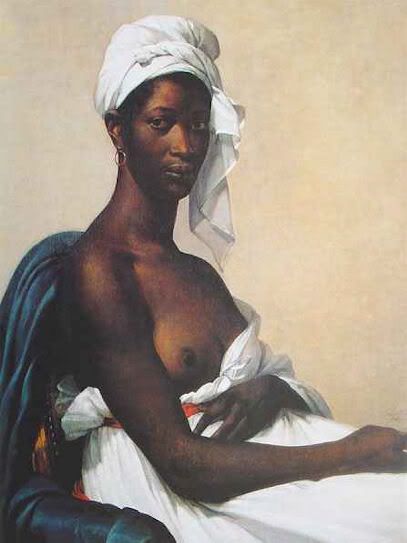
[French Painter, 1768-1826]Marie-Guillemine Benoist (1768-1826): Marie-Guillemine Benoist was the daughter of a government official. She studied with Vigee-Lebrun and her earlier works show a distinct influence of her famous teacher. Benoist later studied with the celebrated Jacques-Louis David and her later works reflect the Neo-Classical style.During her lifetime, Benoist painted in several genres ranging from historical themes to family portraiture.Her works also included subjects that touched upon the contemporary issues of her day:herPortrait of a Negress, painted in 1800,for instance, was inspired by the decree to abolish slavery.Benoist was commissioned by Napolean to paint his portrait as well as portraits of his family members. 
References: Women Artists: An Illustrated History by Nancy G. Heller, pp.63-64. 


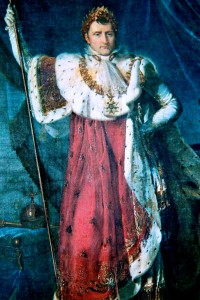
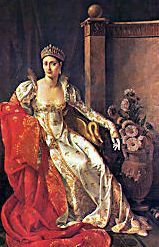
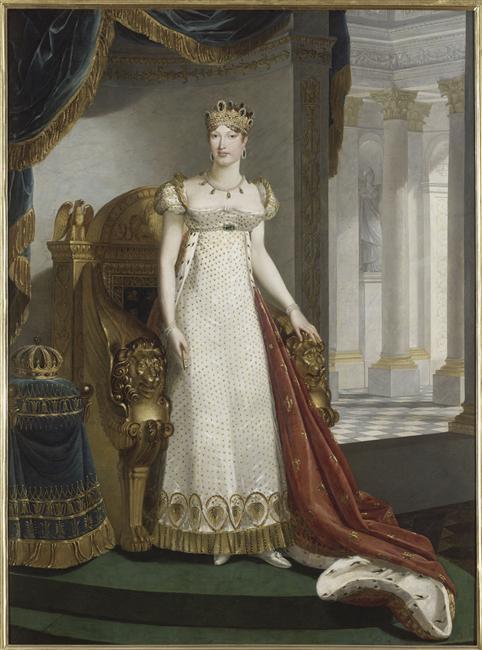
Marie Guilhelmine Benoist (1768 – 1826) painted this portrait of Napoleon in 1809. She also painted portraits of Napoleon’s sisters Pauline and Elisa, as well as his second wife, Marie Louise.

click to enlarge
Elisa

Pauline Bonaparte, Princess Borghese, by Marie Guilhelmine Benoist.  Pauline Bonaparte was born October 20, 1780.Pauline Borghese

Empress Marie-Louise

Portrait of a black woman (1800) is a very special painting. It is one of the first portraits of real existing african person in western art. 
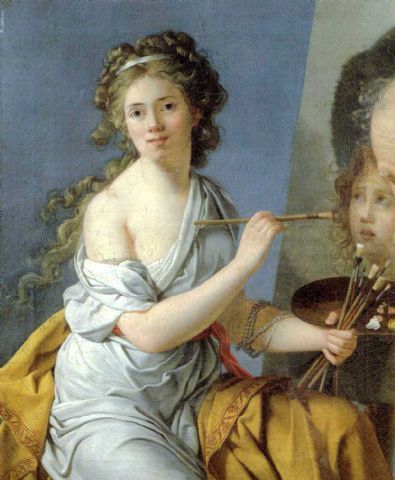
Marie-Guillemine Benoist (self-portrait)