Translate

Friday, December 28, 2012

Clothing

Lady of Paris, 1450


Waiting Woman, 1460 


Countrywoman, 1491

Prostitute, 1491


Baron 1493 

Doctor 1493


14-15th century clothing


 French men's headdresses of the 15th Century   


 French women's headdresses of the 15th Century


14th-15th Century European Armor 


14th-15th Century European Jewelry 

15th Century English dress

15th Century armor

The Execution of Louis XVI Eyewitness Account


1792
"I Pardon those who have occasioned my death"
On January 20, 1793, the National Convention ordered that Louis XVI be executed the following day. The next morning a priest, Henry Essex Edgeworth, accompanied the king on the 2 hour drive to his execution. What follows are Edgeworth’s observations.
"The King, finding himself seated in the carriage, where he could neither speak to me nor be spoken to without witness, kept a profound silence. I presented him with my breviary, the only book I had with me, and he seemed to accept it with pleasure: he appeared anxious that I should point out to him the psalms that were most suited to his situation, and he recited them attentively with me. Thegendarmes, without speaking, seemed astonished and confounded at the tranquil piety of their monarch, to whom they doubtless never had before approached so near.
The procession lasted almost two hours; the streets were lined with citizens, all armed, some with pikes and some with guns, and the carriage was surrounded by a body of troops, formed of the most desperate people of Paris. As another precaution, they had placed before the horses a number of drums, intended to drown any noise or murmur in favour of the King; but how could they be heard? Nobody appeared either at the doors or windows, and in the street nothing was to be seen, but armed citizens - citizens, all rushing towards the commission of a crime, which perhaps they detested in their hearts.
The carriage proceeded thus in silence to the Place de Louis XV, and stopped in the middle of a large space that had been left round the scaffold: this space was surrounded with cannon, and beyond, an armed multitude extended as far as the eye could reach. As soon as the King perceived that the carriage stopped, he turned and whispered to me, 'We are arrived, if I mistake not.' My silence answered that we were. One of the guards came to open the carriage door, and the gendarmes would have jumped out, but the King stopped them, and leaning his arm on my knee, 'Gentlemen,' said he, with the tone of majesty, 'I recommend to you this good man; take care that after my death no insult be offered to him - I charge you to prevent it.'… As soon as the King had left the carriage, three guards surrounded him, and would have taken off his clothes, but he repulsed them with haughtiness- he undressed himself, untied his neckcloth, opened his shirt, and arranged it himself. The guards, whom the determined countenance of the King had for a moment disconcerted, seemed to recover their audacity. They surrounded him again, and would have seized his hands. 'What are you attempting?' said the King, drawing back his hands. 'To bind you,' answered the wretches. 'To bindme,' said the King, with an indignant air. 'No! I shall never consent to that: do what you have been ordered, but you shall never bind me.
The path leading to the scaffold was extremely rough and difficult to pass; the King was obliged to lean on my arm, and from the slowness with which he proceeded, I feared for a moment that his courage might fail; but what was my astonishment, when arrived at the last step, I felt that he suddenly let go my arm, and I saw him cross with a firm foot the breadth of the whole scaffold; silence, by his look alone, fifteen or twenty drums that were placed opposite to me; and in a voice so loud, that it must have been heard it the Pont Tournant, I heard him pronounce distinctly these memorable words: 'I die innocent of all the crimes laid to my charge; I Pardon those who have occasioned my death; and I pray to God that the blood you are going to shed may never be visited on France.'
He was proceeding, when a man on horseback, in the national uniform, and with a ferocious cry, ordered the drums to beat. Many voices were at the same time heard encouraging the executioners. They seemed reanimated themselves, in seizing with violence the most virtuous of Kings, they dragged him under the axe of the guillotine, which with one stroke severed his head from his body. All this passed in a moment. The youngest of the guards, who seemed about eighteen, immediately seized the head, and showed it to the people as he walked round the scaffold; he accompanied this monstrous ceremony with the most atrocious and indecent gestures. At first an awful silence prevailed; at length some cries of 'Vive la Republique!' were heard. By degrees the voices multiplied and in less than ten minutes this cry, a thousand times repeated became the universal shout of the multitude, and every hat was in the air."
Edgeworth, Henry in Thompson, J.M., English Witnesses of the French Revolution (1938, Memoirs originally published 1815).

The Law of Suspects


http://www.historywiz.com/primarysources/lawofsuspects.htm

France September 17 1793
1. Immediately after the publication of this decree, all suspects found on the territory of the Republic and who are still at liberty will be arrested.
2. Suspects are (i) Those who, either by their conduct or their relationships, by their remarks or by their writing, are shown to be partisans of tyranny and federalism and enemies of liberty; (ii) Those who cannot justify, tinder the provisions of the law of 21 March last, their means of existence and the performance of their civic duties; (iii) Those have been refused certificates of civic responsibility (certificats de civisme); (iv) Public officials suspended or deprived of their functions by the National Convention or its agents, and not since reinstated, especially those who have been, or ought to be, dismissed by the law of 14 August last; (v) Those former nobles, including husbands, wives, fathers, mothers, sons or daughters, brothers or sisters, and agents of émigrés, who have not constantly manifested their loyalty to the Revolution; (vi) Those who have emigrated during the interval between the 1 July 1789 and the publication of the law of 8 April 1792, although they may have returned to France during the period of delay fixed by the law or before.


3. The comités de surveillance established under the law of 21 March last, or those substituting for them, are empowered by the decrees of the representatives of the people to go to the armies and the departments, according to the particular decrees of the National Convention, and are charged with drawing up, in each local district, a list of suspects, of issuing warrants for their arrest and of affixing seals to their private papers. The commanders of the public force, to whom these arrest warrants will be conveyed, must carry them out immediately on pain of dismissal.
4. The members of the committee may only order the arrest of any individual if seven are present, and only by the absolute majority of voices.
5. Individuals arrested as suspects shall be taken first to the jails of the place of their detention; in default of jails, they shall be kept under surveillance in their respective dwellings.
6. Within the following week, they shall be transferred to national buildings, which the departmental administrations shall be required to designate and to have prepared for such purpose immediately after the receipt of the present decree.
7. The prisoners may have their absolutely essential belongings brought into said buildings; they shall remain there under guard until the peace.
8. The expenses of custody shall be charged to the prisoners, and shall be divided among them equally: such custody shall be confided preferably to fathers of families and to the relatives of citizens who are at or are going to the frontiers. The salary therefore is established, for each man of the guard, at the value of one and one-half days of labour.
9. The comités de surveillance shall dispatch to the Committee of General Security of the National Convention, without delay, the list of persons whom they have arrested, with the reasons for their arrest and with the papers they have seized in such connection.
10. If there is occasion, the civil and criminal courts may detain as suspects, and dispatch to the jails above stated, those who are accused of offenses with regard to which it was been declared that there was no occasion for indictment or who have been acquitted of charges brought against them.

Thursday, December 27, 2012

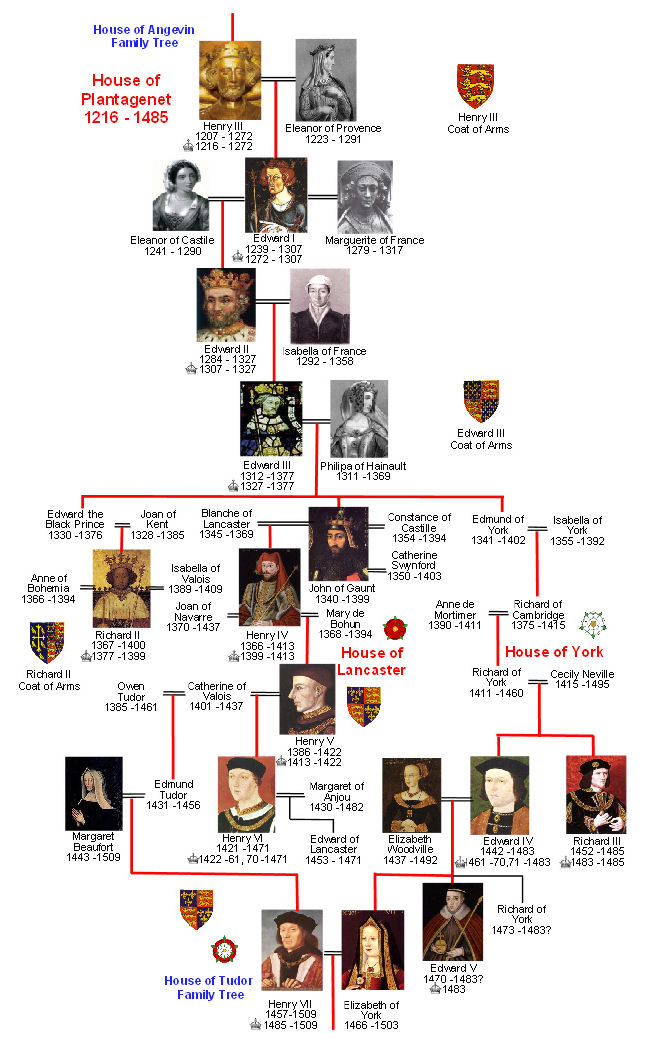
House of Plantagenet Family Tree

Plantagenet, Lancaster and York Family Tree


Margaret of Anjou


Margaret of Anjou was born on the 23 of March 1429 in the province of Lorraine. She was the daughter of René, Duke of Anjou and a neice of Charles VII. Margaret spent her early years living in the Rhone Valley and in Naples, where she was given a full education by her mother and the scholar, Antoine de la Salle.
In 1444, England made peace with France and Margaret was betrothed to King Henry VI ; she married him in April of the next year at Titchfield Abbey, Hampshire. The marriage was unpopular, Margaret being French, and became more so with time as no heirs were born. When the royal couple’s first, and only child, was born in 1453 it was even claimed that Henry was not the father. Margaret clearly dominated the couple and also tried to dominate politics. Unfortunately she wielded a very French view on most things and would never truly understand English politics – something that led her to make some grave mistakes. 
When King Henry fell ill in 1453, a seven-month pregnant Margaret tried to claim the regency, but found no support forthcoming, even from her allies. By the time she gave birth to a son, Edward, in October at Westminster Palace, the question regarding the regency had still not been settled. Then in 1454, Margaret’s mortal enemy, the Duke of York became regent and she was placed out of the way at Windsor Castle.
When the King was captured at the Battle of Northampton in 1460, Margaret did not submit, but instead became the real impetus behind the Lancastrian cause. The Queen raised an army and killed York, who was pushing his claim to the throne, at Wakefield along with several other prominent Yorkists. She then defeated the infamous Earl of Warwick at the battle of St. Albans where she was reunited with her husband.
In 1461, Henry and Margaret’s army was crushed at Towton. In 1462, she went to France where she persuaded Louis XI to finance an invasion. The invasion failed and Margaret and her supporters were forced to withdraw to Scotland. The Lancastrians suffered several more defeats and in 1465, Henry was captured.
Margaret lived in exile with her son until 1470 when her old enemy, Warwick arrived to make his peace with her and bring new hope to the Lancastrian cause. An alliance was formed between the two, and sealed with marriage of Edward, Prince of Wales to Warwick’s daughter Anne. The ‘Kingmaker’ soon restored Henry to the throne, but the Earl was defeated and killed at Barnet, before Margaret could join her husband.
Nevertheless, Margaret invaded with her own army the same year, but Edward in turn defeated her at Tewkesbury where her son was slain, along with many of the Lancastrian nobility. Her husband Henry was murdered in the Tower, just two weeks later leaving no figurehead for the remaining Lancastrians to follow.
After Tewkesbury, Margaret spent some time in the Tower, where she was eventually ransomed by the French King Louis. She died in her native province of Anjou, a poor and broken woman on August 25, 1482.

The Decree abolishing Feudalism


ARTICLE I. The National Assembly hereby completely abolishes the feudal system. It decrees that, among the existing rights
and dues, both feudal and censuel, all those originating in or representing real or personal serfdom shall be abolished without
indemnification. All other dues are declared redeemable, the terms and mode of redemption to be fixed by the National
Assembly. Those of the said dues which are not extinguished by this decree shall continue to be collected until indemnification
shall take place.

II. The exclusive right to maintain pigeon houses and dovecotes is abolished. The pigeons shall be confined during the seasons
fixed by the community. During such periods they shall be looked upon as game, and every one shall have the right to kill them
upon his own land.

III. The exclusive right to hunt and to maintain uninclosed warrens is likewise abolished, and every landowner shall have the
right to kill, or to have destroyed on his own land, all kinds of game, observing, however, such police regulations as may be
established with a view to the safety of the public.


All hunting capitaineries, including the royal forests, and all hunting rights under whatever denomination, are likewise
abolished. Provision shall be made, however, in a manner compatible with the regard due to property and liberty, for
maintaining the personal pleasures of the king.
The president of the Assemby shall be commissioned to ask of the king the recall of those sent to the galleys or exiled,
simply for violations of the hunting regulations, as well as for the release of those at present imprisoned for offenses of this kind,
and the dismissal of such cases as are now pending.
IV. All manorial courts are hereby suppressed without indemnification. But the magistrates of these courts shall continue to
perform their functions until such time as the National Assembly shall provide for the establishment of a new judicial system.
V. Tithes of every description, as well as the dues which have been substituted for them, under whatever denomination they are
known or collected (even when compounded for), possessed by secular or regular congregations, by holders of benefices,
members of corporations (including the Order of Malta and other religious and military orders), as well as those devoted to the
maintenance of churches, those impropriated to lay persons, and those substituted for the portion congrue, are abolished,
on condition, however, that some other method be devised to provide for the expenses of divine worship, the support of the
officiating clergy, for the assistance of the poor, for repairs and rebuilding of churches and parsonages, and for the maintenance
of all institutions, seminaries, schools, academies, asylums, and organizations to which the present funds are devoted. Until such
provision shall be made and the former possessors shall enter upon the enjoyment of an income on the new system, the
National Assembly decrees that the said tithes shall continue to be collected according to law and in the customary manner.

Other tithes, of whatever nature they may be, shall be redeemable in such manner as the Assembly shall determine. Until this
matter is adjusted, the National Assembly decrees that these, too, shall continue to be collected.
VI. All perpetual ground rents, payable either in money or in kind, of whatever nature they may be, whatever their
origin and to whomsoever they may be due, . . . shall be redeemable at a rate fixed by the Assembly. No due shall in the future
be created which is not redeemable.
VII. The sale of judicial and municipal offices shall be abolished forthwith. Justice shall be dispensed gratis. Nevertheless the
magistrates at present holding such offices shall continue to exercise their functions and to receive their emoluments until the
Assembly shall have made provision for indemnifying them.
VIII. The fees of the country priests are abolished, and shall be discontinued so soon as provision shall be made for increasing
the minimum salary of the parish priests and the payment to the curates. A regulation shall be drawn up to determine the status of the priests in the towns.
IX. Pecuniary privileges, personal or real, in the payment of taxes are abolished forever. Taxes shall be collected from all the
citizens, and from all property, in the same manner and in the same form. Plans shall be considered by which the taxes shall be
paid proportionally by all, even for the last six months of the current year.
X. Inasmuch as a national constitution and public liberty are of more advantage to the provinces than the privileges which some
of these enjoy, and inasmuch as the surrender of such privileges is essential to the intimate union of all parts of the realm, it is
decreed that all the peculiar privileges, pecuniary or otherwise, of the provinces, principalities, districts, cantons, cities, and
communes, are once for all abolished and are absorbed into the law common to all Frenchmen.
XI. All citizens, without distinction of birth, are eligible to any office or dignity, whether ecclesiastical, civil, or military; and no
profession shall imply any derogation.
XII. Hereafter no remittances shall be made for annates or for any other purpose to the court of Rome, the vice legation at
Avignon, or to the nunciature at Lucerne. The (p. 408) clergy of the diocese shall apply to their bishops in regard to the filling of
benefices and dispensations, the which shall be granted gratis without regard to reservations, expectancies, and papal months,
all the churches of France enjoying the same freedom.

XIII. [This article abolishes various ecclesiastical dues.]
XIV. Pluralities shall not be permitted hereafter in cases where the revenue from the benefice or benefices held shall exceed the
sum of three thousand livres. Nor shall any individual be allowed to enjoy several pensions from benefices, or a pension and a
benefice, if the revenue which he already enjoys from such sources exceeds the same sum of three thousand livres.
XV. The National Assembly shall consider, in conjunction with the king, the report which is to be submitted to it relating to
pensions, favors, and salaries, with a view to suppressing all such as are not deserved, and reducing those which shall prove
excessive; and the amount shall be fixed which the king may in the future disburse for this purpose.
XVI. The National Assembly decrees that a medal shall be struck in memory of the recent grave and important deliberations
for the welfare of France, and that a Te Deum shall be chanted in gratitude in all the parishes and the churches of France.
XVII. The National Assembly solemnly proclaims the king, Louis XVI, the Restorer of French Liberty.
XVIII. The National Assembly shall present itself in a body before the king, in order to submit to him the decrees which have
just been passed, to tender to him the tokens of its most respectful gratitude, and to pray him to permit the Te Deum to be
chanted in his chapel, and to be present himself at this service.
XIX. The National Assembly shall consider, immediately after the constitution, the drawing up of the laws necessary for the
development of the principles which it has laid down in the present decree. The latter shall be transmitted by the deputies
without delay to all the provinces, together with (p. 409) the decree of the 10th of this month, in order that it may be printed,
published, read from the parish pulpits, and posted up wherever it shall be deemed necessary.