
Wednesday, November 28, 2012

Some Mother's Day Sympathy for Margaret of Anjou

SUNDAY, MAY 11, 2008
http://susandhigginbotham.blogspot.com/2008/05/some-mothers-day-sympathy-for-margaret.html
Of all the mothers in the Wars of the Roses, Margaret of Anjou, queen to the unfortunate Henry VI, has surely been the most maligned. She's regularly portrayed as an adulteress and a vengeful harpy. One historical novel even has her repeatedly trying to murder her daughter-in-law, Anne Neville, though I never quite figured out why. (I'm not sure the author knew either.)
Derived from Shakespeare, a set piece in many a Wars of the Roses novel, even some recent ones where the authors should have known better, involves cruel Margaret ordering immediately after the Battle of Wakefield that the severed heads of the Duke of York and his teenage son, the Earl of Rutland, be displayed and the Duke's head bedecked with a paper crown. In fact, Margaret was not at the Battle of Wakefield; she was in Scotland at the time. There's even been considerable doubt cast as to the extent of the atrocities supposedly committed by her troops.
Margaret's position is surely deserving of more sympathy than she has received. Criticized at first for her failure to conceive a child, when she finally did become pregnant, her enemies accused her of adultery. (There's simply no proof that she had sexual relations with any man but her husband.) During her pregnancy, her husband lost his reason; eventually, the loss of his crown followed. Believing that the throne of England was her son's birthright, she fought for it until his death at the Battle of Tewkesbury. She was brought to London as a prisoner, only to have her husband murdered the night of her arrival. No longer regarded as a threat by the Yorkists, only as a financial burden, she was finally sent back to France, where she died in obscurity.
Margaret is frequently compared to an earlier French-born Queen of England, Isabella of France, and the traditionally negative portrayal of each of them has often been ascribed to misogyny and xenophobia. Both women, indeed, have recently benefited from recent interest in medieval women and medieval queens and have attracted some sympathy from historians, female and male alike. Yet popular culture has lagged behind, for while Isabella has been portrayed sympathetically by a number of novelists, especially female ones, Margaret of Anjou has met a quite different fate at their hands. She's frequently little more than a cardboard villain, and even when she's given some semblance of depth, the myths such as her presence at the Battle of Wakefield are trotted out. (Ironically, this portrayal of Margaret, which owes so much to Shakespeare, is often perpetuated by the very same novelists who decry the Bard's portrayal of Richard III.)
Strangely, Isabella, an adulteress who was disloyal to her husband and even to her own son, has attracted defenders because of those very facts. They attribute her adultery as being the natural reaction of a wronged wife and her deposition of her husband as being a commendable reaction against royal tyranny. Yet the loyalty of Margaret to her husband and to her son is depicted as the power-mad reaction of a vengeful woman. Evidently even her modern-day detractors feel that she should have settled back and worked on tapestries while her son was being deprived of his crown.
So this Mother's Day, why not spare Margaret of Anjou a little kindness for a change? She might well have hoped to have been a traditional queen, smiling at her husband's side, doing good works, and procuring favors for her subjects. Instead, with an incapacitated husband and competing claims to the throne, she found herself thrust into a situation that had no easy solutions, either for the men involved or for Margaret. Novelists have recognized the complexity of the situation these men faced; it's time they did the same for Margaret.
Derived from Shakespeare, a set piece in many a Wars of the Roses novel, even some recent ones where the authors should have known better, involves cruel Margaret ordering immediately after the Battle of Wakefield that the severed heads of the Duke of York and his teenage son, the Earl of Rutland, be displayed and the Duke's head bedecked with a paper crown. In fact, Margaret was not at the Battle of Wakefield; she was in Scotland at the time. There's even been considerable doubt cast as to the extent of the atrocities supposedly committed by her troops.
Margaret's position is surely deserving of more sympathy than she has received. Criticized at first for her failure to conceive a child, when she finally did become pregnant, her enemies accused her of adultery. (There's simply no proof that she had sexual relations with any man but her husband.) During her pregnancy, her husband lost his reason; eventually, the loss of his crown followed. Believing that the throne of England was her son's birthright, she fought for it until his death at the Battle of Tewkesbury. She was brought to London as a prisoner, only to have her husband murdered the night of her arrival. No longer regarded as a threat by the Yorkists, only as a financial burden, she was finally sent back to France, where she died in obscurity.
Margaret is frequently compared to an earlier French-born Queen of England, Isabella of France, and the traditionally negative portrayal of each of them has often been ascribed to misogyny and xenophobia. Both women, indeed, have recently benefited from recent interest in medieval women and medieval queens and have attracted some sympathy from historians, female and male alike. Yet popular culture has lagged behind, for while Isabella has been portrayed sympathetically by a number of novelists, especially female ones, Margaret of Anjou has met a quite different fate at their hands. She's frequently little more than a cardboard villain, and even when she's given some semblance of depth, the myths such as her presence at the Battle of Wakefield are trotted out. (Ironically, this portrayal of Margaret, which owes so much to Shakespeare, is often perpetuated by the very same novelists who decry the Bard's portrayal of Richard III.)
Strangely, Isabella, an adulteress who was disloyal to her husband and even to her own son, has attracted defenders because of those very facts. They attribute her adultery as being the natural reaction of a wronged wife and her deposition of her husband as being a commendable reaction against royal tyranny. Yet the loyalty of Margaret to her husband and to her son is depicted as the power-mad reaction of a vengeful woman. Evidently even her modern-day detractors feel that she should have settled back and worked on tapestries while her son was being deprived of his crown.
So this Mother's Day, why not spare Margaret of Anjou a little kindness for a change? She might well have hoped to have been a traditional queen, smiling at her husband's side, doing good works, and procuring favors for her subjects. Instead, with an incapacitated husband and competing claims to the throne, she found herself thrust into a situation that had no easy solutions, either for the men involved or for Margaret. Novelists have recognized the complexity of the situation these men faced; it's time they did the same for Margaret.
Margaret of Anjou

(1429-1482)
Born: 23rd March 1429 at Pont-à-Mousson, Lorraine, FranceQueen of England
Died: 25th August 1482 at Château de Dampère, Saumur, France
Margaret, the Queen of Henry VI, was the fifth child of “Le Bon Roi René,” Count of Anjou, and Isabella, Duchess of Lorraine, and was born at Nancy. Her father became successively Duke of Bar, Duke of Lorraine, Count of Anjou, Count of Provence and titular King of Naples & Sicily. The young lady was therefore much sought after as a bride and, in 1444, the Earl of Suffolk headed an embassy to ask her hand for his master, King Henry. A marriage by proxy took place in that year and the consent of the King of France to the arrangement was obtained. She brought no dowry to the already impoverished English Crown and it was believed, though without evidence, that Suffolk had agreed, in the marriage contract, to terms surrendering some of the fortresses which England still held in France.
In 1445, Margaret crossed the Channel and was married to Henry at Titchfield Abbey in Hampshire. Once in England, though only fifteen years old, she became a violent partisan of Suffolk and Beaufort against the Duke of Gloucester and the war party. When these were gone, two successive Dukes of Somerset became her favourites and the policy of the Court, against the Duke of York, became her cause. Her only child, Prince Edward of Lancaster, was born in 1453, at the very time when her husband was suffering from his first mental and bodily collapse. She would never agree to the compromises and peaces which Henry was, on more than one occasion, ready to conclude with the Yorkists and was incensed by the Duke of York’s appointment as Protector in March 1454.
After the King’s recovery the following November, Margaret took control of Royal affairs. She persuaded her husband to dissolve Parliament and raised an army with which to crush those she saw as his opponents. When Margaret got the upper hand in the field, she used her victory without mercy and understood how to pack a parliament so they would attaint her enemies wholesale. After the Lancastrian defeat at Northampton, she was found wandering on the borders of Wales and was at least once in danger of her life from robbers. From Wales, she made her way, in 1461, to Scotland and surrendered Berwick to the Scots as the price for their help. She was not present when her army of Northerners won the Battle of Wakefield, but she rejoined her friends after the victory and advanced upon London with a large army which won the Second Battle of St. Albans. There, however, for some reason unknown, she stayed her hand, fell back northwards and saw her forces annihilated and dispersed by the Duke of York's son, now Edward IV, at Towton. She and Henry escaped from that field to Scotland whence, in 1462, she embarked for France to seek foreign help.
King Louis XI of France was friendly towards the Lancastrians and lent Margaret a small force, with which she returned to Scotland. But it seems to have been of little use, for the Royal couple were soon reduced to the direst straits. It was at this time, while wandering in a Northumbrian forest, that Margaret is said to have met a ferocious robber and threw herself upon his generosity, not in vain, by revealing to him her rank and that of her young son. She was again on the Continent in the Autumn of 1463, and received some rather unwilling charity from the Duke of Burgundy. She remained in Lorraine, a costly burden upon her father's charity, waiting always for a chance to strike again at England, but only occasionally travelling as far as the Channel coast.
In 1470, the all-powerful Earl of Warwick finally broke with his cousin, Edward IV, and was reconciled to Margaret and her husband by the mediation of King Louis. However, while Warwick sailed in the Lancastrian interest, almost at once to England, Margaret delayed too long and so allowed Edward IV, whom her friends had driven out, to return and reoccupy London. She finally landed at Weymouth in April 1471, the very day on which her new friend, Warwick, was beaten and slain at Barnet. Edward, by a forced march, fell upon her small army at Tewkesbury, annihilated it and slew her son. Margaret remained his captive in various English castles until 1475, when Louis XI stipulated for her release. Thence after, she lived in the province of Anjou in extreme poverty until her death in 1482, and was buried in the Cathedral of Angers.
Margaret was learned and fierce, a far truer product of the clever and cruel Angevin house than her gentle and scrupulous father, René; she was devoted to hunting as well as to reading and, even in the days of her comparative prosperity, was an importunate beggar of everything which she desired. Her career in England, whose rights and whose fortunes she was ready to sell to anyone who would help her cause, was accompanied by unvarying misfortune for the Lancastrians and most of all for her gentle and uncomplaining husband.
Edited from Emery Walker's "Historical Portraits" (1909).
The battle of Jena

The battle of Jena (14 October 1806) was one of two simultaneous battles won by the French on the same day and saw Napoleon with most of the Grand Armée defeat the Prussian flank guard at Jena while Marshal Davout defeated the main Prussian force further north at Auerstädt.
At the start of the War of the Fourth Coalition (1806-07) Napoleon was faced with an alliance of Prussia, Russia, Britain and Sweden. Much to his surprise the Prussians decided to attack without waiting for their Russian allies to arrive, and in September 1806 occupied Saxony. At this point most of the Grand Armée was based in Germany, largely in the positions it had taken up after the great victory at Austerlitz had ended the War of the Third Coalition. Napoleon decided to take advantage of this, concentrate his army at Bamberg and attack north across the wooded hills of the Landgrafenberg. This would allow him to advance towards Leipzig and Berlin and force the Prussians to fight a battle.
Napoleon crossed the hills in three columns. On the left was Lannes (V Corps) and Augereau (VII Corps). In the centre was Bernadotte (I Corps) and Davout (III Corps). On the right was Soult (IV Corps), Ney (VI Corps) and a Bavarian contingent. Each of these columns had to operate independently until they emerged from the hills. Napoleon assumed that the Prussians wouldn't be able to block all three passes with strong forces, allowing at least one of his columns to come to the support of the others if they were blocked. In fact the Prussians hadn't blocked any of the passes and the French emerged safely on the northern side of the hills
On 9 October the French brushed aside a small Prussia force at Schleiz, and on 10 October they won a bigger victory at Saalfeld, killing the Prussian commander Prince Louis Ferdinand. Napoleon still didn't know where the Prussians were, and at the end of 10 October he believed that they would move east to try and block the road to Leipzig. At this point the Prussians were actually off to the west, with Hohenlohe concentrating at Jena and Brunswick further west at Weimar. On 11 October Napoleon realised the Prussians weren't to his north, but he still didn't know where they were, and decided that they would probably concentrate at Erfurt, west of Weimar.
On 12 October Napoleon ordered his army to wheel to the left. Davoût and Bernadotte were to form the right flank, at Naumberg and Kosen on the Saale. Further to the south Lannes and Augereau were to head for Jena and Kahla, two more crossing points on the Saale. Ney and Soult were posted a little further to the east to watch for any possible Prussian move in that direction.
On the morning of 13 October the Prussians learnt that the French were in Naumberg. The king summoned a council of war at which two courses of action were considered. The first was to concentrate at Jena and attack the French. If the Prussians had indeed united at Jena on the following day then they might have been able to defeat Napoleon's divided army in detail, taking on the 56,000 men he had at Jena on the morning of 14 October before Ney and Soult could appear on the scene. The second was for a retreat north from Weimar to Auerstädt then to go north through the pass of Kosen towards Freiburg. Hohenlohe's flank guard would remain just to the north of Jena, where they would delay the French and give the main body time to escape. The Prussians decided to take the second option.
Napoleon's first orders for 13 October were for Bernadotte to join Davoût and for Ney to move towards Lannes. Early that morning he received a series of reports that convinced him that the Prussians were now planning to retreat north towards Magdeburg instead of north-east to Leipzig. Napoleon altered his orders in response to this possible move. Davoût was still at Naumberg on the right. Bernadotte and Murat's cavalry were ordered to move to Dornburg, further south on the Saale. This would fill a gap that was opening up between Lannes and Davoût. Soult was ordered to send one division to Jena while the rest of his corps moved north-west to guard against a move on Leipzig. Augereau was ordered to Jena, Ney to Roda (just to the south-east) while Napoleon moved to join Lannes at Jena.
As Napoleon moved towards Jena he met a messenger from Lannes reporting that he had found 10,000-15,000 Prussians north of Jena and believed that another 20,000-25,000 more were to the west between Jena and Weimar. Napoleon now believed that he had found the main body of the Prussian army and that the Prussians were probably intending to attack Lannes. He sent out a third set of orders. Murat was still to head for Dornburg, as was Bernadotte. At this stage Bernadotte was ordered to support Lannes if he heard the sound of heavy fighting. Soult and Ney were ordered to bring their entire corps to Jena. Davout was to advance west from Naumburg and attack the Prussians at Jena from the north.
When Napoleon reached Jena he found that Lannes had moved part of his corps on the Landgrafenberg, a steep hill that loomed over the town. The northern slopes were gentler, and if the Prussians had occupied the heights in any strength then the French would have struggled to take them or hold onto them. Napoleon decided to try and hold on to this crucial position. The rest of Lannes' corps was ordered onto the hill, supported by the Imperial Guard. Overnight the French improved the single track that led onto the heights and managed to get their artillery onto the hilltop. Napoleon's big fear was that the Prussians would attack before his reinforcements arrived, but the night passed quietly. By dawn the leading elements from Soult's IV Corps, Ney's VI Corps and Augereau's VII Corps had arrived around Jena. Napoleon began the day with around 50,000 men at his disposal and by noon that would rise to over 90,000.
By the end of 13 October the Prussians were not where Napoleon believed them to be. Hohenlohe's flank guard was north and west of Jena. He had around 38,000 men at his immediate disposal. On the left General von Holtzendorff was posted on the Saale with 5,000 men. Tauentzien, with around 6,000 men, was posted just to the north of Lannes. The rest of the army was posted to his west. Another 15,000 men under von Rüchel, spent the night of 13-14 October at Weimar, further to the west. This force didn't arrive at Jena until the battle was lost and was caught up in the defeat.
The battle of Jena was fought across a plateau to the north of the town of Jena. It was bordered on the east by the River Saale. Steep slopes led up from the Saale and Jena to the plateau, the most famous of them being the Landgrafenberg. This hill rose 500ft from Jena, but its northern slopes were much lower and very gentle. The southern edge of the battlefield was marked by the valley of the River Muhlbach, which runs west from Jena, before turning south. The 'Schnecke' or 'snail' pass continued on to the west from the bend in the river. The road from Jena to Weimar ran alongside the Muhlbach and then up the 'Schnecke' pass. The eastern side of the plateau was broken by a series of other valleys that led down to the Saale.
A series of villages were scattered across the plateau. Nearest to the Landgrafenberg was Cospeda, the southernmost of a triangle of villages, with Closewitz to the north-east and Lützeroda to the north-west. A second line of villages was located another mile and a half to the north-west. This started at Isserstedt on the 'snail' pass, then ran north-east to Vierzehnheiligen, Krippendorf and Nerkewitz. Just to the south of Nerkewitz was the village of Rödingen. Further west was a third line of villages, with Kötschau on the 'snail' pass and Gross Romstedt and Klein Romstedt to its north-east.
On the night of 13-14 June most of Hohenlohe's force (around 28,000 men) was on the western side of the battlefield, around Gross Romstedt, Kotschau and Isserstadt. General Tauenzien's division of 6,000 men was closest to Napoleon, and was camped around Closewitz and Lützeroda. General Holtzendorf, with 5,000 men from the Right Wing, was camped four miles to the north-east (on the Prussian left), watching a bridge over the Salle at Dornburg. Hohenlohe had around 39,000 men for most of the battle of Jena.
Finally General Ruchel was some way to the west of the battlefield, with 15,000 men. His original orders were for him to follow the main body of the army north, but these were changed and he was put at Hohenlohe's disposal. His force didn't arrive until late in the day, by which time the battle was lost. The combined Prussian army was thus 54,000 strong, but Rüchel didn't arrive in time to take part in the main battle and was instead swept away by the pursuing French after the main fighting was over.
On the French side Davout and Bernadotte were heading north, ready for glory at Auerstädt and ignominy on the roads between the two battles respectively. Lannes was camped on the Landgrafenberg. The leading elements of IV Corps (Soult), VI Corps (Ney) and VII Corps (Augereau) reached Jena, and would be ready to play a part in the battle. At the start of the battle Napoleon had around 46,000 men available, but that would double during the fighting as reinforcements arrived on the scene.
Napoleon's initial plan was for Lannes to capture Closewitz to make more space for his reinforcements. Ney was to deploy to the right of Lannes (although as we will see he ended up on his left). Augereau was to advance along the road towards Weimar then turn north to form up on Lannes' left. Soult was to head further north along the Saale then turn west, forming the right flank of the French army.
Lannes would face Tauenzien's 6,000-8,000 men who were now deployed between Closewitz and Lützeroda. The battle began soon after 6am with an advance by Suchet's division on the right and Gazan's division on the left. This advance was carried out in the fog, and Suchet's men ended up veering off to the left, hitting the Prussian line between Closewitz and Lützeroda. By around 9am Suchet had captured Closewitz and part of the road. Gazan had been held up further south at Cospeda. The Prussians had launched a counterattack but that was repulsed. Faced with an attack by two divisions and running short of ammunition Tauenzien decided to retreat from the triangle of village and fall back towards his reserves around Vierzehnheiligen.
Lannes advanced as far at that village, which briefly fell into his hands. At around 9.30 Tauenzien launched a counterattack, which split Lannes's troops in half and recaptured Vierzehnheiligen, Lützeroda and Closewitz. Part of Lannes's command was cut off to the north-east of Vierzehnheiligen and the rest was to the south in Isserstedt Forest (east of Isserstedt village). Lannes restored the situation, recapturing Lützeroda and Closewitz. Despite the success of his counterattack Tauenzien was increasingly concerned about the French troops advancing on both flanks - Soult's leading troops had found his left and Augereau was threatening his right. With this in mind Tauenzien retreated from Vierzehnheiligen towards Gross Romstedt and the main body of the Prussian army. This part of the battle was over by around 10am.
At around 10am the fighting died down in the centre and western parts of the battlefield, but at about the same time fresh fighting broke out in the east. Von Holtzendorff, who had been posted on the far left of the Prussian army, had marched towards the sound of the guns, but his line of advance meant that he ran into Soult's corps, recently arrived on the French right. Soult's troops had captured Closewitz, the north-eastern of the triangle of villages. As Saint-Hilaire's division advanced north-west, they were surprised to be attacked on their right by von Holtzendorff. The Prussians advanced with their right flank leading and their left flank refused, heading towards the right flank of Soult's corps. Saint-Hilaire responded with great skill. His light infantry was hidden from Prussian view, and he now used it to attack the Prussia left. The Prussians were forced to retreat back to Nerkewitz, where von Holtzendorff hoped to rally. Saint-Hilaire kept up the pressure, and the Prussians were never given the time to reform. Von Holtzendorff's infantry retreated to the north, and played little further part in the battle. Some of his cavalry managed to reach the main force, but not enough to make any difference.
At first Hohenlohe believed that he was only facing a minor part of the French army, but it was now clear that this wasn't the case. A messenger was sent to summon Rüchel. Three Saxon brigades were sent south to keep the road to Weimar open (Augereau was further east on the same road). General Grawert, with most of the available Prussian infantry and one Saxon brigade was sent east to face the French around Vierzehnheiligen.
Although the Prussians were preparing for an attack, it was actually Marshal Ney who triggered the third stage of the battle. Having received orders to march to Jena he had left his infantry to make its own way to the field and dashed ahead with his cavalry. He reached Jena at around 9.30, but then had to wait for his troops to arrive. He was finally given orders to advance onto the heights and take up a position to the right of Lannes. When he arrived on the plateau Ney found that Lannes was already in touch with Soult on his right, and so decided to take up a position on his left instead. At this stage Ney had around 3,000 men, a mix of cavalry and infantry.
At around 11am, just as the Prussian reinforcements had formed up facing Lannes, Ney decided to plunge into the fray. He attacked the Prussian line to the south of Vierzehnheiligen. He captured a Prussian gun battery, disrupted the right of their new line, and recaptured the village. Ney's momentum took him well past Vierzehnheiligen before his attack ran out of steam. This also meant that he was well in advance of the rest of the French line, and when his momentum ran out Ney found himself isolated. He was forced to form square and found himself in the way of a major Prussian offensive. The Prussians had gathered together forty five squadrons of cavalry and eleven Prussian infantry battalions for the attack. They swept past Ney's isolated force and threated to advance through a gap in the French line.
Napoleon responded quickly. Lannes was ordered to attack through Vierzehnheiligen and Augereau was ordered to take Isserstedt and form a second line behind Ney. At this point Napoleon had very few reserves on the field. The Imperial Guard were still uncommitted, but Napoleon didn't want them to be used this early in the battle. The main cavalry reserve was still on its way, so all he had was two regiments of cavalry and the guard artillery. The French moves met with limited success. Gazan's division from Lannes's corps managed to take Vierzehnheiligen and advanced towards Ney, but then ran into the main Prussian infantry force and were forced back. Augereau had more luck and was able to make contact with Ney and rescue his isolated command.
At this point the Prussians had some 20,000 infantry in a strong position in the centre of the battlefield, ready to attack the stretched French lines, but in one of the most famous incidents of the battle Hohenlohe decided to halt his advance and wait for Rüchel to arrive from Weimar. This slow and stately style of warfare might have worked against lesser commanders, but against Napoleon it just meant that the Prussians had surrendered the initiative. A prolonged fire fight now took place between the two lines, with the French getting the best of the action. Lannes also launched another attack around Vierzehnheiligen, but was repulsed. The French had more success on their left, where the Saxon troops on the Weimar road were cut off by Ney's first infantry division and part of Augereau's corps. Hohenlohn moved all of his remaining reserves into the front line, leaving only Tauenzien's division out of the line.
By 12.30 another 42,000 French troops had arrived on the field - Soult and Ney's main infantry bodies and Murat's cavalry. The French had now managed to concentrate 96,000 men on the battlefield. Napoleon was now able to plan for his own major attack, which was to take place all along the line. On the left Augereau was to attack the Saxons in the 'snail' pass. On the right Saint-Hilaire, supported by two divisions from IV Corps, was to attack Holtzendorff's infantry, still lurking on the northern edge of the battle. Once the two flank attacks were well underway Lannes (V Corps) and Ney (VI Corps) were to attack in the centre. Once a gap had been created Murat's cavalry was to attack and get into the Prussian rear.
Augereau was already engaged on the French left and St. Hilaire was engaged by 1am. The main attack then began. After some resistance Hohenlohe was forced to order his line to retreat back towards Gross Romstedt and Klein Romstedt. This was the moment that the French had been waiting for. Lannes managed to bring his artillery up and bombarded the retreating Prussians. When Murat's cavalry attacked the Prussian line began to dissolve and the Prussians were soon fleeing from the field. Part of the army headed west towards Weimar while others attempted to escape to the north. In both cases the French pursuit wasn't quite as effective as they had hoped. In the west a single Saxon grenadier battalion under Colonel Winkel formed a square and retreated in good order, slowing the French. In the north Tauenzien's division, which had been resting after playing a major part in the early fighting, also managed to hold up the French for some time. By 2.30pm the main part of the battle was over.
The troops fleeing to the west soon ran into Rüchel's corps, advancing east from Weimar. He had received the order to join Hohenhole at 9am, and had actually advanced at a decent pace. After marching for an hour he stopped to move from his marching formation into a fighting formation, a move that took another hour. During this period he received a message from Hohenhole informing him that all was going well at Jena. He resumed his advance at 11am, and moved three miles nearer to the battlefield by noon. At this point he received the first indications that Hohenhole was in trouble. He reached Kappellendorf, just to the west of the battlefield at 1pm, and was ready to enter the battle by 1.30pm. Soon after this Hohenhole, who had been retreating with the Saxons, reached Rüchel and took command of his army. He then led this fresh force of 15,000 men east towards Gross Romstedt.
As these Prussian reinforcements approached that village they ran into Lannes' pursuing French cavalry. Lannes was forced to stop and wait for reinforcements, but the delay didn't last for long. Saint-Hilaire's division arrived on his right flank, turned the Prussian's left and forced Rüchel's command to retreat. By around 3pm Rüchel's force had lost all cohesion and had joined the general Prussian retreat.
Murat's cavalry wasn't able to begin a full scale pursuit by 4pm. He reached Weimar one hour later, but by then darkness was getting close, and the immediate pursuit halted. The same happened in the north. Even so the Prussians had suffered a crushing defeat, losing 11,000 dead and wounded and 15,000 prisoners, nearly half of the total Prussian force engaged at Jena. The French lost 5,000 men.
That evening Napoleon was shocked to discover that he hadn’t been fighting the main Prussian force after all. Captain Tobriant from Davoüt's staff arrived at Napoleon's camp with the news that his master had just fought and defeated the main Prussian army at Auerstädt, fifteen miles to the north.
Over the next few weeks Napoleon harassed the retreating Prussian army, never letting it stop to regroup. Bernadotte went some way towards restoring his reputation during the pursuit. He defeated the Prussian reserves at Halle on 17 October, and was one of three corps to cross the Elbe by the morning of 22 October. Elsewhere large numbers of Prussians were captured, fortresses surrendered after little or no resistances (Magdeburg held out until 11 November). Davout led the victorious entry into Berlin on 25 October. On 28 October Hohenlohe, with the main remaining force, surrendered to Murat. Blücher was the last of the main commanders to surrender, on 6 November, after failing to find safety at Lübeck.
In just over a month Napoleon had destroyed the military might of Prussia, but the war was not over. King Frederick William escaped into the Prussian occupied part of Poland and found safety with the Tsar. Napoleon prepared to turn east for his first invasion of Poland and two costly campaigns that would last into 1807.
The Convention of Schönbrünn

The Convention of Schönbrünn (15 December 1805) was an alliance between Prussia and France forced on the Prussians in the aftermath of Napoleon's great victory at Austerlitz.
On 3 November 1805 the Prussians had signed the Treaty of Potsdam, agreeing to enter the Third Coalition if Napoleon didn't agree to peace within four weeks of the departure of an envoy from Berlin. This treaty came to nothing after the battle of Austerlitz, and instead the Prussian envoy, Christian Haugwitz, was forced to negotiate a treaty of friendship.
Prussia was forced to agree to a formal alliance against Britain. She was also forced to surrender three outlying parts of the kingdom. Cleves, on the lower Rhine was given to Murat, who became Grand Duke of Berg and Cleves. Ansbach, an isolated Prussian enclave in Bavaria, had been crossed by Bernadotte's corps early in the War of the Third Coalition, and was now given to Bavaria. Neuchâtel, on the western edge of Switzerland, was given to Napoleon's hard working chief of staff Berthier. In return Prussia was offered Hanover.
Haugwitz was forced to sign the convention on 15 December 1805. It was then sent to Prussia to be ratified. King Frederick William III of Prussia attempted to delay this, but was eventually left with no choice, and ratified the treaty on 24 February 1806. Prussia was left diplomatically isolated, and Napoleon now only faced Britain and Russia. Peace negotiations with Russia came quite close to success, but Napoleon's attitude had pushed Prussia towards the war camp. The peace party's cause wasn't helped when Napoleon offered to return Hanover to Britain in return for peace. Much to Napoleon's surprise later in 1806 Prussia joined the Fourth Coalition, and war was renewed.
Tuesday, November 27, 2012
The combat of Ostrolenka (16 February 1807)
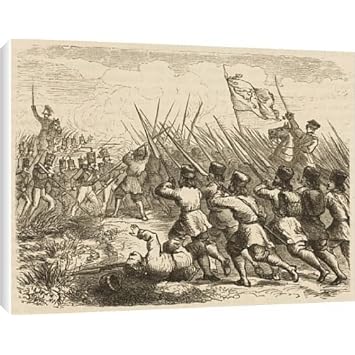
The combat of Ostrolenka (16 February 1807) was a minor French victory won on the right flank of their long front in Poland, and ended a Russian attempt to push the French back in the south.
After their unsuccessful attempt to win a decisive victory at Pultusk (26 December 1806) most of the French army went into winter quarters to the north and north-east of Warsaw. To the left Bernadotte was posted towards the Baltic coast, with Ney linking his corps with the rest of the army. In January 1807 the main Russian army, under General Bennigsen, moved north and then turned west in an attempt to defeat the isolated corps of Marshal Bernadotte, on the extreme left of the French line. Napoleon responded by leading most of his army north at the start of the campaign that ended at Elyau (7-8 February 1807).
Both sides left a holding force in the south. On the French side General Savary was given command of V Corps, made up of Suchet's and Gazan's infantry divisions and Becker's dragoon division, a total of around 18,000 men. Oudinot's grenadier division was also ordered to join Savary, and arrived in time to take part in the fighting at Ostrolenka.
The Russians left two divisions from the Army of Moldavia in the area between the River Bug and the River Narew, under the command of General Essen.
Savary had quite complex orders. If Essen had a weak force at Nur, on the Bug, then Savary was to attack. If the Russians had more men then Savery was to defend Brok, further west on the Bug and Ostrolenka, north of Brok on the Narew River, with cavalry, while his main forces were posted at Pultusk, with orders to guard the right (west and north) bank of the Narew from Sierock (Serock, thirteen miles to the south of Pultusk, where the Narew flows into the Bug) north to the Omulew River, which flows into the Narew close to Ostrolenka, and the River Bug from Sierock east to the Austrian border. He was also to strengthen the bridgehead at Pultusk and build a bridge at Sierock.
Savary didn’t entirely obey his orders. He found his men short of supplies, and decided to move his main force to Ostrolenka. While moving north he captured a copy of orders from Bennigsen to Essen, who had been ordered to go onto the offensive. The Russians sent 4,000-5,000 men onto the right bank of the Narew and advanced towards Ostrolenka, hoping to turn Savary's left flank.
Savary decided to go onto the offensive himself. Three brigades were left at Ostrolenka, on the left (east) bank of the river, commanded by General Reille. They were covered by artillery batteries posted on the opposite side of the river. On 16 February Savary led the rest of his force north along the right bank of the river, heading towards Essen's attacking force.
Gazan's division led the advance on the right bank of the river. His men ran into the advancing Russians as they were passing between two woods. The Russians were unable to deploy and were pushed back for five miles.
At the same time another Russian force was advancing down the left bank of the river towards Ostrolenka. This force drove Reille's brigades back into the town, but the artillery fire across the river disrupted the Russian attack. Savary gathered Suchet's division, which was also on the right bank and part of Oudinot's grenadiers and crossed the river into Ostrolenka.
The French advanced out of the town with Oudinot and the cavalry on the left, closes to the river. Suchet's division was in the centre and Campana's brigade from Gazan's division was on the right. The French attacked and defeated Essen's men, inflicting around 1,000 casualties and capturing seven guns.
In the aftermath of this battle both sides went into winter quarters. Savary was soon replaced by Marshal Massena, who had been summoned from Italy, and the French position was based around large fortified camps.
The Napoleonic Wars
 |  |  |  |  |
| Burg | Dreuse | Dupont | Fabry | Lefebre |
 |  |  |  |  |
| Moret | Schmidt | Ducel | Delignon | Verlinde |
 |  |  |  |  |
| Vitry | Maire | Mauban | Taria | Loria |
The Napoleonic Wars were a series of conflicts fought between France under the leadership of Napoleon Bonaparte and a number of European nations between 1799 and 1815. They followed on from the War of the First Coalition (1793-97) and engaged nearly all European nations in a bloody struggle, a struggle that also spilled over into Egypt, America and South America. During the Wars (for during this period the fighting was not constant) warfare was to change and move towards modern warfare leaving behind forever the idea of war as a sport of kings and moving towards the concept of Total War and the nations in arms. Weaponry also evolved though at a much slower rate than the ideas of the nation at arms and conscription. By the end of the period most European armies had riflemen and the British made the first large scale use of Congreve Rocketsin a European war. The period starting with bright uniforms but by the end of the period dark blue or green uniforms had become common for skirmishers, the beginnings of military camouflage. The period also saw the British Army under the leadership of the Duke of Wellington become renown as the best in Europe.

The first campaign of the Napoleonic wars was the War of the second Coalition - with Bonaparte absent in Egypt fighting the British a new coalition formed against the French in 1798. This consisted of Russia, Great Britain, Austria, Portugal, The Ottoman Empire and the Kingdom of Naples. The fighting took place mainly in Northern Italy and Switzerland, with the Russians under General Aleksandr Suvorov being successful at first undoing the damage done by Napoleon'svictories in Italy. The French defeated the Russians who pulled out of the coalition. Bonaparte offered peace but the coalition refused and in 1800 he crossed the Alps and defeated the Austrians at the battle of Marengo 1800. Other French victories followed and soon only Britain remained to stand against the French. After a failed attack in Holland, Britain made peace (1802). this was not to last long.
In 1805 the War of the Third Coalition broke out, with Britain joined by Russia, Austria and Sweden. Napoleon defeated the Austrians at Ulm (1805)and finally at Austerlitz in 1805 (known as the battle of the three Emperors). Once again the coalition reformed this time with Prussia but without Austria in 1806. Napoleon quickly moved against the Prussians and crushed them at the battle of Jena in 1806. By 1808 Napoleon was master of all Europe but he was now to begin a series of mistakes that would lead to his defeat. Dethroning King Charles IV of Spain he made his brother Joseph Bonaparte King, causing a revolt and what was to be known as a Guerrilla war in Spain. During the Peninsular war (1808-1813) the Spanish Guerillas aided by British troops under Wellington and Portuguese allies drove the French out and eventually invaded southern France. A fifth Coalition formed but the Austrians were defeated at the battle of Aspern and Wagram in 1809.
Subscribe to:
Posts (Atom)