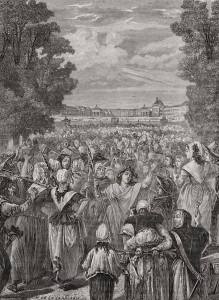
Two hundred and twenty-two years ago today, an angry mob of some 7,000 working women – armed with pitchforks, pikes and muskets – marched in the rain from Paris to Versailles in what was to be a pivotal event in the intensifying French Revolution. To the beat of a drum, the women chanted “Bread! Bread!” – for, despite the fertile French soil, the populace of Paris was starving while the remote Louis XVI and the much-hated Marie Antoinette continued to feast like proverbial kings and queens at their salubrious country gaffe twelve miles west of Paris. The Revolution had begun two months earlier, but neither the Storming of the Bastille, the “Great Fear”, the August Decrees or the “Declaration of the Rights of Man and the Citizen” had thus far managed to topple France’s seemingly intrinsic social and aristocratic Ancien Régime. But the women who set out to Versailles to demand bread from the King were about to change that, and the very course of modern history.
By the time the women reached Versailles, their rage was focussed on Marie Antoinette – whose misattributed response to the plight of the breadless and starving peasants, “let them eat cake”, was nevertheless a wholly accurate indication of her cluelessness. 20,000 French National Guardsmen had been dispatched to protect the royal family, but the mob still managed to break into the palace to search for the Queen – who only narrowly escaped by fleeing to the King’s secure apartments through a secret passageway (two of her bodyguards were not so lucky; their severed heads impaled on pikes served as a clear statement of the mob’s intent). The women then assembled in the palace courtyard and demanded to see the Queen. She eventually emerged, alongside her two children – but the crowd demanded she face them alone. For ten minutes, Marie Antoinette stood on the balcony with her head bowed while the angry throng below screamed and pointed their muskets at her. Remarkably, they did not kill her. Instead, something far more unlikely happened: the miserable masses recognised their strength against the mighty monarchy. The women thenceforth demanded that King Louis XVI distribute bread that the palace had been hoarding, sanction the August Decrees and the Declaration of the Rights of Man and of the Citizen and accompany them back to Paris to see for himself the plight of the city and its citizens. The King had no choice but to agree to the terms. The next day, the royal family Two hundred and twenty-two years ago today, an angry mob of some 7,000 working women – armed with pitchforks, pikes and muskets – marched in the rain from Paris to Versailles in what was to be a pivotal event in the intensifying French Revolution. To the beat of a drum, the women chanted “Bread! Bread!” – for, despite the fertile French soil, the populace of Paris was starving while the remote Louis XVI and the much-hated Marie Antoinette continued to feast like proverbial kings and queens at their salubrious country gaffe twelve miles west of Paris. The Revolution had begun two months earlier, but neither the Storming of the Bastille, the “Great Fear”, the August Decrees or the “Declaration of the Rights of Man and the Citizen” had thus far managed to topple France’s seemingly intrinsic social and aristocratic Ancien Régime. But the women who set out to Versailles to demand bread from the King were about to change that, and the very course of modern history.
By the time the women reached Versailles, their rage was focussed on Marie Antoinette – whose misattributed response to the plight of the breadless and starving peasants, “let them eat cake”, was nevertheless a wholly accurate indication of her cluelessness. 20,000 French National Guardsmen had been dispatched to protect the royal family, but the mob still managed to break into the palace to search for the Queen – who only narrowly escaped by fleeing to the King’s secure apartments through a secret passageway (two of her bodyguards were not so lucky; their severed heads impaled on pikes served as a clear statement of the mob’s intent). The women then assembled in the palace courtyard and demanded to see the Queen. She eventually emerged, alongside her two children – but the crowd demanded she face them alone. For ten minutes, Marie Antoinette stood on the balcony with her head bowed while the angry throng below screamed and pointed their muskets at her. Remarkably, they did not kill her. Instead, something far more unlikely happened: the miserable masses recognised their strength against the mighty monarchy. The women thenceforth demanded that King Louis XVI distribute bread that the palace had been hoarding, sanction the August Decrees and the Declaration of the Rights of Man and of the Citizen and accompany them back to Paris to see for himself the plight of the city and its citizens. The King had no choice but to agree to the terms. The next day, the royal family became prisoners of the Third Estate, or the “common people”, in the Tuileries Palace in Paris until the king and queen were executed in 1791.
The Women’s March brought to an end the great monarchy of Versailles. But, of equal significance, it forever transformed the role of women in revolution and what political gains they could expect for themselves. What immediately followed these events amounted to nothing less than a sub-revolution for the women of France. In the wake of their extraordinary success, they quickly began to organise – and just one month after the March, they would present a groundbreaking demand for equality in The Women’s Petition to the National Assembly. became prisoners of the Third Estate, or the “common people”, in the Tuileries Palace in Paris until the king and queen were executed in 1791.
The Women’s March brought to an end the great monarchy of Versailles. But, of equal significance, it forever transformed the role of women in revolution and what political gains they could expect for themselves. What immediately followed these events amounted to nothing less than a sub-revolution for the women of France. In the wake of their extraordinary success, they quickly began to organise – and just one month after the March, they would present a groundbreaking demand for equality in The Women’s Petition to the National Assembly. orks, pikes and muskets – marched in the rain from Paris to Versailles in what was to be a pivotal event in the intensifying French Revolution. To the beat of a drum, the women chanted “Bread! Bread!” – for, despite the fertile French soil, the populace of Paris was starving while the remote Louis XVI and the much-hated Marie Antoinette continued to feast like proverbial kings and queens at their salubrious country gaffe twelve miles west of Paris. The Revolution had begun two months earlier, but neither the Storming of the Bastille, the “Great Fear”, the August Decrees or the “Declaration of the Rights of Man and the Citizen” had thus far managed to topple France’s seemingly intrinsic social and aristocratic Ancien Régime. But the women who set out to Versailles to demand bread from the King were about to change that, and the very course of modern history.
By the time the women reached Versailles, their rage was focussed on Marie Antoinette – whose misattributed response to the plight of the breadless and starving peasants, “let them eat cake”, was nevertheless a wholly accurate indication of her cluelessness. 20,000 French National Guardsmen had been dispatched to protect the royal family, but the mob still managed to break into the palace to search for the Queen – who only narrowly escaped by fleeing to the King’s secure apartments through a secret passageway (two of her bodyguards were not so lucky; their severed heads impaled on pikes served as a clear statement of the mob’s intent). The women then assembled in the palace courtyard and demanded to see the Queen. She eventually emerged, alongside her two children – but the crowd demanded she face them alone. For ten minutes, Marie Antoinette stood on the balcony with her head bowed while the angry throng below screamed and pointed their muskets at her. Remarkably, they did not kill her. Instead, something far more unlikely happened: the miserable masses recognised their strength against the mighty monarchy. The women thenceforth demanded that King Louis XVI distribute bread that the palace had been hoarding, sanction the August Decrees and the Declaration of the Rights of Man and of the Citizen and accompany them back to Paris to see for himself the plight of the city and its citizens. The King had no choice but to agree to the terms. The next day, the royal family became prisoners of the Third Estate, or the “common people”, in the Tuileries Palace in Paris until the king and queen were executed in 1791.
The Women’s March brought to an end the great monarchy of Versailles. But, of equal significance, it forever transformed the role of women in revolution and what political gains they could expect for themselves. What immediately followed these events amounted to nothing less than a sub-revolution for the women of France. In the wake of their extraordinary success, they quickly began to organise – and just one month after the March, they would present a groundbreaking demand for equality in The Women’s Petition to the National Assembly.


