
Showing posts with label austria. Show all posts
Showing posts with label austria. Show all posts
Friday, July 20, 2012
Marie Louse's Diadem

The King of Rome
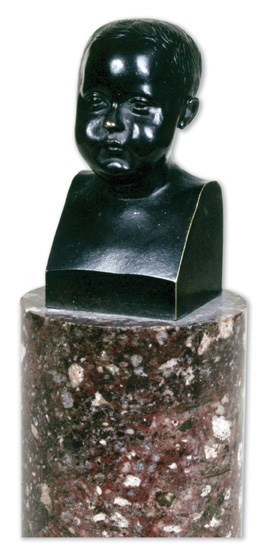
Bust of the King of Rome
Philipp Jakob Treu - c. 1812
This is the only known sculpture of the son born to Napoléon and Marie-Louise in 1811, Napoléon François Joseph Charles, known as Napoléon II and the King of Rome. “King of Rome” is the traditional title for the heir to the Holy Roman Emperor.
Historical Provenance - Caroline Murat family collection
Bronze on marble base
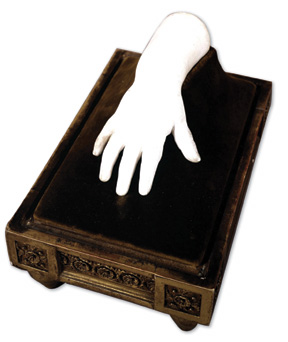
Moulding of the King of Rome’s hand
Made by Dubois, Empress Marie-Louise’s doctor - c. 1814
This was made at about the time that Napoléon saw his son for the last time, at the end of January 1814.
Historical Provenance - Dubois family collection
Plaster
Study for “The King of Rome”
Baron François Gérard - 1812
After a difficult labor, Empress Marie-Louise gave birth to a son, the King of Rome, on March 20, 1811. Napoléon had told the attending doctors that if it became a choice between mother and baby, they should save his wife. He was a doting father who was inordinately proud of his heir. Because his son had French and Austrian blood, Napoléon believed he would reconcile the two countries. Napoléon received the painting for which this drawing was a study while in Russia on September 6, 1812, the day before the Battle of Moskowa. He was very pleased with the portrait and exhibited it in his tent for others to admire. While staying at the Kremlin, he placed the image in his bedroom.
Historical Provenance - Baron François Gérard family collection
Graphite on paper
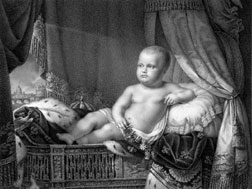
“The King of Rome”
Innocent-Louis Goubaud - c. 1812
In this portrait, Napoléon’s baby son is surrounded by an ermine-trimmed cloak, a crown and other emblems of imperial authority. He confidently plays with a necklace of imperial eagles.
Engraving on vellum
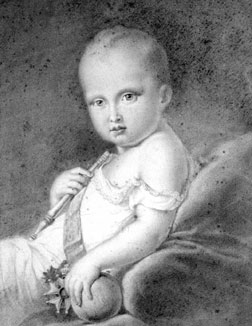
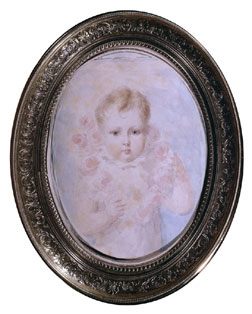
“The King of Rome”
Jean-Baptiste Isabey - c. 1812
The portrait was presented to Madame de Montesquiou, the King of Rome’s housekeeper, by the Empress Marie-Louise.
Watercolor on paper in silver gilt frame
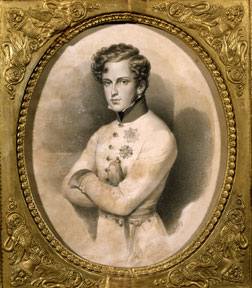
“Duke of Reichstadt”
Louis Léopold Boilly, after Daffinger - c. 1830
After Napoléon’s downfall, his son was taken back to the court of his grandfather, Francis II, in Vienna. There he was renamed Duke of Reichstadt and carefully tutored in Hapsburg history and culture. Although he hoped to someday have a realm of his own, he was to die of tuberculosis in July 1832 at the age of 21.
Historical Provenance - Monstesquiou collection
Indian ink on paper
Friday, July 13, 2012
Eroica
History of dedication
Originally it was intended for Napoleon Bonaparte, but on hearing about his proclamation as Emperor, Beethoven withdrew the dedication.
Inspiration for the "Eroica"
The inspiration to write a symphony about Napoleon Bonaparte probably came from General Bernadotte, the then French Ambassador in Vienna. Jean Baptiste Bernadotte (1763 - 1844), Napoleon’s brother-in-law, General in the French Revolutionary Wars, was made Prince of Pontecorvo by Napoleon I (in 1806), elected Crown Prince by the Swedish Diet and adopted by the Swedish King Charles XIII. It was he who made Sweden join the adversaries of Napoleon and commanded the Northern army during the Wars of Liberation. Beethoven was enthusiastic about Napoleon’s personality and saw in him the political figure that would implement the ideals of liberty, equality and fraternity throughout Europe. He considered him a successor to those Roman consuls who had once brought freedom to Rome and founded the Roman Empire.
Bernadotte offered to hand the finished score to Bonaparte. The title-page already bore the note "intitolata Bonaparte" by "Luigi van Beethoven", when the news arrived that Napoleon had himself proclaimed Emperor of the French. The vote of the Senate about the transformation of France into a hereditary Empire was approved in a referendum. After Pope Pius VII had anointed him, Napoleon crowned himself and his wife Josephine Beauharnais in the Cathedral of Notre Dame in Paris.
Beethoven’s reaction to this news has come down to us through his pupil and confidant Ferdinand Ries.
"Is he, too, nothing but an ordinary human? Now he will trample upon all human rights, indulge in his ambition, will put himself above all others and become a tyrant!"
So he changed his dedication - to Prince Franz Joseph Lobkowitz, in whose palace the first performance took place.
Subscribe to:
Posts (Atom)