Translate

Showing posts with label King Oscar I. Show all posts

Tuesday, August 14, 2012

Oscar's mistress


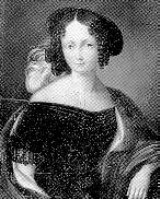
Emilie Sophie Högquist was a Swedish actress and the mistress of Oscar I of Sweden. She was a star of the Royal Dramatic Theatre, the most celebrated dramatic Swedish primadonna of her time, called the Swedish Aspasia, and also famous for her love affairs. She has been called the first female celebrity within Swedish drama.

Background


She was the daughter of Anders Högquist and Anna Beata Hedvall. Her brother Jean also became a famous Swedish actor.

As her father was the butler of count Carl De Geer, Emilie was soon exposed to men from the upper classes. Her mother was the hostess for the ill-reputed "Balls" held to introduce female students from Dramatens elevskola to rich men. Emilie, like her elder sister Hanna, was placed in Dramatens elevskola by her mother in 1821, and acted as a child actor in the child theatre ofAnders Selinder, the Selinderska Barntheatern. At the age of fourteen, she was "introduced" to a rich old man by her mother.

In 1826-1828 she was a part of a travelling theatre company touring the country, and when she returned, she was accepted as a student at the Royal Theatre in Stockholm, making her debut in the play "Qväkaren" in 1828. she was given a contract there at 1831. Her younger brother Jean Högquist (1814–1850), who was also considered to be great talent, followed her there, but his self-destructive way of life made him impossible for the theatre, and Emilie sent him to America. Jean was very close to his sister : he returned in 1846, and when Emilie died, he became so self-destructive that he died only four years later.

Career


Emilie had her breakthrough after the great strike called "The second Torsslow argument" in 1834, when the great star Sara Torsslow left the theatre with her husband. Torsslow had been the most notable "sentimental actress" and comic up till then, and when she left, the theatre had to find a replacement for such roles. They were first given to Charlotta Eriksson, but Eriksson, a star with a different repertoire and expression, was not suited for the parts of Torsslow. Emilie Högvist was now given her chance and immediately excelled. She was received with great enthusiasm in these roles and took over the audience for Torsslow as well as gaining great admiration of her own. Her salary can illustrate her rise in career; in 1835, Emilie Högquist had a vagues of 1.200. As a comparison, the primadonna Henriette Widerberg had a salary of 1.600, and the minimum salary of an actress was 200. 

She was the most celebrated Swedish primadonna of her time, called the Swedish Aspasia; few other dramatic actresses in Sweden before her had enjoyed her popularity and success. Emilie Högquist have been compared to the opera singer Henriette Widerberg, as their lives, personalities and careers were much alike, and she was also to replace Widerberg in many ways, though she is regarded as much more gifted artistically then Widerberg, who was an excellent singer but more talked about for her beauty. 

Her talent was demonstrated through romantic and comical parts. She was very appreciated in so called French salon comedies, a very popular genre of the time. An initial critic to her ability was her weak voice; she herself admitted that she had the "voice of a chicken", but she made the most of it. She was helped with this problem after a student trip to Paris 1836-37, where she was instructed by the French actress Mademoiselle Mars, and when she returned, she was called an ideal of grace and taste, and her earlier "chicken-voice" was replaced by a voice that "caressed the ear". Among her parts were "Qväkaren och dansaren" (The quaker and the dancer) by Scribe, "Shakspears Kär" (Shakespear's love), "Jungfrun av Orleans" (The Maid of Lorraine) by Schiller, Mary Stuart (play) and "Hamlet" and had 125 roles in her repertoire. She also toured in Finland.

Private life


After having a daughter with British diplomat John Bloomfield, 2nd Baron Bloomfield, Emilie made the acquaintance of Oscar, who was at that time heir to the throne. He rented a luxury apartment for her and in time set up a second family with her, close to the royal castle where his queen and legitimate children lived. It is said that the king spent every other night at the castle and every other night with Emilie. With Oscar, Emilie had two sons, Hjalmar and Max. Max was named after Maximilian de Beauharnais, Oscar's brother-in-law (and consequently the queen's brother). The two boys were jokingly referred to as "the princes of Laponia" (Lappland). Max grew up to become a merchant in China, where he died in 1872. Hjalmar died in 1874 inLondon.

Emilies apartment was known for its "Asian luxury". She was a celebrated hostess and held a salon that were quite famous, counting artists and men of important positions among her dinner guests, though it was never visited by female members of the upper classes because of her reputation as a courtesan. During her grand days as a star in the 1840s, she was also active in charity to ease poverty. She was the benefactor of the former primadonna Henriette Widerberg. Her health, however, declined during these years. In the theatre, she was replaced by Zelma Hedin.

Death


Emilie died at age 34 in Turin, Italy, where she had gone to try to cure her ailments, probably tuberculosis and cancer. She was one of the three famous Swedish artistes who were officially celebrated in a memorial in 1847.

Children


With John Bloomfield, 2nd Baron Bloomfield :
  • Tekla, born October 1833


With King Oscar I of Sweden:
  • Hjalmar Högquist, born 18 June 1839 in Hamburg, died 1874 in London.
  • Max Högquist, born 12 August 1840 in Stockholm, died 1872 in China.

In fiction


The love between Emilie Högquist and Oscar I of was Sweden portrayed in the film Filmen om Emilie Högqvist ("The movie about Emilie Högquist") starring Signe Hasso and Georg Rydeberg (1939), one of the most expensive made in Sweden during the 1930s.

Joséphine of Leuchtenberg

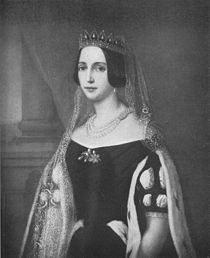
(Joséphine Maximilienne Eugénie Napoléone) (14 March 1807 – 7 June 1876) was Queen consort of Sweden and Norway as the wife of KingOscar I. She was known as Queen Josefina, and was regarded as a politically active consort.

Background


Born in Milan, Italy, she was a daughter of Eugène de Beauharnais, the first Duke of Leuchtenberg, and his wife, Princess Augusta of Bavaria. Her paternal grandmother and namesake was Joséphine Tascher de La Pagerie, the first wife of Emperor Napoléon I of France.

At birth she was given the title Princess of Bologna by Napoléon, and later she was also made Duchess of Galliera.

Princess Joséphine married Oscar I by proxy at the Leuchtenberg Palace in Munich on 22 May 1823. They also conducted a wedding ceremony in person on 19 June in Stockholm. Through her mother (her maternal line of Hesse and upward through Hanau and Ansbach, Baden-Durlach and Kleeburg), Joséphine was a descendant of Gustav I of Sweden and Charles IX of Sweden, thus also making her children descendants of Gustav Vasa, etc. Through her maternal grandfather, she was also one of the descendants of Renata of Lorraine, granddaughter of Christian II of Denmark.

Crown Princess


Six days after her arrival in Sweden, her middle name Napoléonne was removed. This was because Sweden had fought against Bonaparte in the recent war. She had brought with her several pieces of exclusive jewellery made in Paris for her paternal grandmother, which are still among the possessions of the Royal Houses of Sweden and Norway (via Queen Louise of Denmark, née Princess of Sweden and Norway and also via Crown Princess Märtha of Norway, née Princess of Sweden and Norway). In Sweden, she was known by the Swedish version of her name: Josefina.

Joséphine was interested in gardening, enjoyed painting, and was involved in charity and reforms in Sweden. Her interest in art was active and genuine; she greatly supported the career of the painter Sofia Adlersparre, tried to do the same for the sculptor Helena Sophia Isberg, and also encouraged the artistic interest and talent of her own daughter, Princess Eugénie, who became a talented amateur-artist. she was also involved in a several social projects; at her arrival in Sweden, she became friends with Princess Sophia Albertine of Sweden, who introduced her to this work.

In 1824, the crown prince-couple visited Norway and stayed in Oslo, where they engaged in much representation to make the monarchy popular. Already as a crown princess, she was involved in politics as a mediator between her husband and her father-in-law.

Although she was a devout Catholic, she agreed to raise her children in the Lutheran religion. She brought a Catholic priest, and regularly attended mass and confession in her private Catholic chapel. The Pope had given his consent to this. The Lutheran clergy was against the match - queen Désirée Clary was Catholic, but she lived abroad - but the king had his will. Oscar and Josephine had five children, of which two were to become kings of Sweden and Norway.

Her marriage was at the beginning a happy one, unusually so for a royal match, as they shared an interest in culture and had a similar personality, and her husband's unfaithfulness was successfully hidden from her. After she discovered her husband's adultery, however, she was deeply wounded and never really felt happy again. In 1832, she wrote in her diary of her bitterness that a woman was expected to endure a husband's unfaithfulness; A woman should suffer in silence. Her husband's affair with the famed actress Emilie Högquist was well known. In 1835, Josefina and her husband experienced a nine years long separation in their relationship, though this was not official, and they continued to appear together in public. The relationship with her husband was repaired when he ascended to the throne (in 1844), and as a king, he was faithful and they had again a good relationship.

In her charity, Josefina, though deeply religious, did not believe that it was the task of religion, but of the state, to provide welfare, and she did not mix the two. She was, however, also active as a Catholic; in 1837, she had a church built for the Catholic congregation of Stockholm, the first one since the reformation, and she also founded Catholic churches inGothenburg and Oslo.

Queen


In 1844, Josephine became Queen of Sweden and Norway at the accession of her spouse. She was crowned in Sweden 28 September 1844, but not in Norway. In Norway, there was opposition to the coronation of a Catholic; the official reason was that the ceremony was unnecessary, as the queen had no position in the Norwegian constitution.

Josephine was very popular both within the court and with the public from the moment she arrived as crown-princess, and she was more popular as queen than both her predecessor and her successor. She was a success both socially and as a queen consort, and though she remained a devout Catholic, this did not lessen her popularity. She played a great part in making the new dynasty popular in Sweden. She was described as charming, beautiful and with great dignity.

Her closest companions were Bertha Zück, who was responsible for her economy, and her Catholic chaplain and confessor J.L. Studach (d.1873) ; both followed her from Bavaria, and they were called the trio.

The amount of her political influence during her husband's reign is debated. She was pointed out to have acted as her husband's advisor and for having exerted large influence in several matters; in 1848, she tried to prevent the First Schleswig War, in 1855, she was rumoured to be responsible for the treaty between Sweden, Norway, France and Great Britain, and in 1860, she was, according to the rumours, the active force between the new law of freedom of religion; the old version of this law allowed different religious beliefs only if you were born in it; it did not allow for conversion from the Lutheran Faith. She is thought to be the instigator to the laws of equal inheritance for men and women (1845), reforms in the prison and social care and the abolition of the guilds. It is confirmed, that when a crisis occurred, the king and the queen withdrew in private to discuss the matter before the king made a decision. In 1857, her husband became ill; she tried to conceal his condition, and was against her son's appointment as a regent, as he did not wish to allow her any political influence. They showed themselves to the city in a carriage, were the king waved to the public, but Josephine was in fact forced to support and move his hand.

She mourned when Napoleon III of France was dethroned in 1870. In 1873, she visited her sister Amalie in Portugal. The same year, she was moved when she received the public's adoration during the celebration of her fifty years in Sweden. In 1875, she visited the Pope Pius IX in Rome.

Josephine died in Stockholm in 1876 at the age of sixty-nine and received a Catholic burial. Her last words were "I am going home now. I am very happy."

Family and issue


Her children were:
  1. King Charles XV (Charles IV in Norway) (1826–1872)
  2. Prince Gustaf, Duke of Uppland (1827–1852)
  3. King Oscar II (1829–1907)
  4. Princess Eugenie (1830–1889)
  5. Prince August, Duke of Dalarna (1831–1873)


She founded Josefina hemmet (for nursing of poor and handicapped in the catholic church), the institution for nursing of the 'defenseless and fallen', the institution for education of women and the society for 'tender and moral maternity wellfare'