Translate

Saturday, May 17, 2014

NAPOLEON, DIVORCE AND WOMEN’S RIGHTS

HTTP://ARTLARK.ORG/2014/01/10/NAPOLEON-DIVORCE-AND-WOMENS-rights/
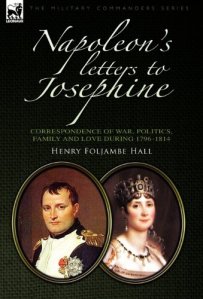
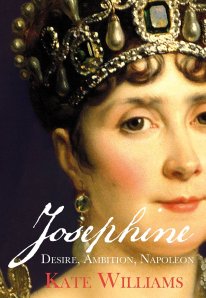
51vKKAg-jALOn the 10th of January 1810, the divorce ceremony of Napoleon Bonaparte and his wife Joséphine was performed as a grand social gathering, with each of the parties reading out a statement of devotion to the each other. A year prior to that, after a tense dinner together, Napoleon had announced to Joséphine that he had his mind set on separation. The emperor had long desired a son who would succeed him and continue the Bonaparte dynasty, but Joséphine, a widow six years his senior and already mother-of-two had been unable to provide him with a heir in their fifteen years together. Although their relationship was an unusual power-struggle with mutual distrust and infidelities, it seemed to have run deep and their separation had a heavy impact on both of them.
Allegedly, upon learning of Napoleon’s decision to divorce, the empress suffered a nervous fit and fainted, and had to be carried back to her chambers by her husband and his aide. The day after the divorce, as she wept at Malmaison, Napoleon went to console her and the couple walked hand-in-hand in the rain. Bonaparte’s  name was on Joséphine’s lips when she died in 1814, aged 51 of pneumonia (but her maid said that she died of grief), and her name was uttered by Napoleon on his deathbed in exile on St Helena seven years later. While in exile on Elba, he read about her death in a journal and is said to have locked himself in his bedroom for two days, refusing to see anyone. He claimed to a friend that “I truly loved my Joséphine, but I did not respect her.”( Felix Markham,  Napoleon, 1992).
81HewPx0abL._SL1417_
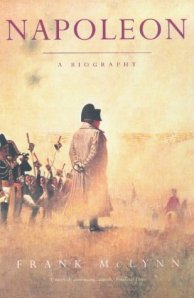
Whilst for most of us love equals respect, just as the rights of men equal those of women, Napoleon had a different view. If these were indeed his words, they were rather telling of his generalised view of women. Proof of which were the laws of his Napoleonic Code, or The French Civil Code 1800-1820, which caused quite a setback to aspirations of female equality. In “The Wife is Obliged”, Napoleon reaffirmed the legal right of men to control women. For instance, a woman could demand divorce only in case the husband moved his concubine into their common residence, but she could not remarry until after 10 months from the dissolution of their marriage! The Code dictated that married women in particular owed their husband obedience in all life matters, and were forbidden from selling, giving, mortgaging or buying property. Napoleon allegedly proclaimed: “Women ought to obey us. Nature has made women our slaves!” This backlash to women’s rights had consequences throughout Europe. In military campaigns, Napoleon carried the Code throughout Europe, where it served as a model to legislators in countries from Italy to Poland. Within France itself, the Code survived basically unaltered for more than 150 years. Only in 1965 did French wives get the right to work without their husband’s permission. Only in 1970 did husbands forfeit the rights that came with their status as head of the family. In many ways, the Code was the most enduring legacy of the French Revolution.
41J4S5Z6MVL
Napoleon’s divorce from Joséphine was in reality a double annulment and the climax of more than two years of speculation, gossip and negotiation which kept leading European courts and governments concerned with France’s innermost troubles. Napoleon and Joséphine both came under intense pressure to ensure the succession of the Bonaparte dynasty; therefore their union was first dissolved in the Senate and finally annulled by the Diocesan and Metropolitan tribunals. “The events during this period not only cover some of the major preoccupations of Napoleon and the French state – dynasty durability and stability, France’s relationships, both with the major political powers on the continent and with the Catholic Church – but also touch on more social issues – the legal basis of marriage in the 19th century – and some of the more complicated aspects of Canon Law.” (Fondation Napoléon 2008)

Tuesday, May 6, 2014

A History of Lingerie


photos:http://www.ecouterre.com/medieval-lingerie-from-15th-century-castle-stuns-fashion-historians/

fashion artifacts, eco-friendly lingerie, sustainable lingerie, eco-friendly underwear, sustainable underwear, Beatrix Nutz, Innsbruck University, Austria, Hilary Davidson, Museum of London, eco-fashion, sustainable fashion, green fashion, ethical fashion, sustainable style

Archaeologists have unearthed several 600-year-old bras that experts say could rewrite fashion history. While they’ll hardly send pulses racing by today’s standards, the lace-and-linen underpinnings predate the invention of the modern brassiere by hundreds of years. Found hidden under the floorboards of Lengberg Castle in Austria’s East Tyrol, along with some 2,700 textile remains and one completely preserved pair of (presumably male) linen underpants, the four intact and two fragmented specimens are believed to date to the 15th century, a hypothesis scientists later confirmed through carbon-dating.fashion artifacts, eco-friendly lingerie, sustainable lingerie, eco-friendly underwear, sustainable underwear, Beatrix Nutz, Innsbruck University, Austria, Hilary Davidson, Museum of London, eco-fashion, sustainable fashion, green fashion, ethical fashion, sustainable style

Unlike female undergarments, male underpants are frequently depicted in medieval imagery.


Want to know how and where lingerie originated? Then look no further, as we have compiled a concise, yet detailed, history for you of how lingerie has developed through the ages into what it is today. My how it has changed.
In one form or another, women have worn garments to support, suppress or accentuate their breasts as far back as 3000BC. Therefore, the modern day bra has developed from Cretan women who wore a hip corset beneath their ceremonial dress, the surcoate worn over the clothes in the middle ages. Depending on the fashions of the time the corset has aided to give shape and definition to the woman’s figure, such as the boyish shape of the Elizabethan & 1920’s.
By the 1500’s the corset elongated the body, flattened and raised the bust while hiding the stomach and hips. When worn with the ‘farthingale’ the wearer had to walk in a sedate gliding fashion. This is also the era of the iron corset - some say worn by Catherine D’Medici’s court as there were strict regulations which correlated a woman’s position in court by her waist size, others say it was for correcting bone deformities.
The corset, commonly known as a ‘stay’, was made of linen with boning and stiffened with paste. Women were then ‘straight-laced’ into them, and the term became synonymous with the pious Puritan women of the 17th century. By the latter part of this century the corsets were more elaborate and it was fashionable to wear them on the outside as in medieval times.
The flamboyant dresses of the 18th century gave way to the simple empire line frock after the French Revolution of 1789. The look did not require heavy corsetry as it kept a more natural shape. The stay was lengthened to shape the hips and thighs, although it is said some ladies wore no corset at all.
By 1825 the high waistline of the Regency style had dropped to a more natural level and corsets became essential to show off an hourglass figure with a desired waist of 18 inches (or less). The Victorian era was the heyday of the corset and advances in design were made through out the century. New metallic eyelets ensured that the tight lacing required to achieve the hourglass figure need not damage the corset. The invention of the sewing machine meant the corset could be produced more quickly than with hand stitching and corsets could be sold ready made. A huge variety of fashion corsets were made and also corsets for maternity, safari, sports, golfing and riding, even for these activities lacing and boning was still used. As corsets were in such demand whalebone became scarce, leading to the use of buffalo-bone, cane, steel, and steam moulding in corsetry.
By the beginning of the 20th century a bust bodices could be worn as an alternative to the corset and this supported the entire bosom as a whole. It was in 1914 when American Mary Phelps-Jacobs, patented her design in the name of Caresse-Crosby. It consisted of two silk handkerchiefs tied together with ribbon to make straps and a seam in the centre front, due to lack of interest, a few years later she sold her idea to Warner’s for $1500-. In 1935 Warner’s introduced the first cup sizing with only A, B &C. Britain continued to use the junior and medium sizing until the 50’s. In 1939 the word bra was added to the English dictionary, it is worth noting the brassiere in French means an infant’s bodice or harness, therefore soutien-gorge is the correct French term for bra.
Throughout the twentieth century the bra has been developed by advancements of man made fabrics such as, nylon, Du ponts’s Lycra, polyester, Elastane microfibres etc. These new fabrics have enabled garments to be lightweight, supportive, flexible and seamless, to have colourful prints and to be easier to wash.
The bra has taken many shapes through out the century. From the conical looks of the 1950’s sweater girls, maximum cleavage bras, sexy lace bras and of course the ‘burn your bra’ ethos of the Women’s Liberation Movement. It is estimated that the lingerie market was worth half a billion pounds at the end of the 1990’s.
The new millennium has seen further advancements in design and fabrics, with many innovative designs now in the market. There are also a number of celebrities who have their own lingerie range. Our own styles have developed and now offer a variety of styles for all occasions from 28-52 back B-K cup sizes.

Tuesday, April 29, 2014

Camelot, stocks and two smoking cauldrons: Guy Ritchie set for King Arthur film

The Sherlock Holmes director is said to be eyeing a new attempt to turn the Arthurian legends into a movie franchise  

  • theguardian.com

Guy Ritchie is in talks to direct a film based on the legend of King Arthur which could be the first of a planned double trilogy of movies, reports Deadline.
Ritchie, these days considered a safe pair of hands in Hollywood following the blockbuster success of his pair of Sherlock Holmes movies, would work from a screenplay by Awake's Joby Harold. The project is being put together at studio Warner Bros, which has been trying to deliver an Arthurian film franchise for a number of years.
One take, titled Arthur and Lancelot, would have seen Game of Thrones' Kit Harington and the US The Killing's Joel Kinnaman in the title roles. It was shelved over budget concerns. Another idea was to remake 1981's Excalibur, with X-Men director Bryan Singer in charge of the cameras.
No details of the plot for Ritchie's film have yet been unveiled. The British director is currently filming The Man From U.N.C.L.E., a big screen remake of the 1960s TV spy show with Henry Cavill, Armie Hammer, Alicia Vikander and Hugh Grant.

Devotion to St George


MONDAY, 28 APRIL 2014


Today is the liturgical commemoration of St George this year - but on that point do look at Fr Hunwicke's post S George??. To mark the feast of the national patron saint here are some late medieval English depictions of him. This was the period in which his cult was widespread and images of him must have been plentiful. However time and chance as well as religious and political upheavels have robbed us of most of them. Those which do survive are often damaged.


File:Saint George and the Dragon alabaster sculpture.jpg 

St George and the Dragon
English polychromed alabaster, 1375-1420
National Gallery of Art, Washington D.C.

Image:Wikipedia 


Altar with St George and the Dragon, presented to Queen Margaret of Anjou, wife of King Henry VI by the first Earl of Shrewsbury, and made in Rouen in 1445. Kneeling at the altar are the Knights of the Garter

This looks similar as acomposition to the statue above,and to such spectaular surviving pieces as the statue of St George which survives in Stockholm, and about which I have posted beforehand in
.

Image: wars of theroses.devhub.com


Medieval glass from St Winnow, Cornwall


Haddon Hall in Derbyshire has this figure, notable for his ginger moustache

Images: aclerkofoxford.blogspot.  

photo

This fine mid-fifteenth century figure of St George, in St Martin Coney Street in York.
Originally in the clerestory of the church the figure survived the bombing of 1942 and has been re-set in a window in the restored south aisle

Image;Steve Day on Flickr 


photo

The figure in its original situation before 1942
Left to right: St Christopher, St Gabriel, the Virgin Mary and St George, with donors below.

Image: jmc4 - Church Explorer on Flickr

If stained glass has been vulnerable to iconoclastic reformers and revolutionaries, not to mention bombs and neglect, so too have been wall paintings. In addition to the one I featured in Medieval Wall paintings uncovered in Wales, here is one of the best surviving examples from England:

St George St Gregory Church Norwich c1500

 St. George, wall-painting in St. Gregory's Church, Norwich, c.1500

Image:Shafe.co.uk 


St George and the dragon (watercolour detail)

St George and the Dragon

This detail is from a watercolour painting by the Great Yarmouth artist Cornelius Jansson Walter Winter (1821-1891), drawn from the wall-painting discovered in St Gregory's Norwich in 1861.
The wall-painting is thought to be one of the finest and most complete medieval depictions of St George to be found in England, and this painting gives an idea of what its original appearance may have been.

Image: BBC - Picture courtesy of the Norwich Castle Museum And Art Gallery


St George pray for us

SATURDAY, 26 APRIL 2014


Strange goings on in Yorkshire


As I understand it last Sunday, Easter Day, there came into being the merger of three Anglican dioceses in Yorkshire to create a new see of West Yorkshire and the Dales. 

This has been done by amalgamating the Diocese of Ripon, founded in 1836, and in recent years styled Ripon and Leeds, whose territory was the western half of the North Riding and the north-eastern part of the West Riding, with the diocese of Wakefield, founded in 1888 - a strip of the central West Riding including Halifax, Huddersfield, Barnsley and Pontefract - and that of Bradford, founded in 1926, which comprised the north-west West Riding up to Skipton and Sedbergh.

Under the scheme the diocese will have three co-cathedrals - Ripon, Wakefield and Bradford plus the recently elevated pro-cathedral in Leeds - and the new Bishop will be assisted by at least two suffragans. the existing diocesan Bishops have retired and the suffragans of Knaresborough and Pontefract have stepped up to take the titles of Ripon and Wakefield respectively. The other West Riding diocese, Sheffield has been left alone. All clear so far?

Now this is my home area, and I can see there was a case for adjusting diocesan boundaries to align with local government ones and social realities and patterns. I can see a case for combining the cities of Bradford and Leeds in one urban diocese, rather like the Anglican dioceses of Birmingham or Manchester, with a cathedral and a pro-cathedral to keep both cities happy. If that were done the rural part of Bradford diocese could be returned to Ripon to create a large, essentially rural/market town diocese, and Wakefield might take in part of the adjacent southern bits of Ripon, and its boundary with Sheffield adjusted in the outskirts of Barnsley. That might well make sense, even good sense.

However what has been done, to my tiny mind, makes no sense whatsoever. There will be a vast new unwieldy diocese, whose people will not know one another. I recall from my days in the Wakefield diocese that the Anglo-Catholic inclined deaneries of Pontefract and Barnsley had little in common with those around Huddersfield and Halifax; when I was on the Diocesan Synod it was a meeting of strangers, guarding our own interests, rather than of a genuine corporate body. 

There will still be three bishops at least, and three cathedrals and a pro-cathedral with their establishments, and doubtless as many Archdeacons etc, not to mention all the diocesan bureaucracy of boards for parsonages, education, ministry..... So the case for economies of scale looks pretty thin.

I am told that one bright idea was to call this monstrosity the diocese of Leeds - until it dawned on the organisers that there is such a body, the Catholic diocese created in 1878 for the West Riding (now minus the fairly recent Sheffield-based diocese of Hallam). Since when did Church of England dioceses have such territorial names as "West Yorkshire and the Dales" rather than using the name of the See city? Since now obviously. How we used to smile slightly, if politely, at the titles of colonial bishoprics such as The Gambia and the Rio Pongos, or even Australian dioceses such as Wangaratta...

There will, I can well imagine, be twenty years of telling parishioners how wonderful this barmy scheme is, despite all the evidence to the contrary, followed by a twenty year long period of divorce and dissolution, back to three separate dioceses...

I know the Church of England has an unfortunate predilection these days for daft ideas - the ordination of women is not a unique aberration - but this one really is a classic. Whoever had this bright idea will, no doubt, get a mitre or an O.B.E. out of it, but they certainly will not deserve it.


THURSDAY, 24 APRIL 2014


Return of the Bourbons in 1814


File:Louis XVIII relevant la France.jpg

Allegory of the Return of the Bourbons on 24 April 1814:Louis XVIII Lifting France from Its Ruins 

A painting by Louis-Philippe Crépin at Versailles

Image:Wikipedia

Today is the two hundredth anniversary of the return of the Bourbon dynasty to France in the restoration of 1814. King Louis XVIII returned to his kingdom at Calais, entering Paris on May 3rd.

In this allegorical painting the King, robed and crowned - he was in fact never to be have a coronation at Rheims due to his physical incapacity - is shown raising a somewhat distree personification of France. He is surrounded by his relatives, with, on the left, the seated figure of Madame Royale, Marie-Thérèse, daughter of King Louis XVI and Queen Marie Antoinette, who had been married to her cousin Louis, Duc d'Angoulème, who stands beside her, and who was the elder son of the King's younger brother Count of Artois, the future King Charles X, who was acting as Lieutenant -General of the Realm in anticipation of King Louis' return.

At Burton Constable Hall in Yorkshire there is a small painting of the return of the French royal family which is not an allegory but appears to be a more direct, if dramatic, representation of the return. In it the seated King Louis XVIII and Madame Royale are presented with three lilies, symbolic of the kingdom whilst still on board their ship, the Royal Sovereign. A fascinating little picture to find amongst the other treasures of that very interesting country house.


The Arrival of King Louis XVIII of France in Calais in 1814 

The Arrival of King Louis XVIII at Calais in 1814

Edward Bird (1772-1819)

Image: BBC Your Pictures

The misfortune of France, in my opinion, since 1814 is that the Restoration celebrated in these images was not to last - consolidated under King Louis XVIII, jeopardised by King Charles X and his advisors, but not such that it might not have endured it was to be followed by a whole series of constitional experiments from 1830 onwards that have done little for the country, and at times its survival has indeed been in question. It is the enduring strengths of France, and they are far older than anything set off in 1789, which have enabled it to survive, and it is those which attract me on my visits.

Vive le Roi!


WEDNESDAY, 23 APRIL 2014


The Martyrdom of St George


This year we get, in effect, two celebrations of St George. Today, April 23rd is his usual feast day, and most people who do so at all will recall that this is indeed the day of our national patron, and might fly his flag or, even, wear a red rose in his honour. However this year today is also Wednesday in Easter Week, and therefore St George is displaced liturgically until next Monday. Not being too phased by such matters, and I assume St George himself is n't, it gives me a potential opportunity to post about him twice.

As today is the calendric anniversary of his martyrdom here is a fourteenth century depiction of that event, which is both afine example of its period and an intersting visual source for its own time:


The Beheading of Saint George 

Altichiero da Zevio circa 1380 

Oratorio of San Giorgio, Padua

Image: lib-art.com
I have posted on several occasions about St George and his cult as can be seen at St George's DayOrders of the DayHymn to St GeorgeSt GeorgeSt George and the DragonSt George at FordingtonPraying to St GeorgeSt George in art - dragon slaying and martyrdomRelics of St GeorgeSt George Altarpiece andMedieval Wall paintings uncovered in Wales.


TUESDAY, 22 APRIL 2014


Observing the Triduum in Oxford


I kept the Triduum here in Oxford, principally at the Oratory but also with some time spent at Blackfriars.

I began with the Dominicans by attending Tenebrae there on Maundy Thursday morning, something I usually do, but this year I was able to attend the service on both Good Friday and Holy Saturday as well. In the rather austere but elegant setting that is the church at Blackfriars - an excellent composition in Perpendicular style from just under a century ago, the singing of the psalms and propers and the gradual extinguishing of the candles on the tenebrae hearse is always striking and thought provoking in the right way, as well as the prostrations of the cantors at the conclusion of the Office.

After time sitting in front of the computer getting this blog up to date or even prepared in advance, I went to the Oratory for the liturgy of Maundy Thursday. I think the congregation was rather larger than in previous years, although perhaps fewer stayed to participate in the watch at the Altar of Repose. I did stay - I am able to do so being free of family or other commitments so it is something I can offer - even if like the Apostles I have to fight drowsiness, and found myself meandering more than usual in reciting the Rosary - and am glad that I can do that on behalf of others. The chapel of the Sacred Heart had been transformed to the Altar of Repose with particular elegance I thought - not too fussy, but very dignified with standard candles flanking the space immediately in front of the altar.

Good Friday began at Blackfriars - looking especially plain after the stripping of the altar - and then after a visit to the Oratory to see if any help was needed ( the standing Crucifix that is set up each year in the forecourt was still awaiting installation as the supporting btrackets were temporarily mislaid, so I could not help with that as I have in  past years - nonetheless it was in place by the afternoon), I had one of my small collations for the day before going back for the Solemn Liturgy.

This always attracts large numbers - and they may again have been up. I think more than usual of the ladies in the congrgation were dressed in black as for a funeral, and some men were wearing black ties - I have managed to mislay mine, so I was unable to do so.The Veneration of the Cross moved quickly, and the whole liturgy was accomplished with dispatch - as one does rather expect there.

After a restorative pot of tea I went back to the Oratory for the Stations of the Cross which concluded with the blessing of individuals with a relic of the True Cross.

Holy Saturday started at Blackfriars again with Tenebrae, then I was back to the Oratory, which was having a more than usually thorough spring-clean with Fr Provost hoovering down the accumulated dust on the clerestory window sills, to sit in the porters's lodge and deal with enquiries and sales before midday.

I then broke off to meet some new Irish friends and to give a tour of Newman's Oxford, taking them to Trinity, St Mary's and Oriel before having a very enjoyable lunch with them.

Then back to the Oratory, another session portering, followed by making my Easter confession and attending Vespers at Blackfriars, and having a meal to set me up for the Vigil.

For this I was again at the Oratory, and I think the congregation, always a large one for this liturgy, was bigger than in previous years. As I said last year I do slightly regret that due to practical necessities in a parish church the shorter form of the Exsultet is sung and that we only have four Prophetic readings rather than seven, but this was a splendid celebration, with four baptisms and two receptions into the Church.


DSCF3822

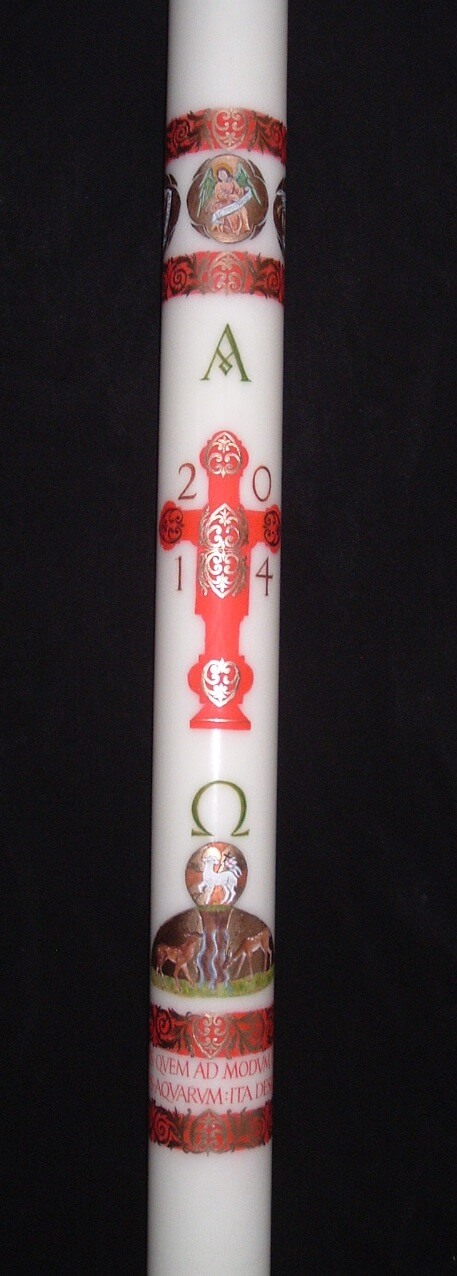
The Oratory Pascal Candle for 2014
Designed and painted by Mrs Freddie Quartley

Image: Oxford Oratory

As I walked home I was surprised to see lights on in the church of St Thomas - my old haunt as churchwarden - and then saw a great procession of the faithful - Orthodox as I realised - who were walking round the church and bearing candles as part of their liturgy. I was delighted to see the church being used by the Orthodoc community - I am not sure which one, but they were alarge crowd.

Easter morning I was at the last minute arriving at the Oratory - my fault entirely - so I had to stand for the whole of the Solemn Mass, but I felt numbers were again slightly up, though it is not easy to say definitely on a day when so many crowd into the church, or indeed in some cases had to stand outside. All was very splendid, the choir supported by an orchestra and the Mass  ended, as is our custom, with the Hallelujah Chorus. Then round to the parish social centre for a celebratory gin and tonic...

Solemn Vespers was, again as is the custom, sung by the Oratorians and with the Choir responding, and again suitably splendid. For Easter Day the church looked very fine with the best altar hangings, ornaments - including the figure of the Resurrected Lord above the Tabernacle - and flowers.

All in all a fine celebration of the Triduum, and for all the work involved, a sense that it is pity it is all over until next year. Meanwhile we can, and should, enjoy Eastertide. Once again, a happy Easter to you all.

IMG_2074 - Version 2

The figure of the Resurrected Lord at the Oratory

Image: Oxford Oratory 

MONDAY, 21 APRIL 2014


Happy birthday Ma'am


Today is the 88th birthday of Her Majesty The Queen, and this is a way for me to express loyal greetings and good wishes to her on the occasion.


H.M. The Queen
A Golden Jubilee photographic portrait
Image:onelondonone

It is an obvious and well-worn cliché to say that the world has changed much in the years since 1926, but that the Queen has remained a constant in our national life - it is true, but it is a very familiar notion in writings about such anniversaries. One might add that both she and the institution she embodies have over her lifetime shown an adaptability, but also a stamina and an endurance, that is both impressive in an individual and in a ruling mechanism.

Less frequently pointed out is the centrality of that ability to the process of monarchy at all times and in all nations. On occasion that skill has been neglected with serious, even disastrous results. The tragedy of some nations - far too many indeed - has been the abandonment of the system for the failings of an individual or their advisors.

That, happily, has not been the case with Queen Elizabeth II. She continues to display not only skill as a Sovereign but seemingly, an enviable zest for life. Long may she reign, happy and glorious.

SUNDAY, 20 APRIL 2014


He is Risen, Alleluia


Christ is Risen! Alleluia!

Resurrection Raffaelino del Garbo 1510 He is Not Here: for He is Risen, as He Said.

The Resurrection
Raffaellino del Garbo (1466/76 - 1527)
Painted in 1510 for the abbey of Monte Oliveto, now in the
Galleria dell' Accademia, Florence

Image: theanglocatholic.com


A happy, blessed and joyful Easter to you all

He is Risen Indeed! Alleluia!