1.) Napoleon Bonaparte was born on August 15, 1769 in the island of Corsica and died in May 5, 1821 at the age of 51.
2.) Autopsy report concluded that Napoleon died of stomach cancer but some scientists believed he was poisoned with arsenic.
3.) Forensic samples of Napoleon’s hair did show high levels which is 13 times the normal amount of the element.
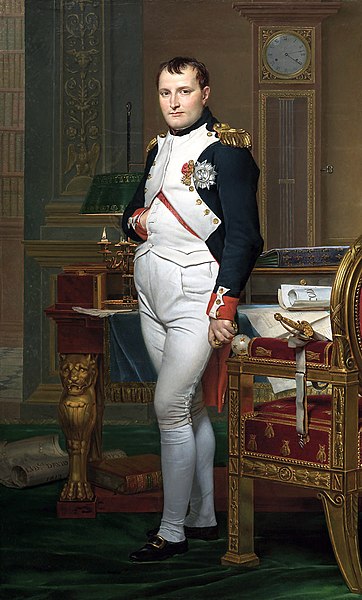
4.) Napoleon was one of the greatest military commanders in history. Oftentimes portrayed as a power hungry conqueror, this strong and ambitious man is indeed one of the greatest.
5.) Before going any further, maybe you would like to know one of the darkest secrets of Napoleon Bonaparte – this great man sufferedfrom hemorrhoids – a condition which is highly considered disgusting during his days.
6.) Napoleon’s legal reform, the Napoleonic Code, was influential on many civil laws jurisdictions worldwide.
7.) His military campaigns are studied extensively at military academies from all over the world.
8.) Napoleon’s father, Carlo Maria Buonaparte or Charles-Marie Bonaparte, was a Corsican politician and lawyer.
9.) Napoleon had 12 siblings, 7 of them survived until adulthood.
10.) His elder brother, Joseph-Napoleon Bonaparte was King of Naples and Sicily for two years from 1806 to 1808 and King of Spain and the Indies as Joseph I of Spain from 1808 to1813.
11.) Napoleon’s sister, Elisa Bonaparte – princess of Piombino and Lucca, then Grand Duchess of Tuscany, was his only sister to possess real political power.
12.) Lucien Bonaparte, Napoleon’s younger brother reigned as Prince of Canino from 1814 to 1840 and Prince of Musignano 1824 to 1840.
13.) His brother, Louis Bonaparte reigned as King of Holland for 4 years from 1806 to 1810. He was the father of Napoleon III, the last emperor of France.
14.) Napoleon III, who was born Louis-Napoleon Bonaparte was napoleon’s nephew and was the President of the French Second Republic and as Napoleon III, the ruler of the Second French Empire.
15.) Napoleon’s nephew by sister Elisa, Camerata-Passionei di Mazzoleni, one of the maitres des requetes au Conseil d’Etat, committed suicide at the age of 26 after being prevented from marrying an actress.
16.) Napoleon’s nephew by Lucien, Louis Lucien Bonaparte, served two brief terms in the Assembly as representative for Corsica in 1848 and for the Seine departments in 1849.
17.) Pauline Bonaparte, Napoleon’s sister who reigned as Duchess of Guastalla, was the only Bonaparte sibling to visit Napoleon on his principality at Elba.
18.) Prince Achille Murat or Achille Charles Louis Napoleon, Crown Prince of Naples, Hereditary Prince of Berg, 2nd Prince Murat was a nephew of Napoleon to her sister who became mayor of Tallahassee in the United States.
19.) Jerome Bonaparte, the youngest brother of Napoleon, reigned asFrench Prince, King of Westphalia and1st Prince of Monfort.
20.) Napoleon Joseph Charles Paul Bonaparte, Napoleon’s nephew by his brother Jerome was elected to the National Assembly as a representative of Corsica.
21.) Napoleon Joseph Charles Paul Bonaparte was buried at Les Invalides, Paris – the capital of France.
22.) Napoleon’s grandnephew to his brother Jerome Charles Joseph Bonaparte served as US State Secretary of the Navy and US Attorney General. Jerome Joseph Charles founded the precursor of the FBI or Federal Bureau Investigation in 1908.
23.) Charles Napoleon who was born in 1950 as Charles Marie Jerome Victor Napoleon Bonaparte or Charles, Prince Napoleon, is the great-great-grand-nephew of Napoleon, is a French politician. He considers himself as male heir to the rights and legacy established by Napoleon, his great-great-grand-uncle.
24.) Napoleon’s great-great-great-grand-nephew Jean Christophe, Prince Napoleon, titular 7th Prince of Montfort (Jean Christophe Louis Ferdinand Alberic Napoleon Bonaparte; 11 July 1986) is a claimant to headship of the House of Bonaparte.
25.) Napoleon’s father was a gambler and when he died of stomach cancer in 1785, left his surviving wife and eight children penniless.
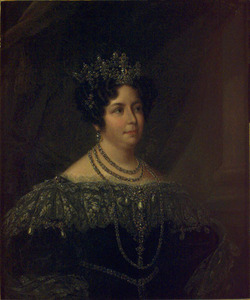
26.) Napoleon’s mother Letizia, whose father was a Captain of Corse Regiments of Chivalry and Infantry in the Army of the Republic of Genoa, was not formally educated.
27.) Napoleon’s mother died in 1836 at the age of 85 in Rome just 3 weeks before the 50th anniversary of her husband’s death.
28.) Napoleon’s mother was nearly blind when she died and had outlived him by 15 years.
29.) Maria Letizia Ramolino, Napoleon’s mother, was only 14 when she married Carlo Buonaparte.
30.) Napoleon’s eldest brother was also named Napoleon. The former did not survive adulthood.
31.) Napoleon was a Roman Catholic but did not believe in the existence of a living God.
32.) Napoleon spoke with a marked Corsican accent and was teased by other students for this and he never learned to spell properly.
33.) Bonaparte was good in mathematics and was fairly well acquainted with history and geography.
34.) Napoleon took the pride and honor for being the first Corsican to graduate from the Ecole Militaire.
35.) His capture of the City of Toulon led to his promotion to Brigadier General at the age of 24 and was put in charge of the artillery of France's Army of Italy.
36.) Napoleon was engaged to Desiree in April 1795. She was presented to him by his brother Joseph.
37.) Her complete name is Bernardine Eugenie Desiree Clary a Frenchwoman who became Queen of Sweden and Norway as the consort of King Charles XIV John.
38.) Napoleon was also a writer; he wrote a romantic novella entitled Clisson et Eugenie. The story was about a soldier and his lover, in a clear parallel to his own relationship with Desiree.
39.) Napoleon Bonaparte marched to Venice and forced its surrender and ending its 1,100 years of independence. Napoleon also authorized the French to loot treasures such as the Horses of Saint Mark.
40.) On 15 September, Bonaparte was removed from the list of generals in regular service for his refusal to serve in the Vendee campaign. He then faced a difficult financial situation and reduced career prospects
41.) In Bonaparte’s Italian campaign, his army captured 150,000 prisoners, 540 cannons and 170 standards.
42.) The French army fought 67 actions and won 18 pitched battles through superior artillery technology and Bonaparte’s tactics.
43.) Napoleon’s Egyptian expedition of 1798 included a group of 167 scientists: chemists, geodesists, mathematicians and naturalists and their discoveries included the Rosetta Stones.
44.) The ‘attack of Jaffa’ on March 3-7, 1799 was brutal; Bonaparte, ordered the garrison and 1,400 prisoners were executed by bayonet or drowning to save bullets. Men, women and children were robbed and murdered for three days
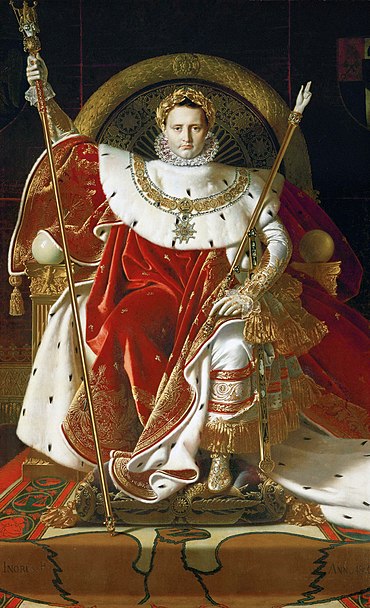
45.) As the most powerful man in France, Napoleon used the title ‘First Consul’. This title lapsed when in December 1804 had himself crowned as emperor.
(Carlo Bounaparte)
46.) One of Napoleon’s greatest achievements was the establishment of the Banque de France or central bank.
47.) The story that Napoleon seized the crown out of the hands of Pope Pius VII during his coronation as emperor to avoid his subjugation to the authority of the pontiff is absolutely false.
48.) Napoleon sold to the United States their French possession – the so-called Louisiana Purchase for less than three cents per acre or $7.40 per km².
49.) Bonaparte was a military and political leader during the latter stages of the French Revolution.
50.) Napoleon Bonaparte’s first wife was Josephine de Beauharnais. She was the first Empress of the French.
51.) Josephine and Napoleon were married in 1796 but she did not bear Napoleon any children which resulted to a divorced in 1810.
52.) Before Josephine became the wife of Napoleon, she was the mistress of several leading political figures in France.
53.) Josephine was beautiful but his mouth is always shut so as not to reveal her halitosis or ‘bad breath’.
54.) Many of Napoleon’s letters to his wife Josephine are still intact today.
55.) When Napoleon left Josephine for a military campaign in 1796, Josephine started an affair with a handsome Hussar lieutenant named Hyppolyte Charles.
56.) Before Napoleon met her first wife, she had been known as “Rose”. He doesn’t like it and called her “Josephine”.
57.) Josephine was known to have many lovers and was reputedly well practiced in the arts of lovemaking.
58.) Having learned of his wife’s infidelity, during the Egyptian campaign of 1798, Napoleon Bonaparte started an affair of his own with Pauline Bellisle Foures, the wife of a junior officer who became known as "Napoleon's Cleopatra."
59.) Napoleon also had an affair with Elisabeth le Michaud d'Arcon de Vaudey, a very pretty woman and was the cause of a violent scene between the Emperor and his wife shortly before their coronation.
60.) In March 1810, Napoleon married Marie-Louise of Austria by proxy; the formal ceremony took place at the Louvre on April 1, 1810
61.) Marie-Louise was 18 years of age when she married Napoleon.
62.) Marie-Louise baptismal name was Maria Ludovica Leopoldina Francisca Theresa Josepha Lucia….whew… that’s quite long.
63.) Napoleon’s 2nd wife was a polyglot being fluent in many languages such as English, French, Italian, Latin and Spanish aside from her native German.
64.) After Napoleon and Marie-Louise wedding ceremony, 13 cardinals were imprisoned for non-attendance at the marriage ceremony.
65.) Napoleon also intended and tried to marry the Grand Duchess Anna of the House of Romanov, younger sister of Tsar Alexander I of Russia but his proposal was rejected.
66.) Napoleon abdicated his throne in April 1814 and was exiled to Elba, Marie Louise returned to Austria and never seen her husband again.
67.) As Napoleon I, he was Emperor of the French from May 18, 1804 to April 11, 1814 for a period of 9 years, 328 days.
68.) Napoleon Bonaparte was crowned emperor on December 2, 1804.
69.) He was Emperor of the French again on March 20, 1815 up to June 22, 1815 which lasted for 94 days only. And his full title was His Imperial Majesty Napoleon the First, By the Grace of God and the Constitutions of the Republic, Emperor of the French.
70.) As King of Italy, he reigned from March 17, 1805 to April 11, 1814. He was crowned king on May 26, 1805.
71.) Napoleon’s full title from 1804 to 1805 was His Imperial and Royal Majesty Napoleon the First, By the Grace of God and the Constitutions of the Republic, Emperor of the French.
72.) From 1805 to 1806, his full title was His Imperial and Royal Majesty Napoleon the First, By the Grace of God and the Constitutions of the Republic, Emperor of the French, King of Italy.
73.) Napoleon’s full title from 1806 to 1809 was His Imperial and Royal Majesty Napoleon the First, By the Grace of God and the Constitutions of the Republic, Emperor of the French, King of Italy, Protector of the Confederation of the Rhine.
74.) From 1809 to 1814, his full title was His Imperial and Royal Majesty Napoleon the First, By the Grace of God and the Constitutions of the Republic, Emperor of the French, King of Italy, Protector of the Confederation of the Rhine, Mediator of the Helvetic Confederation.
75.) Napoleon II, his son, reigned as Emperor of the French from June 22, 1815 to July 7, 1815 for a period of 15 days only.
76.) Napoleon II was never aware at the time that he had been proclaimed Emperor in his father’s abdication.
77.) The complete name of Napoleon’s eldest legitimate son is Napoleon François Joseph Charles (Bonaparte), Duke of Reichstadt. He was born on March 20, 1811.
78.) Napoleon II was Prince Imperial, but he was also known from birth as the King of Rome.
79.) Franz died of tuberculosis at a very young age on July 22, 1832.
80.) The famous German composer and pianist Ludwig van Beethoven was Napoleon’s long-time admirer but when he gets disappointed at Napoleon’s turn towards imperialism, Beethoven scratched his dedication to Napoleon from his 3rd Symphony.
81.) Napoleon had two illegitimate children that he acknowledged; Charles Leon by Eleonore Denuelle de la Plaigne and Count Alexandre Joseph Colonna Walewski by Countess Marie Walewska.
82.) Maria Countess Walewska was a Polish noblewoman and a well-known mistress of Napoleon who later married one of the influential Napoleonic officers.
83.) Count Alexandre Joseph Colonna Walewski, who was born in 1810 and died in 1868, became a Polish and French politician and diplomat.
84.) His other illegitimate children were Karl Eugin von Muhlfeld by Victoria Kraus, Helene Napoleone Bonaparte by Albine de Montholon; and Jules Barthelemy-Saint-Hilaire whose mother is still unknown.
85.) Albine de Montholon was Napoleon’s reputed mistress who stayed with him during his final years of exile on Saint Helena.
(The nose of the Sphinx was severely damage because French soldiers made it a target for shooting.)
86.) His illegitimate son Jules Barthelemy-Saint-Hilaire became a philosopher, journalist and statesman.
87.) Stories telling that Napoleon was a very small guy are absolutely false. The British Tory press sometimes depicted Napoleon as much smaller than average height, and this image persists.
88.) Napoleon Bonaparte was about 1.7 meters or 5 ft 7 in tall, an average height during his period.
89.) The construction of the Arc de Triomphe, a popular tourist attraction in Paris, was commissioned by Napoleon to commemorate his victory over the combined forces of Austria and Russia at Austerlitz putting an end to the “Third Coalition”.
90.) The Battle of Borodino is the bloodiest day of battle in history which resulted in approximately 44,000 Russian and 35,000 French dead, wounded or captured.
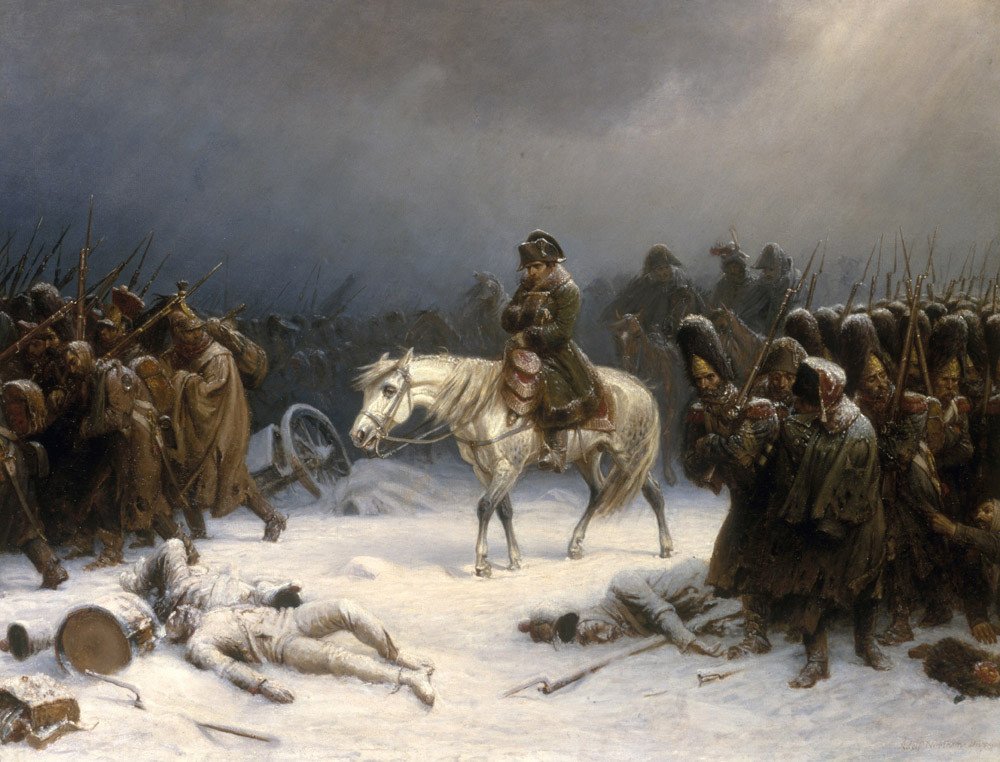
91.) During the French Invasion of Russia, Napoleon’s Grand Army had begun as over 400,000 frontline troops, but in the end fewer than 40,000 crossed the Berezina River in November 1812. The Russians had lost 150,000 in battle and hundreds of thousands of civilians.
92.) The Battle of Leipzig was the largest battle of the Napoleonic Wars and cost more than 90,000 casualties in total
93.) Napoleon was forced to abdicate unconditionally on April 11, 1814.
94.) Napoleon attempted suicide with a pill he had carried since a near-capture by Russians on the retreat from Moscow. Its potency had weakened with age, and he survived to be exiled.
95.) Napoleon’s defeat at the Battle of Waterloo on June 18, 1815 put an end to his rule as Emperor of the French and marked the end of his Hundred Day’s return from exile.
96.) Napoleon died in St. Helena on May 5, 1821. Napoleon’s last words were, “France, armee, tete d'armee, Josephine - "France, army, head of the army, Josephine."
97.) The alleged poisoner of Napoleon was Charles Tristan, marquis de Montholon.
98.) In Napoleon’s will, he have asked to be buried on the banks of the Seine, but the British governor said he should be buried on St. Helena, in the Valley of the Willows. Napoleon’s tomb at St. Helena was nameless.
99.) After 19 years, Napoleon’s remains were return to France in 1840 upon the request of Louis Phillip to the British government and a state funeral was held in on December 15, 1840.
100.) In 1861, his remains were entombed in a porphyry sarcophagus in the crypt under the dome at Les Invalides.
101.) Napoleon’s body was found to be remarkably well-preserved when moved in 1840. Experts say that arsenic is a strong preservative and therefore this supported the poisoning hypothesis.
102.) The type of arsenic found in Napoleon’s hair shafts is the most toxic and according to toxicologist this supported the conclusion Napoleon’s death was murder.
103.) In 2008, researchers studied and analyzed samples of Napoleon’s hair from throughout his life, and from his family and other contemporaries. All samples had high levels of arsenic, approximately 100 times higher than the current average.
104.) Based on the above-mentioned researched, Napoleon's body was already heavily contaminated with arsenic as a boy, and the high arsenic concentration in his hair was not caused by intentional poisoning.
105.) The 2007 and 2008 studies dismissed evidence of arsenic poisoning and confirmed evidence of peptic ulcer and gastric cancer as the cause of death of Napoleon.
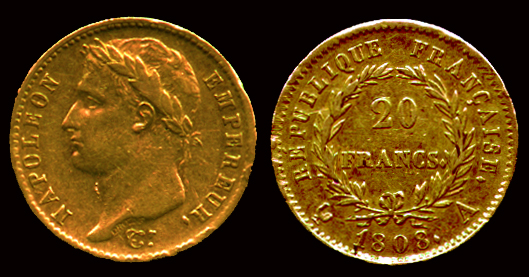
Gold 20 Franc Coin of Napoleon I, struck 1808
106.) Numerous towns, streets, ships, and even cartoon characters have been named after Napoleon since he died.
107.) Napoleon is said to be the world’s most portrayed person in films. He has been portrayed in hundreds of films and discussed in hundreds of thousands of books and articles.
108.) Napoleon is regarded as a genius in the operational art of war and historians rank him as a great military commander. He was never defeated in a battlefield without being heavily outnumbered.
109.) The Duke of Wellington, when asked who was the greatest general of the day, he replied; "In this age, in past ages, in any age, Napoleon”.
110.) Because of Napoleon’s favorable statements to the Jews, the Russian Orthodox Church condemned him as “Antichrist and the Enemy of God”.
111.) Napoleon’s nephew, Louis, became Napoleon III, Emperor of the Second French Empire and was the First France’s President.
112.) Napoleon’s decision to reinstate slavery in France’s oversea colonies is controversial and had badly affected his reputation.
113.) Paris is the most visited city in the world. Major attractions on this French city are museums, museums that contain art stolen by Napoleon’s forces from across Europe.
114.) On Napoleon’s comparison to Hitler, Napoleon’s historian, David G. Chandler wrote that, “Nothing could be more degrading to the former and more flattering to the latter”.
115.) By Napoleon’s critics and opponents, he is considered a tyrant and a usurper.
Read more: http://www.bukisa.com/articles/481959_100-interesting-and-controversial-facts-about-napoleon-bonaparte#ixzz1ydCpBymE