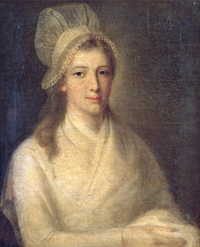
Antoine Dubois (1756-1837),
baron of the Empire
by Xavier Riaud(*), FINS

Antoine Dubois (Corlieu, 1896, © BIUM).
Antoine Dubois was born on June 19, 1756 at Gramat in the Lot area. He started his studies in a secondary school in Cahors called the Collège des Carmes but soon, left for Paris where he registered in the Collège des Quatre-Nations. Upon his father’s death, he had to work to finance his studies. He first decided to take holy orders but changed his mind and started studying medicine and surgery. He found himself working under the leadership of Sabatier and Sue, was Desault’s student for a while and became Peyrilhe’s favourite. He succeeded to combine his studies with his math and latin lectures that he gave the night and which allowed him to finance his studies and help his family on a daily basis. In 1790, he finally got his Master’s degree in surgery and defended his thesis.
He opened a dental office in the capital city. Alongside his profession, he was an anatomy demonstrator in university and a professor in the Practical School of dissections and operations at the College of Surgery. In 1791, he took the position of Sue who had previously retired, and became professor of anatomy in the Royal School of Surgery. That same year, he was also elected as a member of the Academy of Surgery (Ganière, 1988;http://fr.wikipedia.org , 2010).
When the Revolutionaries abolished the medical schools, Dubois saw his financial situation quickly deteriorating. He contacted Danton who allowed him to get a position in Melun’s military hospital. In the following years, he entered the Health Council and became the chief surgeon of Perpignan’s military hospital where, as soon as he arrived, he had to face a dysentery epidemic that he had to stop (Ganière, 1988). During the Terror period, his titles and influence allowed him to save many friends from being killed. It was the case of Bourdois de La Motte who was the soon-to-be doctor of the King of Rome and whom he saved in 1793 (No Author, 2010).
In 1795, he went back to Paris. He was promoted professor of anatomy and physiology in the Ecole de Santé which had just opened. In 1796, he succeeded Desault and held the position of professor of clinical surgery. In 1798, Bonaparte made him in charge of the medical sciences within the scientific team that he planned to bring with him during his campaign in Egypt. Dubois was at the head of 108 surgeons during the campaign (http://fr.wikipedia.org , 2010). On April 18, the doctor embarked for Toulon in the flagship called l’Orient (Ganière, 1988; Dupont, 1999). Upon his arrival in Alexandria, with Dominque Larrey’s help, he treated General Kleber who had been wounded when he besieged the city. After Cairo’s fall, Bonaparte had him integrating the Physics department of the “Institut d’Egypte” on August 22 ( http://fr.wikipedia.org , 2010). On February 8, 1799, Dubois was repatriated to France for health reasons. Indeed, he suffered from vesicle stones and his state worsened. Once in France, he went back to his former business. Still professor at the Ecole de Santé, he then held the position of surgeon of the 33 rd brigade of the National Guard. In 1802, he became the chief surgeon of the hospice of the Faubourg Saint-Denis, the current Fernand Widal Hospital. He was so appreciated by the Parisians that this place will take the nickname of the Nursing Home of Doctor Dubois ( http://fr.wikipedia.org , 2010).
In 1804, despite the fact that he was reaching the climax of his professional glory, that he was 48 years old and that he was appreciated by the new Emperor, he was however not yet summoned as Napoleon’s first surgeon. Indeed, his rival and yet friend, Corvisart conceded that Dubois had not been chosen because « the Emperor’s favourite doctor » wanted to keep for himself that power and was afraid losing it (Ganière, 1988). And yet, in 1808, Corvisart gave him the opportunity to be the only doctor of the Imperial court with fees amounting to 3 000 francs per year. In 1810, he became the Empress Marie-Louise’s obstetrician. The pregnancy went well. However, it was not the same for the delivery so much so that Dubois who was panicking even considered to sacrifice the child who did not seem well. The Empress suffered a lot and Dubois panicked. In front of such a scene, Napoleon got angry and demanded the surgeon to calm down. The latter finally succeeded in helping Marie-Louise to give birth. Yet, with respect to what the delivery proved to be, Dubois did not hesitate to declare that the young woman would never be able to have other children. The future incidents proved that he was wrong (Ganière, 1988 ; Dupont, 1999).
The birth of the King of Rome was such an event that Dubois was constantly the object of praise. Indeed, to his first remuneration amounting to 100 000 francs, 15 000 francs were added and which were planned for the delivery. He also received honors since he was promoted to the rank of Knight of the Légion d'honneur and was made Baron of the Empire with a private income of 4 000 francs which was soon raised to 9 000. Marie-Louise was not the least to do the same since she offered him jewels (Ganière, 1988; http://fr.wikipedia.org , 2010).
When Louis XVIII came back to power, Dubois lost his private income but the new king offered him a 1000 franc pension per year and allowed him to keep his position as consultant to the Court. He also kept his position in la Maison de Santé. In 1820, during the creation of the Academy of Medicine, he sat in the Surgery branch. He was also promoted professor of obstetrics at the hospice of the maternity hospital. When, on February 13, 1820, the Duke of Berry was wounded to death during an attack, he was among the doctors who tried to save him but in vain. This failure was the cause of the many reproaches made by the royal family to the doctors whom they considered as guilty of the Duke’s death (Ganière, 1988).
In 1822, following student demonstrations, Dubois was dismissed but kept his honorary membership. On May 5, 1829, Dubois was summoned to hold again the position as professor of clinic surgery of the Hôpital de la Pitié. In 1830, he became the dean of the Faculty of Medicine. He was unanimously appreciated. Besides, Louis-Philippe rewarded him with the insignias of Officer of the Légion d’Honneur. In 1831, Dubois retired from medicine. In 1833, he renounced all his positions (Ganière, 1988 ; http://fr.wikipedia.org , 2010).
Sick and wickened by his problems of vesicle stones from which he never really recovered, he suffered from jaundice in 1836. On March 30 1837, he died from pneumonia that he caught the previous winter (Ganière, 1988 ; Dupont, 1999).
He did not publish much. Only a few articles mainly in the Dictionary of Medical Sciences (Dictionnaire des sciences médicales ) are rare testimonies of the doctor’s gigantic talent. Moreover, he improved some medical devices such as the forceps. In front of the School of Medicine, he built a hospital which still bears his name today. A street across the School of Medicine in Paris also bears his name. Finally, his funeral oration took place in the Academy of Medicine in 1849 ( http://fr.wikipedia.org , 2010).
Likewise, Corvisart’s and Larrey’s sons, both excellent doctors, were to be very close to Napoleon III. Dubois’s son who held the same positions as his father was to help the Empress Eugénie to give birth on March 16, 1856 (Ganière, 1988).
Bibliography :
Bibliothèque Interuniversitaire (BIUM), personal communication, Paris, 2010.
Corlieu Auguste, Centenaire de la Faculté de Médecine de Paris (1794-1894) [Centenary of the Faculty of Medicine in Paris (1794-1894)], Alcan – Baillère – Doin – Masson (ed.), Paris, 1896.
Dupont Michel, Dictionnaire historique des Médecins dans et hors de la Médecine [Historical dictionary of doctors within and outside of medicine], Larousse (ed.), Paris, 1999.
Ganière Paul, « Dubois Antoine (1756-1837), médecin » [Dubois Antoine (1756-1837), doctor ], inRevue du Souvenir napoléonien [Review of Memories on Napoleon], December 1988 ; 362 : 51-52.
http://fr.wikipedia.org , Antoine Dubois, 2010, pp. 1-2.
Without Author, « Bourdois de La Motte, Edme Joachim », in Les amis du Souvenir napoléonien [Friends of Memories on Napoleon], http://lesapn.forumactif.fr, 2010, pp. 1-2.
|
(*) Dental Surgeon, Doctor in Epistemology, History of Sciences and Techniques, Laureate and member of the National Academy of Dental Surgery.