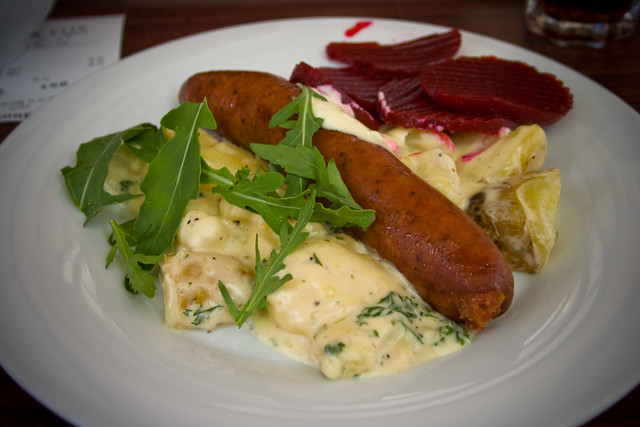
Food habits are more a question of culture than of nature.
We learn what is acceptable to eat from what is served when we grow up and that, to a great extent, has to do with what is available in our immediate surroundings. It is therefore a question of environment, but it is also a question of class and religion. There are a number of food taboos (pork, beef, horsemeat, shellfish etc.), both of a religious and of a social nature.
Food habits are mostly very long lasting and change only slowly since we usually continue to eat what we learned was “good food” when we grew up. Even if we emigrate we usually adhere to what we are used to. The main reason is that we mostly eat at home and so we have few opportunities to come into contact with other kinds of food. How can we learn about new ways of cooking if we never go into other people’s kitchens? And how can we discover new types of food when we are not even able to read the labels on the packaging?
In the pre-industrial society transport was a problem. The fastest way to travel was either by boat or on horse-back. Under these circumstances people had to rely on what could be produced locally. As a result, food traditions varied considerably from one area to another, owing to what kind of food was available.
Also, weather conditions are often quite bad in Scandinavia. The growing season is short, especially in the north, and it is impossible to raise more than one crop a year. In the old days it was also difficult to feed the cattle during the long winters and in the late winter or early spring the cows usually stopped producing milk (which of course made it easier for the women in one way but was also a problem, particularly if there were children to feed).
Under these circumstances it was necessary to find ways to preserve and store as much food as possible. The food had to last at least to the next harvest, preferably longer since you never
1(8)
Traditional tools for food preparation.knew what the next season would bring. For this reason traditional cooking was very much
concerned with the processing and preserving of food. The cooking itself was not very sophisticated. The preservation methods used were fermentation, drying, salting and smoking. Fermentation is the oldest method; it was mostly used for milk and fish. When fish is fermented less salt is needed than when salting it, and salt was in the old days a very expensive commodity1.
Staple food
Until the beginning of the 19th century bread and turnips were the most common staple foods. Then we started cultivating the potato in earnest, and it became extremely important2. Many people – especially the older generation – still think they have not had a “proper” meal if they have had no potatoes. The younger generation tends to prefer pasta or rice though. Pasta was hardly known in Sweden before World War II, and rice was something very rare and expensive in the old days – served only at the great holidays, like Christmas.
Side-dishes of vegetables were also rare. Carrots, onions, turnips and different kinds of cabbages were used as well as dried yellow peas but these were seen more as staple food than as the complement we think vegetables are today.
Grain – bread, porridge, gruel, dumplings
Our oldest grains are wheat and barley; we have cultivated them here in Sweden for some 6 000 years, although wheat was not cultivated in any great quantities until the turn of the last century (1900). Rye arrived here about 2 000 years ago, but became popular only in the 16th century. Oats was not a common crop until some 300 years ago3. In addition to these grains we also used to grow buckwheat.4
1 Which did not deter people from using it: today a Swede’s daily consumption of salt is 10 g, in the 18th century it was 70 g – however all this salt was not actually eaten since a lot of salt was used for brine and also for tanning (curing leather). Since taxes were often paid in commodities rather than in cash, salt was a very important product also for the state. From medieval times until the 18th century salt was the most important imported item and from the 17th century the state tried to find domestic alternatives; to some extent salt processed from the sea was eventually used.
2 The potato was first cultivated in Sweden in the mid 17th century but was regarded with suspicion by the farmers for nearly 150 years. Its importance was recognized already early in the 19th century when one of our most famous authors, the Bishop of Växjö (Esaias Tegnér), wrote that the spectacular population growth was due to “the peace, the vaccine and the potatoes” (“freden, vaccinet och potäterna”). Sweden has (officially) not been at war since 1814 and the vaccination was against small-pox (invented in England by Dr. Edward Jenner in 1796, first performed in Sweden in 1801).
3 Oats was also important as a cash crop – it was exported to England in large quantities, to feed the increasing number of horses needed for transportation in the industrial revolution. 4 Barley was – and still is – the most common crop in Sweden. Today it is mostly cultivated as forage – but also to make beer ... and quite a lot is exported to Scotland, to be distilled and made into whisky.
Bread differed quite a lot in Sweden for two
reasons. The first was that different kinds of grain were cultivated in different parts of the country. In southern and central Sweden rye was the grain of choice. In northern Sweden barley was for centuries the most common crop, since the Swedish farmers did not believe that rye could be grown so far north5. On the west coast oats were popular. Barley and oats do not contain any gluten, a protein that makes the bread rise, and so a lightly coloured, thin and crisp bread was made6. Rye on the other hand will rise and in the south they made loaves that were soft when freshly baked but eventually became harder and harder7.
The other deciding factor was what kind of mill was used for grinding the grain. In northern and central Sweden watermills were used and they were dependent on the spring and autumn floods. Southern Sweden and the two Baltic islands of Öland and Gotland had windmills. Where watermills were used they would thus grind the grain and bake bread only twice a year, while the farmers with access to windmills could enjoy fresh bread every two to four weeks. When you bake only twice a year you must make sure that the bread will stay edible until the next time – and so knäckebröd was invented. Knäckebröd – Swedish crisp bread – is
made from rye; the bread is made quite thin and then dried. It keeps fresh “forever” if stored in a dry place. Knäckebröd can be said to be a truly national bread in Sweden; most Swedes always have at
5 Which the Finnish farmers did not believe – so they grew it and used it to bake bread. This is culture! 6 This kind of bread can also be found in Norway and on the Shetlands. 7 So hard in fact that in order to eat it you first had to soften it in some liquid. This sort of bread was (is) common also in central and eastern Europe.
Baking bread was hot work so the women dressed only in shift, apron and coif. This was considered perfectly decent and was also used outdoors, e.g. during harvest.
Traditional crisp bread, “knäckebröd”.
least one package at home – it still does last forever – and it is also a success on the world
market. Although these days we mostly eat bread made from wheat, something ordinary people were quite unused to before World War I.
Besides bread and – starting in the early 19th century – potatoes, the most common dishes were grey or yellow peas, porridge and gruel. Porridge and gruel could be made from all kinds of grain, but rye, barley and (from the 18th century) oats were commonly used.
Porridge was served with a little butter or molasses and milk (mostly sour). Everyday food like gruel and porridge was served in a big bowl, common to all. Everybody had his/her own spoon8 and knife9 but would eat from the same bowl10.
Dumplings (palt), made from potatoes and/or rye or barley flour, were also quite common. If possible, small pieces of pork or other leftovers were made into a filling, together with finely chopped onion. The dumplings could also be plain and served with fresh cheese and/or lard or even butter11. To serve the dumplings with cheese or butter was more common in the north where more dairy products were produced.
Bread and dumplings were mostly made with water, but blood could also be used. Sausages were made from blood as well. Food made with blood is still eaten regularly in Sweden – black pudding (blodpudding) is a very popular dish, particularly among students, since it is very cheap and easily cooked: just fry it and
8 Spoons were made from wood, bone or horn. Before banks became common – and indeed, for a long time after that, since people did not trust them – the traditional way was to put any money you were able to save into silver objects, and the most popular objects were spoons. If you already had a number of spoons you would perhaps become ambitious and aim for a goblet, a tumbler or a pair of candle-sticks.
9 But no forks for everyday use. The knife was the one everybody normally carried at all times, not a special one for eating. 10 On festive occasions, like a wedding, people seated at the high table had their own plate (perhaps, if it was a well-to-do farmer, made from pewter) and, usually, a complete set of cutlery. This was accomplished through extensive borrowing from neighbours. However, if you were not seated at the high table, chances were that you would not have a plate of your own and you would definitely be expected to bring your own cutlery.
11 But most often lard from pigs or sheep.
_______________________________________________________________________________________________________________________________________________________ 4(8)
Black pudding with a couple of good slices of bacon and lingonberry jam.
_______________________________________________________________________________________________________________________________________________________ serve it with fried bacon and lingonberry12 jam (lingonsylt). We also still eat dumplings, but
these days a more “luxurious” variety made with potatoes and wheat flour; this dish is also traditionally served with lingonberry jam and butter.
Milk
Sweden has always been a dairy country, but milk was rarely consumed fresh by the farmers. Instead it was preserved, very often fermented. Then, as now, the most common way was to make filmjölk. However, in the north they preferred a special type of fermented milk, made with a germ culture that made the milk “long”13 and thick. This “long” milk (indeed, it is called långmjölk) tastes less sour than the more regular type of fermented milk. The “long” milk also keeps fresh much longer than other types of fermented milk; it could last for months14, although the women had to tend it regularly and “wash” it with aquavit. It is not very easy to start a “long” milk culture from scratch. The easiest way is to take a small amount from existing “long” milk and mix it into the fresh milk. To make sure you did not run out of “long” milk culture it was common to preserve it by soaking a piece of linen or cotton cloth in the “long” milk and let it dry. In this way the culture could be preserved for years. Emigrants to America sometimes brought such cloth pieces with dried “long” milk culture with them.
Another way to preserve milk is to make butter and cheese. This was most common in the north. But cheese and butter were not primarily for the farmers and their families; it was made for selling or paying taxes and tithes.
Fish
Salted herring (salt sill) was probably the most common dish in the old days, always served with potatoes and bread. In really hard
12 The lingonberry is a bright red berry growing wild in the forests. In the autumn quite a lot of people go out into the woods and pick lingonberries and mushrooms. The mushrooms are sometimes hard to find – especially the most popular varieties – but lingonberries can be found everywhere (except in southern Skåne and on Öland). The lingonberry is too sour to be eaten as it is but makes a very nice jam, perfect when served with traditional Swedish dishes.
13 If you pour it, you have to cut it with a knife to stop pouring because it sticks together – it is “long”. 14 The farm women “collected” – and fermented – milk before the cattle was sent off to graze at the remote pastures in the summer; during summer the farms had no fresh milk and had to make do with the fermented milk.
_______________________________________________________________________________________________________________________________________________________ 5(8)
Different parts of Sweden have different traditional cheeses.
_______________________________________________________________________________________________________________________________________________________ times the potatoes could be served with only the brine the herring had been preserved in. Most
people had herring at least once a day. To Sweden’s east lies the Baltic Sea where the water is brackish; it is home to the Baltic
herring (strömming), a smaller type of herring than the regular saltwater one. The Baltic herring was very common, both served fresh and preserved, e.g. salted. However, on the northern east coast it was far more common to ferment it. This herring, which is still produced
according to the old methods, is called surströmming (literally, sour Baltic herring) and it is today regarded as a great delicacy in the northern parts of Sweden (Norrland).
Fresh fish was a popular alternative and made a welcome change in an otherwise monotonous diet. The Baltic herring could be served fresh; another common and popular fish was salmon which was not regarded as the delicacy it is today15. However, fishing in the lakes was a privilege that belonged to those who
owned the surrounding land; other people had to have to landowner’s permission. On the west coast – by the sea – the fishing was free.
Meat
Meat was mostly preserved; the most popular curing methods were salting, drying and smoking. The most common meat was pork. Salted bacon (fläsk), a very popular dish, was mostly served fried in slices.
Game was also very popular, but only landowners were allowed to hunt the big game, like deer and elk. Everybody was however allowed to hunt for hares and birds etc16.
Meat from horses was never used, it was considered impure. This was a cultural taboo though not a religious one, like pork is forbidden to Jews and Muslims17.
In Western Europe, to which Sweden belongs, meat was always cooked in large pieces, together with onions and turnips. From the beginning of the 19th century the meat was often
15 Though today, thanks to cultivated salmon, the price of salmon is less than that of e.g. cod. 16 Today, hunting is a very popular pastime: Sweden has some 300 000 registered hunters (you have to pass an exam and register to be allowed a license for a hunting rifle). Hunting is still quite important food-wise, too. The elk hunt by itself yields more meat than the combined butcher of reindeers, calves and horses. 17 It actually still is a cultural taboo to eat horse meat: quite a lot of horse meat is sold and also consumed, but its retail name is “hamburger meat” (hamburgerkött) – it is however not used for hamburgers.
_______________________________________________________________________________________________________________________________________________________ 6(8)
Traditional pickled herring brought up to date.
_______________________________________________________________________________________________________________________________________________________ served with potatoes, earlier with bread only. In Eastern Europe, to which eastern Finland
belongs culturally, meat was mostly cut into cubes and stewed (as e.g. Chinese food).
Meat was rare on the table. As long as Sweden was a Catholic country (abt 1100- 1527/159318) meat was allowed only twice a week, normally Sundays and Thursdays. At this time we did not yet have the potato, and it was instead common practice to boil the meat (i.e. the pork) together with dried and
soaked yellow peas, making a soup. This was usually served on Thursdays. Still today most restaurants serve yellow pea soup with pork (ärtsoppa med fläsk) for lunch on Thursdays19. This you can call tradition! Every Swede knows that Thursday is the day for yellow pea soup, but very few know why – now you do.
Seasoning
The most common seasoning was salt and pepper; both were imported and therefore expensive. Onions (lök), dill (dill), parsley (persilja) and horseradish (pepparrot) were also popular, and since they are all indigenous to Scandinavia they were locally grown. Most other spices had to be imported and were very expensive20.
Beverages
The most common beverage was water, often mixed with whey21. Beer was regarded as a male drink, and mostly used on special occasions22, although it was considered to be of such importance that hops (for making beer) had to be grown on every farm. Svagdricka – “small
18 At the Parliament of Västerås in 1527 the (Catholic) bishops’ power was broken and most church property was confiscated (dissolution of monasteries etc.); it was however only in 1593, at the church council of Uppsala (Uppsala möte), that Lutheranism became the officially recognized religion of Sweden. The Swedish version of Lutheranism is founded on the so-called older or original Augsburg confession (1530).
19 Traditionally with thyme and a good dollop of mustard; dessert is usually pancakes with jam and cream. 20 Although today most Swedes would probably say that cinnamon (kanel), caraway (kummin), fennel (fänkål), aniseed (anis), cardamom (kardemumma) and, especially at Christmas, saffron (saffran) are also very traditional in Swedish cuisine. 21 A by-product when making cheese; whey is also used for making whey-cheese (mesost). 22 Old people may still refer to the traditional dinner following a funeral as gravöl, quite literally “grave beer”, and in the old days the feast following a child’s baptism was called barnsöl, “child beer”.
_______________________________________________________________________________________________________________________________________________________ 7(8)
Thursday yellow pea soup doesn’t get much more traditional than this!
_______________________________________________________________________________________________________________________________________________________ beer” – was (is, it is still brewed for Christmas) a very low alcohol beer and quite common,
particularly in the south. Fresh milk was reserved for children and invalids, only soured milk or buttermilk were used for drinking.
Brännvin, aquavit, strong liquor, was very common. It was neither as strong, nor as pure as it is today23 but it was imbibed in not insignificant quantities; in the middle of the 19th century the average annual consumption was about 15 litres per person – “per person” including every man, woman and child, in spite of the fact that most of it was consumed by adult men24. Liquor consumption was a problem, mainly before we learnt to make aquavit from potatoes in the late 18th century, since a good part of the limited harvest was used – grain that could have been put to better use as food.
23 Since the farms made their own aquavit; methods were not so sophisticated. 24 Today’s consumption in Sweden is also about 15 litres per person, but “per person” means adults over 20.
_______________________________________________________________________________________________________________________________________________________ 8(8)
A selection of todays wide variety of flavoured aquavit.