Translate

Showing posts with label malmaison. Show all posts

Sunday, September 2, 2012

Napoleon and Josephine


ORIGINAL AIR DATE:
November 10, 1987

Malmaison and the French Influence


During the Regency, the French and most importantly the Empress Josephine had a significant impact on the development of the rose garden.The Empress Josephine collected roses for her gardens at the Chateau de la Malmaison from 1805 to 1810.  This collection gave the French an interest in the culture of roses in the vicinity of Paris that lead to some of the most important work in rose hybridization during the early years of the 19th century.
The French writer, De Pronville, stated that in 1814, there were only about 182 varieties of roses, but by mid-century due the keen interest in the rose and hybridization, there were 6,000 varieties--most created by cross-pollination and the resultant seed production.  The gardener of the Empress Josephine was a Frenchman named Dupont and he, along with Vilmorin and Descement were among the earliest cultivators of roses from seed.
The Empress Josephine had over 150 different Gallica cultivars in her collection, and as you may guess, the Gallica was the 'darling' of the Regency period.
When the allied armies entered Paris in 1815, Descement's garden contained 10,000 seedling roses which Vibert, succeeded in saving and carrying to his garden on the Marne in the countryside of France.
The Empress Josephine's goal with Malmaison was to obtain every species of rose then known.  Napoleon instructed the French Navy to seize any plants or rose seeds they found when they searched ships at sea.  In just one year, Josephine spent close to 2,600 pounds  with the English nursery of Kennedy and Lee, despite the war with Britain.  Despite the naval blockade, the British Admiralty granted a safe-conduct pass to the Kennedy and Lee firm to deliver the new China Roses to Malmaison.  The Englishman Kennedy was employed by the Empress to assist them in laying out her rose garden and interestingly enough, there was one plan (never used) that laid out a rose garden in a design close to the Union Jack.
Josephine set the standard for rose gardening for a very long time.  All the wealthy French followed her lead and many joined in the competition to see who could amass the largest collection.  Her influence was felt across the Channel, in England, as well.  The English, anxious to keep up with social fashion, made concerted efforts to collect roses, just like the French.
Her biggest rival was the Countess of Bougainville, who tried to amass as many new roses as possible.  It is no surprise that economically, the rose became the most important flower in France.
After her death, the gardeners who helped create Malmaison went to other positions throughout France and established gardens and nurseries which still have an impact on the rose industry today.
After her death in 1814, Malmaison quickie fell into neglect, but roses still passed from Britain to France.
Many of the men who trained at Malmaison went on to become rose hybridizers and they established France as the premiere country in rose-breeding.  During Josephine's residence at Malmaison, Dupont amassed nearly 260 rose species and cultivars.  Dupont passed on this legacy toAlexandre Hardy, who took over the Luxembourg Garden and raised many roses we still grow today, including 'Mme. Hardy' and 'Safrano'.  Hardy took on a young assistant at the Luxembourg Garden, Jacques-Julien Margottin, who also founded his own rose nursery.  He and his son Jules kept alive Josephine's dream and continued to grow and hybridize roses.
These gardens were probably the most important factor in establishing the popularity of the rose in the 19th century.  Part of Josephine's efforts at Malmaison included commissioning the painter, Pierre-Joseph Redoute to paint the roses in her collection.  He had been the court painter to Queen Marie-Antoinette, but despite the revolution, he managed to survive and become the court rose painter.
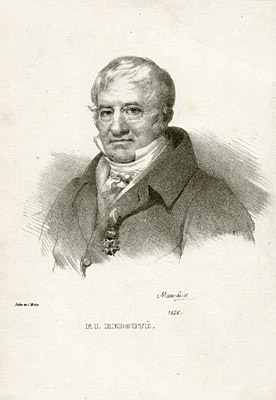
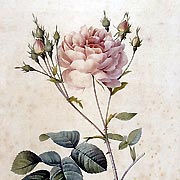
Redoute's work, Les Roses, was completed after Josephine's death, the three volumes, issued between 1817 and 1824 is one of the most beautiful and important books ever published on roses.  Botanist Claude-AntoineThory provided the commentary for the book and these volumes became the standard reference work on roses for quite some time.  It is still used as a reference work to identify older varieties of roses.  Thory made the first serious attempt to untangle the genealogy of roses.  Much of his work has proven to be accurate and still stands up today.
Many of the 170 roses illustrated by Redoute are still grown in garden today.  Many consider his painting of 'Blush Noisette' to be the all-time masterpiece of botanical illustration.
Even after the exile and death of Napoleon, Redoute continued to paint for Louise-Philippe, the new Bourbon king, in 1830.  Redoute died in 1840 at 81 years old.  He was painting a lily at the time.
Others carried on the work of cataloguing and growing roses.  PrevostPepinieriste a Rouen wrote "Catalogue descriptifmethodique et raisonne de especesvarietes et sous-varietes du genre rosier', which listed 880 names of roses.
There were two very famous Englishmen who specialized in roses:  Thomas Rivers and William Paul.  Rovers wrote:  Rivers's Rose Amateur's Guide in 1837, which lists current varieties and cultivation methods.  Paul's The Rose Garden was written in 1848 which included a rather pompous essay about the rose in Art, as well as how to cultivate the rose.  He describes 87 Damask, 76 Provence (Centifolia), 84 Moss and 471 French (Gallica) roses.  As I mentioned earlier, the Gallica rose was really the darling of the 1st half of the 19th century.
But, sadly, tastes changed rapidly.  By 1896, George Paul (a nephew to William Paul) wrote in RHS Journal, "Wanted:  a refuge for the old roses where they may be found gain when tastes change."  There were many wonderful, sumptuous, hardy Old Roses roses raised during the early years of the 19th century, including: 'Mme Hardy' - 1832; 'Felicite Parmentier' - 1836; 'Cardinal de Richelieu' - 1840; 'La Ville de Bruxelles' - 1849; and 'Tour de Malakoff' - 1856.  Their heyday of popularity was around 1810 to 1830 and had they not been so vigorous and simply gorgeous, they might have perished with the emergence in mid-century of the remontant varieties.


Friday, August 24, 2012

From the preface to 'Choix des Plus Belles Fleurs' (Redouté's Fairest Flowers


Austrian BriarZabeth
A Picture of Roses
This site is dedicated to appreciating the roses painted by the artist, Pierre-Joseph Redouté (1759-1840). 

Who’s Pierre-Joseph Redouté?
P.J. Redouté, esteemed by his peers as the ‘Raphael of flowers’, is perhaps the most well-known botanical artist of all time. He devoted his life to plant illustration and his exquisite rose portraits are especially well known and loved. Even if you don't recognise the name Redouté, you may have seen his rose pictures as framed art prints, or used commercially to decorate anything from a greeting card to a coffee cup.

View the complete collection of Redouté's roses online
Close to 200 of Redouté's roses, from both prints and original paintings, are represented on this site. Every rose from the books, Les Roses and Choix des Plus Belles Fleurs is pictured here, plus an assortment of other roses Redouté painted during his lifetime. In addition to its picture, for each rose you can view information about its nature, history and cultivation, which we'll keep expanding as time permits.
For convenience the rose pictures are arranged by collection, by colour and by class.
Plus there’s the fully ‘assortable’ Master List so you can look a rose up by its botanical or common names.

A picture of roses: What do you imagine?
Most of the roses Redouté painted look nothing like the classic long-stemmed roses you’ll find in florist shops come Valentine’s Day or Mother’s Day. If you’re wondering why not, the answer lies in the history of the modern rose.  
For over a century now, the most common roses have belonged to the class of rose known as the ‘Hybrid Tea’. These are the roses of our popular culture – the ones you’ll most commonly buy from the florist and see growing in gardens.  But these roses are not, as is sometimes thought, exclusively European or English in origin. Instead they are a multi-cultural blend of East meets West.
When Redouté lived during the 18th and 19th centuries, it was a time of great discovery as European botanists were allowed into China for the first time. They brought back to Europe roses that although new to the West, were old varieties long-grown in Chinese gardens. When these roses were bred with the roses already in Europe, a revolution started that saw thousands of new varieties emerge. But this revolution had barely begun when Redouté lived. The classic modern rose did not yet exist. Instead many of the roses Redouté painted were roses that would, in time, become its ancestors. These forebears and all roses known prior to 1867 are now classified as ‘Old Garden Roses’ or ‘Old Roses’ for short. They are also called ‘Heritage Roses’, ‘Antique Roses’ and ‘Vintage Roses’.

Old Roses revived
Although many Old Roses have been lost to history, others have survived to this present day.
Over the last few decades there's been a resurgence of interest in growing and learning about Old Roses. As well as having a unique beauty, Old Roses are often very fragrant, the ones that have survived the test of time are commonly disease resistant and all have the added bonus of a long and often intriguing history. Old Roses are also providing inspiration for modern rose breeders such David Austin and the ‘English Roses’ he’s developed over the last 40 years. These he describes as ‘new’ Old Garden Roses and their introduction has inspired many people to revisit and appreciate the Old Roses of bygone days.

If Redouté were alive today…
No doubt, if Redouté could be alive in the 21st century, he'd be amazed that from the few hundred varieties of rose known in his time, a staggering 40 000 have been bred in the time since. It’s not hard to imagine that he’d feel satisfied to know, that as well as being among the ancestors of these modern roses, some of the varieties he painted nearly 200 years ago are still growing in gardens today.

A few words from the Master…
‘I therefore here dedicate my pictures to disciples of botany, to emulators in industry, to friends of the arts, to admirers of nature and to students who have devoted themselves to the study of an art...to which I have given all my love in return for some degree of fame.’

From the preface to 'Choix des Plus Belles Fleurs' (Redouté's Fairest Flowers).

Thursday, August 23, 2012

Pierre-Joseph Redouté (1759-1840)


pierre-joseph-redoute

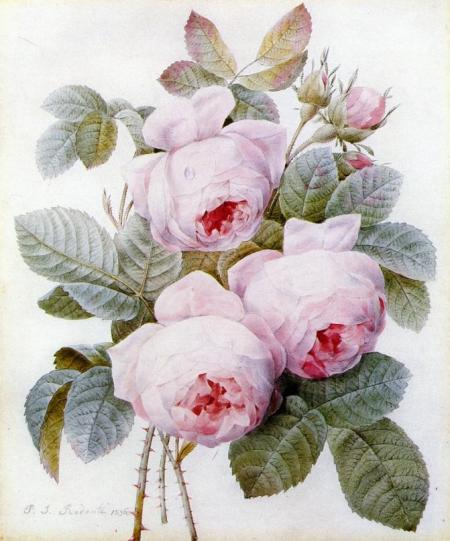
Pierre-Joseph Redouté’s flower prints are so lush and detailed that you can almost pick the flowers off the page. In the famous rose print below, a single drop of water rests exquisitely on a rose petal of the top rose. Born in a family of artists*, Pierre-Joseph became known as the premier botanical illustrator of his day (indeed, to this day). His influence spread far and wide and can be still felt in illustrations on cards, decorative boxes, books, wallpapers and prints, and calendars.
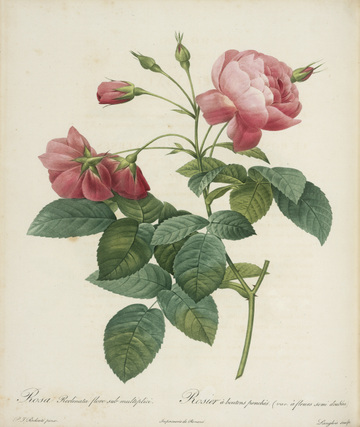
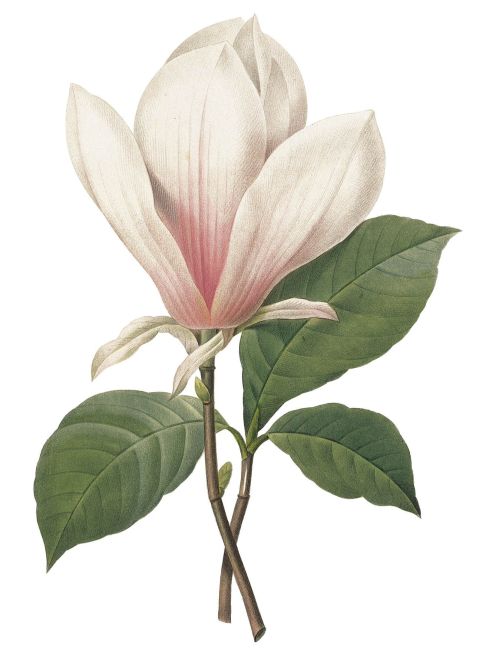
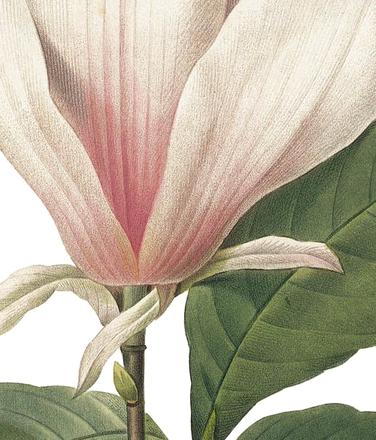
The watercolor images in this post were taken from his famous book of prints, Les Roses. Redouté, known as the “Raphael of flowers, mastered the technique of stipple engraving- in which he uses tiny dots, rather than lines, to create engraved copies of his watercolor illustrations. This new technique allowed him to make subtle variations in coloring (see the detail of the magnolia in the last image below).
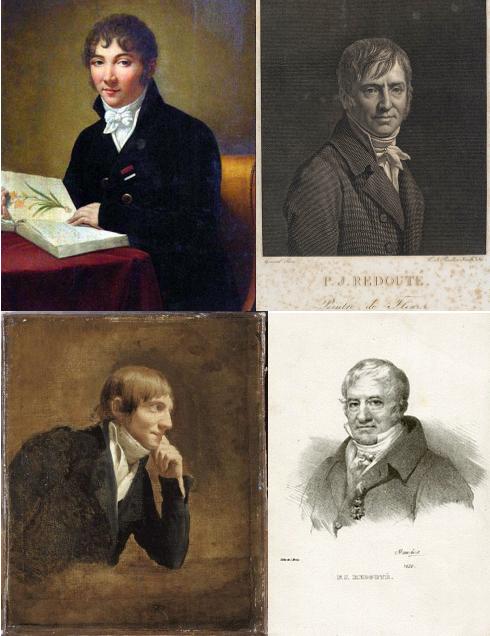
4 faces of PJ Redoute
The four faces (and ages) of Pierre-Joseph Redouté
Redouté completed the three volumes of Les Roses, his best known work, between 1817 and 1824. His most popular illustrations are assembled in Les Liliacées (486 watercolors); and Les Roses (169 watercolors). Hand-colored stipple engravings, such as the magnolia sitting at the bottom of this post, were made from these watercolors. – Discovery Editions
Rosa gallica_maheka from Redoute's Les Roses 1817-1824 Huntington LibraryJosephine, wife of Napoleon Bonaparte, was known for her spectacular garden at Chateau de Malmaison, where exotic plants were cultivated. The plants, acquired from around the world, were documented by France’s leading horticulturists and botanists, and painted by Pierre-Joseph Redouté.
Magnolia
Detail of the magnolia engraving below.
magnolia closeup
More on this topic

Napoleon and Josephine Their Rose Legacy


Empress Joesphine roses


This is the story about Napoleon and Josephine and their rose legacy, and how without them the modern repeat-blooming roses that we grow today, might never have come to be.
Josephine was the wife of Napoleon Bonaparte of France.
When Josephine died in 1814, she left behind a floral legacy, and a love of roses, that lives on in gardens around the world.
Empress Josephine's passion for roses has greatly influenced the way we know the rose flower today.
Josephines's role in the development of the modern roses is indeed significant.
The 19th century was a very important era in the history of horticulture: the birth of the modern roses was under way.
josephine

Josephine and Napoleon
With Ladies In Waiting


In the late 18th century, repeat-blooming, or remontant, roses from southern China and central Asia had just been introduced into Europe.

Up until that time, few European roses flowered more than once in a blooming season.
Empress Josephine's passion for these new rose arrivals from Asia and China gave the roses an imperial allure that heightened their popularity and helped drive demand.
While Napoleon was waging war against Britain, Josephine was spending vast sums of money collecting new varieties of roses for her garden at Chateau Malmaison ouside Paris.
She even enlisted her husband's aid in the pursuit of her hobby.
At the height of the war in the early 1800's, Napoleon was sending money to England to pay for his wife's rose plant bills.
The British Admiralty was allowing ships to pass through its naval blockade to deliver new roses to Malmaison.
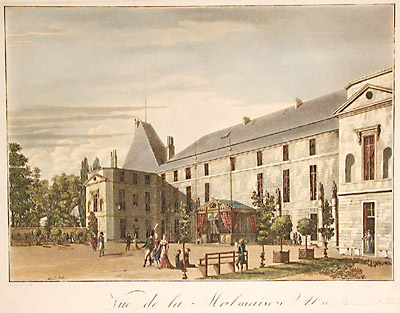
chateau malmasion

Painting of Chateau Malmasion


Josephine further elevated the stature of the rose by commissioning Pierre-Joseph Redoute, a former court painter of Marie Antoinette, to paint a series of rose portraits.
These were later published, after Josephines's death, in Les Roses, which the artist dedicated in her memory.
Redoute's collection of 170 stipple-engraved, colored plates is universially acknowledged as one of the most beautiful and important books ever produced.
les rose book

Redoute's Rose Book


You can buy Redoute's The Roses: The Complete Plates Here , it's a fabulous book featuring his renditions of Josephine's garden roses at Malmaison, that I personally own.

Spurred by the intense demand for new roses that Josephine and Redoute had helped to create, 19th-century hybridizers began crossing repeat-blooming Asian varieties with the hardier, and more fragrant European native roses.
Between 1840 and 1900, over 4,000 hybrid repeat-flowering roses were introduced.
Although Josephine didn't live to see and enjoy them, they became the natural legacy of her great passion: roses.
I think this is a fascinating story about Napoleon and Josephine that all rose gardeners should know, and that's why I wrote this page for you, my vistors, who all love roses.


Wednesday, August 22, 2012

IMAGINE yourself in Paris 200 years ago.


elephants-banner-980x200On December 1-3, 2011, the APS Museum held a symposium, Of Pictures & Specimens: Natural History in Post-Revolutionary and Restoration France, in conjunction with the Of Elephants & Roses exhibition.
Read more about the symposium.
See a webcast of the symposium.
IMAGINE yourself in Paris 200 years ago. You might have seen Empress Josephine’s famous black swans, a mastodon tooth sent by Thomas Jefferson to a naturalist in Paris, and original watercolors by Pierre Joseph Redouté, known as the “Raphael of Flowers.” These are among the objects that will be on view in this sumptuous exhibition about the science and art of French natural history from the 1789 Revolution to the July Monarchy of 1830—an era when Paris was the center of life sciences in the Western world, and Philadelphia, the center of science in North America.
Of Elephants and Roses: Encounters with French Natural History, 1790–1830 explores natural history in post-revolutionary France. Two grand gardens serve as the exhibition’s point of departure—the Paris Muséum of Natural History with its Jardin des Plantes, and Malmaison, the private garden of Empress Josephine, Napoleon’s wife.

Jardin des Plantes (Bibliothèque nationale de France)

Empress Josephine (Musée Masséna - Nice (photo ville de Nice))
These two sites acclimatized plants and animals from all around the world, produced new scientific knowledge, improved agricultural productivity and diversity, helped promote economic prosperity, and contributed to the glory of France, even during a tumultuous political period that lurched from bloody revolution to new republic, to empire, and ultimately back to monarchy.

OBJECTS TO SEE

Many of these objects have never before been exhibited in the U.S.
  • Fossilized mastodon teeth sent by Thomas Jefferson from the White House to French scientist Georges Cuvier, the founder of paleontology.
  • The score for a revolutionary song played for two elephants in the Paris menagerie in an attempt to make them breed.
  • One of Empress Josephine’s stuffed Australian black swans, which she was the first to breed in captivity.
  • Les Roses, one volume of Pierre Joseph Redouté’s three-volume masterpiece on roses, including many of Josephine’s 250 varieties at Malmaison.
  • The only surviving dinner plate from a Sèvres porcelain service for Louis XVIII, decorated with a South African sand lily.
  • Ceramic ware, a beadwork bag, an ink stand, a lady’s belt, and a man’s tie—all part of the craze for a celebrity giraffe who walked 800 kilometers across France to greet the king.
  • Acorns and oak leaves sent back to France by André Michaux, who was dispatched to North America to search for useful trees.

FIVE EXHIBITION SECTIONS

“Music for Elephants” documents two live elephants (named Hans and Parkie) that arrived in Paris in 1798 as spoils of war, and it documents the birth of paleontology based partly on the study of fossils sent to France by Philadelphia naturalists.

American Philosophical Society Library, detail

The Academy of Natural Sciences, Ewell Sale Stewart Library, detail
“Hunting for Trees” reveals how France’s decreasing forests led to a worldwide search for useful and beautiful trees including the North American oak and the flowering Franklinia. 

American Philosophical Society Library, detail

American Philosophical Society Library, detail
“Black Swans for an Empress” highlights Josephine’s love of exotic birds, second only to her love of flowering plants.  Images of exotic African and South American birds—as well as specimens of two fancy pigeons and one of Josephine’s black swans taxidermied 200 years ago—are included, along with birds in watercolors and scientific books, and on Sèvres porcelain.

The Academy of Natural Sciences, Ewell Sale Stewart Library, detail

Hillwood Estate, Museum & Gardens; Bequest of Marjorie Merriweather Post, 1973; Photo by E. Owen.
“A Flower Blooms” highlights a glorious Redouté image of an amaryllis and its bulb; Josephine paid the large sum of 100 gold louis for this desirable plant.  

Courtesy David Brind, detail

Hillwood Estate, Museum & Gardens; Bequest of Marjorie Merriweather Post, 1973; Photo by E. Owen.
“Everything Giraffe” tells the story of a baby African giraffe who was led on foot from Marseilles to Paris. She became a celebrity, and her image appeared on souvenirs, folk-art ceramics, and ordinary household objects. In addition to natural history in France, the exhibition will also focus on connections between scientists in Paris and those in Philadelphia. 

Courtesy of the Trustees of the Boston Public Library/Rare Books, detail

American Philosophical Society Library, detail
Of Elephants and Roses will be open for nine months, from March 25 – December 31, 2011.
Support for this exhibition was provided by:
The Florence Gould Foundation
Richard Lounsbery Foundation
Crystal Trust
The Gladys Krieble Delmas Foundation
Alexander G. Bearn Memorial Fund