Translate

Showing posts with label fantasy. Show all posts

Saturday, July 26, 2014

New Amazon Review!


Format:Kindle Edition
Although the story is set in the future, one wouldn't have to search far to find parallels in the present-day world... or in the past. The genius of this book is that the familiar is also the fantastic. We're hurled immediately into an astonishing action scene, written with gorgeous cinematic vividness, and plunged instantly into a universe of great peril and even greater heroism. It is a wild ride. Plan to stay up all night with this one; it is difficult to put it down.
Comment | 


click to go to Amazon

Tuesday, April 1, 2014

The Gold Stone Girl Series


The Gold Stone Girl Series, soon out in Kindle and Audiobook formats, is a hero's journey, by, for, and about human females, set in the distant future.  

In It's Nightmare,  we meet Mina.

Mina lives in a world where dreaming is outlawed.  Blinkin is the sole continent of the planet formerly known as Earth and Winkin is its only city.  There are no women here, only breeders.  Women were reclassified by the Night Mare in the long ago.  

The Night Mare is the supreme dictator of Blinkin, and the head of its government-church.  She is the sole architect of the stone-rule, the method by which the Gold Stone Girl, the breeder who will be raised as human sacrifice, is identified.  These rare girls are eaten alive, on a live broadcast, by the Night Mare herself.  It has something to do with ancient rites, planet-wide renewal, and how the dread demon first came to power, but mostly it’s just gross.  

Mina won’t learn any of the details of this her fate, until she’s surrendered to the government, as is required by law.  She grows up in the Off-grid land that surrounds Winkin City, with Bubba and Dee-Dee, who rescued her as a baby, from inside the trunk of the willow tree where she gestated alongside lygaeids hibernating as larvae.  They raise her as their own in this land where the birth of girls is legally discouraged and privately-owned females are licensed as domestic pets.  They don’t know that Mina is the Dream Weaver, a being who will discover that if she is to survive the Night Mare’s land, she must change everything. 

Wednesday, January 22, 2014

Nicole’s Story: The Recording of American Gods Public Post

https://intersect.com/stories/0n59KKcNS1zH


I was able to locate Nicole Quinn, the Grand Prize winner of the Neil Gaiman Audiobook contest, via Facebook. I had only hoped to hear a few tidbits from her experiences on the day of recording, but to my pleasure and surprise she sent quite a detailed account. She graciously agreed to let me reprint it here in total. – Js. Rapson
I ran into the studio just on time, after a 3 hour drive that normally takes 2 from upstate NY. I was having a hot flash, sheesh, 55 and feeling like a school girl running in sweaty from the play yard. We were all nervous. It’s a risk to add an unknown to 20 carefully cast voices.
In the room – Karen (exec dir), Beth (marketing), Barbara (engineer), and Paula (American Gods director). More would come later.
I had four small parts to read, sweet gems really. I met with Paula Parker, the director, who was, I found out at lunch later, not excited about the contest, and worried that whoever won might be mediocre. She’s a great actor, because I didn’t have a clue.
I wanted to put her at ease quickly, so I told her that I’m a classically trained actor turned writer turned filmmaker (http://www.racingdaylightthemovie.com/shameless self-promotion, and yes I did pass out dvds like business cards, which I always forget to carry). I explained that I had rehearsed the sides to the punctuation, but that should she want me to blow through the commas and periods just to let me know.
She smiled, such a lovely smile. I calmed a bit more. We talked about my road to reading on the bookperk site: birth, adoption, boarding school, Berkeley, London, Berkeley again, then on to NY. We talked about my life as an actor, which was, after all, the most important bit in the room. I think I’m a pretty good actor. You have to feel that way to stay in it this long. I got my AEA card in 1978 and my SAG and AFTRA cards in the early 1980s (WAGE in 1993). I belong to a company upstatehttp://www.actorsandwriters.com/, and its offshoot Denny Dillon’s Improv Nation. And as my friend Melissa Leo says – “I’d do this naked on a street corner for no money.” I have to agree.
And yes, I did shamelessly name drop famous actors as friends, hoping to bathe my unknownness in stellar light. Its something I’m not proud of, but nerves make my gums flap.
Paula led me to the booth, and just as the door was about to close I remembered I’d brought a plastic bin of sliced apples. I have done some voice work before – computer games (Space Colony and Stonghold 2), and apples are the best way to quickly wet your whistle. Paula was almost beatific at the apples, and so was I, dry-mouth that I am.
We laid down the tracks, the shortest first. Paula gave great direction – attitude, atmosphere, she set the scene. Maybe 3-5 takes on each segment, and we were done with the recording. The relief in the room was palpable.
We waited around for a bit to speak with Neil himself via Skype. He was in England, I think, post Dr. Who airing of his episode. He was charming and I was tongue-tied, having a HUGE professional crush on both he and A.F.P. I love how accessible they are to their fans. The conversation was a bit anti-climactic, and short, I mean I had an audience of engineers and producers, so I reigned in my gush and ….
Then out to lunch with Producers and directors and Harper Audio folks. Tuna Steak Nicoise is what I ate. I think we were all relieved that it worked out to everyone’s satisfaction. Everyone was delightful. They all encouraged me to take a Narrator’s workshop, skill-building, which I have since signed on to do.
We talked about audio books, and Harry Potter, of which Harper exec. Chrissie and I are huge fans. The Audies, the state of the art, etc…
Many warm handshakes later I checked into the Omni Berkshire Hotel (on Harper’s dime) where I jumped on beds, ate junk food and drank very good wine with my 25 year old incredibly gorgeous daughter (who lives in the city) and my hunky husband (who works there).
I’m back in a 1964 Tradewind Airstream, (my office), in the middle of a meadow, now all yellows and soft greens. I can see the tin gambrel roof of the blue barn-home in which I live, cresting the berm. I’m deep in the nightmare world of the novel I’m writing, hoping only to make the one we live in a little less frightening.
ps – I listened to all twenty finalists, and I am honored to be among you.
Keep dreaming, they do come true,
Nicole
(Nicole Quinn May 19 at 4:39am via Facebook)

Sunday, March 3, 2013

Medieval French King Arthur Stories -

http://www.legendofkingarthur.co.uk/literature


Wace (1155), Vulgate Cycle (1215-1235) and Robert de Boron (1200) 

Wace 1155
Wace was an Anglo-Norman author, who wrote the Roman de Brut, in 1155. This was a French adaptation of Geoffrey of Monmouth's Historia regum Britanniae. Wace's work varied in places from Geoffrey's. Wace was the first to introduce the knightly fellowship of the Round Tabler. Wace's work on Arthur spread the popularity of the legend in French and Anglo-Norman courts, where a new genre of literature was soon developed by Chretien de Troyes from 1170 to 1185
Vulgate Cycle 1215-1235
The five-part romance which was composed by several authors, probably Cistercian monks in France between 1215-1235.
The Vulgate Cycle either elaborated the earlier work of Geoffrey of Monmouth and Wace or added new adventures. Arthur and Gawain become less important so that new heroes such as Lancelot, Galahad and Tristan can be seen.
The Vulgate Cycle has eight large volumes to give the whole Arthurian story as we now know it. Scholars believe that the outline for the cycle was the work of one man but that several authors wrote the works.
The Vulgate Cycle makes Lancelot the main character and the tragic love of Lancelot and Guinevere a crucial element of the downfall of Arthur's kingdom and his Round Table.
The Round Table, for the first time, is a means of righting wrongs and combating evil. The Knights of the Round Table are bound by chivalry to do good, and this mission to do good is the cental driving force of the Round Table for the first time. There is a sharp contrast between the sins of Arthur, Lancelot, Guinevere and Mordred on the one hand, and goodness of Galahad and Perceval on the other.
Robert de Boron c1200
Despite being famous for his cycle of Arthurian Romances centred around the Holy Grail, very little is known about Robert de Boron. He was a French poet of the late 12th and early 13th centuries, probably originally from the village of Boron, in Montbéliard, France. He was the author of a two surviving poems, Joseph d'Arimathe and Merlin; Merlin survives only in fragments. The two are thought to have been part of a trilogy (or tetralogy) which also contained a verse Perceval, and possibly a Mort Artu (Death of Arthur).
In 1202, his master is known to have taken part in the Fourth Crusade from which he never returned, dying abroad ten years later. So Robert's Arthurian trilogy must have been written in the late 12th century, probably after the Glastonbury monks' 1191 "discovery" of King Arthur's body. His poems were the inspiration for the later Vulgate Cycle of Arthurian tales.
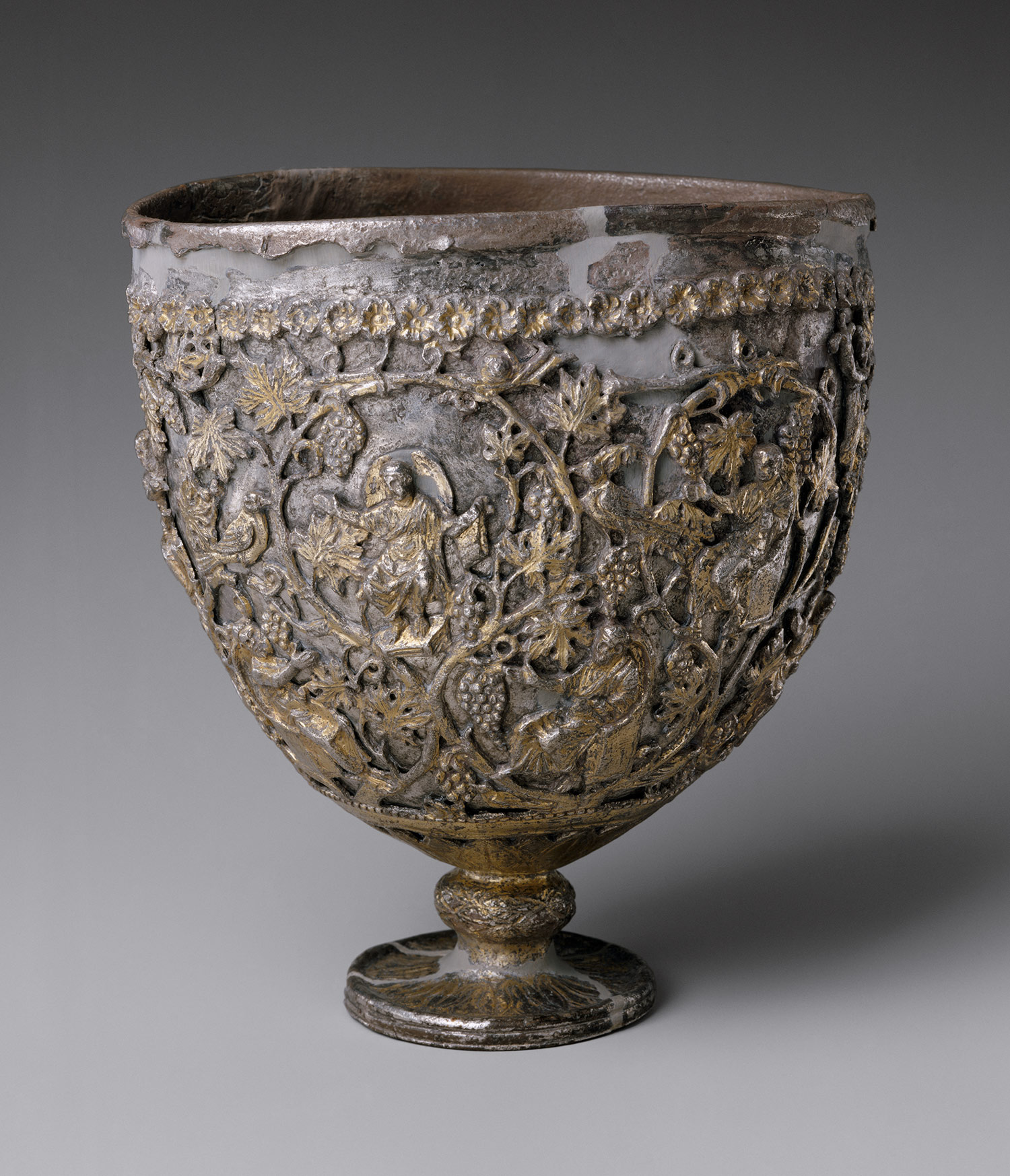
Robert was the first to identify Sir Percival's Grail as the Last Supper vessel used by St. Joseph of Arimathea to collect the blood of Christ from the Cross.

The Holy Grail in Legend of King Arthur


The Holy Grail is the cup from which Christ drank at the Last Supper and which was used by Joseph of Arimathea to catch Christ's blood as he hung on the cross. The Holy Grail was introduced into the King Arthur legends by Robert de Boron in his romance Joseph d'Arimathie which was probably written at the very end of the twelfth century or the first decade of the thirteenth.
In earlier sources the word "grail" comes from the Latin gradale, which meant a dish brought to the table during various stages (Latin "gradus") or courses of a meal. SoChrétien de Troyes and other early writers intended this sort of platter by the term "grail." Chrétien speaks of "un graal," a grail or platter and thus not a unique holy grail.
In medieval romance, the Holy Grail was said to have been brought to Glastonbury in Britain by Joseph of Arimathea, though one would assume that to be an unlikely thing for him to have done. In te time of King Arthur the quest for the Holy Grail was the highest spiritual pursuit for a knight.
Chrétien credits Perceval is the knight who must achieve the quest for the Grail.
Malory though has Galahad as the chief Holy Grail knight, though other knights (Perceval and Bors in the Morte d'Arthur) do achieve the quest.
Tennyson is perhaps the author who has the greatest influence on the conception of the Holy Grail quest through his Idylls and his short poem "Sir Galahad".

Sir Gawaine


Florence Harrison (1884-19--). "Nevertheless You, O Sir Gauwaine, Lie" from: Early Poems of William Morris. London: Blackie & Son, 1914.

Saturday, March 2, 2013

Camelot, King Arthur's Court


Camelot is the legendary center of King Arthur's realm. Camelot is first mentioned in Chrétien de Troyes's Lancelot; and the name does not even appear in all manuscripts of that poem. Camelot is a dream city, a Utopia, King Arthur's personal capital where he dispenses justice, hosts feasts, and surrounds himself with brave knights. Camelot has come to be associated more with the values Camelot is believed to have represented than an actual place. If King Arthur did exist, his stronghold, his Camelot, would not have resembled a many spired palace, it would have been more basic and the inhabitants would have survived under near constant warfare.
The name Camelot is of unknown origin. It may have taken from the Roman Camulodunum, which means "Fort of Camulos," an ancient British war-god. Camulodunum was a town in Essex, which doen't seem a likely source for the legend.
In the thirteenth-century Vulgate Cycle, Camelot is given as the principal city of Arthur's kingdom.
Malory identifies Camelot with Winchester.
John Leland identifies as being Cadbury Castle in his work of 1542 as the "real" Camelot. Cadbury was the head quarters for a 5th century king. Its west country location gives it credibility as the original Camelot. Excavations carried out a there between 1966 and 1970 confirmed that this large hill fort was refortified in the King Arthur era and was occupied by a powerful leader and his followers. More recently, largely through the influence of T. H. White.
Tennyson's description in the "The Lady of Shalott" as "many-tower'd Camelot." is much more complex.
Sites that claim to be Camelot include Cadbury CastleCastle KilliburyCaerleonWinchester, the Roman city of Viroconium in Shropshire and Rough Castle, a Roman Fort near Camelon. Other sites have less substantial claims to be Camelot include Arthur's Seat in Edinburgh.

Isle of Avalon


Many writers tell that after his last battle at Camlann, the wounded King Arthur was laid in a barge and sailed to the Isle of Avalon (Avalonia translatesas Apples) for his wounds to heal. The Isle of Avalon is described with a fair amount of detail, however its exact location is usually left vague. Some writers state that Arthur is still alive on the Isle of Avalon and will return to Britain to be their future king in the country's hour of need.
Some texts do attempt to locate the Isle of Avalon. The Isle of Man has been presented being the Isle of Avalon, as well as Bardsey Island in northern Wales. There is a less well-known story, The Death of King Arthur, that may have been intended as an addition to Geoffrey of Monmouth's History. Richard Barber's Arthurian Legends, whose manuscripts date from the fourteenth century, claims that the king gave orders that he should be carried to Gwynnedd, for he intended to stay in the Isle of Avalon, a pleasant and delightful placewhere the pain of his wounds would be eased.
Geoffrey of Monmouth tells that King Arthur was mortally wounded and was carried off to the Isle of Avalon, so that his
wounds might be attended to. He handed the crown of Britain over to his cousin Constantine, the son of Cador Duke of Cornwall. On the Isle of Avalon, Arthur is looked after by Morgan
Glastonbury has been claimed as the Isle of Avalon. At that time Glastonbury Tor would have been an island in the fenland here. Glastonbury claims to be the Isle of Avalon, the site of King Arthur's, and the site to which the Holy Grail was borne to by Joseph of Arimethea. The claim appears to date back to some monks in the late twelfth century, who decided to cash in on the popular Arthurian legends circulating at that time. They claimed to have found the tomb of Arthur in 1190, with an inscription conveniently claiming Glastonbury to be Avalon. This find brought many pilgrims, and hence money, to Glastonbury.

Friday, March 1, 2013

Sir Thomas Malory, author of Morte d'Arthur


Image: How Arthur drew his sword Excalibur for the first time (Arthur Rackham)

http://www.legendofkingarthur.co.uk/literature/malory.htm

Sir Thomas Malory (c1416 - c1470) is the author of Le Morte d'Arthur, said to have been completed in 1469 (or 1470) then revised and printed by William Caxton in 1485. There are two versions as to who Sir Thomas Malory actually was. Malory was either a Warwickshire knight, who was imprisoned for thuggery, and wrote Morte d'Arthur while in his prison cell. Or Malory could have been a different and law-abiding Yorkshire Knight with the same name.
The most commonly accepted historical identity is Sir Thomas Malory was the Warwickshire knight. An American scholar, George Lyman Kittredge (1860-1941), published a monograph 'Who Was Sir Thomas Malory?' in 1897 which details his research and conclusion that it was this Warkwickshire knight..
According Kittredge, Thomas Malory, born circa 1416, lived at Newbold Revell in Warwickshire, England. He fought in France under the Earl of Warwick and later on the Lancastrian side during the Wars of the Roses. Malory was knighted in 1442 and entered Parliament representing Warwickshire in 1445 (remember, being a member of parliament then was not the result of a democratic election)
Then his life appears to have changed around 1450 when Malory was accused of armed assault and rape. Malory was gaoled for most of the 1450s in London's Newgate Prison), and the so called "knyght presoner" wrote the Arthurian legend which he named 'The noble and joyous historye of the grete conquerour and excellent kyng, Kyng Arthur' and died shortly after its completion around 1470..
The writer and scholar William Matthews, however believes that this is a case of mistaken identity and that Malory, the author of Mort d'Arthur, was in fact a different and law-abiding Yorkshire Knight from Studley and Hutton.
According to a detailed bibliographical note on Malory written by the 20th Century literary historian A.W. Pollard:
"The name of a Sir Thomas Malorie occurred among ... Lancastrians excluded from a general pardon granted by Edward IV. in 1468. In September 1897 ... the finding of the will of a Thomas Malory of Papworth ... This will was made on September 16, 1469, and as it was proved the 27th of the next month the testator must have been in immediate expectation of death. It contains the most careful provision for ... a family of three daughters and seven sons. We cannot say with certainty that this Thomas Malory, whose last thoughts were so busy for his children, was our author, or that the Lancastrian knight discovered by Mr. Williams was identical with either or both, but ... the Morte Darthur offers ... such a belief ... most naturally from an author who was a Lancastrian knight."
Sir Thomas Malory originally wrote his story as 8 books, and first published by William Caxton as 21 books in the year 1485. There is a modern Penguin Classics version of Malory written in Middle English but converted to modern spelling.

Sir Gawain and the Green Knight Online


17 August 2012

Thursday, February 28, 2013

Illuminations of Sir Gawaine

banner

Click on bar above to visit the exhibit.  Quite wonderful!

London, British Library MS Cotton Nero A.x. (art. 3): A Digital Facsimile

left
This resource is one part of London, British Library MS Cotton Nero A.x. (art. 3): A Digital Facsimile and Commented Transcription. Publications of the Cotton Nero A.x. Project 3 (Calgary: Cotton Nero A.x. Project, 2012).
For the commented transcription, to be published shortly after this digital facsimile, please see the main Web site of the Cotton Nero A.x. Project
http://www.gawain-ms.ca
The images that are part of this digital facsimile are provided under license from the British Library for private viewing on a single display connected to a single computer. Please note that all other uses require permission of the British Library, and please take note of the following copyright notice, which applies to all images provided here:
Copyright © THE BRITISH LIBRARY BOARD. ALL RIGHTS RESERVED.
Any copyright or database right that subsist in the work remains the property either of the British Library Board or individual persons. The Work may not be used, sold, licensed, transferred, copied or reproduced in whole or in part in any manner or form or in or on any media to any person without the prior written consent of the British Library.
The Cotton Nero A.x. Project, led by Murray McGillivray, has received funding from the Social Sciences and Humanities Research Council of Canada to permit us to license the images displayed here. Their support is gratefully acknowledged.
Hosted by the Centre for Scholarly Communication, Libraries and Cultural Resources

Le Morte D'Arthur

Illustrations by Beardsley

Le Morte d'Arthur - ill Aubrey Beardsley   MDCCCXCIII (1893)


Le Morte d'Arthur - ill Aubrey Beardsley   MDCCCXCIII (1893)


The Romance of King Arthur-Illustrated by Arthur Rackham


The Images and the Tale in its entirety can be found here:  http://www.kellscraft.com/KingArthur/KingArthurContentPage.html

Illustrated by Arthur Rackham

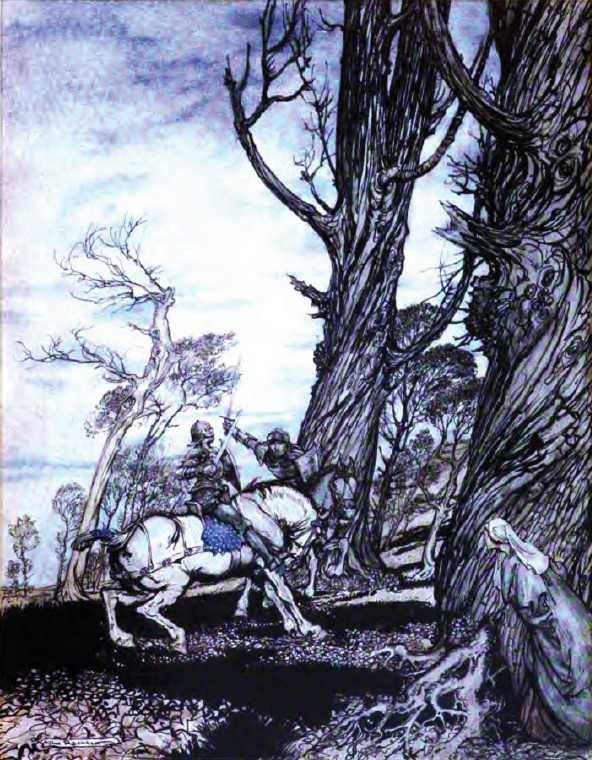
How Sir Launcelot slew the knight Sir Peris de Forest Savage
that did distress ladies, damosels and gentlewomen.
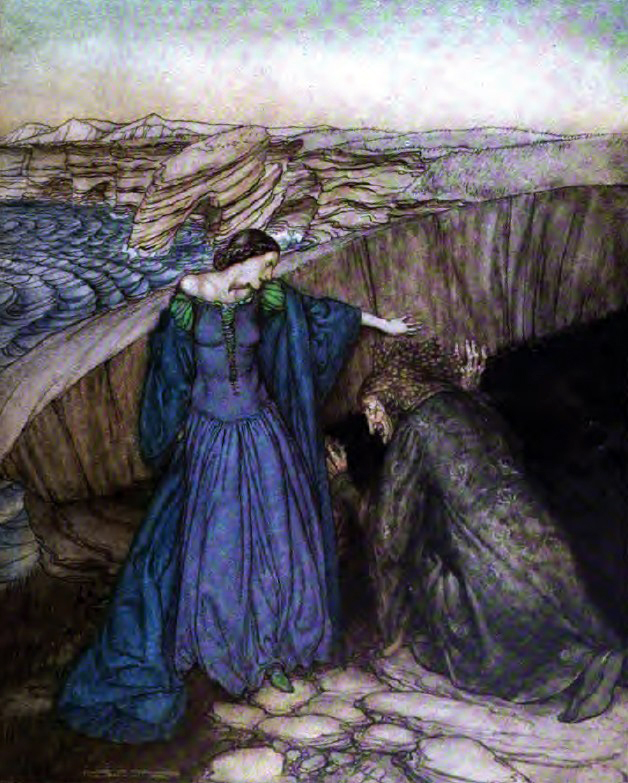
Merlin and Nimue


How Beaumains defeated the Red Knight, and always the damosel spake
many foul words unto him

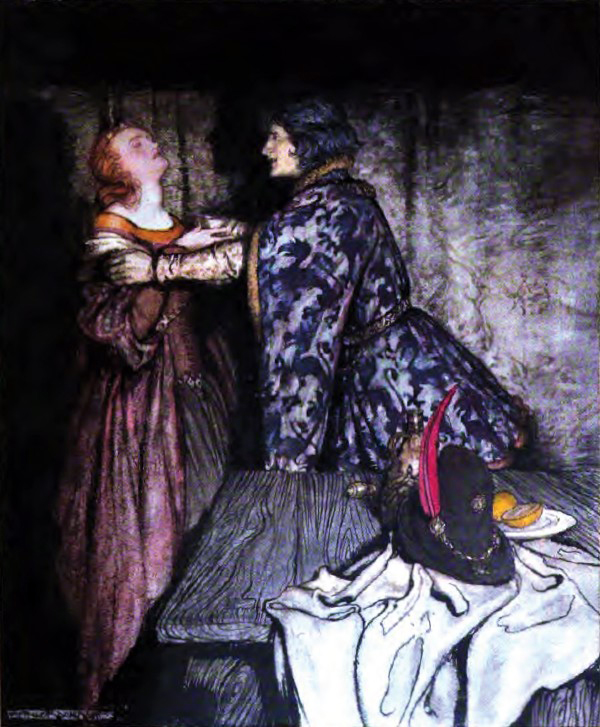
How Tristam and Isould drank the love drink.


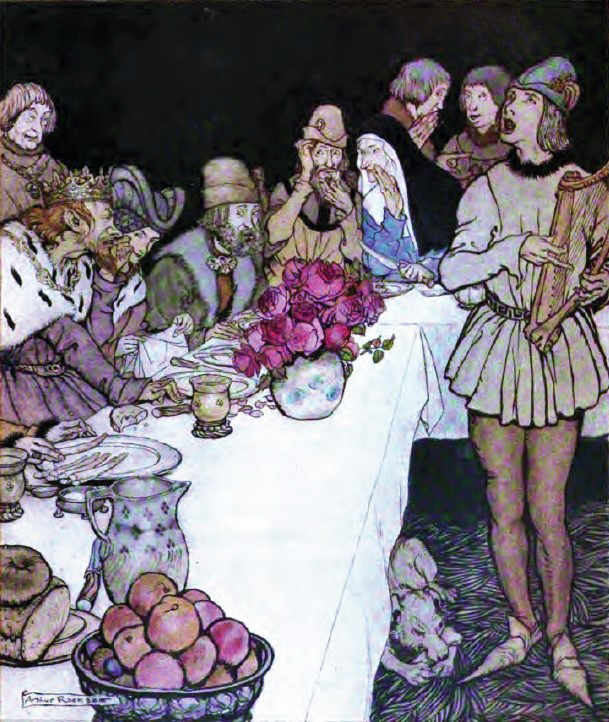
How at a great feast King Mark made came Eliot the harper 
and sang the lay that Dinadan had made.


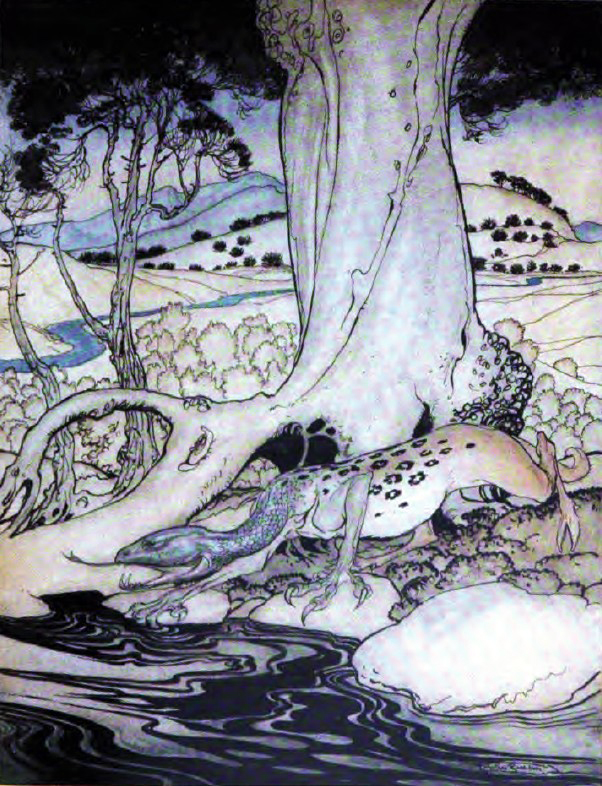
The Questing Beast.

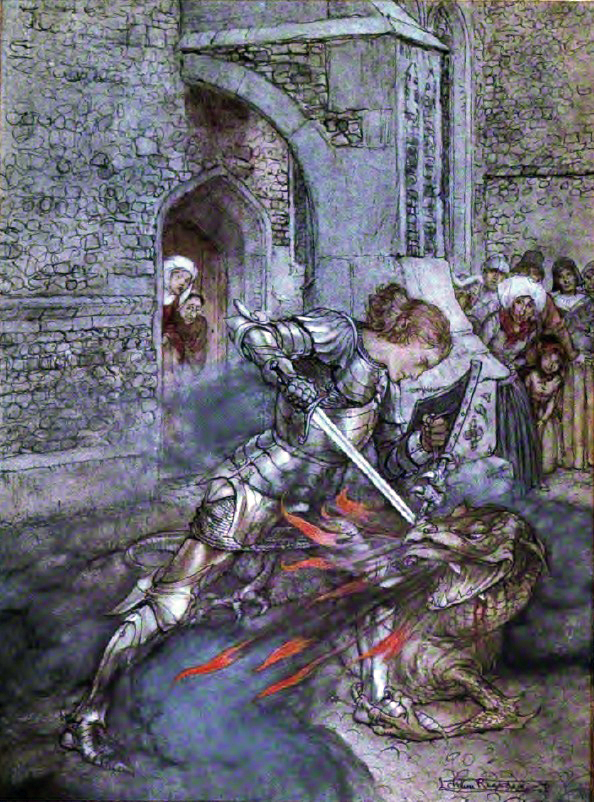
How Sir Launcelot fought with a friendly dragon.


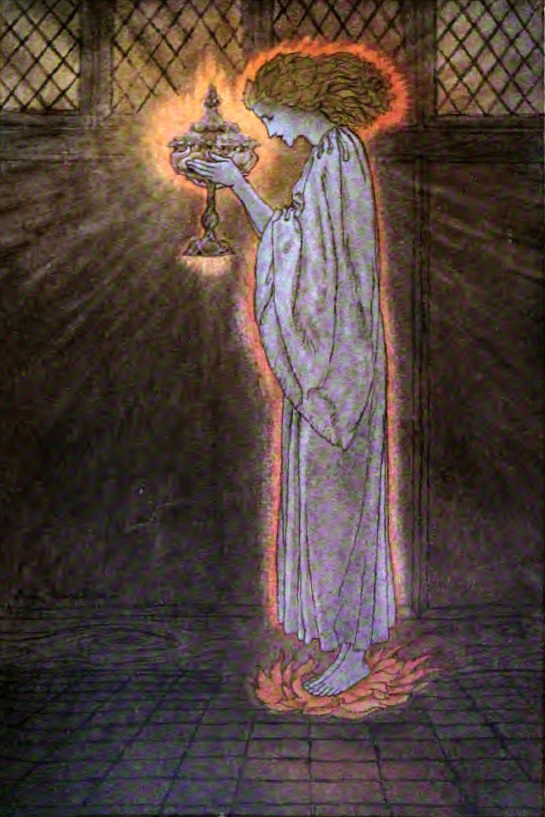
How at the Castle of Corbin a maiden bare in the Sangreal 
and fortold the achievements of  Galahad.


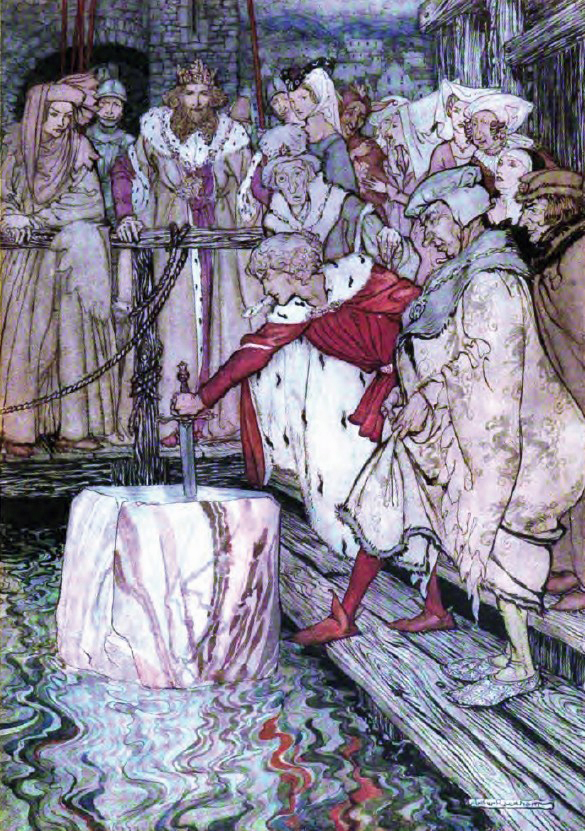
How Galahad drew out the sword from the from the floating stone of Camelot.


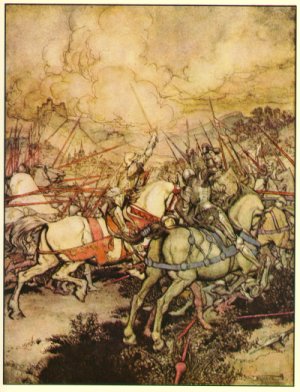
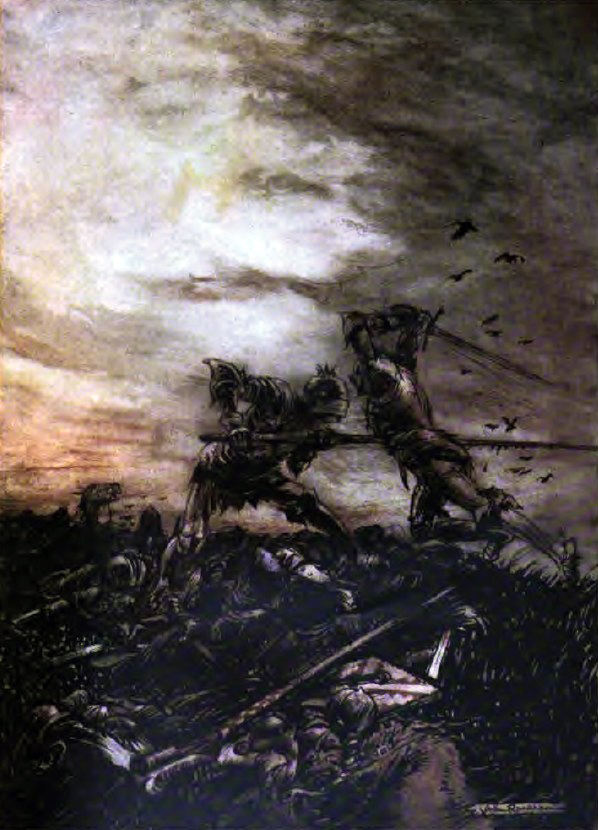
How Mordred was slain by Arthur, and how by him Arthur was hurt to the death

Tuesday, February 26, 2013

King Arthur


Camelot (1967) Poster

We can be certain King Arthur was not a medieval King with a bevy of knights in suits of armour and a big castle called Camelot. We know very little historically but if he existed, then King A rthur was probably a 5th century warrior chief who protected his peoples from the Saxon invaders for a time. The battle of Camlan is probably connected to King Arthur. But virually everything about King Arthur is conjecture. He could have come from CornwallWalesSouthern EnglandNorthern England . Britain abounds with sites which have King Arthur connections.
King Arthur was said to be the son of Uther Pendragon and Ygraine of Cornwall. Arthur is a near mythic figure in Celtic stories such as Culhwch and Olwen. In early chronicles he is presented as a military leader, the dux bellorum. In later romance he is a king and emperor. The Tudor monarchs traced their lineage to King Arthur and used that connection as a justification for their occupation of the English throne.
Irrespective of whether King Arthur was real or mythical, it cannot be denied that King Arthur has been a major influence on literature, from the early Middle Ages to the present day. And although if King Arthur had been a "real" king, he would have lived around the 5th or 6th centuries, it is more as a Middle Ages knight that he is presented in literature. From Malory to Tennyson to T. H. White. The central story is of a noble kingdom of high ideals, whose ideals are undermined by the adultery of Queen Guinevere with Lancelot, the most noble of all the knights. And eventually brought down by the treachery of Mordred. And in spite of this, Arthur's memory lives on.
Historia Brittonum (written c.830AD) says “Arthur fought against them [the Saxon invaders] in those days, together with the kings of the Britons, but he was the leader in battles [dux bellorum].” The rest of the text lists a number of his supposed battles of which the Battle of Badon is the only one that we know from other historical sources (Gildas’s De Excidio Britanniae of c.540AD, which mentions the battle but not Arthur).
The main impetus for Arthurian stories starts with Geoffrey of Monmouth who records Arthur's birth, childhood, ascension to the throne, military conquests, and death. He places King Arthur as living from the late fifth century to 542, when the king was mortally wounded in his last battle. This story became the basis of the Arthurian legend, and was built on by Chrétien de Troyes and Sir Thomas Malory.
Geoffrey completed his History around 1130, using earlier sources such as GildasNenniusThe Annales Cambriae and Bede. But none of these makes any subsantial mention of a King Arthur. So where did he get his facts? Geoffrey claimed to have had in his possession a "certain very ancient book written in the British language." However nobody else has used this book, and if it existed, has not been passed down to modern times
Other attempts to fill-out the above concept of King Arthur have focused on trying to localise this Arthur. Arthur has been placed by various researchers as the war-leader in the North of Britain, the South, the Midlandssouthern Scotland as well as Wales and Cornwall . But these are not particularly sucessful at localising King Arthur, as the early "historical" references just are too vague to tie him down.
But the main source of Arthurian myths did not come from British English writings. Rather from French authors living in Brittany about 300 years before Malory's epic Arthurian tale was published. They might well have based their tales on stories told by English Crusaders in the 11th century, but they undoubtedly embroidered these stories themselves. These early romantic novelists gave us most of the myths that was later further embroidered by Malory and Tennyson.
So really King Arthur, the 'King of the Britons' was in probably a French invention, as are so many of the details of the legend that come from these early French writers. Lancelot, his affair with Guinevere, Excalibur, Camelot, the Round Table, Sir Perceval all originate with these French writers.
And at roughly the same time Geoffrey of Monmouth was writing his History of the Kings of Britain. In Geoffrey's story Arthur lived during a war-torn period in Welsh history, and becomes the leader of a large kingdom he has created by military victories against the invading Saxons. In Geoffrey's account, Arthur goes on to invade France, defeats the Roman armies and almost conquers the remnants of the Roman empire.
It seems that there was a war leader, whose name we do not know, who defeated the Saxons, checking their advance temporarily. As time went by people remembered this leader fondly, the good old days and a touch of "Oh, if only ... was our leader now". Eventually the name Arthur stuck as his name in folk memory, and his ascribed deeds grew long after his death - King Arthur arrives, the once and future king.


The Legend of King Arthur


Whether King Arthur existed or not is doubtful. However if King Arthur did exist, then he would have lived sometime between 400 AD and 600 AD, a time of turmoil in Britain following the Roman withdrawl. And a time when written literature did not exist, therefore events during this period are only known about from folklore passed down several generations before being written down, or from modern archeology giving insights from excavations of sites.
If there was ever a true King Arthur in history, he would probably be Romano-British warleader, probably named Artorius, which is a Roman name for Arthur. Though the Roman legions may have left Britain in AD 410, the general population of mixed Romans and Celts, would have had generations of Roman law, education, culture and way of life.
The name, Artorius, is similar enough to the Gallic god of the bear, Artaius or Artaios. The Roman had identified this god with their Mercury. In Latin, Arto means "bear". So Arthur like other Welsh characters, could be derived from ancient Celtic god in Gaul (France).
Possibly the earliest reference about come from Y Gododdin written by the Welsh poet, Aneirin, c. 6th century. Though, the poem was attributed to the 6th century, Gododdin was actually preserved in the manuscript called Book of Aneirin, in c. 1250. The poem only mentioned Arthur's name, once, referring to a warrior in the poem as being brave "but he was no Arthur". There is no linguistic evidence that would dati Y Gododdin as a whole before the 9th- or 10th-century
Most of the early legends of King Arthur come from Welsh sources, between the 8th and 10th century.The earliest tale where King Arthur had more active role in early Welsh literature come from Culhwch and Olwen (before AD 1100), one of eleven tales in the Mabinogion. Other tales found in the Mabinogion were composed of later date from Dream of Rhonabwy and the three Welsh romances: Geriant, Owein and Peredur. These tales are similar to those found in Chretien de Troyes' three King Arthur romances – Erec, Yvain and Perceval, which may have been composed earlier than the Welsh versions.
The case for a historical King Arthur rests on two sources, the Historia Brittonum and the Annales Cambriae, both of which show that King Arthur that is at least partly historical. The Historia Brittonum was written anonymously in A.D. 829/30, the ascription to one 'Nennius' now being regarded as false. Historia Brittonum is of dubious historical value as it shows a number of mythical figures as genuinely historical, but it does show at least that King Arthur as a figure was current by A.D. 829/30 at the latest.
St Bede the Venerable wrote in his Historia ecclesiastica gentis Anglorum ("Ecclesiastical History of the English People"), in AD 731, but does not mention King Arthur by name.
The Annales Cambriae, was compiled in 950s and is sometimes seen as offering evidence for Arthur being a historical figure. It mentions Arthur in two entries: that for A.D. 516 which tells of the "battle of Badon, in which Arthur carried the cross of our Lord Jesus Christ on his shoulders for three days and three nights, and the Britons were the victors" and that for A.D. 537 concerning "the battle of Camlann, in which Arthur and Medraut fell". The Annales Cambriae is basically a version of the 'Chronicle of Ireland' and there is no justification for thinking that any of the British entries are drawn from contemporary or even near-contemporary sources and, rather, they should be seen as interpretations dating from between the very late 8th-century and the mid 10th-century when the Annales reached its final form.
In Gildas's De Excidio Britanniae, Ambrosius is given prominence as the initiator of the British counterattack which, after the fighting of several battles, culminates in the battle of Badon.
These sources cannot prove that there was a historical 5th-/6th-century King Arthur and no contemporary or near-contemporary source makes any mention of him.( The best we can say is that there existed by the 9th-century at the latest a concept of King Arthur as a historical figure. The sources that we have today are simply not of the quality that would allow us to come to any firmer conclusion than this.
Geoffrey of Monmouth derived his sources, mainly from Nennius, but also from the GildasBede and the Annales Cambriae. However, Geoffrey set the year of Arthur's deaath a little later on 542. Also, Geoffrey had turned Ambrosius Aurlianus into Aurelius Ambrosius, an uncle of King Arthur. Around A.D. 1139 Geoffrey of Monmouth (Galfridus Monemutensis) completed his Historia Regum Britanniae ('History of the Kings of Britain') which glorified King Arthur and made him an international warlord. This work became influential throughout western Europe and affected the King Arthur legend in all areas with the result that scholars look to sources written before Geoffrey's Historia for the 'original' King Arthur.
Geoffrey of Monmouth wrote about the warrior king of Britain at the time of flux in Britain. After the Romans left, Saxons and Angles had invaded Britain, driving the Britons (Celts) into Wales, Scotland, Cornwall and Brittany between the 5th and early 7th century. The Normans from Normandy in France won control of Britain after the Battle of Hastings in 1066. Geoffrey was writing at the time of the death of Henry I and in the reign of King Stephen (1135-1154), a period of anarchy and civil war. It could have been that Geoffrey wanted to give them a British hero, someone that the country could be proud of, and massaged the historical scripts that existed, to get King Arthur as his hero.
The souces that are used for King Arthur research are as follows :-
Gildas - died 570 AD
The Venerable Bede - 731 AD
Nennius - 800 AD
Geoffrey of Monmouth - 1130 AD
Chretien de Troyes - 1170/1185 AD
Gerald of Wales - 1145 to 1223 AD
Medieval Welsh Literature - 8th to 14th cent.
Medieval French Literature 1155 - 1235 AD
Sir Thomas Malory 1416 - 1470
John Leland 1545
Alfred, Lord Tennyson 1809-1892
T.H.White 1906 - 1964