Translate

Showing posts with label directoire. Show all posts

Monday, January 21, 2013

The Historical Context Of Contemporary International Relations


Chapter Summary

I. INTRODUCTION

  • The purpose of this historical overview is to trace important trends over time—the emergence of the state and the notion of sovereignty, the development of the international state system, and the changes in the distribution of power among states
  • Contemporary international relations, in both theory and practice, is rooted in the European experience, for better or worse.

II. THE PRE-WESTPHALIAN WORLD

  • Many international relations theorists date the contemporary system from 1648, the year of the Treaty of Westphalia, ending the Thirty Years War. This treaty marks the end of rule by religious authority in Europe. The Greek city-state system, the Roman Empire, and the Middle Ages are each key developments leading to the Westphalian order
  • The Middle Ages: Centralization and Decentralization
    • When the Roman empire disintegrated in the fifth century A.D., power and authority became decentralized in Europe.
    • By 1000 A.D. three civilizations had emerged from the rubble of Rome:
      1. Arabic civilization: under the religious and political domination of the Islamic caliphate, advanced mathematical and technical accomplishments made it a potent force.
      2. Byzantine Empire: located near the core of the old Roman Empire in Constantinople and united by Christianity.
      3. The rest of Europe, where languages and cultures proliferated, and the networks of communication developed by the Romans were beginning to disintegrate.
  • Much of Western Europe reverted to feudal principalities, controlled by lords and tied to fiefdoms that had the authority to raise taxes and exert legal authority. Feudalism was the response to the prevailing disorder
  • The preeminent institution in the medieval period was the church; virtually all other institutions were local in origin and practice.
  • Carolus Magnus, or Charlemagne, the leader of the Franks (in what is today France), challenged the church’s monopoly on power in the late eighth century.
  • Similar trends of centralization and decentralization, political integration and disintegration, were also occurring in Ghana, Mali, Latin America, and Japan.
  • The Late Middle Ages: Developing Transnational Networks in Europe and Beyond
    • After 1000 A.D. secular trends began to undermine both the decentralization of feudalism and the universalization of Christianity in Europe. Commercial activity expanded into larger geographic areas. All forms of communication improved and new technologies made daily life easier.
    • Economic and technological changes led to fundamental changes in social relations.
      1. A transnational business community emerged, whose interests and livelihoods extended beyond its immediate locale
      2. Writers and other individuals rediscovered classical literature and history, finding intellectual sustenance in Greek and Roman thought
      3. Niccolò Machiavelli, in The Prince, elucidated the qualities that a leader needs to maintain the strength and security of the state. Realizing that the dream of unity in Christianity was unattainable, Machiavelli called on leaders to articulate their own political interests. Leaders must act in the state’s interest, answerable to no moral rules.
      4. In the 1500s and 1600s, as European explorers and even settlers moved into the New World, the old Europe remained in flux. Feudalism was being replaced by an increasingly centralized monarchy.
      5. The masses, angered by taxes imposed by the newly emerging states, rebelled and rioted.

III. THE EMERGENCE OF THE WESTPHALIAN SYSTEM

  • The formulation of sovereignty was one of the most important intellectual developments leading to the Westphalian revolution.
  • Much of the development of sovereignty is found in the writings of French philosopher Jean Bodin. To Bodin, sovereignty was the “absolute and perpetual power vested in a commonwealth.” Absolute sovereignty, according to Bodin, is not without limits. Leaders are limited by natural law, laws of God, the type of regime, and by covenants and treaties.
  • The Thirty Years War (1618-48) devastated Europe. But the treaty that ended the conflict, the Treaty of Westphalia, had a profound impact on the practice of international relations in three ways:
    • It embraced the notion of sovereignty—that the sovereign enjoyed exclusive rights within a given territory. It also established that states could determine their own domestic policies in their own geographic space.
    • Leaders sought to establish their own permanent national militaries. The state thus became more powerful since the state had to collect taxes to pay for these militaries and the leaders assumed absolute control over the troops.
    • It established a core group of states that dominated the world until the beginning of the nineteenth century: Austria, Russia, England, France, and the United Provinces of the Netherlands and Belgium.
  • The most important theorist at the time was Scottish economist Adam Smith. In An Inquiry into the Nature and Causes of the Wealth of Nations, Smith argued that the notion of a market should apply to all social orders
    • Individuals should be permitted to pursue their own interests and will act rationally to maximize his or her own interests
    • With groups of individuals pursuing self-interests, economic efficiency is enhanced as well as the wealth of the state and that of the international system. This theory has had a profound effect on states’ economic policies.

IV. EUROPE IN THE NINETEENTH CENTURY

  • The American Revolution (1776) and the French Revolution (1789) were the products of Enlightenment thinking as well as social contract theorists.
  • The Aftermath of Revolution: Core Principles
    • Legitimacy: absolutist rule is subject to limits and imposed by man. In Two Treatises on Government, John Locke attacked absolute power and the divine right of kings. Locke’s main argument is that political power ultimately rests with the people rather than with the leader or the monarch.
    • Nationalism: the masses identify with their common past, their language, customs, and practices. Individuals who share such characteristics are motivated to participate actively in the political process as a group.
  • The Napoleonic Wars
    • The political impact of these twin principles was far from benign in Europe. The nineteenth century opened with war in Europe on an unprecedented scale.
      1. Technological change allowed larger armies.
  • French weakness and its status as a revolutionary power made it ripe for intervention and the stamping out of the idea of popular consent
  • The same nationalist fervor that brought about the success of Napoleon Bonaparte also led to his downfall.
    1. In Spain and Russia, nationalist guerillas fought against French invaders.
    2. Napoleon’s invasion of Russia ended in disaster, leading to French defeat at Waterloo three years later.
  • Peace at the Core of the European System
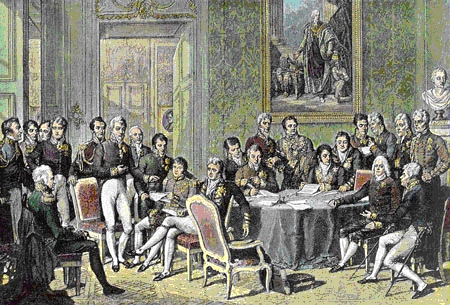
    • Following the defeat of Napoleon in 1815 and the establishment of peace by the Congress of Vienna, the Concert of Europe—Austria, Britain, France, Prussia, and Russia—ushered in a period of relative peace.
    • The fact that general peace prevailed during this time is surprising, since major economic, technological, and political changes were radically altering the landscape.
    • At least three factors explain the peace:
      1. European elites were united in their fear of revolution from the masses. Elites envisioned grand alliances that would bring European leaders together to fight revolution from below. Leaders ensured that mass revolutions did not love from state to state.
      2. Two of the major issues confronting the core European states were internal ones: the unifications of Germany and Italy. Although the unification of both was finally solidified, through small local wars, a general war was averted since Germany and Italy were preoccupied with territorial unification.
      3. Imperialism and colonialism
  • Imperialism and Colonialism in the European System before 1870
    • The discovery of the “New” World by Europeans in 1492 led to rapidly expanding communication between the Americas and Europe.
      1. Explorers sought discovery, riches, and personal glory.
      2. Clerics sought to convert the “savages” to Christianity
    • European powers sought to annex distant territories. The term imperialism came to mean the annexation of distant territory, usually by force, and its inhabitants into an empire.
    • Colonialism, which often followed imperialism, refers to the settling for people from the home country among indigenous peoples whose territories have been annexed.
    • This process also led to the establishment of a “European” identity.
      1. European, Christian, civilized, and white were contrasted with the “other” peoples of the world.
    • The industrial revolution provided the European states with the military and economic capacity to engage in territorial expansion.
    • During the Congress of Berlin (1885), the major powers divided up Africa.
    • Only Japan and Siam were not under European control in Asia.
    • The struggle for economic power led to the heedless exploitation of the colonial areas, particularly Africa and Asia.
    • As the nineteenth century drew to a close the control of the colonial system was being challenged with increasing frequency.
    • During this period, much of the competition, rivalry, and tension traditionally marking relations among Europe’s states could be acted out far beyond Europe.
    • By the end of the nineteenth century, the roll of political rivalry and economic competition had become destabilizing.
  • Balance of Power
    • The period of peace in Europe was managed and preserved for so long because of the concept of balance of power.
    • The balance of power emerged because the independent European states feared the emergence of any predominant state (hegemon) among them. Thus, they formed alliances to counteract any potentially more powerful faction
  • The Breakdown: Solidification of Alliances
    • The balance-of-power system weakened during the waning years of the nineteenth century. Whereas previous alliances had been fluid and flexible, now alliances had solidified.
    • Two camps emerged: the Triple Alliance (Germany, Austria, and Italy) in 1882 and the Dual Alliance (France and Russia) in 1893.
    • In 1902 Britain broke from the “balancer” role by joining in a naval alliance with Japan to prevent a Russo-Japanese rapprochement in China. For the first time, a European state turned to an Asian one in order to thwart a European ally.
      1. Russian defeat in the Russo-Japanese war in 1902 was a sign of the weakening of the balance-of-power system
    • The end of the balance-of-power system came with World War I.
    • Germany had not been satisfied with the solutions meted out at the Congress of Berlin. Being a “latecomer” to the core of European power, Germany did not receive the diplomatic recognition and status its leaders desired.
    • With the assassination of Archduke Ferdinand, Germany encouraged Austria to crush Serbia. Under the system of alliances, states honored their commitments to their allies, sinking the whole continent in warfare.
    • Between 1914 and 1918, more than 8.5 million and 1.5 million civilians lost their lives.

V. THE INTERWAR YEARS AND WORLD WAR II

  • The end of World War I saw critical changes in international relations:
    • First, three European empires (Russia, Austro-Hungary, and the Ottoman) were strained and finally broke up during the war. With those empires went the conservative social order of Europe; in its place emerged a proliferation of nationalisms.
    • Second, Germany emerged out of World War I an even more dissatisfied power. The Treaty of Versailles, which formally ended the war, made Germany pay the cost of the war through reparations. This dissatisfaction provided the climate for the emergence of Adolf Hitler, who was dedicated to right the “wrongs” imposed by the treaty.
    • Third, enforcement of the Versailles Treaty was given to the ultimately unsuccessful League of Nations, the intergovernmental organization designed to prevent all future wars. The League did not have the political weight to carry out its task because the United States refused to join.
    • Fourth, a vision of the post-World War I order had clearly been expounded, but it was a vision stillborn from the start. The world economy was in collapse and German fascism wreaked havoc on the plan for post-war peace.
  • World War II
    • World War II was started by Germany, Italy, and Japan.
      • Japan had attacked China in a series of incidents beginning in 1931 eventually leading to war.
      • Italy attacked Ethiopia in 1935, using yperite (a form of mustard gas banned by the Geneva Protocol).
      • Nazi Germany was the biggest challenge, as it set to right what Hitler saw as the wrongs of the Treaty of Versailles.
    • The power of fascism—German, Italian, and Japanese versions—led to the uneasy alliance between the communist Soviet Union and the liberal United States, Britain, and France. When World War II broke out, this alliance (the Allies) fought against the Axis powers in unison.
    • The Allies at the end of the war were successful. Both the German Reich and imperial Japan lay in ruins at the end of the war.
    • Two other features of World War II demand attention as well.
      • The German invasion of Poland, the Baltic States, and the Soviet Union was followed by the organized murder of human beings, including Jews, Gypsies, communists, and Germans who showed signs of genetic defects.
      • While Germany surrendered in May 1945, the war did not end until the surrender of Japan in August.
        • In order to avoid a costly invasion, the United States dropped atomic bombs on the cities of Hiroshima and Nagasaki.
        • The new weapon, combined with the Soviet declaration of war against Japan led to the surrender of Japan to the Allies.
    • The end of World War II resulted in a major redistribution of power and changed political borders.

VI. THE COLD WAR

  • Origins of the Cold War
    • The most important outcome of World War II was the emergence of two superpowers—the United States and the Soviet Union—as the primary actors in the international system and the decline of Europe as the epicenter of international politics.
    • The second outcome of the war was the recognition of fundamental incompatibilities between these two superpowers in both national interests and ideology.
      1. Russia used its newfound power to solidify its sphere of influence in the buffer states of Eastern Europe.
      2. U.S. interests lay in containing the Soviet Union. The United States put the notion of containment into action in the Truman Doctrine of 1947. After the Soviets blocked western transportation corridors to Berlin, containment became the fundamental doctrine of U.S. foreign policy during the Cold War.
      3. The U.S. economic system was based on capitalism, which provided opportunities to individuals to pursue what was economically rational with little or no government interference.
      4. The Soviet state embraced Marxist ideology, which holds that under capitalism one class (the bourgeoisie) controls the ownership of production. The solution to the problem of class rule is revolution wherein the exploited proletariat takes control by using the state to seize the means of production. Thus, capitalism is replaced by socialism.
      5. Differences between the two superpowers were exacerbated by mutual misperceptions. The Marshall Plan and establishment of the North Atlantic Treaty Organization (NATO) were taken as a campaign to deprive the Soviet Union of its influence in Germany. Likewise, the Berlin Blockade was interpreted by the West as a hostile offensive action.
    • The third outcome of the end of World War II was the beginning of the end of the colonial system. European colonialists. Beginning with Britain’s granting of independence to India in 1947, Indochina and African states became independent in the 1950s and 1960s
    • The fourth outcome was the realization that the differences between the two superpowers would be played out indirectly, on third-party stages, rather than through direct confrontation between the two protagonists. The superpowers vied for influence in these states as a way to project power.
  • The Cold War as a Series of Confrontations
    • The Cold War itself (1945-89) can be characterized as forty-five years of high-level tension and competition between the superpowers but with no direct military conflict.
    • More often than not, the allies of each became involved, so the confrontations comprised two blocs of states: those in the North Atlantic Treaty Organization (NATO) in Western Europe and the United States, and the Warsaw Pact in Eastern Europe.
    • One of those high-level, direct confrontations between the superpowers took place in Germany.
      1. Germany had been divided after World War II into zones of occupation. In the 1949 Berlin blockade, the Soviet Union blocked land access to Berlin, prompting the United States to airlift supplies for a year.
      2. In 1949, the separate states of West and East Germany were declared.
      3. East Germany erected the Berlin Wall in 1961 in order to stem the tide of East Germans trying to leave the troubled state.
  • The Cold War in Asia and Latin America
    • China, Indochina, and especially Korea became symbols of the Cold War in Asia.
      1. By 1949 the Kuomintang was defeated in China and its leaders fled to the island of Formosa (not Taiwan).
      2. In French Indochina communist forces fought against the French colonial forces leading to the eventual French defeat in 1954.
      3. In 1950 North Korea attempted to reunify the Korean peninsula under communist rule, launching at attack against the South.
        • U.S. forces, fighting under the auspices of the United Nations, counterattacked and nearly defeated North Korea.
        • As UN troops approached the Chinese border, the Chinese attacked, driving the UN forces South and leading to an eventual three-year stalemate ending in a armistice in 1953.
    • The 1962 Cuban Missile Crisis was another direct confrontation in yet another part of the world. The Soviet Union’s installation of missiles in Cuba was viewed by the United States as a direct threat to its territory.
    • In Vietnam, the Cold War played out in an extended civil war, in which communist North Vietnam were pitted against South Vietnam.
    • U.S. policy makers argued that communist influence must be stopped before it spread like a chain of falling dominoes throughout the rest of Southeast Asia (hence the term domino theory).
  • The “Cold” in “Cold War”
    • It was not always the case that when once of the superpowers acted the other side responded.
      1. When the Soviet Union invaded Hungary in 1956 and Czechoslovakia in 1968, the United States verbally condemned such actions but the actions themselves went unchecked.
      2. The Soviets kept quiet when the United States invaded Granada in 1983 and Panama in 1989.
    • The Middle East was a region of vital importance to both the United States and Soviet Union, and thus the region served as a proxy for many of the events of the Cold War.
      1. Following the establishment of Israel in 1948, the region was the scene of a superpower confrontation by proxy: between a U.S.-supported Israel and the Soviet-backed Arab states of Syria, Iraq, and Egypt. Proxy “hot” wars, such as the Six-Day War in 1967, and the Yom Kippur War in 1973 were fought.
      2. Confrontation through proxy also occurred in parts of the world of less strategic importance, such as the Congo, Angola, and the Horn of Africa.
    • The Cold War was also fought and moderated in words, at summits (meetings between the leaders) and in treaties.
      1. Some of these summits were successful, such as the 1967 Glassboro Summit that began the loosening of tensions known as détente.
      2. Treaties placed self-imposed limitations on nuclear arms.
  • The Cold War as a Long Peace
    • John Lewis Gaddis has referred to the Cold War as a “long peace” to dramatize the absence of war between the great powers. Why?
      1. Nuclear deterrence: Once both the United States and Soviet Union had acquired nuclear weapons, neither was willing to use them.
      2. Division of power: the parity of power led to stability in the international system
      3. The stability imposed by the hegemonic economic power of the United States: being in a superior economic position for much of the Cold War, the United States willingly paid the price of maintaining stability throughout the world.
      4. Economic liberalism: the liberal economic order solidified and became a dominant factor in international relations. Politics became transnational under liberalism—based on interests and coalitions across state boundaries—and thus great powers became obsolete.
      5. The long peace was predetermined: it is just one phase in a long historical cycle of peace and war.

VII. THE POST-COLD WAR ERA

  • The fall of the Berlin Wall symbolized the end of the Cold War, but actually its end was gradual. Soviet premier Mikhail Gorbachev had set in motions two domestic processes—glasnost (political openness) and perestroika (economic restructuring)—as early as the mid-1980s.
  • Gorbachev’s domestic reforms also led to changes in the orientation of Soviet foreign policy. He suggested that members of the UN Security Council become “guarantors of regional security.”
  • The first post-Cold War test of the new so-called new world order came in response to Iraq’s invasion and annexation of Kuwait in 1990.
  • A few have labeled the end of the Cold War era the age of globalization. This era appears to be marked by U.S. primacy in international affairs to a degree not even matched by the Romans.
  • However, U.S. primacy is still not able to prevent ethnic conflict, civil wars, and human rights abuses from occurring.
  • The 1990s was a decade marked by dual realities (and sometimes converged and diverged), the first being U.S. primacy and the second being civil and ethnic strife.
    • Yugoslavia’s violent disintegration played itself over the entire decade despite Western attempts to resolve the conflict peacefully.
    • At the same time, the world witnessed ethnic tension and violence as genocide in Rwanda and Burundi went unchallenged by the international community.
  • On September 11, 2001, the world witnessed deadly, and economically destructive terrorist attacks against two important cities in the United States. These attacks set into motion a U.S.-led global war on terrorism.
    • The United States fought a war in Afghanistan to oust the Taliban regime, which was providing safe haven to Osama bin Laden’s Al-Qaeda organization and a base from which it freely planned and carried out a global terror campaign against the United States.
    • Following the initially successful war in Afghanistan, the United States, convinced that Iraq maintained weapons of mass destruction and supported terrorist organizations, attempted to build support in the United Nations for authorization to remove Saddam Hussein from power. When the United Nations failed to back the U.S. request, the United State built its own coalition and overthrew the Iraqi government. The fight continues today.
    • Despite its primacy, the United States does not feel it is secure from attack. The issue of whether U.S. power will be balanced by an emerging power is also far from resolved.

VIII. IN SUM: LEARNING FROM HISTORY

  • Whether the world develops into a multipolar, unipolar, or bipolar system depends in part on by looking to the trends of the past and how they influence contemporary thinking. Or is the entire concept of polarity an anachronism?

Sunday, January 20, 2013

Was Napoleon Bonaparte a member of the Masonic Brotherhood?


Was Napoleon Bonaparte a member of the Masonic Brotherhood? Multiple hypotheses have been advanced on the subject, and although the probability is high, it has never been definitely established that he was made a Freemason, either in Valence (French Department Drome), Marseille, Nancy ("St. John of Jerusalem" Lodge, December 3, 1797?), Malta, Egypt or elsewhere.

What is certain is that members of the expedition he commanded during the Egyptian campaign brought the Freemasonry to the banks of the Nile. General Kleber founded the "Isis" Lodge in Cairo (was Bonaparte a co-founder?), while Brothers Gaspard Monge (member, among others, of the "Perfect Union" Military Lodge, Mezieres) and Dominique Vivant Denon (a member of Sophisians, "The Perfect Meeting" Lodge, Paris) were among the scholars who would make this strategic and military setback a success that the young General Bonaparte would exploit upon his return to France.

What is also undeniable is that, beginning with Bonaparte's coup of 18 Brumaire, the Freemasonry would thrive for 15 extraordinary years, multiplying the number of lodges and members. The First Consul Napoleon Bonaparte, understanding the advantages he could derive from the obedient Freemasonry, invested in these reliable men, hoping to be rewarded with faultless servility. He was not disappointed.


Freemasonry under the Consulate

When Napoleon Bonaparte came to power, a text of nine articles was signed on June 22, 1799 (the 21st day of the third year of the V:. L:. 5799) that unified the Great Lodge of France (Grande Loge De France: GLDF) and the Great Orient of France (Grand Orient De France: GODF). The text provided for the assembly of archives of both organizations, removed the privileges of the masters of the lodges of Paris, entrenched the tenure of Worshipful Masters, and established a system of election of officers. However, some "Scottish" lodges rejected this arrangement.

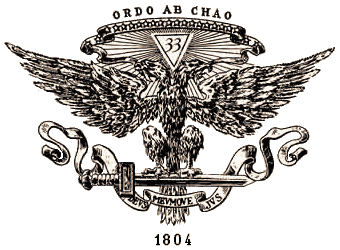
In 1801, while in Paris, Brother Jean Portalis ("Friendship" Lodge, Aix-en-Provence) actively participated in negotiating the Concordat with the Holy See and drafting the Civil Code with Brothers Jean-Jacques Regis de Cambaceres and Claude-Ambroise Regnier, a page of Freemason history was written on May 31 in Charleston, South Carolina. There, Colonel John Mitchell, a merchant born in Ireland, and Frederick Dalcho, a physician born in London of Prussian parents, "opened the Supreme Council 33° for the United States of America", the first Supreme Council of rite in 33 grades that would take the name Ancient and Accepted Scottish Rite (AASR) of France. It would announce its creation through a circular distributed "across both hemispheres" on January 1, 1803.

The Master Masons of the two great rival systems (Ancients and Moderns) were eligible indiscriminately, regardless of religion (hence perhaps the term "Accepted"). The motto Ordo ab Chao was adopted which, in organizational terms, expressed the desire to create a coherent system of degrees and to end the chaotic profusion of high grades. The rite, whose ranks were all of French origin, synthesized the influences initially spun by the English lodges, Scottish Lodges of Perfection, dissident structures such as the Council of the Eastern Knights of Brother Pirlet, the Order of Scottish Trinitarians, and the Order of the Flamboyant Star of Baron Tschoudy, and of the administrative system of the Mother Lodge of the Scottish Social Contract, which was a member of Count Auguste de Grasse-Tilly (started in 1783 in the "Saint John of the Scottish Social Contract" Lodge, Paris).

The universality of the AASR was founded on the basis of 33 successive degrees of initiation and the content of its various grades that encompassed almost all sources of ancestral spirituality in the West and Middle East. It was, therefore, not possible to claim the AASR without rigorously following its initiation rites and trusting the consistency of its gradual evolution.

In 1801, the Vatican reiterated its ban on priests receiving Masonic initiation.

The same year, the Freemason Rulebook, on the Modern French Rite of the Great Orient of France, was published, in line with the first Moderns, House of Grades of the Great Orient and some aspects of the Rectified Scottish Regime (RSR) that were made in 1795 by the Great Worship Master Alexander-Louis Roëttiers de Montaleau.

This document was consistent with decisions made in 1785, but in 1796 was repudiated by the Grand Orient, which had opted for communication of rituals to be exclusively in handwritten, not printed, form. The ritual of the French Rite was subsequently revised several times.

Regarding the Rectified Scottish Rite, 1801 saw the beginning of a three-year correspondence between Jean-Baptiste Willermoz, of Lyon ("founder" of the RSR in France and general counsel of Department Rhone by the First Consul Napoleon Bonaparte since June 1, 1800) and Claude-François Achard, of Marseille (Worshipful Master of The Triple Union, which resumed its work on June 1, 1801). In September 1802, Brother Taxil was received in Lyon by Willermoz and tasked to copy the "new rituals," which took five years.

On November 12, 1802 (the 12th day of the ninth month of the year of the V:. L:. 5802), a circular from the Grand Orient of France condemned the "so-called Scottish" Lodges and invited Brothers to "turn from our Temples a seed of discord that, during the most tempestuous times, seemed to have been respected."So as to maintain "regular lodges in France," the GODF began to write off all lodges practicing a rite other than the French Rite of seven degrees &ndish; an action that specifically targeted Scottish Mother Lodges.


Emblem of the Supreme Council of France
http://www.scdf.net/
Emblem of the Supreme Council of France
The year 1804 saw, in the atmosphere following the global exclusion of the Grand Orient, the Count of Grasse-Tilly returning to France and founding the Supreme Council of the 33rd Degree on September 22. It met on October 22 at the Scottish General Grand Lodge of France with the participation of the Scottish Mother Lodge of Marseilles. Both lodges had refused the merger with the Grand Orient in 1799, and were "blacklisted" by the Big East because of "discrepancies" - that is, for practicing the Scottish Rite &ndish; as representatives of Santo Domingo lodges followed the rite of Ancients, and, according to some sources, the Prince of Rohan, who had signed the Morin patent in 1761. Louis Bonaparte became the Grand Master.

Seeing the Supreme Council extended de factoauthority over the lodges' first three degrees, the Grand Orient suddenly had the power to sign a contract that merged the Scottish Grand Lodge with the Grand Orient, but left in existence a Sublime Council of the 33rd degree, which remained the sole authority to confer this level and to "decide on everything that was a point of honor."


Freemasonry under the Empire

It was during this period that French Freemasonry would experience its first golden age, as the number of lodges grew from 300 to 1,220 in ten years.

Bonaparte (initiated in "The Perfect Sincerity" Lodge of Marseilles) became Grand Master of the Grand Orient, which was entirely devoted to Napoleon and rarely failed to criticize the fiercely independent Scottish lodges.

Napoleon's relationship with the Grand Orient was all the more excellent that Roëttiers de Montaleau undertook to purify anti-Bonapartists, and that there were then among the dignitaries of the obedience:
  • Prince Louis Bonaparte
  • The Chancellor of the Empire Jean-Jacques Régis of Cambaceres
  • Marshals Andre Massena (initiated in Toulon in 1784 by "The Students of Minerva," a member of many lodges, including "The Real Friends Meeting" in Nice and the military lodge "The Perfect Friendship," GODF administrator and member of the Supreme Council), Joachim MuratFrançois Etienne Christophe Kellermann ("Saint Napoleon" Lodge, Paris), Charles Augereau (initiated in the lodge "The Children of Mars" in The Hague during his assignment in Holland, then a member of the Parisian Lodge "The Candor" before becoming Worshipful Master of the "Friends of the Arts and Glory" regimental Lodge), François Joseph Lefebvre("Friends Meeting," Mainz), Catherine Dominique de PerignonJean-Mathieu Philibert Serurier (Parisian lodges "St. Alexander of Scotland" and "The Imperial Bee"), Guillaume Brune ("Saint-Napoleon", Orient of Paris and "The Constant Friendship"), Adolphe Edouard Casimir Joseph Mortier (33°), Jean-de-Dieu Soult and Jean Lannes
  • Senators Antoine-César de Choiseul-Praslin ("The Candor," Paris), Arnail-Francis de Jancourt, Louis-Joseph-Charles Amable de Luynes and Dominique Clement de Ris
  • Deputy Luc Duranteau de Baune
  • Grand Chancellor of the Legion of Honor Bernard Germain Etienne de Lacepede (member of the "Nine Sisters" and "Saint Napoleon" lodges in Paris)
  • Scholar Joseph Jérôme Lefrançois de Lalande (the first Worshipful Master of the "Nine Sisters" Lodge in Paris)
  • Generals Etienne Macdonald and Horace Sebastiani
  • Contre-Admiral Charles Rene Magon de Medine
  • Ambassador Pierre Riel de Beurnonville
  • Interior Minister Jean-Baptiste de Nompere de Champagny
  • Constable Joseph Fouché (initiated in the "Sophie Madeleine, Queen of Sweden" Lodge in Arras) and the first president of the Court of Appeal Honoré Muraire (in original records of the secularization of the Civil State).
  • Brother Jean-Antoine Chaptal ("The Perfect Union," Montpellier) was in charge of agriculture.
Clearly the Freemasonry was still in power, and its influence not hidden.

Napoleon I, whether he had been initiated or not, was wary of Freemasonry, which he monitored through Joseph Fouché, and although the lodges displayed his bust in their temples and considered any challenge to his regime a serious Masonic error, some workshops were devoted mainly to celebrating the glory of the Emperor ("Napoléomagne", "The French Saint-Napoleon"), while others used the distinctive Masonic signage to conceal the work of subversive royalist activities ("St. Napoleon", in Angers).

There was a strong development of Masonic military lodges under the Empire, and Napoleon saw in that Masonic presence a powerful means of military cohesion and a tool for his European ambitions (using his own passionate feelings to unite the Brotherhood).


Receipt of a young woman in a Lodge of Adoption under the First Empire
Enlarge
As for Lodges of Adoption (women's lodges attached to men's lodges by a ritual called "adoption"), most weakened under the Empire, except for those of the Empress Josephine, who was a Grand Mistress ("Free Knights" and "Sainte Caroline" Lodges of Adoption, in Paris). In 1808, Lodges of Adoption were banned by the male Masons as "contrary to its constitution". The Masonic practice of adoption did not survive into the nineteenth century, except marginally.

Trade guilds, which had been banned during the Revolution &ndish; a prohibition reinforced by the Consulate &ndish; were tolerated, but closely monitored, under the Empire. At the beginning of the nineteenth century, the guilds were organized around three rites. The rite of Father Soubise included roofers, plasterers and carpenters. Those seen as heirs to the Holy Duty to God (Catholic, royalist and Bonapartist), followers of Master Jacques, gathered stonemasons, smiths and tanners, as well as some otherprofessions (rope makers, basket makers, hatters, etc.).

Under the rite of Solomon, which welcomed Protestant or agnostic members with a Republican, left-leaning political sensitivity, one found foreign stonemasons (C:.E:.) and the Journeymen of the Duty of Freedom (I:.N:.D:.G:.), which separated from the Duty of Freedom in 1804 under the pressure of freethinking and anticlerical trade union members. It was during that period that a French Freemason journeyman introduced the third grade in the Duty of Freedom (which now included affiliates of members), and an aristocratic body (the "insiders") composed mainly of members established as Masters was formed.

In 1804, the system of Beneficent Knights of the Holy City (the final stage of the Rectified Rite or Regime), which had been dormant during the French Revolution, was revived in Besançon.

In 1805, the first of two series of the rite of Mizraim (symbolic degrees 1-33° and philosophical degrees 34-66°) developed in France and Italy, borrowing various high levels from the eighteenth century (to compete with the AASR):
  • The rite of the Metropolitan Chapter of France
  • The Rite of Perfection of the Council of Eastern and Occidental Emperors (also used for AASR)
  • The Adonhiramite rite
  • The rite of the Grand Lodge of the Regular Masters of Lyon
  • The rite of the Scottish Mother Lodge of Marseilles
  • The Strict Templar Observance (SOT) and the Rectified Scottish Rite (RSR),
  • The Primitive Rite of Namur, the Scottish Philosophical Rite of Avignon, the Golden Rosicrucian, the Inside Brothers of Asia and the Egyptian Rite of Cagliostro.
Specific contributions rose from the gradations of Chaos (49-50°) and Key Masonics (54-57°).

That same year, Charles-Maurice de Talleyrand-Perigord was introduced to the Imperial Lodge of the Free Knights in Paris, where he remained apprenticed throughout his life.

It was also in 1805 that the Grand Orient created a Grand Executive Board of Rites, where some Brothers received the 33rd degree, in violation of agreements with the Sublime Council. The latter reacted by denouncing the text, restoring the Grand Lodge and Scottish General, and reinstating its authority over the entire AASR. But again, the imperial power intervened on behalf of the Grand Orient and forced the signing of a power-sharing agreement that gave it authority over the first eighteen degrees, with the Supreme Council of France overseeing the nineteenth to thirty-third.

Contrary to the wishes of Napoleon, there were now two rival Masonic powers in France, so the next year, to ensure control of the Supreme Council, he named Chancellor Jean Jacques Régis de Cambaceres the Sovereign Grand Commander instead of Grasse-Tilly or one of several dignitaries of the Grand Orient (Dominique Clement de Ris, Pierre Riel de Beurnonville, Catherine Dominique de Pérignon, Honoré Muraire, D'Aigrefeuille, etc.).


Jean-Jacques Régis de Cambaceres, Grand Commander 
    of the AASR in France from 1806 to 1821
Jean-Jacques Régis de Cambaceres, Grand Commander of the AASR in France from 1806 to 1821.
Enlarge
In the next decade, the Supreme Council dedicated itself to developing the "Guide to Scottish Freemasons", which took its roots from the Scottish Mother Lodges and Freemasonry of English and American Ancients (particularly Three Distinct Knocks of 1760) but also in theFreemason Regulator of the Modern French Rite. For the blue lodges (the first three workshops degrees), there was the "Journal of Symbolic three grades of the Ancient and Accepted Rite".

On February 18, 1806, two months after the battle of Austerlitz, Napoleon I decided to build a triumphal arch, a project that involved several Freemasons. Brother Jean-Baptiste Champagny Nompère convinced the Emperor to choose the site of the monument in these terms: "An Arch of Triumph that features the most majestic, superb and picturesque view, of the imperial palace of the Tuileries ... It will strike admiration in the traveler entering Paris ... It will imprint in any visitor to the French capital an indelible memory of its incomparable beauty ... Although the visitor has gone away, he will always have in front of him the triumphant arch. Your Majesty will cross it on your way to Malmaison, St. Germain, St. Cloud and even to Versailles ..."

Brother Jean Chalgrin ("The Simple Hearts of the North Star" Lodge, Paris), an architect, drew up the plans, based upon an initial draft prepared by Brother Charles Louis Balzac ("The Great Sphinx" Lodge, Paris). Under the July Monarchy (constitutional monarchy in France under King Louis-Philippe, starting with the July Revolution of 1830), two Brothers were to be in charge of the sculpture in bas-relief of the North Face - Francois Rude (The Marseillaise) and Jean-Pierre Cortot (The Peace of Vienna).

It was probably also in 1806 that Pierre-Joseph Briot, Governor of Abruzzo (under the authority of Joseph Bonaparte), introduced the Carbonari in Italy and started a "Secret Society of Philadelphian Republicans" at Besançon, "Good Cousin Carbonari" of the woodsman rite of Alexander the Great's Order of the Forger, which became affiliated at the rite of Mizraim in 1810.

Meanwhile, Filippo Buonarroti, a French revolutionary from Pisa and an old friend of Gracchus Babeuf, who knew Briot at Sospel, spent 30 years serving the lodges, especially within his own organization ("The Perfect Sublime Masters", under the direction of a "Great Firmament"), to cover up the spread of revolutionary ideas, Babouvist ideals and communism. Although its incidence was relatively limited, this unfortunate confusion between Freemasons and Carbonari ideas would quickly be interpreted as the politicization of the lodges.

The same year, 1806, saw the demise of the Strict Templar Observance (SOT), which did not survive the Revolution, as well as the introduction of the RSR and the loss of interest of its great master Charles of Hesse-Cassel, who became much more passionate about his research and mystical theurgics than about the Freemasonry.

Not counting the Anderson texts (The Constitutions of the Free-Masons of Pastor James Anderson, published in 1723), which defined the Freemasons of British influence, the statutes enacted in 1806 by the Grand Orient of France merely noted that "the Masonic Order in France was composed only of Freemasons recognized as such, assembled at regular workshops for camaraderie".

Also in 1806, archaeologist Alexandre Du Mège (or Dumège) founded an Egyptian rite, the "Sovereign Pyramid of Friends of the Desert", in Toulouse. There were some spin-offs in the region (Auch, Montauban), but they didn't last. The Friends of the Desert came into contact with the neighboring Napoleomagne Lodge, whose members had revived the Jacobite Scottish Rite of "Scottish Faithful," brought to Toulouse in 1747 by George Lockhart, aide to Charles Edward Stuart. The Grand Executive Board of Rites of the Grand Orient of France rejected this rite, based on Eastern occultism, in 1812.

In 1808, Brother Michel Ange de Mangourit, Grand Officer of the Scots Philosophical rite (who was temporary Foreign Minister in the Government of the Convention in November 1794), revived the Masonic "adoption" practice by creating the "Sovereign Metropolitan Chapter of the Ladies Scottish Hospice of France in Mount Tabor, Paris", which consisted mainly of women of imperial nobility. This highly esteemed lodge, which would operate until 1830, had a "class of choice" (Novice Freemason and Discreet Companion), two grades of Perfection, or "Great Mysteries" (Mistress Adonis and Mistress Moralist), and two highest grades (Historical and Philosophical).

In Naples, where Joachim Murat became king on August 1, 1808, the (military) Franco-Italian lodges saw a blossoming of the Rite of Mizraim, which would last until the end of the Empire. In 1811, Murat required the Grand Orient and Supreme Council of Naples to unify, and became their Grand Commander. It was doubtless during this period that the first attempts were made to establish the Rite of Mizraim in France. The rite thus received its third series (67-77° mystic degrees) the last (78-90°) would be introduced only until about 1812 in Naples.

In 1809, the Pope Pius VII was arrested by order of Napoleon, in anger over his excommunication because of the capture of Rome and the despoliation of the Papal States. It seemed the Emperor had not lost the support of the Grand Orient when he introduced a certain anticlericalism in the lodges, but the Pope did not forget how the Freemasons supported Napoleon.

In 1810, there arose in France a groundswell of opposition to republican secret societies such as the Carbonari founded by Arnaud Bazard, Jacques Flotard and Brother Jacques Buchez. In the region of Besançon, a revolutionary movement of Carbonari Cousins tried to infiltrate the lodges to let in opposing ideas and recruit workers to participate in a republican uprising. The Carbonari were organized into groups of twenty members, coordinated by a "High" group that belonged to Brother Lafayette (it also housed the venerable "Friends of Truth" of Rosoy and member of Supreme Council).

At the other end of the political spectrum, Count Ferdinand de Bertier in 1810 founded the "Knights of the Faith" ("Banner Association"), an ultra-royalist political movement based on ancient and medieval orders and the more recent and concrete experience of the Philanthropic Institute. The order had five grades: Charity Partner, Squire, Knight, Knight of Hospitality, and Knight of Faith. Several of its members also belonged to the religious congregation of the "Blessed Virgin".

In 1811, several Masonic events occurred:
  • Brother Jean-Baptiste Jules Bernadotte - Marshal of the Empire, who the previous year had become hereditary prince of Sweden - reformed the Swedish rite, whose organization still exists in twelve degrees in the 21st century.
  • The Provincial Grand Lodge of Hamburg adopted the rite developed by Brother Friedrich Ludwig Schroeder, limited to three symbolic grades, inspired by the ancient "Templar" Freemasonry - a rite still practiced today in some lodges in Germany, Austria, Hungary and Switzerland.
  • In Egypt, the "Mother Lodge of Paris of the Scottish Philosophical Rite" was founded in Cairo ("Knights of the Pyramids") and Alexandria ("Friends of the Concorde").
  • In Spain, the Count of Grasse-Tilly installed the Spanish Supreme Council.
  • In 1813, the Rite of Mizraim was endowed from 90 degrees from the impetus of Charles Lechangeur, Theodoric Cerbes and brothers Marc, Michel and Joseph Bédarride. Pierre Lassalle, grand master of Mizraim in Naples, was probably the one who introduced the Arcana Arcanorum in the "Plan of Naples" to the primitive rite of Mizraim. At the same time, the occultist Lodge of the "Commanders of Mount Tabor", linked to the Scottish Philosophical Rite, was founded, while a lodge of Egyptian Rite of Cagliostro ("The Vigilanza") continued its work independently of Mizraim.
The same year in England, after more than half a century of conflict, the Union Act put an end to the quarrel between the Ancients and Moderns, merging them into a universal masonry at three degrees (Emulation rite), in which explicit references to Christianity were removed.

After the first abdication of Napoleon and his exile to Elba, the Grand Orient provided support to King Louis XVIII, affirming the position that the Empire was only tyranny. This led many Freemasons to resign, especially as the Grand Orient changed its position again during the Hundred Days.

The Battle of Waterloo saw the end of the First Empire and of the great period of military lodges. The units commanded by Brothers Michel Ney (initiated in 1801 at the "St. John of Jerusalem" Lodge in Nancy, then a member of "The Candor" Lodge of the 6th Corps of the Grand Army), Pierre Cambronne andEmmanuel de Grouchy (of the "Heroism" Lodge in Beauvais and the "Candor" Lodge in Strasbourg) were defeated by those headed by Brothers Arthur Wellesley of Wellington (of the "Wellesley Family Lodge # 494" of Trim, Ireland) and Gebhard Leberecht von Blücher ("Archimedes" Lodge in Altenburg). Most of the marshals of the Empire were Freemasons, as were many of their opponents, including the English Vice-Admiral Horatio Nelson (York Union Lodge # 331), Sir John Moore, Marshal Mikhaïl Illarionovitch Kutuzov("The Three Keys" Lodge, Regensburg) and General Jean-Victor Marie Moreau.

Among the famous Freemasons of the Empire were:
  • Prince Jerome Bonaparte (acknowledged as Wolf Cub when he was 17 years old at the "Peace" Lodge in Toulon, then serving as Grand Master of the Grand Mother Lodge of Westphalia)
  • Prince Eugene de Beauharnais, Viceroy of Italy (founder of the Grand Orient and Supreme Council of Italy)
  • Prince Marshal Jozef Antoni Poniatowski ("Bracia Polacy Zjetnoczeni" Lodge, Warsaw)
  • Marshal Bon Adrien Jannot de Moncey, Duke of Conegliano
  • Marshal Nicolas Charles Oudinot, Duke of Reggio ("Saint Napoleon" Lodge, Amsterdam)
  • Marshal Louis-Gabriel Suchet, Duke of Albufera
  • Grand Marshal of the Palace Géraud-Michel Duroc, Duke of Friuli
  • General Jean Andoche Junot, Duke of Abrantes (initiated in Toulon in 1794 by "The Children of Mars and Neptune" and member of "The Great Master" Lodge, Paris)
  • General Armand de Caulaincourt, Duke of Vicenza ("Friends Meeting" and "Candor" lodges, Paris)
  • General général Jacques Alexandre Law de Lauriston ("Sully" Lodge, regiment of Toul, and deputy Grand Master of the GODF)
  • General Louis Bertrand de Sivray
  • General Charles Tristan de Monthollon
  • General Remi Joseph Isidore Exelmans
  • General Joseph Leopold Sigisbert Hugo ("Friends of the French Honor" Lodge)
  • Admiral Charles-Henri Verhuell
  • Joseph Simeon (Attorney for GODF, then Grand Master of the Kingdom of Westphalia)
  • Astronomer Pierre-Simon de Laplace
  • Baron Jean-Domique Larrey ("Children of Mars" Lodge at the 27th RI)
  • Sir Charles-Louis Cadet de Gassicourt
  • Painters Pierre Prud'hon ("The Charity" Lodge, Beaune), François Gerard ("The Great Sphinx" Lodge, Paris) and Jean-Baptiste Isabey ("Friends Meeting" and "Saint-Napoleon" lodges, Paris)
  • The tragedian François-Joseph Talma ("The Union" Lodge, Paris)
  • Academic Georges Cabanis
  • Writer and politician Benjamin Constant
  • Architects Alexandre Brongniart ("Saint John of the Social Contract" Lodge, Paris) and Pierre Fontaine
  • Composers Luigi Cherubini ("Saint John of Palestine" Lodge, the GODF) and Andre Gretry
  • Sculptor Claude Clodion ("Friends Meeting" Lodge, Paris)
  • Academic Joseph Lakanal ("The Perfect Point" and "The Triple Harmony" lodges, Paris)
  • Industrialist Christophe Oberkampf ("The Perfect Harmony" Lodge, Paris)
  • Privateer Robert Surcouf (initiated in 1796 to the "The Triple hope" Lodge in Port Louis, Mauritius and a member in 1809 of "The Triple Essence" Lodge in Saint-Malo)...
The fall of Napoleon caused to a large extent that of French Freemasonry. Louis XVIII was returned to power, and during the subsequent White Terror, people suspected of having ties with the government of the French Revolution or Napoleon &ndish; including the military and Freemasons &ndish; saw their armies and lodges decimated by "Knights of Faith," led by General Amédée Willot de Gramprez, a freemason himself. Duke Elie Decazes, Prefect of Police and a member of the Supreme Council of France, was hardly able to limit attacks against the Freemasons. The Freemasons would later, like many public figures, capitalize on political opportunism. But they would have to wait until the Second Empire and, more importantly, the Third Republic, before the Freemasonry would know a second "golden age" in France.


Lionel A. Bouchon and Didier Grau, webmasters of this site, warmly thank their friend who permitted them to use his personal archives about Freemasonry during French Consulate and First Empire.