Translate

Showing posts with label avalon. Show all posts

Sunday, March 3, 2013

Medieval French King Arthur Stories -

http://www.legendofkingarthur.co.uk/literature


Wace (1155), Vulgate Cycle (1215-1235) and Robert de Boron (1200) 

Wace 1155
Wace was an Anglo-Norman author, who wrote the Roman de Brut, in 1155. This was a French adaptation of Geoffrey of Monmouth's Historia regum Britanniae. Wace's work varied in places from Geoffrey's. Wace was the first to introduce the knightly fellowship of the Round Tabler. Wace's work on Arthur spread the popularity of the legend in French and Anglo-Norman courts, where a new genre of literature was soon developed by Chretien de Troyes from 1170 to 1185
Vulgate Cycle 1215-1235
The five-part romance which was composed by several authors, probably Cistercian monks in France between 1215-1235.
The Vulgate Cycle either elaborated the earlier work of Geoffrey of Monmouth and Wace or added new adventures. Arthur and Gawain become less important so that new heroes such as Lancelot, Galahad and Tristan can be seen.
The Vulgate Cycle has eight large volumes to give the whole Arthurian story as we now know it. Scholars believe that the outline for the cycle was the work of one man but that several authors wrote the works.
The Vulgate Cycle makes Lancelot the main character and the tragic love of Lancelot and Guinevere a crucial element of the downfall of Arthur's kingdom and his Round Table.
The Round Table, for the first time, is a means of righting wrongs and combating evil. The Knights of the Round Table are bound by chivalry to do good, and this mission to do good is the cental driving force of the Round Table for the first time. There is a sharp contrast between the sins of Arthur, Lancelot, Guinevere and Mordred on the one hand, and goodness of Galahad and Perceval on the other.
Robert de Boron c1200
Despite being famous for his cycle of Arthurian Romances centred around the Holy Grail, very little is known about Robert de Boron. He was a French poet of the late 12th and early 13th centuries, probably originally from the village of Boron, in Montbéliard, France. He was the author of a two surviving poems, Joseph d'Arimathe and Merlin; Merlin survives only in fragments. The two are thought to have been part of a trilogy (or tetralogy) which also contained a verse Perceval, and possibly a Mort Artu (Death of Arthur).
In 1202, his master is known to have taken part in the Fourth Crusade from which he never returned, dying abroad ten years later. So Robert's Arthurian trilogy must have been written in the late 12th century, probably after the Glastonbury monks' 1191 "discovery" of King Arthur's body. His poems were the inspiration for the later Vulgate Cycle of Arthurian tales.
Robert was the first to identify Sir Percival's Grail as the Last Supper vessel used by St. Joseph of Arimathea to collect the blood of Christ from the Cross.

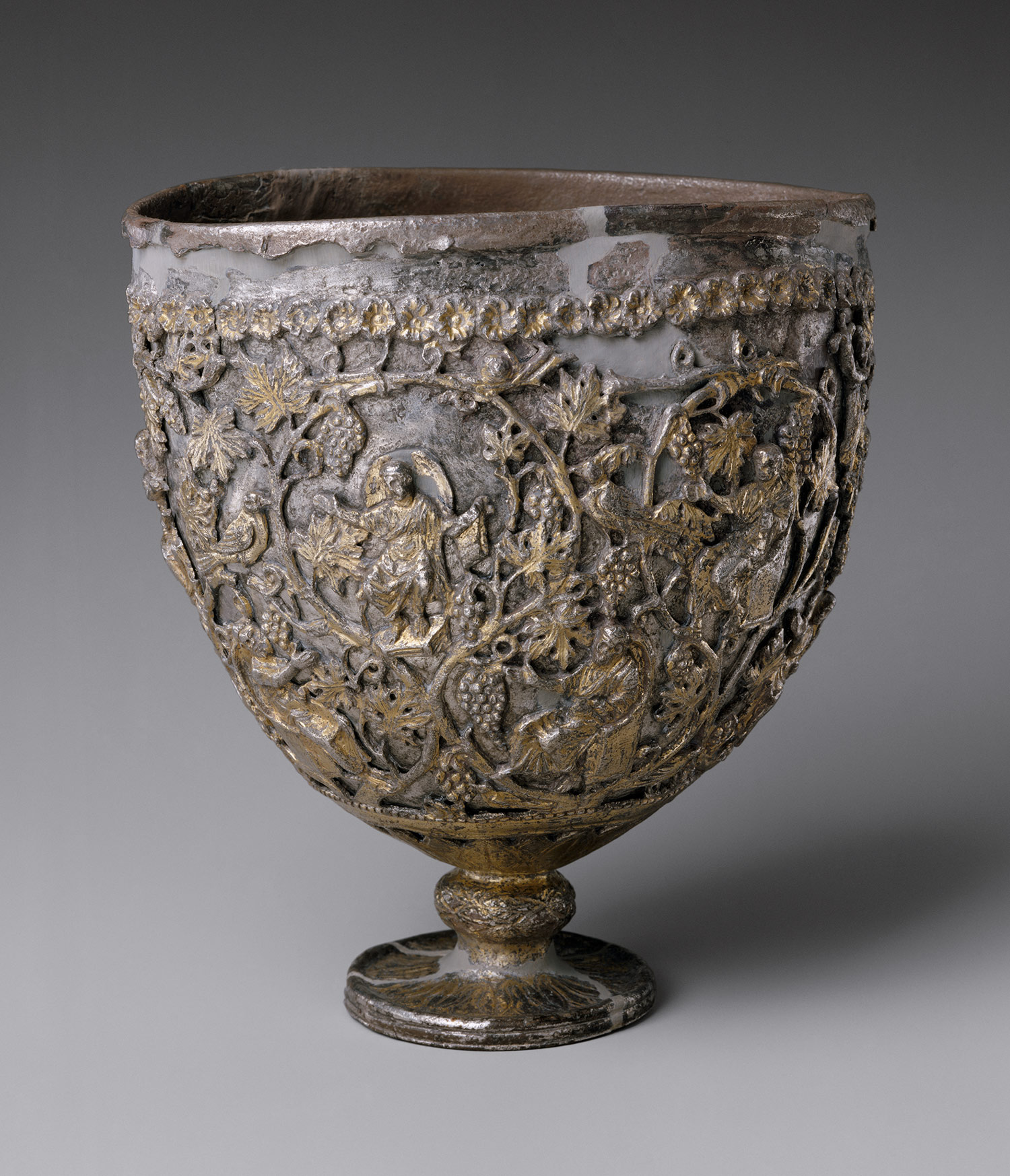
The Holy Grail in Legend of King Arthur


The Holy Grail is the cup from which Christ drank at the Last Supper and which was used by Joseph of Arimathea to catch Christ's blood as he hung on the cross. The Holy Grail was introduced into the King Arthur legends by Robert de Boron in his romance Joseph d'Arimathie which was probably written at the very end of the twelfth century or the first decade of the thirteenth.
In earlier sources the word "grail" comes from the Latin gradale, which meant a dish brought to the table during various stages (Latin "gradus") or courses of a meal. SoChrétien de Troyes and other early writers intended this sort of platter by the term "grail." Chrétien speaks of "un graal," a grail or platter and thus not a unique holy grail.
In medieval romance, the Holy Grail was said to have been brought to Glastonbury in Britain by Joseph of Arimathea, though one would assume that to be an unlikely thing for him to have done. In te time of King Arthur the quest for the Holy Grail was the highest spiritual pursuit for a knight.
Chrétien credits Perceval is the knight who must achieve the quest for the Grail.
Malory though has Galahad as the chief Holy Grail knight, though other knights (Perceval and Bors in the Morte d'Arthur) do achieve the quest.
Tennyson is perhaps the author who has the greatest influence on the conception of the Holy Grail quest through his Idylls and his short poem "Sir Galahad".

Sir Gawaine


Florence Harrison (1884-19--). "Nevertheless You, O Sir Gauwaine, Lie" from: Early Poems of William Morris. London: Blackie & Son, 1914.

Saturday, March 2, 2013

Isle of Avalon


Many writers tell that after his last battle at Camlann, the wounded King Arthur was laid in a barge and sailed to the Isle of Avalon (Avalonia translatesas Apples) for his wounds to heal. The Isle of Avalon is described with a fair amount of detail, however its exact location is usually left vague. Some writers state that Arthur is still alive on the Isle of Avalon and will return to Britain to be their future king in the country's hour of need.
Some texts do attempt to locate the Isle of Avalon. The Isle of Man has been presented being the Isle of Avalon, as well as Bardsey Island in northern Wales. There is a less well-known story, The Death of King Arthur, that may have been intended as an addition to Geoffrey of Monmouth's History. Richard Barber's Arthurian Legends, whose manuscripts date from the fourteenth century, claims that the king gave orders that he should be carried to Gwynnedd, for he intended to stay in the Isle of Avalon, a pleasant and delightful placewhere the pain of his wounds would be eased.
Geoffrey of Monmouth tells that King Arthur was mortally wounded and was carried off to the Isle of Avalon, so that his
wounds might be attended to. He handed the crown of Britain over to his cousin Constantine, the son of Cador Duke of Cornwall. On the Isle of Avalon, Arthur is looked after by Morgan
Glastonbury has been claimed as the Isle of Avalon. At that time Glastonbury Tor would have been an island in the fenland here. Glastonbury claims to be the Isle of Avalon, the site of King Arthur's, and the site to which the Holy Grail was borne to by Joseph of Arimethea. The claim appears to date back to some monks in the late twelfth century, who decided to cash in on the popular Arthurian legends circulating at that time. They claimed to have found the tomb of Arthur in 1190, with an inscription conveniently claiming Glastonbury to be Avalon. This find brought many pilgrims, and hence money, to Glastonbury.