Translate

Showing posts with label africa. Show all posts

Saturday, August 4, 2012

Africans and the French Revolution


http://histclo.com/essay/war/fr/fr-slave.html
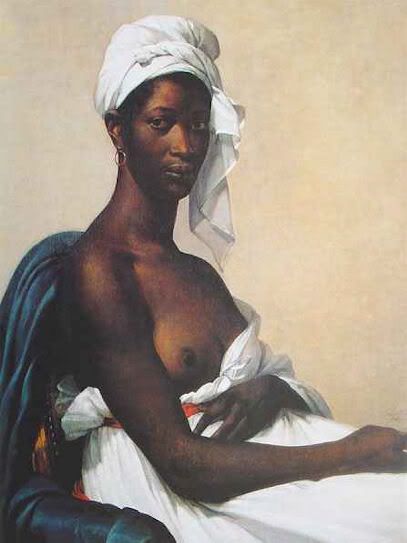
Portrait of a black woman (1800) is a very special painting. It is one of the first portraits of real existing african person in western art.   Marie-Guillemine Benoist (1768-1826) 


African slavery became well established in European colonies, including French colonies, during the 17th century. African slavery was an important economic institution by the 18th century, especially important for the Caribbean sugar islands which were a major element in Western European economies. France lost most of its empire to the British, but retained important Caribbean islands. Liberty was a byword of the French Revolution as it had been in the American Revolution. But like the Americans, the leaders of the French Revolution did not move toward abolition. In America any step toward abolition during the Revolution or the framing of the Constitution would have meant disunion as it would have been unacceptable to the southern colonies. In France it appears to reelect the bourgeoise character of the Revolution and the economic importance of Caribbean slavery to the French economy. While France did not move toward abolition, the Revolution did have substantial reverberations, both in the Caribbean and in England which affected slavery. Neither the Revolutionaries or Napoleon moved toward abolition. Neither did the restored French monarchy after the Napoleonic Wars. This in fact posed a problem for Britain which after abolishing slavery gave the Royal Navy the task of ending the Atlantic slave trade. 
A new outlet for African slaves appeared in the 15th century. Portuguese explorers began voyages south along the Atlantic coast of Africa. The Portuguese were looking for a route to Asia, but as they moved south they began setting up trading posts. First the Portuguese established trading posts along the coast of West Africa, but gradually moved further south along the coast. Other European maritime powers followed suit. This was the beginning of the African slave trade. The Europeans differed from the Arabs in that they did not normally conduct raids themselves, but usually bought slaves from Arab slave brokers and African chiefs. Europeans built trading post and forts all along the coast of West Africa. From Senegal south to Cameroons there were about 60 forts that served as trading posts for the slave trade. The Europeans exchanged rum, cloth, guns, and other trade goods for their human cargo. The slaves were transported across the Atlantic Ocean primarily to Brazil, the West Indies and the English colonies in North America. Immense fortunes were made in the trade. As the demand for slaves expanded, whole areas of Africa were depopulated. Scholars estimate that 10-15 million Africans were transported to the New World. The European African slave trade began during the mercantilist era. It continued well into the industrial era. In fact because African slaves played a major role in the industrial revolution in Europe. The immense profits from West Indian sugar islands helped to finance the industrial revolution. And the raw material for the first real modern industry, cotton textiles, was produced by slaves. The slave trade was finally ended by the Royl Navy in the mid-19th century. 
Britain Before the Revolution
Attitudes toward slavery began to change in Britain after the American Revolution and the loss of the American colonies (1776-83). America had been Britain's principal colony. Its loss resulted in a review of imperial policies. British merchants were shocked to learn that they were making larger profits after the abolition of the mercantile system which had been established to regulate trade with America. This was rigid trade rules which had required the American colonies to only trade with Britain and restricted the development of manufacturing. As a result, the British moved toward free trade policies as postulated by Adam Smith in The Wealth of Nations. The British also began to focus more on India, a prise won from France in the Seven Years War
The Caribbean before the Revolution
The economy of the 18th century was fueled by Caribbean sugar, almost all of which was produced by slave labor. Sugar made even small islands of great economic importance. A large island like France's Saint-Domingue (modern Haiti) was enormously profitable. This is not well understood today, because modern Haiti is one of the poorest countries in the worked. Data shows that at the time of the Revolution Saint-Domingue exports totaled about $20 million. This was about half of all French exports (1789). Notably exports from all of Britain's colonies was only about $10 million. Saint-Domingue alone produced about 40 percent of all the sugar and 60 percent of all the coffee (an increasingly important crop) consumed in Europe. Britain at the time was also the most important country involved in the Atlantic slave trade. French sugar planters were dependent on the British as a source of labor. About half of all the slaves imported into the British-controlled islands were then sold to the French colonies, most going to Saint-Domingue. In terms of power politics, the British slave trade was in effect strengthening the country's principal adversary--France. 
British Abolition Movement
French Caribbean sugar production and the wealth it brought may have been a factor in leading Prime Minister William Pitt to encourage Wilberforce to move his first motion in Parliament calling for the abolition of the slave trade . The measure failed as Pitt failed to support it. It was, however, the beginning of the British abolition movement. 
Amis des Noir
The French abolition movement began with the founding of the "Amis des Noir" (The Friends of the Blacks) just before the Revolution (1787). With the outbreak of the Revolution, the Friends became the principal group advocating abolition. The Friends basic argument was that The Rights of Man, the essence of the French Revolution, applied to all people. As part of the complicated politics of the Revolution, they plunged into the controversial issue of equal and full rights of citizenship for all free people of color in Saint-Domingue. Amis des Noir is believed to have gad about 0.5 million members. They faced the powerful Massiac Club, the well-financed voice of the French planters and maritime French bourgeoise. [Cooper] 
Financial problems forced King Louis XVI to call the Estates General. This set in motion a series of unforeseen events. The Estates General did not prove to be a compliant assemblage and their sessions soon spun beyond the ability of Louis to control. The French Revolution erupted in Paris with the storming of the Bastille (July 1789). The force of the events which flowed from the initial action in France have led historians to refer to it as THe Revolution. The American Revolution is often given short shift by European historians. It is the French Revolution which is the turning point in European history. It sent shockwaves which were to end feudalism in France and eventually other countries and lead to the decline of monarchial government in Eruope. The Revolution also promoted the rise of nationalist sentiments which would mark 19th and 20th century events. 
Impact on Britain
The British were at first unsure as to how to respond to the Revolution. Unlike Austria, there was no rush to support King Louis XVI. The British adopted a kind of semi-neutral position. Prime Minister Pitt at first saw opportunities in Britain's century-old struggle with France. The British in particular saw an opportunity to acquire more of France's colonies. Just as the French had attempted to use the American Revolution to weaken Britain, the British saw opportunities with the French Revolution. Others were interested in seeing a British-style constitutional monarchy emerge in France. ’ based on the British model. British attitudes began to shift as the Revolution began more radical and violent. The modest bourgeois movement began to spin out of control as the Paris sans-culottes mobs began to drive the revolutionary process. The Revolutionary ethis of ‘liberty, equality, fraternity’ caused profound disquiet in Britain even among the bourgeois. 
French Caribbean Colonies (1789-91)
News of the French Revolution had an electrifying effect, especially in the French colonies. While slaves may have had an imperfect knowledge of the course of events, the Revolutionary slogan ‘liberty, equality, fraternity’ was not difficult to understand. There were uprisings in both Guadeloupe and Martinique, but they were suppressed by the French authorities (1789). These were small islands. The core of France's much reduced empire at the time was Saint-Domingue. French settlers on Saint-Domingue differed as regards the development in France. This split was largely between the ‘small whites’ and the large plantation owners. The immediate issue was over the status of free mulattoes (mixed-race people). Some mulattoes even owned plantations and slaves themselves. The ‘small whites’ generally opposed any movement toward equal legal rights for the mulattoes. The small whites were not wealthy. Their social status was based on race. The slaves gradually learned of events in France and divisions among whites on the island, giving some home that their condition might improve. French Republican soldiers arrived on Saint-Domingue (March 1791). They embraced the principles of the Revolution and declared that and declared all men free and equal. The Revolutionary Government had not, however, abolished slavery. 
National Assembly
France's new Revolutionary Government, the National Assembly, considered both feudalism and slavery. Feudalism was easy. By ending feudalism, Revolutionary authorities undercut the aristocracy and strengthened the bourgeois elements that backed the Revolution. Slavery was an entirely different matter. slavery was a very difficult problem for the Revolution. How were they to deal with slave ownership. The Assembly faced a wrenching choice. Clearly the principle of the Revolution led unquestionably to abolition. But the Revolution was under attack from powerful external and internal enemies. Organizing the armies of the Republic had to be financed and massive amounts of fiunds were needed. Freeing the slaves meant the destruction of major sources of funds. First the vast income from sugar exports. Second income from the slave trade. [Cooper] In the end the slave revolt and the Royal Navy would end both, but these were the stark options considered by the Assembly. And there were the personal interests of the Assembly delegate, It was the French bourgeoisie that had benefitted from the slave trade and sugar exports. Thus conservative Revolutionaries, especially the maritime opposed abolition. Even radical Revolutionaries hesitated because of the importance of sugar exports and respect for property. The sans-culottes, however, pushed for abolition. The issue rose to the surface as a result of news from Saint-Domingue. French settlers there arrested a spokesman for the island's mullato population. His name was Ogé. Settler tortured and murdered him. When this news reached Paris, Ogé became a hero of the sans-culottes. The most radical faction of the National Assembly was led by Robespierre. In a speech before the National Assembly during debates on the colonial question, he challenged thee delegates, "You urge without ceasing the Rights of Man, but you believe in them so little you have sanctified slavery constitutionally". He was not, however, demanding abolition. The Assembly debated the colonial question for 4 days. Finally they decided that every person of mixed-race whose parents were both free should be declared free. This in reality avoided the central issue of slavery, It affected very few people, only about 400 individuals. 
The National Assembly in Paris had a major impact on the direction of events on Saint-Domingue (1789-94). First the white settlers were driven toward succession from France because of the modest victories of abolitionist forces. The reaction on Saint-Domingue to the National Assembly's decision on the status of mulattos was an outburst of violence. Settlers ran riot. They lynched mullatoes they could lay their hands on and n=burned the Tri-Color flag of the Republic. Seemingly unconsidered was the reaction of slaves which constituted the great bulk of the population. Unlike North America where slaves were a minority, even in the South, the white and mulatto population on Saint-Domingue was very small. THe slaves, however, had some knowledge of events in France and were quietly organizing. The slave revolt that took place exhibited a surprising degree of planning given the restrictions on the slaves limited their movement and activities. Thousands of slaves were involved in the initial revolt (1791). The fact that there was no leak from such a large group is one indicator of organization. The insurrections killed their masters and their families and burned the plantations to the ground. This in effect destroyed the foundation on which a national economy could be based, but the slaves were motivated by a desire to destroy slavery not to build a nation. Toussaint L’Ouverture quickly joined the insurrectionists and emerged as a powerful leader. He organized unruly bands into an actual army. This was the beginning of a 12 year struggle for liberty. The slaves not only defeated the white settlers, but invading British, Spanish, and French armies. The Haitian Revolution is one of the few successful slave rebellions in history. This long complicate revolutionary struggle carried on by the slaves of Saint-Domingue finally ended with freedom and the founding of the Republic of Haiti (January 1, 1804). 
Jamaica
It was a slave revolt on Jamaica that ultimately undercut opposition in Britain the abolition and ending the slave trade.
British Abolition
Parliament legally abolished slavery throughout the empire with passage of the Emancipation of Slaves Act (1833). 
It was the Royal Navy that eventually ended the slave trade. The slave trade had been a lynch pin in thr triangular trade that has been a key element of the British economy and helped bring great wealth to Britain. It had in part helped to finance the growth of the Royal Navy. The expansion of the British merchant fleet under the protection of the Royal Navy resulted in Britain dominating the slave trade by the 18th century. British ships beginning about 1650 are believed to have transported as many as 4 million Africans to the New World and slavery. The British Parliament during the Napoleonic Wars banned the slave trade (1807). This was a decision made on moral grounds after a long campaign in Britain against slavery at considerable cost at a time of War. After Trafalgar (1805) the powerful British Royal Navy could intercept suspected slave ships under belligerent rights. After the cessation of hostilities this became more complicated. The only internationally recognized reason for boarding foreign ships was suspected piracy. Thus Britain had to pursue a major diplomatic effort to convince other countries to sign anti-slavery treaties which permitted the Royal Navy to board their vessels if suspected of transporting slaves. Nearly 30 countries eventually signed these treaties. The anti-slavery effort required a substantial effort on the part of the Royal Navy. The major effort was carried out by the West Coast of Africa Station which the Admiralty referred to as the ‘preventive squadron’. The Royal Navy from this station for 50 years conducted operations to intercept slavers. At the peak of these operations about 25 ships and 2,000 officers and men were deployed. There were about 1,000 Kroomen, African sailors, operating West African Station. The Royal Navy deployed smaller, shallow draft vessels so that slavers could be pursued in shallow waters. Britain also targeted African leaders who engaged in the slave trade. A British forced in one operation deposed the King of Lagos (1851). The climate and exposure to filthy diseased laden slave ships made the West African station dangerous. The officers and men were rewarded with Prize money for both freeing slaves and capturing the ships. The Royal Navy's task in East Africa and the Indian Ocean was even more difficult. This was in part because of the support for slavery among Islamic powers (both Arabian and Persian). The slave trade persisted into the 1860s, in part because of the continued existence of slavery in the United states. Even though the slave trade was outlawed in America, the American Navy was not used to aggressively restrict the slave trade. This did not change until President Lincoln signed the Right of Search Treaty in 1862, a year before the Emancipation Proclamation. The Cuban trade ended (1866). 
Slave produced cotton was America's principal export commodity. It was imported by textile producers in Britain and France. America had about 4 four million slaves of whom about 60 were employed on cotton plantations. Many British industrialists wanted the Government to support the South. Prince's Albert's final gift to the British nation before his untimely death was to recommend against that. British industrial workers sided with the slaves despite the personal cost as a result of the Norther blockade of the South.
Sources
Cooper, Anna Julia. Slavery and the French Revolution, 1788-1805 (The Edwin Mellen Press, 1988). Translated with forward and introductory essay by Frances Richardson Keller. Anna Julia Cooper is as interesting as her book. She was born into slavery in the United States just before the Civil War (1859). At the age 66 she presented her study as her doctoral dissertation at the University of Paris (1925). 

Thursday, August 2, 2012

The Quest for Human Rights


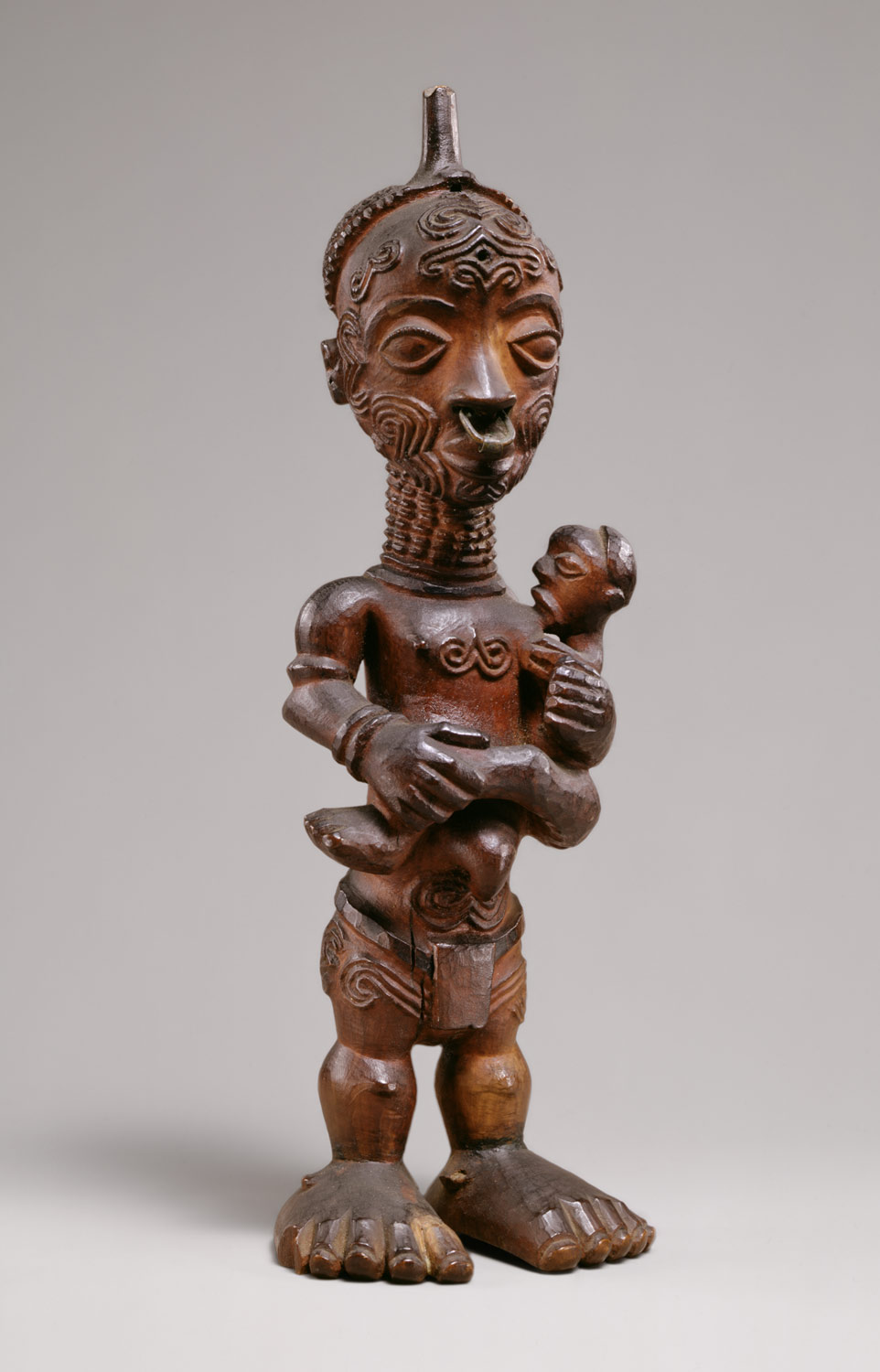
Maternity Figure, 19th–20th century
Luluwa peoples; Democratic Republic of Congo
Wood, metal ring
http://www.enotes.com/french-revolution-article/
Prior to 1789, the year the French Revolution began, the only nations with any true understanding of the modern conception of human rights were Great Britain and its former colony, the United States. To those two nations, the most important rights were political and civil rights—the right to participate in government, freedom of expression, and equality before the law. Human rights also encompass economic and social freedoms—the right to move out of the class into which one was born, for example, and to no longer be dependent on another’s whims for one’s livelihood (as was the case in the eighteenth century for French peasants whose income fluctuated not only due to each season’s crops but also to the number of payments their feudal lords decided to charge). During the last decades of the eighteenth century, two segments of French society—women and the Third Estate (France’s middle-class and poor)—sought to gain all of these rights—political, economic, and social—which had been largely withheld from them. Their efforts to transform France from a nation dominated by the king, clergy, and aristocrats into one that took into account the needs of the entire nation helped lead to the French Revolution. The revolution significantly altered French society, but only for a decade—unfortunately, by the turn of the nineteenth century, when Napoleon Bonaparte ascended to power, France had mostly reverted to its old ways. Several more revolutions were required until France successfully established a republic, a government for all the people.
Life Before the Revolution
In the years before the revolution, French women enjoyed virtually no civil or economic rights. As Darline Gay Levy, Harriet Branson Applewhite, and Mary Durham Johnson explain in the introduction toWomen in Revolutionary Paris, 1789–1795: “By and large, women were legally totally subservient to their husbands or fathers in virtually all areas of marriage contracts, inheritance laws, property and tax laws, and child custody arrangements. Marriages were indissoluble.” Noblewomen were not permitted to rule on disputes on properties they held. Meanwhile, working women lacked economic rights and protections; many were concerned about the entrance of men into traditionally female occupations such as seamstress and embroiderer. These women feared that unless such employment was restricted to females, the “fairer sex” would have to look for less respectable jobs.
Women were not the only people in France who were denied basic human rights, of course. Indeed, France’s peasants lived under the worst conditions. Although industry was becoming a more important part of the nation’s economy, France was still largely dependent on the feudal system in which powerful feudal lords (seigneurs) owned profitable farmlands on which peasants lived and worked. Some peasants had managed to earn enough money from their crops to purchase their own small plots of land, but the vast majority lived in poverty, completely under the thumbs of seigneurs. In his book The Old Regime and the French Revolution, nineteenth-century historian Alexis de Tocqueville details the burdens of the typical farmer:
Everywhere the resident seigneur levied dues on fairs and markets, and everywhere enjoyed exclusive rights of hunting. . . . [It] was the general rule that farmers must bring their wheat to their lord’s mill and the grapes to his wine press. A universal and very onerous right was that named lods et ventes; that is to say an impost levied by the lord on transfers of land within his domain. And throughout the whole of France the land was subject to quitrents, ground rents, dues in money or in kind payable by the peasant proprietor to his lord and irredeemable by the former.
Not only did the peasants owe rent and crops to their feudal lords, they also had to pay burdensome taxes to the government. By comparison, as Gwynne Lewis explains in The French Revolution: Rethinking the Debate, “The persistence of feudal social structures meant that the real wealth of the country was not taxed: the great landowners, the Church and the nobility, escaped most of the taxes which fell upon land.”
Even peasants who were landowners were far from comfortable economically. As J.F. Bosher points out in his book, The French Revolution, the typical rural family of five required sixty bushels of wheat per year, “or with the triennial rotation of crops, about 15 acres of land for food.” However, the majority of French peasants— as much as 70 percent in the region of Cambrésis, for example— owned less than two-and-a-half acres of farmland. To make matters worse, France suffered several droughts and harsh winters during the 1780s, and French peasants were unaware of new, more efficient farming techniques; most used outdated tools and methods that dated back to the Middle Ages.
While some peasants could at least hope that they would grow enough grain to cover the money owed to their landlords and the government and provide food for their family, the urban poor— who, if not unemployed, worked primarily in factories and shops—were dependent on the affordability and availability of pre-baked bread. In the summer of 1787, a four-pound loaf, two of which were required daily to feed a family of four, cost eight sous. Due in large part to poor weather and low crop yields, by February 1789 the price had nearly doubled to fifteen sous. In his book Citizens: A Chronicle of the French Revolution, Simon Schama notes: “The average [daily] wage of a manual laborer was between twenty and thirty sous, of a journeyman mason at most forty. The doubling of bread prices—and of firewood—spelled destitution.” Urban workers, especially those in Paris, started to protest the price of bread. When two Parisian manufacturers, Réveillon and Henriot, suggested in late April 1789 that the distribution of bread should be deregulated, thereby lowering prices and reducing both wages and costs of production, riots ensued. Laborers—not only those who worked for bakers—took violent action against Réveillon and Henriot because they feared that other employers would use reduced bread prices as an excuse to cut their own workers’ wages.
Another sector of French society that began to protest unequal treatment was the bourgeoisie, or middle class. Unlike the rural and urban poor, this economic class, whose members would prove so important during the revolution, had already begun to gain economic and social status before 1789. As France’s population started its migration from country to town and factories began to dot the urban landscape, capitalists and financiers saw their wealth steadily increase. Middle-class children had more access to education and culture, and their upbringing brought them in closer contact to the French aristocracy, resulting in many marriages between the upper and middle classes. However, the grow- ing economic strength of France’s middle class was not accompanied by equal political power. Bourgeois members of the Third Estate were particularly aggrieved by the fact that the votes in the Estates-General (a legislative body convened on rare occasion by the king) were counted by estate, not head. Thus the Third Estate often found itself outvoted by the First Estate (clergy) and Second Estate (nobility), which usually voted together for measures that furthered their interests at the expense of the needs of the Third Estate. However, the Third Estate had twice as many deputies as either of the other two estates. Thus, had voting been done by a head count, all a unified Third Estate would need was a single vote from either the nobility or the clergy to establish a majority. An increased political voice was for most middle-class French people the most important human right to be attained. Albert Mathiez, a leading interpreter of the revolution, says of the middle class, “They were advancing steadily [economically]. . . . Their very rise made them more acutely sensitive to the inferior legal status to which they were still condemned.”
Demanding Rights
The grievances of women, the rural and urban poor, and the middle class culminated in the French Revolution. The revolution began in 1789, with the first demands for greater rights made that January by French women. On January 1, 1789, King Louis XVI was presented with the Petition of Women of the Third Estate to the King. The rights demanded by the women included permission to send female deputies to the Estates-General, the right to an adequate education, and the right to earn a respectable living (and thus avoid drifting into prostitution). These demands were not especially radical—the petition made clear that they were not asking for equality with men. The petitioners explained, “We ask to be enlightened, to have work, not in order to usurp men’s authority, but in order to be better esteemed by them.” They added further, “We implore you, Sire, to set up free schools where we might learn our language on the basis of principles, religion and ethics. . . . Sciences? . . . they only serve to inspire us with a stupid pride, lead us to pedantry, go against the wishes of nature.”
Other women, however, were more radical in their demands. In September 1791 Marie Gouze, under the pseudonym Olympe de Gouges, published a pamphlet, the Declaration of the Rights of Women. The pamphlet, which was addressed to Queen Marie-Antoinette, asserted that women were entitled to seventeen rights, including property rights, free speech, and equal access to public and private “dignities, offices, and employments.” Many women also expressed their political opinions in the salons, clubs that had flourished throughout the eighteenth century, where upper-class and middle-class women could gather with eminent writers and philosophers to discuss important issues.
For some women, however, gathering together to discuss politics with leading philosophers or writing revolutionary pamphlets was hardly practical. To the poorer women in Paris, access to affordable bread was the most important right. In October 1789 a large group of poor women marched to Versailles, the royal palace situated twelve miles beyond the capital, to demand bread, as supplies were limited within the city. Upon reaching the palace, a small delegation of women was granted an audience with King Louis XVI. The women eventually convinced the monarch to sign decrees agreeing to provide Paris with sufficient stores of affordable bread.
French women did not lack male support in their quest for human rights. One of the leading male voices for female political equality was Marie-Jean Caritat, the Marquis de Condorcet. Condorcet, a member of Paris’s municipal assembly, expressed his support for women’s rights in the July 1790 document, “On the Admission of Women to the Rights of Citizenship.” Condorcet argued that, like men, women are able to acquire and analyze moral ideas and therefore are equally entitled to rights. He acknowledged that women may prefer to remain in the domestic sphere and perhaps are not as qualified for political office, but he maintained that such differences should not lead to unequal treatment. According to Condorcet:
It is . . . unjust to advance as grounds for continuing to refuse women the enjoyment of their natural rights those reasons that only have some kind of reality because women do not enjoy these rights in the first place. If one admits such argu- ments against women, it would also be necessary to take away the rights of citizenship from that portion of the people who, having to work without respite, can neither acquire enlightenment nor exercise its reason, and soon little by little the only men who would be permitted to be citizens would be those who had followed a course in public law.
France’s women met several of their early revolutionary goals. Levy, Applewhite, and Johnson conclude in their book that French women became politically influential; the three authors assert that the French government could no longer ignore their female subjects’ demands. Women also benefited economically, with previously gender-biased laws on inheritance and property rights relaxed under the new regime. The divorce law of 1792 further improved women’s civil status by setting seven grounds for divorce that women as well as men could use, including insanity, brutality, and abandonment. The new law made it equally easy for men and women to dissolve marriages quickly and inexpensively.
For peasants, change came swiftly and violently. In July 1789 France was wracked by what became known as the “Great Fear.” On the fourteenth of that month, a riot at the Bastille, a Paris prison and armory, had resulted in the death of more than one hundred people. The riot began when the citizens of Paris—fearful that troops recently sent to the city by King Louis XVI might decide to attack the populace—began collecting weapons at the Bastille. Similar uprisings against the government followed. Rural citizens began hearing rumors that King Louis XVI was ordering his troops into the French countryside to stanch peasant rebellions. Fearful peasants began burning and pillaging manors, destroying feudal records, and reclaiming what had previously been common land. On August 4, 1789, worried that these demonstrations would not cease, the nation’s nobles agreed to give up most of their feudal rights. This decision was codified one week later by the National Assembly. Peasants were now free to earn their own wages, unencumbered by feudal tithes; the economic element of human rights was becoming a reality for the nation’s rural poor. The economic freedoms for urban laborers also widened during the revolution. The abolishment of guilds allowed artisans more oppor- tunities to find jobs, unburdened by a complicated hierarchical system. Workshops established throughout cities were sources of employment for poor women. Urban laborers frequently went on strike, with higher wages a common result. Bread became more affordable; in 1793, the price of a loaf was six sous.
The first great triumph of the bourgeois was the reshaping of the Estates-General into the National Assembly. On May 5, 1789, King Louis XVI convened the Estates-General for its first meeting in 175 years to discuss solutions to France’s economic woes. The delegates also debated on how voting should proceed and whether the system of representation should be altered. The Third Estate walked out of the meeting when the other two estates refused to change the traditional methods of voting. On June 17, 1789, the Third Estate held its own meeting and declared itself the National Assembly, inviting the delegates from the other two estates to join it. In the estimation of Nora Temple, author of The Road to 1789: From Reform to Revolution in France, the establishment of the National Assembly “[was] technically the beginning of the revolution because the Third Estate, and the few clergy who by that stage joined it, knew that they were claiming sovereign power when they assumed the title of National Assembly.” A break from the monarchy, from what would be known as the Ancién Regime, had officially begun.
The second accomplishment of the National Assembly, and the one that had the greatest effect on the concept of modern human rights, was the adoption of the Declaration of the Rights of Man and Citizen on August 26, 1789. Debate about what to include in the document had begun earlier in the month, culminating in the decision to pare down the originally conceived twenty-four rights to seventeen. Assembly deputies argued over how much influence the United States’s Declaration of Independence should have on the document; a chief disagreement was whether the American understanding of equality could be transferred successfully to a nation with a long history of aristocracy and feudalism. In the end, while the Declaration of the Rights of Man and Citizen was partly influenced by its American predecessor, the French document proved unique and enduring in its own way. Most important for many revolutionaries, was that the declaration helped the French middle class achieve its greatest goal: the codification of basic political, social, and civil rights.
Historians have long agreed that few documents have been more influential in Western history than the declaration. Geoffrey Best, the editor of The Permanent Revolution: The French Revolution and Its Legacy, 1789–1989, contends that the Declaration of the Rights of Man and Citizen was important because of its realistic understanding that in order to be beneficial, rights cannot be abstract. Rather, they must be codified in well-functioning constitutions. As Best opines, “Modern history is rich in instances of states with constitutions which read excellently, but in whose functioning there are hidden catches or practical failures which rubbish them as far as human rights go.” Best further explains that the declaration was an important achievement because it was a document that expressed the rights of France as a people and as a nation, without regard to previous or current rulers. The opening paragraphs of the declaration help delineate what Lynn Hunt, in her introduction to The French Revolution and Human Rights: A Brief Documentary History, describes as the National Assembly’s “vision of government based on principles completely different from those of the monarchy”:
[The] National Assembly recognizes and declares, in the presence and under the auspices of the Supreme Being, the following rights of man and citizen.
1. Men are born and remain free and equal in rights. Social distinctions can be based only upon public utility.
2. The aim of every political association is the preservation of the natural and imprescriptible [self-evident] rights of man. These rights are liberty, property, security, and resistance to oppression.
3. The source of all sovereignty is essentially in the nation; no body, no individual can exercise authority that does not proceed from it in plain terms.
The Declaration of the Rights of Man and Citizen has proved to be one of the most influential documents in history, one that has influenced the quest for human rights in not only Europe but throughout the world. Other accomplishments during the French Revolution turned out to be less enduring.
French women, who had benefited during the early stages of the revolution, found themselves at odds with the Jacobins, a radical party led by Maximilien de Robespierre and Georges Danton. The Jacobins rose to power in 1792 and established the first French Republic. Believing that women did not belong in the political sphere, the Jacobin government closed women’s political clubs in November 1793. The Convention—the ruling body of the French Republic— had made its decision after hearing a report by André Amar, who suggested that it would be dangerous to give women too much political power. He declared, “Women are disposed by their organization to an over-excitation that would be deadly in public affairs. . . . Interests of state would soon be sacrificed to everything which ardor in passion can generate in the way of error and disorder.”
Some of the more prominent revolutionary women lost not only their rights but also their lives. The Jacobin reign has been associated with the Reign of Terror, a nearly year-long stretch between the fall of 1793 and the summer of 1794 when the government arrested and executed more than twenty thousand people it believed were politically dangerous, including women whom it believed failed in their roles as obedient wives and mothers. Olympe de Gouges and Marie-Antoinette were among the victims. The lot of French women did not improve after the more moderate Thermidorians overthrew the Jacobin regime in July 1794. Women’s workshops were disbanded in 1795, with the government urging women to work at home so they could become better wives and mothers.
The modest gains by the urban poor also proved short-lived. The decade-long revolution, which coincided with several wars against European foes, wracked France’s already vulnerable economy. Affordable foodstuffs continued to be a problem for urban families. Despite the riots and the efforts of the Convention to guarantee adequate provisions for the urban poor, the high cost of bread remained a problem. In 1792 hoarding caused a rise in the cost of sugar. Levy, Applewhite, and Johnson explain, “Speculators hoarded vast stores of colonial products such as sugar, coffee, and tea in expectation of future profits from depleted sup- plies.” Concerns over unequal allocations of eggs and butter led to riots in 1793. Urban workers lost the economic power they had gained when the National Assembly passed the Le Chapelier law in 1791, which prohibited all workers’ coalitions and assemblies. A September 1793 law placed limits on wages. Freedom from hunger and want had been the right sought most fervently by the urban poor, but it was a right they were unable to enjoy.
The end of feudalism was on the surface a significant accomplishment for the peasants, who no longer suffered the burden of excessive dues and taxes. Yet not all peasants benefited equally from the revolution. Historian George Lefebvre points out that only well-off peasants could afford to purchase Church properties, which had become available for purchase when the National Assembly seized land held by clerics. Moreover, he explains, the lords who had dominated the countryside before the revolution were merely transformed by the revolution into landlords who still held most of the economic and political power in rural France. He writes, “The consequences of the Revolution from 1789 to the Terror were, for the most part, socially conservative. The effects of much of the legislation of this period played directly to the interests of groups who had done very well at the end of the old regime.”
People of the French middle class had increased their economic power throughout the eighteenth century through trade and industry and had gradually gained social status via marriages into upper-class families. For this group, the primary revolutionary goal was to achieve a commensurate level of political strength. Once those desires were fulfilled with the passage of the Declaration of the Rights of Man and Citizen and the establishment of a government that did not favor the wealthy or the Church, the bourgeoisie had little else to demand. With the revolution being, at the end, essentially conservative, it is not surprising that the people from the middle classes who benefited the most were those who were able to enjoy the newfound wealth of land and business ownership that the revolution brought. As long as they remained economically strong, and as long as the monarchy and powerful aristocracy remained a thing of the past, the middle class seemed happy to remain where they were.
The revolution effectively came to an end on November 10, 1799, when Napoleon Bonaparte led a coup of the government and named himself the First Consul; he declared the revolution over on December 15. Emmanuel-Joseph Sieyès, who participated in that coup, penned a new constitution—one that made no mention of human rights or liberty, instead emphasizing peace, security, and property rights. The constitution was followed by the Napoleonic Code, a set of laws that purportedly guaranteed equality under the law but favored the wealthy. Napoleon’s favoring of the wealthy continued throughout his reign. On March 1, 1808, Napoleon created more than three thousand noble titles. For a man who touted the idea of meritocracy—of people improving their social position through talent, not birth—Napoleon seemed to have a less-thanwarm attitude toward the political and economic aspirations of France’s lower classes. His consolidation of power ended the political freedoms of the bourgeois, as there was no longer a national legislature that the middle class could dominate.
The urban and rural poor were also affected under Napoleon’s rule. Napoleon continued the ban on trade unions and introduced passbooks, which limited the ability of urban workers to move freely about the nation. However, he did set maximum prices for bread and flour, thus reducing the threat of either hunger or bread riots. According to Robert B. Holtman, author of The Napoleonic Revolution, peasants did not necessarily fare badly under Napoleon, as he maintained the work the revolutionaries had done (namely, abolishing feudalism). However, other scholars have asserted that Napoleon was largely uninterested in social and economic reforms that would improve the quality of life for his poorer subjects.
The Napoleonic Code also had a deleterious effect on women’s rights. His rewriting of the divorce laws gave more control to husbands while advancements in inheritance and property rights were also swept away. Although French women later participated in their nation’s nineteenth-century revolutions, they continued to lack basic political rights for many more decades; it was not until 1944 that they were given the right to vote.
New Revolutions
France’s first attempt at a republic—at a government that would represent the interests of all its citizens, not just the privileged few—came to an end when Napoleon took over. His rule as France’s dictator, and eventually its self-proclaimed emperor, ended in 1815 after his humiliating defeat at the Belgian town of Waterloo at the hands of England’s Duke of Wellington, who led the combined forces of Britain, Belgium, Hanover, and the Netherlands against the French army. The French monarchy reemerged under the Restoration, when the Bourbon family returned to the throne, first with King Louis XVIII and then with Charles X, brothers of Louis XVI, and later in the nineteenth century with Louis Philippe. Napoleon’s nephew Louis Napoleon Bonaparte followed his uncle’s lead by declaring himself emperor in 1852.
Although the power of the first two kings was limited by constitutions (as had also been the case for Louis XVI during his final year as king), distaste for the return of the monarchy led to the revolutions of 1830 and 1848. During those revolutions, the French lower and middle classes fought to regain the rights they had acquired between 1789 and 1799. The Revolution of 1830 stemmed from fears that Charles X sought a return to an absolute monarchy. In July 1830 the king issued ordinances that limited the freedom of the press, dissolved the newly elected, liberaldominated Chamber of Deputies (France’s legislature), and reduced the number of eligible voters. Workers and the middle class demonstrated against the king, who soon fled to England. Louis Philippe, the Duke of Orleans, replaced him as king. Philippe’s reign lasted until 1848. Frustration over a failing economy, political corruption, and voting restrictions led to the Revolution of 1848, France’s third revolution in sixty years. Finally, after a revolution in 1870, France was able to establish a republic, and that system of government has remained intact for over 130 years, except for a period of four years when the Nazis occupied the country during World War II.
British poet William Wordsworth wrote in his 1804 poem, “French Revolution As It Appears to Enthusiasts,” “Bliss was it in that dawn to be alive! But to be young was very heaven!” For France’s women, poor, and middle class, the early years of the revolution may indeed have seemed heavenly. They found themselves free to declare their wishes for a political and economic voice in a new France. However, as the revolution continued, the actions of the fledging republic’s leadership clearly showed that the new leaders’ belief in human rights spread to the upper- and middle-class male but no further. The freedom experienced by France’s lessprivileged groups, though brief, ultimately whetted their appetite for more liberty. The French Revolution that began in 1789 may have ended in 1799, but the desire of its citizens for freedom would continue for decades beyond.
In Opposing Viewpoints in World History: The French Revolution,contributors evaluate the causes, controversies, and effects of the revolution in the following chapters: The Causes of the Revolution, The Controversial Events of the Revolution, Social Change in Revolutionary France, Historians Evaluate the French Revolution. In their viewpoints the authors show how the quest for human rights expanded beyond Great Britain and the United States to include a third nation, one determined to move from monarchy to modernity.