
Jewelry from Georgian times is relatively rare as most of it has been taken apart over the years and refashioned to fit the varying jewelry styles of successive periods. Materials like gold, silver and diamonds have always been expensive and fine period pieces were frequently regarded as economical sources of raw materials. The few exceptional pieces of this period that have survived intact all show extraordinary craftsmanship.
Most Georgian Jewelry available is from the later dates and is characterized by highly dimensional repousse. Floral and scroll motifs are typical of the period and the most common stones used are garnets, topaz, coral and early faceted diamonds set in silver.
During most of the 18th century, diamonds were set in closed silver-settings and in order to protect from tarnish, the interior of the pieces were crafted in gold. Jewelry was custom designed to suit the diamonds available. Stones were never specially cut for the pieces. The most common cuts used in Georgian designs were rose-cuts and table-cuts. The setters routinely backed the rose-cut diamonds with a reflecting foil to enhance their beauty and fire, which is best seen under candlelight.
Care must be taken when wearing these Georgian foil backed diamonds as the foil will gradually lose its effect after it has come in contact with water. The best way to clean the setting is to use a soft brush and chalk powder to act as a polisher. It takes a highly skilled goldsmith to professionally replace the foil.
Standards for gold in the Georgian era were usually 18kt and higher, giving the finished jewels a lovely satin luster. The goldsmiths of the days were not only artisans but also highly trained technicians and all items were completely handcrafted. When a gold band had to be formed for a ring, this was done by melting an alloy and casting it into a bar. Young apprentices then hand-hammered the block of gold down to the desired thickness for the master goldsmith to then work his magic with. An incredibly labor-intensive process.
Around 1750, a new rolling mill was invented, that would revolutionize the appearance of all jewelry that came after. It was able to roll uniform sheets of silver and gold, eliminating the need for time-consuming hand hammering.
The Georgian era produced many different styles. On the European continent it is often spoken of as the Louis styles, named after the French kings Louis XIV, Louis XV and Louis XVI. Around the dawn of the 19th century we saw the Empire style of Napoleon Bonaparte. In a century of artistic and political turmoil there were many forces at work and often at the same time.
Although Louis XIV died in 1715, at the beginning of the Georgian period, he did leave a legacy on Georgian jewelry. By revoking the Edict of Nantes in 1685, he caused a massive emigration of Huguenots, most of whom found refuge in countries as Germany, Holland and England. A large percentage of the Huguenots were artisans and designers. Louis XIV unwittingly gave the Protestant world some of the best craftsmen to be found anywhere in the Western hemisphere.
One of the key designers that influenced jewelry and silversmithing in the early years of the Georgian period was Daniel Marot, whom, when in his twenties, found shelter in the then Republic of Holland. Prince William of Orange, whom later became William III of England, soon discovered his talents and Marot's designs for the Royal Court became all the rage amongst the London and Amsterdam beau monde.
Most striking in his designs is the total symmetry and the use of fabulous hanging elements like culottes, lambrequins andtassels. Marot's view on the Baroque influenced the world of art well until the 1750's.
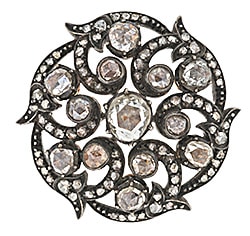
In the European fashion capital of Paris, the Louis XIV style influenced by Jean Berain was also dominated by complete symmetry. C-shaped volutes in the traditional repousse technique are also very characteristic.
Around 1725, when Louis XV was old enough to reign France, a new creative breeze blew through Paris. Artists freed themselves from the heavy Baroque style of Berain and theRococo was born. Lines became fluent and asymmetrical. Jewelry became more frivolous and airy following the Baroque-Regence style between 1715 and 1725. The motifs seemed to want to break out of the overall form. Jewelers throughout Europe soon followed this style but only really adopted it in the 1740's. (England though, almost entirely skipped this style.) Shell motifs and S-shaped lines were highly popular.
Circa 1760, a massive shift towards neoclassicism in the jewelry arts was fueled by designers such as Robert Adam. The excavations of Pompeii and Herculaneum some decades earlier planted seeds in romantic minds that would come to full fruition in the Victorian period. When Goethe published his, 'The Sorrows of Young Werther' in 1774, young men in central Europe identified themselves with this modern day Narcissus and followed Werther's fatal example in large numbers.
Artists found inspiration in Roman history and the assumed pure values of morality in ancient times. The established powers of the day probably never had the slightest thought that the new found ideas of self determination and freedom sweeping the continent and North America would soon seal their fates. The Western world was about to change dramatically.
Currently jewelry pieces from this Neo-Classicism period are amongst the most sought after items.
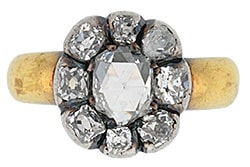
Navette, oval and rectangular formed rings, finely worked with royal blue glass or enamel and topped with silver inlays, were in fashion. Often the inlays consisted of Roman vases which were delicately embedded with diamonds. Rings, brooches and pendants with natural pearl rims also were en vogue.
Memento mori jewelry from the renaissance was reintroduced. Loved ones requested locks of hair from each other to be incorporated in brooches and rings to commemorate them while far away. Jewelry made of hair came to a peak around the end of the Georgian era when complete sets including bracelets and necklaces were woven following the many published designs on this craft. Cameos, often joined by a series of delicate chains to form fabulous necklaces, were some of the fashionable items as well as sevignes, rivieres and chatelaines.
The so-called girandoles (ribbon bows supporting pear shaped gemstones such as garnets) were in high demand during the Georgian period, along with crescent, flower-head and star-burst brooches. Napoleon Bonaparte was so fond of jewelry that he founded a cameo carving school which was directed by Roman Vincent. One of the finest carvers at the end of the Georgian period was Benedetto Pistrucci.
The Napoleonic war against Egypt at the end of the century gave rise to a whole range of new ornamentation - sphinxs', pyramids and papyrus leaves were incorporated into the jewelry of the day. Bracelets were worn in pairs as they were for centuries.
Legend has it that when Josephine de Beauharnais (Napoleon's first wife) was presented flowers during an official visit, she handed a customary bracelet to the young flower girl. The fashion of wearing a bracelet on each arm was so common that the girl instinctively offered her other arm. Josephine gracefully solved it by giving the girl one of her own.
Around 1804 in Prussia, now Germany/Poland, the wealthy were called upon to give up their jewelry in order to finance the war against Napoleon. They were thanked with iron jewelry relacements, often inscribed with "Ich gab Gold fur Eissen" (I gave gold for iron). Those delicate 'Fer-de-Berlin' objects are highly collectible in present time.
This was also the beginning of the first French Empire led by Napoleon. Favorite motifs included non-naturalistic flowers, Greek keys, laurel leaves, eagles and arches. From Italy came fabulous mosaics that were incorporated in necklaces, rings and brooches.
The beautiful Roman mosaics ('micro-mosaics') were made up of very small handcrafted glass squares, called tesserae. Pietra dura mosaics from Florence were composed of hand-sawed semi-precious stones which were then inlayed in black onyx to create a dramatic effect.
After the fall of Napoleon we saw the rise of finely detailed cannetille work. Very thin gold wires and granules decorated the detailed repousse ornaments. The long wars made diamonds so scarce that courser settings were used to make them appear larger. Coral came back in fashion after a long hiatus. The new Neo-Gothic style formed the prelude to eclecticism in the 19th century.


