http://archive.constantcontact.com/fs080/1101600634271/archive/1110289466820.html
Showing posts with label Higginbotham. Show all posts
Showing posts with label Higginbotham. Show all posts
Tuesday, June 4, 2013

Monday, June 3, 2013
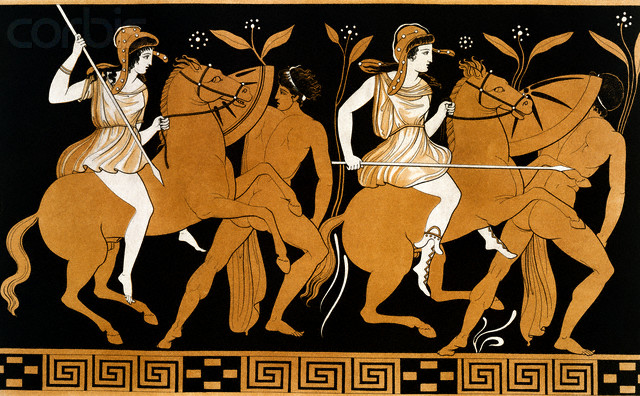
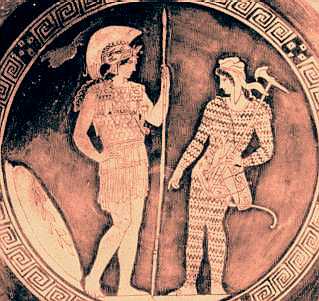
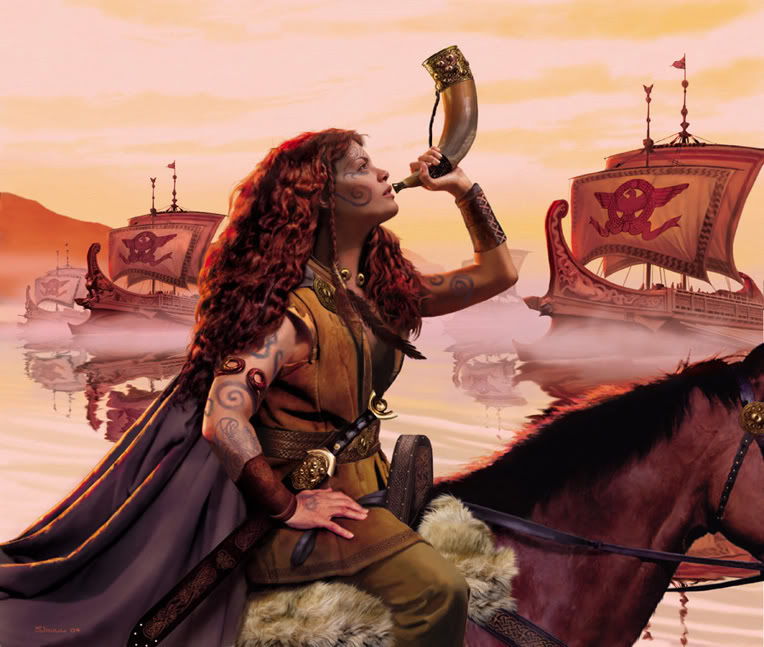
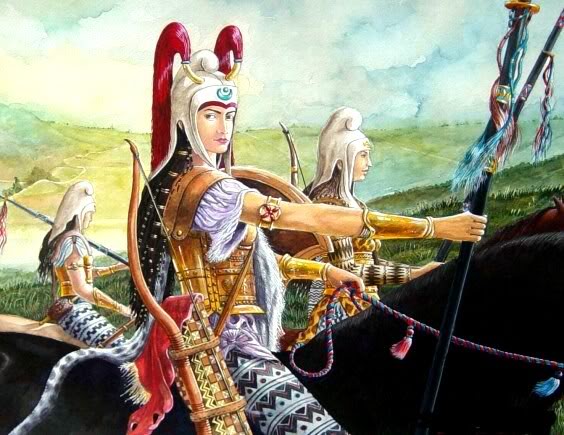
Women as Warrior

African Warrior Women
According to Greek accounts, the earliest Amazons came from Libya (then a name for most of North Africa). They wore red leather and carried crescent-shaped shields. It was these Libyan Amazons, they said, who later founded cities and temples in the Aegean and Anatolia.
At a much later period, the Amazons of Dahomey were crack all-female troops, all female, who also served as royal bodyguards. They were also priestesses and wore crescent moon crowns.
The Hausa had a number of warrior queens, notably Amina of Zau Zau. A woman named Bazao-Turunku led warriors and founded a town south of Zaria.
Nupe women warriors called Isadshi-Koseshi fought as fiercely as the men, opposing invasions of the Fulbe conquerers who raided the Nupe for cattles and slaves, especially women.
JAMAICA
Nyabinghi, the "hidden queen" fought to free Africans from English slavery and rule. Also called Queen Muhmusa or Tahtahme, she inspired the Nyabinghi underpinnings of Rastafarianism..
Nanny of the Maroons was born in Ghana, and folk history says that she came to Jamaica with the express purpose of becoming a high priestess and leader of her people, never having been a slave. She was an obeah-woman who led the eastern Maroons based in Moreton, and forged an alliance with another group led by Cudjoe. (The name Maroons comes from the Spanishcimarron,meaning "gone back to the wild.")
The Jamaican Maroons were the first people to force the English to sign a treaty with their subjects, on March 1, 1738. The lands conceded in this treaty formed a base for the Maroon's independent survival. One of these communities was named Nannytown after the female Ghanaian leader. Maroon country was so feared by the English that it became known as the "Land of Look-Behind."
(Queen Nanny is discussed in the Rebel Shamans presentation.)
WOMEN BEAT BACK SLAVECATCHERS
In the summer of 1848, eight or ten people made it across the Ohio river in their northward flight from slavery. The slave catchers tracked them into town, but the bounty they were after turned out to be elusive:
"The women began to gather from adjoining houses until the Amazons were about equal to the [slave-hunters]-- the former with shovels, tongs, washboards and rolling pins; the latter with revolvers, sword-canes and bowie-knives. Finally the beseigers decamped, leaving the Amazons in possession of the field, amid the jeers and loud huzzahs of the crowd."
--Report from The North Star, an African-American paper out of Cincinnati, August 11, 1848. (For more, see Dorothy Sterling's book Speak Out In Thunder Tones.)
GHANA
"If you the men of Ashanti will not go forward, then we will. We the women will. I shall call upon you my fellow women. We will fight the white men. We will fight until the last of us falls in the battlefield."
---Ya Asantewa, an Ashanti queen who led the resistence to British colonial rule in Ghana. She succeeded in the short run, but the Ashanti were heavily outgunned.
THE "WAR OF THE WOMEN"
The Aba rebellion in southeastern Nigeria grew out of a traditional female rite of the Igbo. People were outraged at the colonial government's plan to tax women, "the trees that bear fruit." In protest, Ibo women bound their heads with ferns, painted their faces with ash, put on loincloths and carried sacred sticks with palm frond wreaths. Thousands marched on the District Office, dancing, singing protests, and demanding the cap of office of the colonial chief Okugo. When he approached one woman to count her goats and sheep, she had retorted, "Was mother counted?"
This protest spread into a vast regional insurrection. The Ibo women's councils mobilized demonstrations in three provinces, turning out over 2,000,000 protesters. The British District Officer at Bende wrote, "The trouble spread in the 2nd week of December to Aba, an important trading center on the railway. Here there converged some 10,000 women, scantily clothed, girdled with green leaves, carrying sticks. Singing angry songs against the chiefs and the court messengers, the women proceeded to attack and loot the European trading shops, stores, and Barclay's Bank, and to break into the prison and release the prisoners."
Elsewhere women protestors burned down the hated British "Native Courts" and cut telegraph wires, throwing officials into panic. The colonials fired on the female protesters, killing more than fifty and wounding more. Marches continued sporadically into 1930. These mass actions became known as the Aba Rebellion of 1929, or The War of the Women. It was one of the most significant anti-colonial revolts in Africa of that day.
Diola women led similar protests against French attempts to exact a tribute from their rice harvest in Senegal, an event dramatized by filmmaker Ousmane Sembene.
\\\\\\\\\\\\\\\\\\\\\\\\\\\\\\\\\\\\\\\\\\\\\\\\\\\\\\
If you want to know who I am
I am daughter of Angola, of Kêto and Nagô
I don't fear blows because I am a warrior
Inside of samba I was born
I raised myself, I transformed myself, and
no one will lower my banner, O, O, O.
I am a warrior woman daughter of Ogun and Yansâ
---Song from an album by Brazilian singer Clara NuñesDzugudini, a grand-daughter of "the famous ruler Monomatapa," was the founding Rain Queen of the Lovedu. Her royal father was angry that she bore a child out of wedlock. Oral tradition says her mother taught her the art of rain-making and gave her rain charms and sacred beads. Then she fled south with some supporters. They settled peacefully among the Sotho. In the early 1800s, a leadership crisis was resolved by accession of the first Mujaji, a Rain Queen with both political and ceremonial power. Chiefs presented her with wives. She had no military, but even the Zulu king Shaka paid her tribute because of her rain power. Her successors have less authority, but still preside over womanhood initiations and other important rituals.
Rain Queens of the Lovedu
SWAZI
The queen is called by honorific titles such as "Mother of the Country" and Indlovukati, "Lady Elephant." She is a powerful rain maker, guardian of the royal clan's sacred objects, and addresses the ancestors on behalf of the Swazi nation. She has the power to give sanctuary to persons condemned by the king's court. Her village is the capital of the country, where troops are quartered.
HAUSA
Many powerful queens are remembered in Hausa tradition. Among the Kotoko, the Gumsu was the female heir of the land, associated with the morning star, mother of all stars. She lived in the southern part of the palace and performed functions associated with the south, was the head of the country's women and played a leading part in the seven year rites for its welfare. The Kotoko government was based on a delicate balance of male/female, right/left, north/south. Among the Kanuri, the Gumsu retained her authority in Muslim times. Diwan records recount that the Gumsu Fasama became angry at her son, Sultan Biri ibn Dunama, for executing a thief, rather than cutting off his hands as the Koran decreed. "Accordingly his mother put Biri in prison, and he submitted to the punishment for a whole year.
Friday, May 31, 2013
THE FLIGHT OF MARGARET OF ANJOU
http://www.museusoaresdosreis.pt/en-GB/collections/painting/highlights_painting/ContentDetail.aspx?id=414

Francisco Vieira, “O Portuense” (1765-1805)
Oil on canvas
126 x 102 cm
Inv. 23 Pin CMP/ MNSR
Francisco Vieira, “O Portuense” (1765-1805)
Oil on canvas
126 x 102 cm
Inv. 23 Pin CMP/ MNSR
Thursday, May 30, 2013
Edmund Beaufort, Duke of Somerset (c. 1406–1455)
http://warsoftheroses.devhub.com/blog/532740-edmund-beaufort-duke-of-somerset-c-14061455/
August 22, 2010
Henry VI and His Queen, Margaret of Anjou
Through his quarrel with Richard PLANTAGENET, duke of York, Edmund Beaufort, second duke of Somerset, helped initiate the political conflicts that eventually escalated into the WARS OF THE ROSES.Edmund Beaufort was a younger son of John Beaufort, earl of Somerset (d. 1409), eldest of the legitimated children of John of Gaunt, duke of Lancaster (1340–1399), by his mistress Katherine Swynford (d. 1403). As a branch of the house of LANCASTER, the BEAUFORT FAMILY held a claim to the Crown that could possibly rival the claim of the house of YORK. Beaufort succeeded his elder brother John as earl of Somerset in 1444 and as duke of Somerset in 1448. He served in FRANCE from the 1420s, recapturing Harfleur in 1440 and relieving CALAIS in 1442. In 1446, he succeeded York as lieutenant of France, but his failure to hold Normandy against French assaults, though not entirely his fault, earned him great unpopularity.
In 1450, anger over the defeats in France sparked JACK CADE’S REBELLION, which in turn led to the overthrow and murder of HENRYVI’s chief minister, William de la POLE, duke of Suffolk. Despite his unpopularity and his military failures, Somerset enjoyed Henry’s confidence and assumed leadership of the royal government. York, angered by Somerset’s appointment to the French governorship and believing him to be ambitious for the throne, attacked the duke as an obstacle to needed reforms and as a traitor responsible for the loss of France.
Holding few lands of his own, Somerset was staunchly loyal to Henry VI, upon whom he depended for favor and office. The king frustrated all York’s attempts to remove Somerset from power until 1453, when the onset of Henry’s mental illness initiated York’s FIRST PROTECTORATE and allowed the duke to commit Somerset to the TOWER OF LONDON. Released immediately upon Henry’s recovery in early 1455, Somerset was acquitted of all charges and restored to office. Fearing perhaps that Somerset meant to destroy him, York and his noble allies, Richard NEVILLE, earl of Salisbury, and his son Richard NEVILLE, earl of Warwick, took arms against the COURT. After failing to achieve Somerset’s surrender, York and his allies attacked a royal party at the Battle of ST.ALBANS in May 1455. The battle ended when York’s forces slew Somerset. Considering his father’s death a murder, Henry BEAUFORT, third duke of Somerset, intensified his family’s rivalry with the house of York, thereby ensuring the continuance of civil strife.
Further Reading: Allmand,C.T., Lancastrian Normandy, 1415–1450 (Oxford: Clarendon Press, 1983);“Edmund Beaufort,” in Michael Hicks, Who’s Who in Late Medieval England (London: Shepheard- Walwyn, 1991), pp. 285–287; Griffiths, Ralph A., The Reign of King Henry VI (Berkeley: University of California Press, 1981); Storey,R. L., The End of the House of Lancaster, 2d ed. (Stroud, Gloucestershire, UK: Sutton Publishing, 1999);Wolffe, Bertram, Henry VI (London: Eyre Methuen, 1981).
Saturday, May 25, 2013
Was Edward of Westminster Really the Son of Henry VI? (1453)

Margaret of Anjou (1430 - 1482) was the queen consort of England's Henry VI of England (1421 - 1471). Henry's father, Henry V, died when the son was only nine months old. Henry VI was raised with considerable influence of his regents. Even before Margaret, at 15, married Henry in 1445, there were rumors he'd been afflicted with bouts of mental instability. Henry's mother, Catherine of Valois, was the daughter of Charles VI of France, known to have struggled with insanity. (Henry also inherited the crown of France through his mother when he was eleven months old, when that grandfather died; he never ruled France as the throne was taken by Charles VII Valois in 1429.)
Even after he assumed power, Henry seemed mostly interested in religion and statecraft, not in his wife. Margaret did not become pregnant until 1453. About that time, Henry slipped into a serious mental breakdown, and was unaware of what was happening, including the birth of his son, Edward, in October 1453. When he came out of the breakdown, he acknowledged paternity of his son, and had him invested as Prince of Wales in 1454.
However, there were rumors that, given the long period before the queen became pregnant, and his insanity around the time of conception, the son had a different father. Two men were the primary suspects of being the real father:
- Edmund Beaufort, second (or first) Duke of Somerset (1406 - 1455). He was a younger son of John Beaufort, whose parents were John of Gaunt, Duke of Lancaster, and Katherine Swynford. He was a cousin of Henry VI, and a favorite of Henry. Edmund Beaufort had considerable power from 1451 through 1453, when the king's insanity made him vulnerable; the king was imprisoned in the Tower of London, released only when he recovered his wits. Edmund Beaufort was killed in 1455 at the First Battle of St. Albans, known as the first battle of the Wars of the Roses. The rumor of his adultery with the queen may have been part of a campaign during the king's insanity to destroy his reputation and reduce his power. His marriage in the early 1430s was unlicensed, and had to be later pardoned (1438), so he was already the subject of marital scandal. His wife, Eleanor Beauchamp, lived until 1467.
- James Butler, fifth Earl of Ormond and first Earl of Wiltshire (1420 - 1461). He was a strong supporter of the Lancastrians in the Wars of the Roses, and was an advisor to the young Prince of Wales, his alleged illegitimate son. When the York party prevailed at the Battle of Towton, Butler was beheaded. Butler was married in 1458 to the daughter of Eleanor Beauchamp and Edmund Beaufort, the latter being the other suspect in Margaret's alleged adultery.
As with other accusations of infidelity and illegitimacy, these were leveled by those who had an interest in destroying the reputation of the prince and his claim to the throne, and countered by those who had the contrary interest. Few have taken these claims seriously, however.
Friday, May 24, 2013
The Legend of Queen Margaret of Anjou at Mucklestone

The latin inscription from the stained glass window in Mucklestone church.The inscription translates as:Inscription to beautify God's House and to commemorate the Battle of Bloreheath |
A colourful legend exists regarding the location of Queen Margaret of Anjou during the battle. The King's wife was the driving force behind the formation of the Lancastrian army which intercepted the Yorkists, and hence triggered the battle. The Queen was known to be in the area prior to the battle, at Eccleshall castle which is eight miles south east of Blore Heath. The legend states that Margaret and her son Prince Henry, actually watched the defeat of her forces from the tower of St Mary's church in Mucklestone, which lies one mile (as the crow files) to the north east of Blore Heath. The legend also proclaims that once she had seen the defeat of her troops she ordered the blacksmith, one William Skelhorn, to reverse her horses shoes to disguise her escape, before having the poor smith executed to preserve his silence.
 | For many years, the presence of Margaret at Mucklestone was dismissed as the battlefield could not be seen from the top of the tower. However, records have been found which indicate that the church once had a steeple which could have overlooked the battlefield, so the legend persists. |
| |
An anvil found in the smithy, believed to have been owned by Skelhorn, now lies in the church yard at Mucklestone to commemorate this legend. Also, a stained glass window in the church depicts Margaret of Anjou.
So is the legend true? Some have maintained that it would have been too risky for the Queen to venture to Mucklestone, as this would have been behind Yorkist lines. However, dense woodland separated Mucklestone from the Yorkists at Blore Heath, and Margaret was in a Lancastrian area. Her presence at Mucklestone would indeed have been risky but not impossible. It is also possible that she got lost en route to Blore Heath, and therefore emerged from the Bishops wood at Mucklestone.
It has also been noted that Margaret was very short-sighted, which would obviously prevent her from being able to see the action from as far as Mucklestone. However, Margaret is known to have previously used one of her aides to relate information to her from the vantage point of a steeple.
Thursday, May 23, 2013
John Millar Watt
http://www.illustrationartgallery.com/acatalog/info_MillarWattMagsMH.html
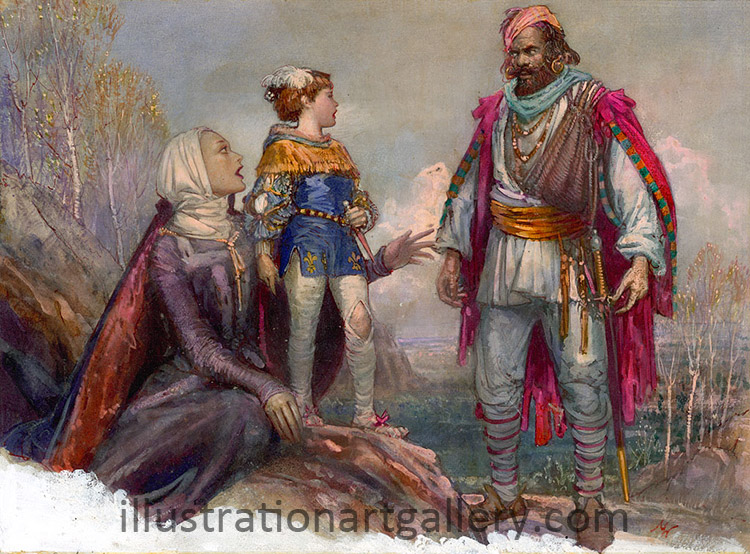
Margaret of Anjou - Queen of England (Original) (Signed)
(Ref: MillarWattMagsMH)
Artist: John Millar Watt
Medium: Watercolour on Board
Size: 15" x 11" (375mm x 270mm)
Date: 1967
Signature: Signed by Artist
This is the Signed original Watercolour painting by John Millar Watt.
Margaret of Anjou was the French-born Queen of Henry VI and a major player on the Lancastrian side of the Wars of the Roses. When her husband began to suffer from a mental illness, Margaret took control. Her conflicts with the Yorkist branch of the Plantaganets led to their open rebellion and the instalment of Edward IV on the throne.
Margaret fought to regain her husband's throne, which she briefly succeeded in doing from late 1470 to early 1471. She was captured after the Lancastrian defeat at the battle of Tewksbury and released into exile in Anjou, France where she died in 1482.
Millar Watt's highly romantic scene shows Queen Margaret, her son the future Edward IV and what looks to be a Barbary Pirate. The signed painting was published in Princess Tina issue 46.
Medium: Watercolour on Board
Size: 15" x 11" (375mm x 270mm)
Date: 1967
Signature: Signed by Artist
This is the Signed original Watercolour painting by John Millar Watt.
Margaret of Anjou was the French-born Queen of Henry VI and a major player on the Lancastrian side of the Wars of the Roses. When her husband began to suffer from a mental illness, Margaret took control. Her conflicts with the Yorkist branch of the Plantaganets led to their open rebellion and the instalment of Edward IV on the throne.
Margaret fought to regain her husband's throne, which she briefly succeeded in doing from late 1470 to early 1471. She was captured after the Lancastrian defeat at the battle of Tewksbury and released into exile in Anjou, France where she died in 1482.
Millar Watt's highly romantic scene shows Queen Margaret, her son the future Edward IV and what looks to be a Barbary Pirate. The signed painting was published in Princess Tina issue 46.
Wednesday, May 22, 2013
Queen Margaret of Anjou
 Character Analysis
The widow of Henry VI, one-time vigorous prosecutor of the Lancastrian cause, has survived into old age as a kind of Fury voicing curses and horrible prophecies. In her speeches, so highly rhetorical and formalistic, the major theme of the play receives repeated emphasis. She lives to see, and practically to gloat over, the fulfillment of one curse, one prophecy, after another. It is she who makes understandable why — in accordance with that mathematical scheme of justice which she constantly dwells upon — Queen Elizabeth, the Duchess of York, and even the little princes should suffer.
Tuesday, May 21, 2013
Margaret of Anjou, book review
Mhttp://www.history.ac.uk/reviews/review/355argaret of Anjou: Queenship and Power 
Book:
Margaret of Anjou: Queenship and Power in Late Medieval England
Helen Maurer
Woodbridge, Boydell Press, 2003, ISBN: 851159273X; 240pp.; Price: £29.95
Helen Maurer
Woodbridge, Boydell Press, 2003, ISBN: 851159273X; 240pp.; Price: £29.95
Reviewer:
Dr Joanna Laynesmith
NA
NA
Citation:
Dr Joanna Laynesmith, review of Margaret of Anjou: Queenship and Power in Late Medieval England, (review no. 355)
URL: http://www.history.ac.uk/reviews/review/355
Date accessed: 17 May, 2013
URL: http://www.history.ac.uk/reviews/review/355
Date accessed: 17 May, 2013
Subscribe to:
Posts (Atom)