Translate

Monday, July 22, 2013

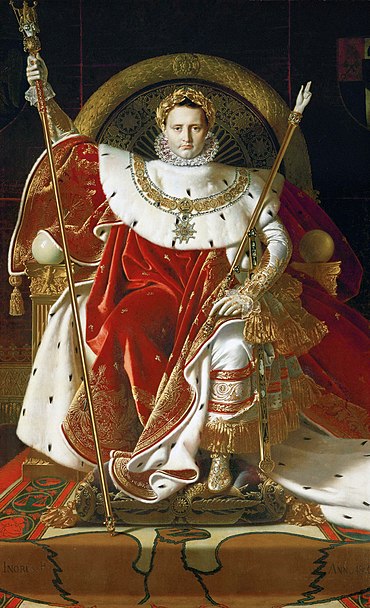
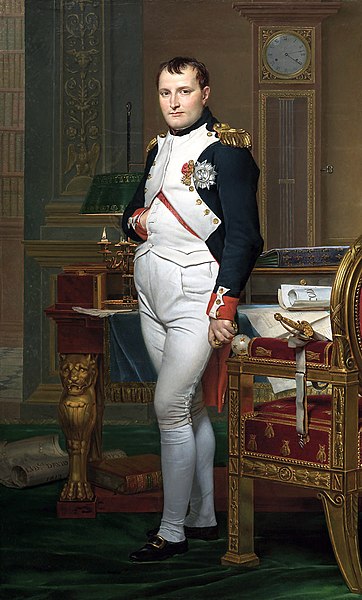
Napoleon I


[Napoleon Bonaparte]
August 15, 1769 - May 5, 1821
Born Napoleone Buonaparte in Corsica and trained in military schools in Paris, Napoleon was promoted to general after the seige of Toulon in 1793. He lead troops into most of Europe and, in 1798, Egypt. Returning to France, he was nominated first Consul after the revolution of 18th Brumaire.
Napoleon founded the Bank of France, reformed the tax system, restored the church, improved the education system and in 1804 assumed the hereditary title of emperor of the French. The following year he was at war with Russia, Austria and England. By April 1814 he was forced to abdicate and exiled to Elba. He attempted to regain his empire in 1815 but was defeated at Waterloo. Banished to St. Helena, he died six years later.
His masonic affiliation is not universally agreed.

http://freemasonry.bcy.ca/biography/bonaparte_n/bonaparte_n.html

Sunday, July 21, 2013

Gwalchmai


Welsh - A hunter at King Arthur's court. Son of Lot and Gwyar. Brother of Mordred. A nephew of King Arthur. He made peace between Tristram and King Mark and accompanied Culhwch on his quest for the hand of Olwen. In later stories he is Gawain although others regard them as separate characters. In some accounts, he is the son of Arthur by his own sister, Gwyar, and was reputed to know the nature of everything. In some accounts, called Gwalchmai,GawainGawainGauvaineGavainGawan,GawayneKnight of the GoddessGalvagin,Gauvain(e)GwrfanThe Red KnightDutch WalwainWaleweinWalwanusFrench Gauvain,GauwainGayainIrish Balb(u)aidhBhalbhuaidh,Latin Walga(i)nusScottish UallabhWelsh GwalchgwynGwalchmeiGreen Knight,GwalchgwynGwalchgwynWhite HawkGwalkmy,GwalkmyHawk of May or Hawk of May.

MARGARET OF ANJOU’S INFLUENCE ON CERSEI LANNISTER


Cersei Lannister shares many personality traits (and some story lines or events) with Queen Margaret of Anjou, wife of Henry VI—the “Mad King” defeated in the first phase of the Wars of the Roses. Both women were good-looking, commanding, indomitable, and fiercely devoted to their children, regardless of their flaws. Rumors of infidelity plagued the two queens. Their subjects despised them and they had few loyal followers. In addition, both women had a permissive attitude towards their reputedly monstrous sons. In some ways, Cersei is like the dark side of Margaret of Anjou—the rumors about Margaret of Anjou brought to life. At first glance, the two women have a lot of parallels.
Cersei and Robert Baratheon visit Ned Stark. Via Wikia (c) HBO.
While this certainly isn’t unique for the period, both Cersei and Margaret had arranged marriages. Years before Game of Thrones begins, Robert Baratheon married Cersei to not only reward Tywin Lannister for switching sides during Robert’s Rebellion but also cement their alliance. However, the marriage was unhappy and Robert typically wasn’t interested in sleeping with his wife.
Margaret of Anjou’s arranged marriage may also have been sexless. Henry VI supposedly shied away from sex, arguably due to excessive piety and mental illness. It took eight years for the couple to conceive, which no doubt fed rumors of a sexless marriage. However, some historians, such as Alison Weir, report that the couple was extremely happy and appear to have spent as much time together as possible.
Even before Margaret’s became queen, she was almost set up to fail. Not only were the people unhappy when they learned of the marriage, Henry and Margaret’s father (Rene of Anjou) had kept divisive secrets about the arrangement.
The English automatically mistrusted Margaret because she hailed from England’s traditional and long-hated enemy France. In the 1440s and 1450s, England was still immersed in the Hundred Years’ War so forging an alliance, through marriage, with France seemed unnatural. Worse, Henry VI and Margaret’s father (Rene of Anjou) secretly agreed that not only would  Henry VI to accept Margaret without a dowry, but also Henry would return Maine and Anjou to Charles VII of France.
This agreement was so unpopular that Henry almost chickened out of giving back the territories and dragged his heels until the last-possible minute. When he gave the order for the troops at those garrisons to withdraw, it proved so divisive amongst the magnates, especially ones like York who’d sacrificed his personal money to protect French territories, that the rift it created would ultimately fester into civil war.
None of these events are Margaret’s fault, but they certainly got the young princess off to a bad start with the English.
When Margaret in England, she was a lovely, but impoverished, fifteen-year-old French princess. Knowing little English, yet highly intelligent, she quickly became fluent.  However, Margaret was also politically naïve, temperamental, uncompromising, arrogant, entitled, and haughty. Unfortunately, like Cersei, Margaret had a whiff of the old “Let them eat cake” about her.
When Margaery Tyrell feeds the poor in King’s Landing, Cersei dismisses it to Joffrey as a bid for popularity. While Margaery may have ulterior motives, Cersei’s cynicism likely stems from the fact she herself isn’t particularly concerned for the less fortunate. Cersei only cares about maneuvering to gain power. It’s no wonder people don’t like her. Likewise, towards the end of her reign, Margaret of Anjou had no compunction about hiring Scottish mercenaries as her soldiers and paying them by letting them take whatever spoils and plunder they could.
Rumors swirled around Margaret and Cersei that their husbands did not father their children. In Cersei’s case, the rumors were true.  Jaime fathered all of “Robert’s” children, except for one dark-haired boy who died. In Margaret’s case, there’s never been any evidence she was unfaithful to Henry VI. However, Yorkist-generated rumors that her son Edward was a bastard ran rampant across the kingdom.
margaret-of-anjou-marriage-h6
A depiction of Margaret of Anjou and Henry VI getting married. Source: Vigiles de Charles VII by Martial d’Auvergne. (From Wikimedia Commons.)
Until Henry VI had a son, many expected Richard of York would be appointed heir. Richard of York was extremely loyal but also wealthy and powerful. He had a stronger claim to the throne than Henry himself. Because of this, Henry, and Margaret in particular, were reluctant to make York the official heir and give him any more power (or influence). Richard had faithfully served the crown, often at his own expense, and he felt overlooked. Perceived slights eventually fostered discontentment, rage, and resistance.
When Margaret finally gave birth, Henry had gone mad and was in an unreachable stupor.  This alone gave the Yorks, who had hoped Henry would stay without an heir, the ability to spin believable rumors that the baby was a bastard and Henry wasn’t capable of fathering a child.
Nobles often claimed their enemies’ children were bastards in the fifteenth century. Like Cersei, Margaret of Anjou was repeatedly accused of adultery – first with her avuncular mentor Suffolk, a man in his late fifties, and then with Edmund Beaufort, the Duke of Somerset (commonly known as “Somerset”).  Alleging adultery or witchcraft let opponents obliquely attack the man heading up a dynastic house without overtly targeting him.
Soon after Margaret gave birth, Warwick publicly described Edward of Westminster as the product of adultery or fraud at a huge assembly of nobles and, falsely, claimed the king hadn’t acknowledged the prince as his son. As a result, rumors of Edward of  Westminster’s illegitimacy persisted until his death. Historians haven’t found any evidence Edw

Napoleon - facts


Napoleon Bonaparte is one of the most popular and controversial conquerors in the world. His intriguing and colorful personal life and political life made him one of the most popular figures all over the world.
1.) Napoleon Bonaparte was born on August 15, 1769 in the island of Corsica and died in May 5, 1821 at the age of 51.
2.) Autopsy report concluded that Napoleon died of stomach cancer but some scientists believed he was poisoned with arsenic.
3.) Forensic samples of Napoleon’s hair did show high levels which is 13 times the normal amount of the element.
4.) Napoleon was one of the greatest military commanders in history. Oftentimes portrayed as a power hungry conqueror, this strong and ambitious man is indeed one of the greatest.
5.) Before going any further, maybe you would like to know one of the darkest secrets of Napoleon Bonaparte – this great man sufferedfrom hemorrhoids – a condition which is highly considered disgusting during his days.
6.) Napoleon’s legal reform, the Napoleonic Code, was influential on many civil laws jurisdictions worldwide.
7.) His military campaigns are studied extensively at military academies from all over the world.
8.) Napoleon’s father, Carlo Maria Buonaparte or Charles-Marie Bonaparte, was a Corsican politician and lawyer.
9.) Napoleon had 12 siblings, 7 of them survived until adulthood.
10.) His elder brother, Joseph-Napoleon Bonaparte was King of Naples and Sicily for two years from 1806 to 1808 and King of Spain and the Indies as Joseph I of Spain from 1808 to1813.
11.) Napoleon’s sister, Elisa Bonaparte – princess of Piombino and Lucca, then Grand Duchess of Tuscany, was his only sister to possess real political power.
12.) Lucien Bonaparte, Napoleon’s younger brother reigned as Prince of Canino from 1814 to 1840 and Prince of Musignano 1824 to 1840.
13.) His brother, Louis Bonaparte reigned as King of Holland for 4 years from 1806 to 1810. He was the father of Napoleon III, the last emperor of France.
14.) Napoleon III, who was born Louis-Napoleon Bonaparte was napoleon’s nephew and was the President of the French Second Republic and as Napoleon III, the ruler of the Second French Empire.
15.) Napoleon’s nephew by sister Elisa, Camerata-Passionei di Mazzoleni, one of the maitres des requetes au Conseil d’Etat, committed suicide at the age of 26 after being prevented from marrying an actress.
16.) Napoleon’s nephew by Lucien, Louis Lucien Bonaparte, served two brief terms in the Assembly as representative for Corsica in 1848 and for the Seine departments in 1849.
17.) Pauline Bonaparte, Napoleon’s sister who reigned as Duchess of Guastalla, was the only Bonaparte sibling to visit Napoleon on his principality at Elba.
18.) Prince Achille Murat or Achille Charles Louis Napoleon, Crown Prince of Naples, Hereditary Prince of Berg, 2nd Prince Murat was a nephew of Napoleon to her sister who became mayor of Tallahassee in the United States.
19.) Jerome Bonaparte, the youngest brother of Napoleon, reigned asFrench Prince, King of Westphalia and1st Prince of Monfort.
20.) Napoleon Joseph Charles Paul Bonaparte, Napoleon’s nephew by his brother Jerome was elected to the National Assembly as a representative of Corsica.
21.) Napoleon Joseph Charles Paul Bonaparte was buried at Les Invalides, Paris – the capital of France.
22.) Napoleon’s grandnephew to his brother Jerome Charles Joseph Bonaparte served as US State Secretary of the Navy and US Attorney General. Jerome Joseph Charles founded the precursor of the FBI or Federal Bureau Investigation in 1908.
23.) Charles Napoleon who was born in 1950 as Charles Marie Jerome Victor Napoleon Bonaparte or Charles, Prince Napoleon, is the great-great-grand-nephew of Napoleon, is a French politician. He considers himself as male heir to the rights and legacy established by Napoleon, his great-great-grand-uncle.
24.) Napoleon’s great-great-great-grand-nephew Jean Christophe, Prince Napoleon, titular 7th Prince of Montfort (Jean Christophe Louis Ferdinand Alberic Napoleon Bonaparte; 11 July 1986) is a claimant to headship of the House of Bonaparte.
25.) Napoleon’s father was a gambler and when he died of stomach cancer in 1785, left his surviving wife and eight children penniless.
26.) Napoleon’s mother Letizia, whose father was a Captain of Corse Regiments of Chivalry and Infantry in the Army of the Republic of Genoa, was not formally educated.
27.) Napoleon’s mother died in 1836 at the age of 85 in Rome just 3 weeks before the 50th anniversary of her husband’s death.
28.) Napoleon’s mother was nearly blind when she died and had outlived him by 15 years.
29.) Maria Letizia Ramolino, Napoleon’s mother, was only 14 when she married Carlo Buonaparte.
30.) Napoleon’s eldest brother was also named Napoleon. The former did not survive adulthood.
31.) Napoleon was a Roman Catholic but did not believe in the existence of a living God.
32.) Napoleon spoke with a marked Corsican accent and was teased by other students for this and he never learned to spell properly.
33.) Bonaparte was good in mathematics and was fairly well acquainted with history and geography.
34.) Napoleon took the pride and honor for being the first Corsican to graduate from the Ecole Militaire.
35.) His capture of the City of Toulon led to his promotion to Brigadier General at the age of 24 and was put in charge of the artillery of France's Army of Italy.
36.) Napoleon was engaged to Desiree in April 1795. She was presented to him by his brother Joseph.
37.) Her complete name is Bernardine Eugenie Desiree Clary a Frenchwoman who became Queen of Sweden and Norway as the consort of King Charles XIV John.
38.) Napoleon was also a writer; he wrote a romantic novella entitled Clisson et Eugenie. The story was about a soldier and his lover, in a clear parallel to his own relationship with Desiree.
39.) Napoleon Bonaparte marched to Venice and forced its surrender and ending its 1,100 years of independence. Napoleon also authorized the French to loot treasures such as the Horses of Saint Mark.
40.) On 15 September, Bonaparte was removed from the list of generals in regular service for his refusal to serve in the Vendee campaign. He then faced a difficult financial situation and reduced career prospects
41.) In Bonaparte’s Italian campaign, his army captured 150,000 prisoners, 540 cannons and 170 standards.
42.) The French army fought 67 actions and won 18 pitched battles through superior artillery technology and Bonaparte’s tactics.
43.) Napoleon’s Egyptian expedition of 1798 included a group of 167 scientists: chemists, geodesists, mathematicians and naturalists and their discoveries included the Rosetta Stones.
44.) The ‘attack of Jaffa’ on March 3-7, 1799 was brutal; Bonaparte, ordered the garrison and 1,400 prisoners were executed by bayonet or drowning to save bullets. Men, women and children were robbed and murdered for three days
45.) As the most powerful man in France, Napoleon used the title ‘First Consul’. This title lapsed when in December 1804 had himself crowned as emperor.
(Carlo Bounaparte)
46.) One of Napoleon’s greatest achievements was the establishment of the Banque de France or central bank.
47.) The story that Napoleon seized the crown out of the hands of Pope Pius VII during his coronation as emperor to avoid his subjugation to the authority of the pontiff is absolutely false.
48.) Napoleon sold to the United States their French possession – the so-called Louisiana Purchase for less than three cents per acre or $7.40 per km².
49.) Bonaparte was a military and political leader during the latter stages of the French Revolution.
50.) Napoleon Bonaparte’s first wife was Josephine de Beauharnais. She was the first Empress of the French.
51.) Josephine and Napoleon were married in 1796 but she did not bear Napoleon any children which resulted to a divorced in 1810.
52.) Before Josephine became the wife of Napoleon, she was the mistress of several leading political figures in France.
53.) Josephine was beautiful but his mouth is always shut so as not to reveal her halitosis or ‘bad breath’.
54.) Many of Napoleon’s letters to his wife Josephine are still intact today.
55.) When Napoleon left Josephine for a military campaign in 1796, Josephine started an affair with a handsome Hussar lieutenant named Hyppolyte Charles.
56.) Before Napoleon met her first wife, she had been known as “Rose”. He doesn’t like it and called her “Josephine”.
57.) Josephine was known to have many lovers and was reputedly well practiced in the arts of lovemaking.
58.) Having learned of his wife’s infidelity, during the Egyptian campaign of 1798, Napoleon Bonaparte started an affair of his own with Pauline Bellisle Foures, the wife of a junior officer who became known as "Napoleon's Cleopatra."
59.) Napoleon also had an affair with Elisabeth le Michaud d'Arcon de Vaudey, a very pretty woman and was the cause of a violent scene between the Emperor and his wife shortly before their coronation.
60.) In March 1810, Napoleon married Marie-Louise of Austria by proxy; the formal ceremony took place at the Louvre on April 1, 1810
61.) Marie-Louise was 18 years of age when she married Napoleon.
62.) Marie-Louise baptismal name was Maria Ludovica Leopoldina Francisca Theresa Josepha Lucia….whew… that’s quite long.
63.) Napoleon’s 2nd wife was a polyglot being fluent in many languages such as English, French, Italian, Latin and Spanish aside from her native German.
64.) After Napoleon and Marie-Louise wedding ceremony, 13 cardinals were imprisoned for non-attendance at the marriage ceremony.
65.) Napoleon also intended and tried to marry the Grand Duchess Anna of the House of Romanov, younger sister of Tsar Alexander I of Russia but his proposal was rejected.
66.) Napoleon abdicated his throne in April 1814 and was exiled to Elba, Marie Louise returned to Austria and never seen her husband again.
67.) As Napoleon I, he was Emperor of the French from May 18, 1804 to April 11, 1814 for a period of 9 years, 328 days.
68.) Napoleon Bonaparte was crowned emperor on December 2, 1804.

69.) He was Emperor of the French again on March 20, 1815 up to June 22, 1815 which lasted for 94 days only. And his full title was His Imperial Majesty Napoleon the First, By the Grace of God and the Constitutions of the Republic, Emperor of the French.
70.) As King of Italy, he reigned from March 17, 1805 to April 11, 1814. He was crowned king on May 26, 1805.
71.) Napoleon’s full title from 1804 to 1805 was His Imperial an


Read more: http://www.bukisa.com/articles/481959_100-interesting-and-controversial-facts-about-napoleon-bonaparte#ixzz2YaWowZgY
Follow us: @bukisa on Twitter | bukisa on Facebook

Saturday, July 20, 2013

SIR GAWAIN


http://orgs.bsc.edu/arthur/knights.html
He called Gwalchmai the son of Gwyar, because he never returned home without achieving the adventure of which he went in quest. He was the best of footmen and the best of knights. He was nephew to Arthur, the son of his sister, and his cousin. -Kilhwch and Olwen in Guest, 107


The Headless Horseman from Sir Gawain and the Green Knight
Gawain, along with Bedivere and Kay, appears early in some of the earliest Arthurian writings. He appears in early Welsh poetry as Gwalchmai, Walwen, or Gauvain. In the different legends, he is consistently related to Arthur as a nephew, though his parentage is variable. The earlier legends seem to place more emphasis on performance in battle, as seen in the quote above from Kilhwch and Olwen, than the later romances. Some believe that the character of Gawain is derived at least in part from some forgotten Celtic sun god. Gawain's strength increases, according to some stories, with the sun, peaks at noon, and wanes as evening approaches.
The character of Gawain has evolved incredibly over time, however. In the earlier stories, he is seen as a brave, honorable knight, but by the romances he has become womanizing, vengeful, and impulsive. In the Stanzaic Le Morte Arthur, he vows to kill Lancelot for his dishonor to the queen, king, and his brother, Agravain:
'I'll not return to England till
He's hanged upon a tree
For while I live and my powers last,
There are folk who'll fight for me.'
The king spoke next, then every lord
Gave his opinion plain,
And each one advocated peace,
Yes, all except Gawain.
                       -lines 2680-2687
Perhaps the most well-known story about Gawain is the poem Sir Gawain and the Green Knight, in which Gawain's knightly virtues are tested by Bertilak, the lord of a mysterious castle deep in the forest. The story is famous for its symmetry, irony, and complex narrative structure.

The real-life inspirations for “Game of Thrones”


Mischief and murder --medieval-style -- inspired the epic series


The real-life inspirations for Lena Headey in "Game of Thrones"
Yes, “Game of Thrones” has dragons and ice zombies and giant clairvoyant wolves, but for every viewer (or reader) who climbed onto George R.R. Martin’s epic fantasy bandwagon for the magical stuff, I suspect there are two of us who are in it for the palace intrigue. Velvet sleeves concealing jewel-encrusted daggers, scheming eunuchs with networks of spies, parvenue commoners outwitting the supercilious aristos and totally, utterly ruthless power plays — what’s not to love?
Martin has always maintained that he’s been influenced at least as much by history and historical fiction as by the traditional epic fantasy of writers like J.R.R. Tolkien. Aficionados know that his novels (collectively called “A Song of Ice and Fire”) are loosely based on the Wars of the Roses, a vicious series of battles of succession that took place in 15th-century England. Martin has also listed Maurice Druon and Thomas B. Costain as models, two mid-20th-century historical novelists who wrote about medieval France, and you can see echoes of that material in his fictional universe, as well.
It would probably surprise several generations of British schoolchildren to learn that the dynastic politics of the late 1400s could be transformed into anything coherent, let alone entertaining. (“It’s worse than the Wars of the Roses!” Lucy Pevensie cries in dismay when someone tries to explain a particularly complicated bit of Narnian history in “Prince Caspian.” She speaks for many.) This, however, hasn’t kept many novelists and historians from trying.
It’s not that there aren’t fabulous characters and nefarious doings in the Wars of the Roses — Secret marriages! Mad monarchs! Vanishing princes! This is a story that concludes with one of the players being drowned in a barrel of wine, after all. But keeping the Wars’ family trees, convoluted legalistic arguments and perpetually shifting allegiances straight is enough to give anyone a headache. It certainly doesn’t help that all the male principles seem to have the same three names (Henry, Richard or Edward) or that they are forever gaining or losing and then gaining again the titles that serve to distinguish them from one another.
For fans who wish to investigate further into the real-life inspirations for Martin’s characters, one of the most lucid popular histories of the conflict is Alison Weir’s “The Wars of the Roses” (originally published as “Lancaster and York”). Some of Martin’s references to the Wars are easy to pick up. For example, the two dueling clans in “Game of Thrones,” the Lannisters and the Starks, have names that resemble those of the two sides in the Wars of the Roses. Like the Yorks, the Starks are northerners, while the Lannisters, like the Lancasters, are famously rich.
Both English families were branches of the House of Plantagenet who vied for the throne after the deposition of the last Plantagenet king, Richard II, in 1399 and before the establishment of the Tudor dynasty in 1485. There’s no one-to-one correspondence between the characters in “Game of Thrones” and actual historical figures, but Martin was clearly inspired by Edward IV in creating, say, Robert Baratheon, the great, strapping warrior who became a stout, ailing king. There’s a dash of Edward, too, in Rob Stark, a brilliant commander who makes an impetuous, disadvantageous marriage.
Cersei Lannister, Robert’s ambitious, conniving widow, is thought by many to have been inspired by the hot-headed Margaret of Anjou, wife of Henry VI, the king Edward IV helped depose. Henry’s bouts of insanity left him frequently unable to rule, and Margaret, a leading Lancastrian, fought ferociously against those she saw as threatening her family’s hold on the crown. Historians view her as a prime driver in the Wars of the Roses, just as Cersei is substantively responsible for the War of the Five Kings in “A Clash of Kings.” Cersei also resembles Isabella of France, an earlier medieval English queen, who conspired with her adulterous lover to dethrone, and possibly to murder, her (bisexual) husband, Edward II, in the 1300s.
Cersei is a crude, incompetent politician, however, which cannot be said of Isabella. Although unpopular in England, where she was nicknamed “the She-wolf of France,” Isabella has acquired some sympathizers over the years, including the indefatigable Alison Weir, who wrote a contrarian biography of her in 2006, “Queen Isabella: Treachery, Adultery, and Murder in Medieval England.” Weir has also written novels about various women in the Tudor era, no doubt aspiring to the success of Philippa Gregory, whose romantic historical novels routinely land on the New York Times Bestseller List.
For her own part, Gregory has already published three books in a series set during the Wars of the Roses, “The Cousins’ War” (an apt title, given the intricate blood relationships among the many combatants). The most recent of these, “The Lady of the Rivers,” may even be infused with enough magical elements to appeal to some “Game of Thrones” readers: In it, the character of Jacquetta, Duchess of Bedford, possesses psychic abilities (the real duchess was tried for witchcraft by her political enemies) and is initiated into the mysteries of alchemy by her first husband. For those who prefer a more grounded view, Gregory collaborated with two historians, David Baldwin and Michael Jones, on a nonfiction book,“The Women of the Cousins’ War: The Duchess, the Queen, and the King’s Mother,”published last year.
You may have noticed that most of these books are about women, despite the fact that, with very few exceptions, the women of the Middle Ages had little power. Much of today’s popular historical fiction about the rulers of the Middle Ages is read by women who are primarily interested in the lives and problems of women. Since the historical record contains next to no information on this topic, fiction has stepped in to fill the breach.
Another, more manly, popular contemporary historical novelist, Bernard Cornwell, has set a series of novels, “The Grail Quest,” during a slightly earlier period. His hero, an archer named Thomas of Hookton who gets caught up in the Hundred Years’ War, is an entirely fictional commoner in search of that fabled relic. What Cornwell’s novels lack in historically based, Machiavellian aristocrats they make up for in action-packed, blood-soaked battle scenes.
For the ultimate in medieval scuttlebutt, however, you can’t do better than Barbara Tuchman’s prizewinning 1978 history, “A Distant Mirror: The Calamitous 14th Century.”This account of the Hundred Years’ War centers around the life of a French nobleman who married an Englishwoman, but it’s more expansive than any novel, taking in such fascinating details as the bizarre fashion for long-toed shoes in court (so long, they had to be tied up with strings and were inveighed against by puritanical clergymen) to the legendarily brutal rampages of British mercenary John Hawkwood through Italy. If you really want to know how the peasants fared while their rulers skirmished, the peculiar challenges of sewage-management in a stone castle, what the real agenda was behind the Crusades, or just how dastardly the highborn and royal can behave when it suits them, then look no further.
Laura Miller
Laura Miller is a senior writer for Salon. She is the author of "The Magician's Book: A Skeptic's Adventures in Narnia" and has a Web site,magiciansbook.com.