 | |
 | |
Napoleon Bonaparte was born the 15th of August, 1769 on Corsica, just three months after the island had been defeated by the French. He would spend his childhood hating France, the nation he would one day rule. "I was born when [Corsica] was perishing. Thirty thousand Frenchmen spewed on to our shores, drowning the throne of liberty in waves of blood... The cries of the dying, the groans of the oppressed and tears of despair surrounded my cradle from the hour of my birth."After the French victory, many Corsican rebels fled to the mountains, where they continued to fight on. But Napoleon’s father Carlo, a twenty-three year-old university student, readily submitted to French rule. Soon he was wearing powdered wigs, embroidered waistcoats, and silver buckled shoes. The Bonapartes were Corsican aristocrats, but they were not rich. With eight children, they struggled just to get by on an island that had been impoverished for centuries. Napoleon never forgave his father for betraying his Corsican heritage. He would later say harshly that Carlo was rather "too fond of pleasure." His mother, Letizia, was a hard, austere woman, toughened by war, who punished her children to teach them sacrifice and discipline. "She sometimes made me go to bed without supper, as if there were nothing to eat in the house. One had to learn to suffer and not let others see it."As a representative of the Corsican parliament, Carlo travelled to Versailles. There, he saw the splendor of the French court in all its majesty, and he worked to secure Napoleon a scholarship to Brienne, a private academy in France. Napoleon set foot in France for the first time in the winter of 1778, a thin, sallow nine year-old, accustomed to the warmth of the Mediterranean, suddenly alone on the windswept plains of northern France. He could hardly speak French. CARRINGTON: When he was in school in Brienne in continental France, where he was very much laughed at and bullied for being a barbarous Corsican, he dreamt all the time of…liberating Corsica. But he did something quite exceptional. He conquered his conquerors. He got the better of the French. "Always alone among men, I come home to dream by myself and to give myself over to all the forces of my melancholy," Napoleon wrote. "My thoughts dwell on death... What fury drives me to wish for my own destruction? No doubt because I see no place for myself in this world."Then the French Revolution changed everything. Bonaparte was twenty-three when he took leave of absence from the French army and returned to Corsica an idealistic revolutionary. The French Republic had made Corsica a part of France, and given Corsicans all the rights and liberties of French citizens. Bonaparte, a lieutenant in the island’s National Guard, threw himself into Corsican politics. Bonaparte soon became the leader of a faction opposed to the island’s governor Pasquale Paoli. The Corsican patriot thought Bonaparte too ambitious, too self-centered, too sympathetic to France. The Corsican Assembly declared Bonaparte and his entire family "traitors and enemies of the Fatherland, condemned to perpetual execration and infamy." Bonaparte no longer had the right to live in Corsica. He had been given a death sentence by his own people. On June 10, 1793 he set sail for France with his widowed mother, three brothers and three sisters – a refugee family carrying with them all they owned in the world. Twenty-four years old, he was banished from the land of his birth forever. |
Monday, February 24, 2014
Napoleon's Youth and Family Life
http://www.pbs.org/empires/napoleon/n_myth/youth/page_1.html

Thursday, February 20, 2014
Queen Guinevere
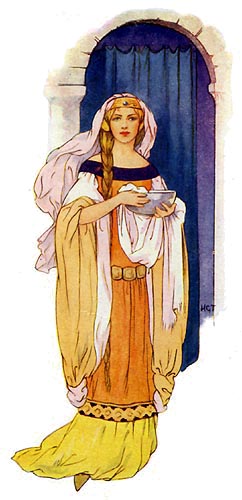 http://www.earlybritishkingdoms.com/bios/guinever.html(Born c.AD 490)(Welsh: Gwenhwyfar; Latin: Wenebara; English: Jennifer)
According to Sir Thomas Malory, King Arthur's wife, Guinevere, was the daughter of King Leodegrance of Cameliard (possibly Maelienydd in South-East Wales). His name comes from the Welsh, Lleudd-Ogrfan, for the traditions of that country call this man Ogrfan Gawr (Ogrfan the Giant) and locate his residences at Oswestry and Castell y Cnwclas (Knucklas Castle). Although, Geoffrey of Monmouth does not give him a name, he claims he was a Roman nobleman and that Guinevere was raised in the house of Cador, Earl of Cornwall.
One of the most beautiful maidens in Britain, Guinevere is usually depicted as meeting King Arthur after he helped expel King Ryonsfrom her father's kingdom. Naturally he fell in love with her at once and the two married soon afterward. They were given the Round Table as a wedding present by her father. In some accounts, they had a son namedSir Loholt.
Guinevere often appears in the Arthurian legends as the victim of abduction, a theme which is sometimes linked with a deified aspect of her origins. Her abductor is usually, Sir Meleagant (earlier known as King Melwas) who takes her to his stronghold at Glastonbury. She appears on the Modena Archivolt being rescued by Arthur and Gawain. Another early version has Arthur rescue her, aided by St. Gildas. However, in the most popular version, it is Sir Lancelot who is the hero of the day.
From the time of Geoffrey of Monmouth, Guinevere appears to have been something of a traitress, for he implies that she was a willing participant in Sir Mordred's rebellion; although the earlier Welsh Triads tell an otherwise unknown story that the Battle of Camlann at the climax of this conflict was caused by Mordred raiding Arthur's court and striking his Queen. Chrétien de Troyes mentions her infidelity, but it was the 13th century Vulgate Cycle of Arthurian tales, followed by Malory, which turned her into something of a latter-day Jezebel. She began a passionate affair with the young Sir Lancelot upon his arrival at court and yet banished him twice when she thought he had been deliberately unfaithful to her. Morgan le Fay discovered the affair, but failed in her attempts to warn Arthur. It was left to Sir Mordred to reveal the two lovers in flagrante delicto, an event which led to Guinevere being sentenced to burning at the stake. She was rescued by Lancelot, but captured by Mordred when Arthur pursued her lover abroad. As already indicated, in less sympathetic versions of the story, she was not sorry and even bore Mordred two children.
She is usually said to have spent the latter days of her life in a nunnery at either Caerleon or Amesbury. A particularly horrible version has her slain by Lancelot and entombed with Mordred who is forced to turn cannibal before he dies of starvation. In Scotland, Hector Boece recorded that she died a prisoner of Mordred's followers at Barry Hill in Strathmore. Local tradition adds that she was eventually torn to pieces by dogs and was buried at Meigle where her memorial can still be seen today. However she met her end, Guinevere's body is claimed to have made its way to join Arthur at Glastonbury Abbey. According to Giraldus Cambrensis, her body was found alongside him when the monks discovered his grave in 1191.
Although not mentioned by other writers, Giraldus goes on to tell how the inscription on the famous leaden burial cross, found there, recorded Guinevere as Arthur's 'second wife'. This may echo the story of the lady's half-sister, Guinevere the False (alias Guinevack), born to Leodegrance's lover on the same night as Guinivere. At one point she is said to have managed to exile the Queen and take her place. Alternatively, the Welsh Triads claim that Arthur was married, not twice, but three times, to ladies all named Guinevere: Gwenhwyfar daughter of Cywryd, Gwenhwyfar daughter of Gwythyr ap Greidiol and Gwenhwyfar daughter of Ogrfan Gawr. This may be due to confusion over his wife's parentage or indicate further the lady's origins in Celtic mythology, possibly as a triple aspect goddess.
Napoleon Rocks!

http://napoleononline.ca/about/napoleon-rocks/
These are my top five picks for why Napoleon rocks!
- The Original Spin Doctor and brilliant PR man – through creation of his own Bulletins, articles for the official press, campaign newspapers, medallions, and selected patronage of the arts, Napoleon was the first modern man to create and publicize the image he wanted portrayed. The effects of this calculated positive public image on events from 1796 onwards cannot be underestimated in contributing to his political and military success.
- Ended the French Revolution – after 10 years of civil strife, constant violence, topsy-turvy governments, revolution, counter revolution, counter-counter-revolution, economic instability and general uncertainty, the French people just wanted someone to bring stability to their nation on all these fronts. After the Coup d’Etat of 18 Brumaire, they finally had it. Napoleon Bonaparte.
- Significant Civil reforms – in the span of just a few short years he accomplished what some nations take decades (or in some case centuries) to achieve. Complete re-write of the legal code (Code Napoleon), created the Banque de France to restore financial stability, reformed the education system, instituted an extensive program of public works (building roads, bridges and canals, dredging harbours; and beautifying cities, especially Paris), centralized the governmental systems which is still in effect today in France, settled the dispute with the Catholic Church (Concordat)…the list goes on.
- Meritocracy – he implemented the ideals of the French Revolution (égalité) by promoting and advancing people from all ranks of society, including nobles. The Légion d’honneur, the first order of merit, admitting men of any class. They were judged not by ancestry or wealth but by military, scientific or artistic prowess.
- Sowing the seeds of nationalism – the original purpose of Frances declaration of war in 1792 (War of the First Coalition) was to sow the seeds of a free democratic republic to those neighbouring countries who were mired in there own Ancien Régimes. By implementing reforms (Code Napoleon, reorganizing civil administrations, freeing the Jews, abolishing the discriminatory trade guilds etc.) in those realms where Napoleon had influence, he sowed the first seeds of nationalism that would eventually lead to the decline and fall of the archaic monarchies and the rise of legitimate governments.
Friday, February 14, 2014
Kingdom of Summer - Now Available on Audible!
The Second book in Gillian Bradshaw's HAWK OF MAY: DOWN THE LONG WIND series, tells the tale of King Arthur's England through the eyes of Gwalchmai's servent, Rhys ap Sion.

Tuesday, February 11, 2014
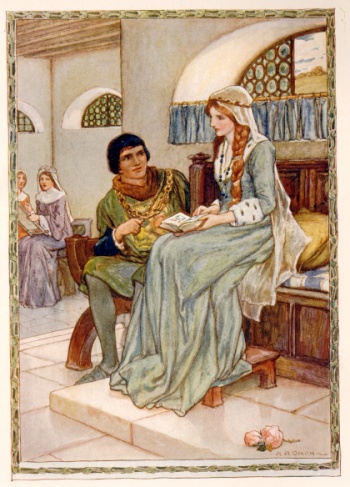
Guinevere
http://d.lib.rochester.edu/camelot/theme/guinevere
Sir Launcelot and the Queen Talked Sadly Together
by: Arthur Dixon (Artist)from: King Arthur and the Knights of the Round Table (Facing p. 126) - 1921
CharactersName Variants: Guenevere, Ginevra, Gwenhwyfar, Gaynor, Guanhumara, Guennivar, Ganore, Guenever, Waynor
Guinevere is said to be the daughter of Leodegrance of Cameliard in late medieval romance. In many sources, she marries Arthur and then has a love affair with Lancelot which causes the downfall of Camelot.
The Welsh Triads speak of "Arthur's Three Great Queens," all named Gwenhwyfar (Triad 56) and name Gwenhwyfar as "more faithless" than the three faithless wives of the Island of Britain (Triad 80). One of the earliest Arthurian stories is about the abduction of Guinevere by Meleagant (or Melyagaunce or Melwas). The story is told in The Life of St. Gildas (c. 1130) by Caradoc of Llancarfan and in the Welsh "Dialogue of Melwas and Gwenhwyfar." It is the subject of the earliest known Arthurian sculpture on the archivolt of the Porta della Pescheria on the Modena Cathedral. The story of the abduction is the central action in Chrétien de Troyes' Lancelot and appears in Malory.
Geoffrey of Monmouth introduces the notion of Guinevere’s infidelity (with Modred) while Arthur is fighting on the continent. In the twelfth-century Rise of Gawain, Arthur’s wife is called Gwendoloena and is said to have been initiated into sorcery and to be able to divine the future.
In Chrétien’s Lancelot, Guinevere becomes Lancelot’s lover after he rescues her from Meleagant. She is a demanding courtly lover; for example, she refuses to see Lancelot after he has suffered greatly in saving her because he hesitated two steps before leaping into a cart on his quest to rescue her, thus suggesting that his love was not absolute. But she loves deeply and contemplates suicide when she hears rumors of Lancelot’s death.
Although generally in the romance tradition, Guinevere is portrayed as Lancelot’s lover, that is not the case in Ulrich von Zatzikhoven’s Lanzelet. Ginover, who fails the chastity test of the mantle, she is said to have erred only in thought. The nature of those thoughts is not revealed, but she and Arthur have a son and seem to be happily married. And she is an intimate friend of Lanzelet’s beloved Yblis. Lanzelet does champion Ginover, but when she is abducted by Valerin, Arthur leads the expedition to rescue her and Lanzelet plays only a minor role.
In the Vulgate Cycle, the first meeting between Guinevere and Lancelot is arranged by Galehaut, and Guinevere subsequently arranges for Galehaut and the Lady of Malehaut to become lovers. She is later accused of not being the true Guinevere by the illegitimate daughter of her father Leodagan and the wife of his seneschal. When Arthur falls in love with the False Guinevere and accepts her as his queen, Guinevere is protected by Lancelot and Galehaut until the truth is revealed. Lancelot assists Guinevere again by rescuing her when she is abducted by Meleagant. In the Mort Artu, after Guinevere is found to be Lancelot’s lover and condemned to be burned to death, Lancelot rescues her again and takes her to Joyous Guard, but the Pope demands that Arthur be reconciled with her. When Arthur leaves for France to attack Lancelot, Mordred tries to claim the throne and to marry Guinevere. She flees to the Tower of London and then, when Arthur returns, to a convent, where she dies.
Malory’s Guinevere is jealous and demanding but also a true lover. Her jealousy and anger drive Lancelot mad and lead her to say she wishes he were dead. Nevertheless, she remains true to him. She is accused several times of crimes—infidelity and the murder of Mador’s relative—and must be saved by Lancelot, as she is once again when their love is discovered and she is sentenced to be burned at the stake. When Mordred rebels against Arthur and attempts to marry her, she flees first to the Tower of London and then to the nunnery at Amesbury, where she becomes abbess. Lancelot visits her there after the death of Arthur, but she asks him to leave and never to return and refuses even to give him a final kiss. She dies a holy death, of which Lancelot learns in a vision that instructs him to have her buried next to Arthur.
While Malory is understanding of the true love of Guinevere, Tennyson makes her an example of an unfaithful wife. His Guinevere believes that "He is all fault who hath no fault at all" and wants her lover to "have a touch of earth." Arthur, before whom she grovels with guilt when he visits her in the nunnery, says that she has "spoilt the purpose of my life." Nevertheless, Tennyson does bring Guinevere and other female characters to the fore, as does one of his contemporaries, William Morris. In his poem "The Defence of Guenevere," Morris is the first to give the Queen her own voice, thus beginning a tradition that is continued in Sara Teasdale's poem "Guenevere," Dorothy Parker's "Guinevere at Her Fireside," and Wendy Mnookin's collection Guenever Speaks, as well as in many contemporary novels told from Guinevere's point of view, such as Parke Godwin's Beloved Exile and Persia Wooley's Guinevere trilogy.
BIBLIOGRAPHY
Ahern, Stephen. “Listening to Guinevere: Female Agency and the Politics of Chivalry in Tennyson’s Idylls.” Studies in Philology 101.1 (2004): 88-112.
Archibald, Elizabeth. "Malory's Lancelot and Guenevere." In A Companion to Arthurian Literature. Ed. Helen Fulton. Oxford: Wiley-Blackwell, 2009. Pp. 312-25.
Cross, Tom Peete and William Albert Nitze. Lancelot and Guenevere: A Study on the Origins of Courtly Love. 1930; rpt. New York: Phaeton Press, 1970.
Fulton, Helen. “A Woman’s Place: Guinevere in the Welsh and French Romances.”Quondam et Futurus: A Journal of Arthurian Interpretations 3.2 (1993): 1-25.
Gordon-Wise, Barbara Ann. The Reclamation of a Queen: Guinevere in Modern Fantasy. Westport, CT: Greenwood Press, 1991.
Hoberg, Tom. “In Her Own Right: The Guinevere of Parke Godwin. In Popular Arthurian Traditions. Ed. Sally K. Slocum. Bowling Green, OK: Popular Press, 1992. Pp. 68-79.
Hodges, Kenneth. “Guenevere’s Politics in Malory’s Morte Darthur. Journal of English and Germanic Philology 104.1 (2005): 54-79.
Korrel, Peter. An Arthurian Triangle: A Study of the Origin, Development and Characterization of Arthur, Guinevere and Modred. Leiden: E. J. Brill, 1984.
Lancelot and Guinevere: A Casebook. Ed. Lori J. Wlaters. New York: Garland, 1996.
Noble, James. “Guinevere, the Superwoman of Contemporary Arthurian Fiction.”Florilegium 23.2 (2006): 197-210.
Ranum, Ingrid. “Tennyson’s False Women: Vivien, Guinevere, and the Challenge to Victorian Domestic Ideology.” Victorian Newsletter 117 (201): 39-56.
Samples, Susann. "Guinevere: A Re-Appraisal." Arthurian Interpretations 3.2 (1989): 106-18.
Sasso, Eleonora. “Tennyson, Morris and the Guinevere Complex.” Tennyson Research Bulletin 9:3 (2009): 271-27.
Shichtman, Martin B. “Elaine and Guinevere: Gender and Historical Consciousness in the Middle Ages.” In New Images of Medieval Women: Essays towards a Cultural Anthropology. Ed. Edelgard E. DuBruck. Lewiston, NY: Edwin Mellen, 1989. Pp. 255-71.
Skinner, Veronica L. “Guinevere’s Role in the Arthurian Poetry of Charles Williams. Mythlore 4.3 (1977): 9-11.
Archibald, Elizabeth. "Malory's Lancelot and Guenevere." In A Companion to Arthurian Literature. Ed. Helen Fulton. Oxford: Wiley-Blackwell, 2009. Pp. 312-25.
Cross, Tom Peete and William Albert Nitze. Lancelot and Guenevere: A Study on the Origins of Courtly Love. 1930; rpt. New York: Phaeton Press, 1970.
Fulton, Helen. “A Woman’s Place: Guinevere in the Welsh and French Romances.”Quondam et Futurus: A Journal of Arthurian Interpretations 3.2 (1993): 1-25.
Gordon-Wise, Barbara Ann. The Reclamation of a Queen: Guinevere in Modern Fantasy. Westport, CT: Greenwood Press, 1991.
Hoberg, Tom. “In Her Own Right: The Guinevere of Parke Godwin. In Popular Arthurian Traditions. Ed. Sally K. Slocum. Bowling Green, OK: Popular Press, 1992. Pp. 68-79.
Hodges, Kenneth. “Guenevere’s Politics in Malory’s Morte Darthur. Journal of English and Germanic Philology 104.1 (2005): 54-79.
Korrel, Peter. An Arthurian Triangle: A Study of the Origin, Development and Characterization of Arthur, Guinevere and Modred. Leiden: E. J. Brill, 1984.
Lancelot and Guinevere: A Casebook. Ed. Lori J. Wlaters. New York: Garland, 1996.
Noble, James. “Guinevere, the Superwoman of Contemporary Arthurian Fiction.”Florilegium 23.2 (2006): 197-210.
Ranum, Ingrid. “Tennyson’s False Women: Vivien, Guinevere, and the Challenge to Victorian Domestic Ideology.” Victorian Newsletter 117 (201): 39-56.
Samples, Susann. "Guinevere: A Re-Appraisal." Arthurian Interpretations 3.2 (1989): 106-18.
Sasso, Eleonora. “Tennyson, Morris and the Guinevere Complex.” Tennyson Research Bulletin 9:3 (2009): 271-27.
Shichtman, Martin B. “Elaine and Guinevere: Gender and Historical Consciousness in the Middle Ages.” In New Images of Medieval Women: Essays towards a Cultural Anthropology. Ed. Edelgard E. DuBruck. Lewiston, NY: Edwin Mellen, 1989. Pp. 255-71.
Skinner, Veronica L. “Guinevere’s Role in the Arthurian Poetry of Charles Williams. Mythlore 4.3 (1977): 9-11.
Lady Margaret Beaufort, The King’s Mother
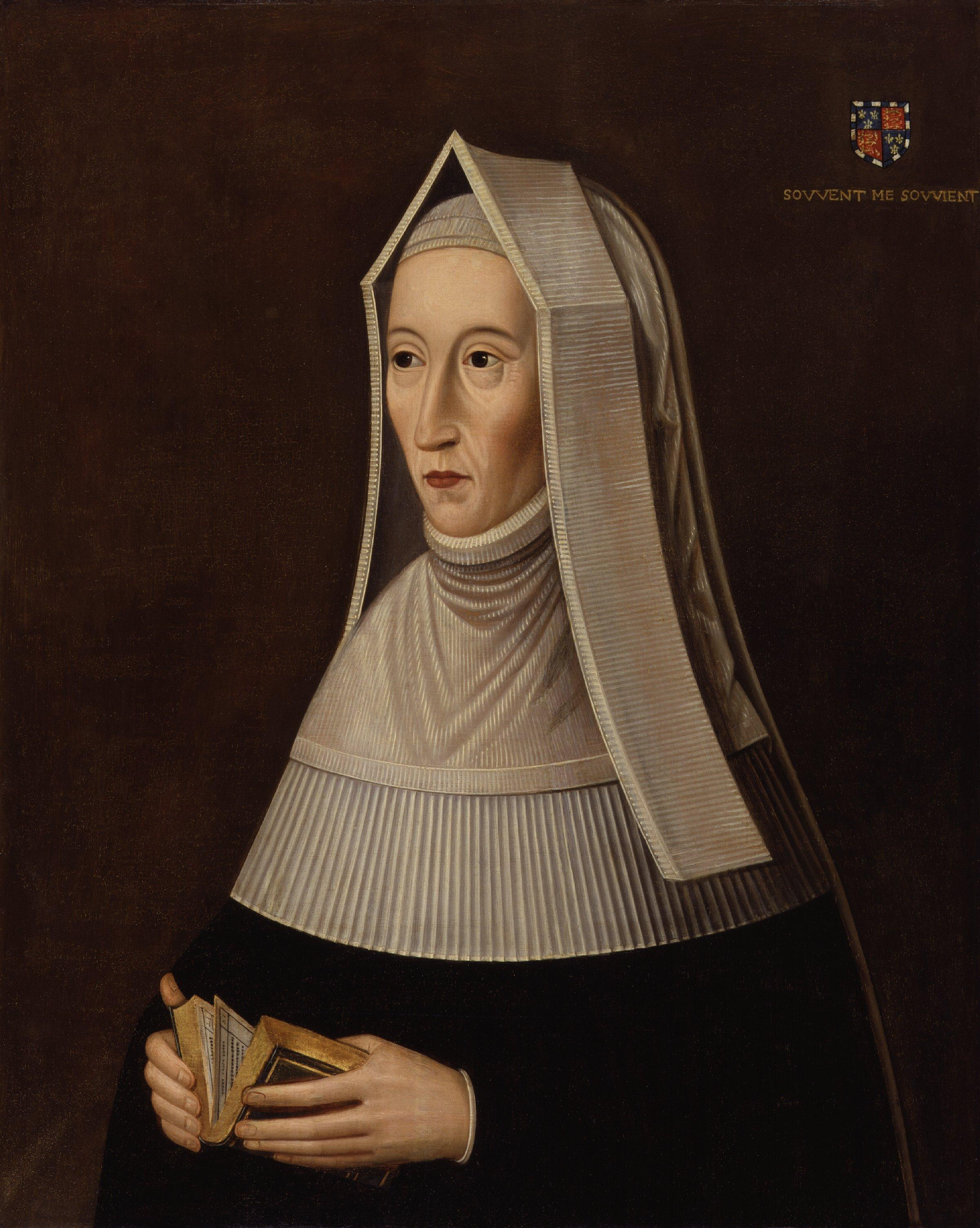
Lady Margaret Beaufort at Prayer from the National Portrait Gallery (Image in the public domain)
Lady Margaret Beaufort was the matriarch of the Tudor dynasty of Kings in England. Her life was greatly influenced by the turning of the Wheel of Fortune. That she managed to survive the vagaries of the War of Roses in England is something at which to be marveled. We have the memories of her confessor, John Fisher, Bishop of Rochester and Margaret gave him permission to share these memories after her death. Fisher saw the emotional Margaret but most people saw the steely, self-controlled Margaret of politics. She had great presence and a forceful personality. She was skilled and effective and could be ruthless.
Margaret was born on May 31, 1443 at Bletso in Bedfordshire. She was the daughter of John, Earl of Somerset. Somerset was a grandson of John of Gaunt, Duke of Lancaster who was the third surviving son of King Edward III and Gaunt’s mistress and later wife, Katherine Swynford. The children of John of Gaunt and Katherine Swynford were legitimized after their marriage but they were unable to inherit the throne of England. Margaret’s mother was Margaret Beauchamp, the daughter and heiress of Sir John Beauchamp of the gentry. Margaret Beauchamp had been previously married to Sir Oliver St. John by whom she had seven children.
As an aristocrat, John Beaufort was to be the longest held English prisoner in France of the Hundred Years’ War. When King Henry VI finally arranged his release, he was bitter and financially strapped. The King gave him lands and offices and the title of Duke of Somerset and sent him back to France to fight and make as much money as possible. But Somerset caused trouble in France and the King was furious. When Somerset returned to England, the King refused to meet with him and he faced charges of treason. It is believed he committed suicide just a few days short of Margaret’s first birthday. Upon his death Margaret became one of the greatest heiresses in England.
King Henry granted Margaret’s wardship to one of his favorite councilors, William de la Pole, Earl of Suffolk. There is little on record of Margaret’s upbringing but she remained in her mother’s custody and she appears to have been affectionate with her mother and her St. John half-siblings. She also received a decent education.
The Earl of Suffolk arranged a marriage between his eight year old son John de la Pole and Margaret when she was six years old. There may have been a marriage ceremony but Margaret was returned to her mother and the marriage was never consummated. When Suffolk was disgraced in April of 1450, the marriage between Margaret and John de la Pole was voided. Margaret never referred to John de la Pole as her first husband.
In 1453, King Henry VI granted the wardship of Margaret to his half-brothers Edmund and Jasper Tudor. Presumably, King Henry intended Margaret to marry one of the Tudors and he may have considered Margaret to be a prospective heir to the throne as a surviving member of the House of Lancaster. In 1455, Margaret was married to the elder of the two brothers, twenty-two year old Edmund, 1st Earl of Richmond.
Edmund was sent to Wales by the King and took Margaret with him. Although Margaret was of a legal age to be married, she was petite and still very much a child. Edmund, in an effort to have an heir and gain the rights to Margaret’s fortune, consummated the marriage. She became pregnant in the early part of 1456. Unfortunately in August of 1456, Edmund was captured by an ally of the Duke of York. Edmund was imprisoned and later released but died of plague in early November at Carmarthen Castle. Margaret was pregnant, only thirteen and a widow. She put herself under the protection of her brother-in-law Jasper in Pembroke Castle and her son Henry Tudor was born there on January 28, 1457.

Pembroke Castles, Wales where Margaret’s son was born (Image in the public domain)
The birth of Henry had been very hard on Margaret but both mother and child survived. Margaret may have suffered permanent physical damage in the childbirth as there is no record she ever had another pregnancy or child. She spent about a year at Pembroke with her son to whom she became very devoted. She then sought, with the help of her brother-in-law, a new marriage alliance before the King forced another husband on her. An agreement was made between Margaret and the Duke of Buckingham’s second son, Henry Stafford in April of 1457 and the marriage was celebrated in January of 1458. This appears to have been a happy marriage. Margaret’s son Henry remained in the custody of his uncle Jasper in Pembroke and Margaret and her husband visited him there regularly.
In 1461, after Edward IV became King, Henry Tudor’s wardship was sold to Lord Herbert for £1000. Lord Herbert and his wife Anne Devereux supervised his upbringing in a kind and considerate way. Margaret made arrangements allowing for visits with her son and she sent regular messengers to the Herbert’s inquiring for news.
In 1466, King Edward granted the manor at Woking to Margaret and her husband. Margaret was proficient in running her household and estates and enjoyed dressing in rich clothes. In 1468, the Stafford’s entertained King Edward at Woking. In October 1470, Henry joined his mother in a visit to King Henry VI who had just been returned to the throne. Henry then returned to Pembroke. Not long after this visit, Edward IV returned with an army to reclaim the throne.
On April 18, 1471, Edward defeated the Lancastrian forces under the Earl of Warwick at the Battle of Barnet. Margaret’s husband Henry was severely wounded in the battle and returned home. After the defeat of King Henry VI’s wife Margaret of Anjou at the Battle of Tewkesbury, and the death of her son Edward of Lancaster, King Henry VI was murdered in the Tower of London. This left Margaret Beaufort and her son Henry with the best claim to be the heirs of the House of Lancaster. Jasper and Henry Tudor tried to flee to France but were blown off course and landed in Brittany. Margaret’s husband Henry Stafford died, mostly likely from his battle wounds on October 4, 1471.
Margaret’s political situation was perilous and she immediately sought a new protector. In June of 1472, Margaret married Thomas, Lord Stanley. Stanley was a major landowner in England and he managed to never lead his troops into battle for either the House of Lancaster or York. This marriage was most likely a business arrangement with Margaret getting protection for her land holdings and her wealth and Stanley getting the prestige of her name and her wealth.
Stanley was in King Edward’s circle and Margaret did attend court. Her marriage to Stanley was probably agreeable in the beginning. Margaret began working to get her son returned to favor in England. Jasper and Henry had gone to the court of Francis II, Duke of Brittany where they were treated with courtesy but essentially prisoners. Margaret didn’t see her son between 1471 and 1485 but she was in constant contact with him.
In 1476, Margaret was in sufficient favor with the Yorkist court of King Edward that she attended Queen Elizabeth Woodville during the reburial ceremony of Edward’s father the Duke of York. During the christening of Edward’s youngest child Bridget in 1482, Margaret was given the honor of holding the infant. Margaret eventually persuaded Edward to allow her son to return to England. In June of 1482, there was a draft pardon drawn up and discussion of Henry marrying Edward’s eldest daughter Elizabeth of York. But before all these arrangements could be finalized, King Edward died on April 9, 1483, leaving his twelve year old son Edward as his heir.
With the death of King Edward IV, leaving a child as his heir, another period of political unrest ensued and the War of the Roses resumed. Margaret was caught up in the crossfire of the struggle that ensued as well as contributing to the instability by fighting to put her own son on the throne. King Edward’s brother Richard, Duke of Gloucester had Edward’s children declared illegitimate, put aside young King Edward V and Parliament declared the Duke King. He was crowned King as Richard III. King Edward V and his young brother Richard, Duke of York were held in the Tower of London and after some time had passed they disappeared.
The new King was not sure of Margaret’s husband’s loyalty and for a short time had him imprisoned. But Stanley declared his support for Richard and was released, keeping all of his offices. Lord Stanley and Margaret played a role in the coronation of King Richard III and his wife Anne Neville. Margaret was magnificently dressed and carried the train of the new Queen. She also sat to the left of the Queen during the ceremony and sat near the Queen at the banquet afterwards.
There is some scant evidence that Margaret was already working on a plan to bring her son back to England at the very least; and wanted to have him named as the heir to the House of Lancaster and eventually made King at most. Margaret was not alone in working to oppose the new King. There is not much detail about these plans but when some men were discovered plotting against the King, they were caught and executed.
Margaret solicited the help of her nephew the Duke of Buckingham and of Edward IV’s Queen Elizabeth Woodville in her scheme. Part of the plot was the marriage of Margaret’s son to the former Queen’s eldest daughter, Elizabeth of York. She sent word to Henry in Brittany and he began preparations to return to England with troops.
King Richard was apprised of the rebellion and took his army to fight against Buckingham. There never was a battle due to bad weather but Buckingham was caught and executed. Margaret was attainted for treason by Parliament but because her husband remained loyal to Richard, the death sentence for treason was commuted to life in prison and her goods and lands were confiscated. Margaret’s imprisonment was served in the home of her husband. Lord Stanley gave Margaret quite a bit of freedom, allowing her to keep in contact with her son.

Margaret Beaufort’s son, King Henry VII (Image in public domain)
Over the next eighteen months, Margaret worked to get her son on the throne. Henry, in France, gathered supporters and troops and in the summer of 1485, he landed in England and engaged the forces of King Richard III at Bosworth Field. King Richard fought bravely but died on the battlefield and Margaret’s son Henry was now King as Henry VII. He couldn’t have done it without his mother’s help.
Margaret was immediately released from her imprisonment and traveled south for a reunion with her son in London after fourteen years. Henry gave his step-father the title of the Earl of Derby and Margaret was now known as the Countess of Richmond and Derby and “the King’s mother”. She witnessed Henry’s coronation on October 30, 1485 and his marriage to Elizabeth of York on January 18, 1486.
Margaret had a special place in her son’s government from the first day, providing him with trusted political advice. He entrusted her with many offices, titles, ceremonies and special commissions. She managed to legally and spiritually obtain independence from her husband so she owned everything in her own right. Henry gave her a home at Coldharbour near London and she made this her main home there along with another residence in the country called Collyweston. She basically acted as Queen, overshadowing her daughter-in-law.
Margaret delighted in the births of her many grandchildren. Prince Arthur married the Spanish princess Catherine of Aragon in 1501 but died soon after of the sweating sickness. She saw her eldest grand-daughter and namesake Margaret Tudor married toKing James IV of Scotland in 1503. Her most beautiful grand-daughter Mary would become Queen of France after Margaret’s death.
In her later years Margaret made significant religious, educational and literary contributions. She became a patron and benefactor of two colleges at Cambridge University. She commissioned William Caxton to print a French romance book. She translated several devotional works from French into English and had them printed. Her personal chapel became an important center for the composition of polyphonic music.

Tomb of Margaret Beaufort in Westminster Abbey (Image in public domain)
Margaret’s beloved son King Henry VII died in April of 1509. Margaret lived long enough to see her grandson King Henry VIII marry Catherine of Aragon and witnessed their coronation on June 24th. Perhaps all the celebrations were too much for her as her health was failing. She died five days later at Westminster at the age of sixty-six. Her confessor, John Fisher, gave a eulogy describing her life about a month later. The Wheel of Fortune had finally stopped turning for Margaret.
Further Reading: “Margaret Beaufort: Mother of the Tudor Dynasty” by Elizabeth Norton, section on Margaret Beaufort from “The Women of the Cousins’ War: The Duchess, the Queen, and the King’s Mother” by Michael Jones, “Blood Sisters: The Hidden Lives of the Women Behind the Wars of the Roses” by Sarah Gristwood, entry on Margaret Beaufort in the Oxford Dictionary of National Biography by M. Jones and M. Underwood
Subscribe to:
Posts (Atom)