Translate

Tuesday, February 25, 2014

Audiobooks and the Return of Storytelling


Great NY Times article by T. M. Luhrmann (a contributing opinion writer and a professor of anthropology at Stanford.) T. M. Luhrmann
Tanya Marie Luhrmann is a professor of anthropology at Stanford University and a contributing opinion writer. Her books include “Persuasions of the Witch’s Craft: Ritual Magic in Contemporary England,” “The Good Parsi: The Fate of a Colonial Elite in a Postcolonial Society,”  “Of Two Minds: The Growing Disorder in American Psychiatry”  and “When God Talks Back: Understanding the American Evangelical Relationship with God.”  She received her Ph.D. the University of Cambridge, and taught at the University of California, San Diego, and then at the University of Chicago before arriving at Stanford. She was elected to the American Academy of Arts and Sciences in 2003 and received a Guggenheim Fellowship in 2007. Her work focuses on the way people experience God and the supernatural in the United States and abroad.  She also studies psychiatric illness.  She is interested in the way that different ways of understanding the mind alter these profound mental experiences.

Napoleon Bonaparte (1769 - 1821


One of the greatest military leaders in history and emperor of France, he conquered much of Europe.
Napoleon Bonaparte was born on 15 August 1769 in Corsica into a gentry family. Educated at military school, he was rapidly promoted and in 1796, was made commander of the French army in Italy, where he forced Austria and its allies to make peace. In 1798, Napoleon conquered Ottoman-ruled Egypt in an attempt to strike at British trade routes with India. He was stranded when his fleet was destroyed by the British at the Battle of the Nile.
France now faced a new coalition - Austria and Russia had allied with Britain. Napoleon returned to Paris where the government was in crisis. In a coup d'etat in November 1799, Napoleon became first consul. In 1802, he was made consul for life and two years later, emperor. He oversaw the centralisation of government, the creation of the Bank of France, the reinstatement of Roman Catholicism as the state religion and law reform with the Code Napoleon.
In 1800, he defeated the Austrians at Marengo. He then negotiated a general European peace which established French power on the continent. In 1803, Britain resumed war with France, later joined by Russia and Austria. Britain inflicted a naval defeat on the French at Trafalgar (1805) so Napoleon abandoned plans to invade England and turned on the Austro-Russian forces, defeating them at Austerlitz later the same year. He gained much new territory, including annexation of Prussian lands which ostensibly gave him control of Europe. The Holy Roman Empire was dissolved, Holland and Westphalia created, and over the next five years, Napoleon's relatives and loyalists were installed as leaders (in Holland, Westphalia, Italy, Naples, Spain and Sweden).
In 1810, he had his childless marriage to Josephine de Beauharnais annulled and married the daughter of the Austrian emperor in the hope of having an heir. A son, Napoleon, was born a year later.
The Peninsular War began in 1808. Costly French defeats over the next five years drained French military resources. Napoleon's invasion of Russia in 1812 resulted in a disastrous retreat. The tide started to turn in favour of the allies and in March 1814, Paris fell. Napoleon went into exile on the Mediterranean island of Elba. In March 1815 he escaped and marched on the French capital. The Battle of Waterloo ended his brief second reign. The British imprisoned him on the remote Atlantic island of St Helena, where he died on 5 May 1821.

Monday, February 24, 2014

Sir Lancelot (Sir Launcelot)


http://www.arthurian-legend.com/more-about/more-about-arthur-6.php

Both the English and French cycles of Arthurian Legend are dominated by three inter-related themes:
• The fellowship of the knights of the Round Table
• The quests for the Holy Grail (the Sangreal)
• The Arthur/Guinevere/Lancelot love-triangle
Throughout, Lancelot is arguably as important a figure as Arthur himself. In French versions of the legend more attention is focused on Sir Lancelot than on King Arthur, and the French - compared to their English counterparts - appeared to be interested in the balance between the spiritual dimension and the earthly. The character of Lancelot fitted the bill more readily than did the King, but ultimately, for all his 'noble chevalry', Lancelot remains a figure of tragic failure.
In summary: Sir Lancelot is regarded as the first and greatest of King Arthur's legendary knights. Son of King Ban of Benoic (anglicized as Benwick) and Queen Elaine, he is known as Lancelot of the Lake (or Lancelot du Lac) because he was raised by Vivien, the Lady of the Lake. His knightly adventures include the rescue of Queen Guineverefrom the evil Méléagant, a failed quest for the Holy Grail, and a further rescue of Guinevere after she is condemned to be burned at the stake for adultery (with him). Lancelot is also loved by Elaine of Astolat (the daughter of King Pelles) who dies of grief because her love is unrequited. Another Elaine (Elaine of Corbenic) tricks him - apparently he thought she was Guinevere - into sleeping with her (and begetting Galahad). His long relationship with the real Guinevere ultimately brings about the destruction of King Arthur's realm.

Le Chevalier de la Charrette

Sir Lancelot first appears in Arthurian legend in 'Le Chevalier de la Charrette', one of a set of five Arthurian romances written by the French poet Chrétien de Troyes (completed by Godefroy de Lagny) as a large collection of verses, c.1180 to 1240. Lancelot is characterised alongside other knights, notably Gawain, Kay, and Méléagant (or Meliagaunce) - a consistent rival and parallel anti-hero against Lancelot - and is already heavily involved in his legendary romance with Guinevere, King Arthur's queen.
The dual role of (i) superb knight-at-arms and (ii) enduring, courtly lover defines Lancelot's legendary gallantry. The incongruous notion of the super-hero resorting to a 'charrette' (cart) arises when Guinevere was abducted by Méléagant (the son of King Bagdemagus). Lancelot - hesitatingly at first, to Guinevere's later disgust - pursued him in a cart driven by a dwarf. The episode culminates in Lancelot's 'crossing of the Sword Bridge': a bridge consisting from end to end of a sharply honed blade. Ultimately it is Lancelot's character - the epitome of constancy and obedience to love - which is the key to his defeat of Méléagant and the self-love, treachery, and cruelty which he personified.
During the ensuing combat between Lancelot and Méléagant (which Lancelot came close to losing because he could not stop gazing upon her - he collected himself just in time) King Bagdemagus successfully pleaded with Guinevere to stop the fight so his son's life could be spared. Lancelot was forced to defend her honour a second time, when Méléagant later accused her of an affair with Kay, and once again Bagdemagus successfully pleaded for his son. Lancelot finally slew Méléagant in combat at King Arthur's court, and his literary reputation as chivalric hero and arch-exemplar of 'saver-of-damsels-from-distress' was sealed.

The origin of the affair between Lancelot and Guinevere

Chrétien de Troyes composed 'Le Chevalier de la Charrette' at the request of the Countess Marie de Champagne, daughter of Louis VII of France and Eleanor of Aquitaine, then later the wife of Henry II of England. It was apparently written to foster the notion of the 'Courts of Love' as the principal settings for (adulterous) social relations rather than the spontaneous passion typified by the story of Tristan and Iseult. Like other courtly ladies of the day, Guinevere required a lover, and the literary Lancelot - a convenient and suitable hero - was pressed into service.

Lancelot in the Vulgate Cycle

'Lancelot en Prose' - The Vulgate Cycle - is a comprehensive trilogy ('Lancelot Propre', 'La Queste del Saint Graal', and 'La Mort de Roi Artu'), believed to have been compiled by Cistercian monks between 1215 and 1235 and which mark the transition between verse and prose versions of the Arthurian legend.
The authors contrasted earthly chivalry with spiritual chivalry idealized in the Quest for the Sangreal. Sir Lancelot is 'the best knight in the world' but cannot succeed in that quest, which is eventually achieved by his son, the virgin knight Sir Galahad. The blame for the destruction of the Round Table is placed firmly on Lancelot and his affair with Guinevere - which started with a kiss and is supposedly the story which, in 'Dante's Inferno', Francesca tells Dante that she and her lover Paolo were reading when they exchanged their first kiss: "That day we read no further".
In 'Lancelot en Prose' the affair between Lancelot and Guinevere began through a series of stories culminating in his knighting at Arthur's court and his falling secretly in love with the queen. Guinevere knows of his love but the affair is not consummated until Galehaut, King of the Long Isles and Lord of Surluse, makes war on Arthur - who would have lost his kingdom except for the feats of arms of an unknown knight in black armour who comes to Arthur's aid at the last moment. Galehaut is so impressed by the Black Knight that he befriends him and at the knight's request agrees to make peace with Arthur. Because the knight is often red-eyed from sadness, Galehaut discovers the secret of his love for Arthur's queen, and out of friendship for the (still un-named) knight he arranges a meeting between him and Guinevere.
According to a translation by Carleton W. Carroll, Galehaut says "My lady, I ask that you give (the knight) your love, and that you take him as your knight forevermore, and become his loyal lady for all the days of your life, and you will have made him richer than if you had given him the whole world."
The Queen replied, "In that case, I grant that he should be entirely mine and I entirely his..." and at Galehaut's behest she gave Lancelot a prolonged kiss. Galehaut then asked her for the Black Knight's companionship.
"Indeed," she replied, "if you didn't have that, then you would have profited little by the great sacrifice you made for him." Then she took the knight by the right hand and said, "Galehaut, I give you this knight forevermore, except for what I have previously had of him. And you," she said to the knight, "give your solemn word on this." And the Lancelot did so. "Now do you know," she said to Galehaut, "whom I have given you?"
"My lady, I do not."
"I have given you Lancelot of the Lake, the son of King Ban of Benoic."
Guinevere had finally revealed Lancelot's identity to Galehaut, whose joy was "the greatest he had ever known" for he had heard many rumours that this was Lancelot of the Lake and that he was the finest knight in the world, though landless, and he knew that King Ban had been a very noble man.
In the Vulgate Cycle's 'La Mort de Roi Artu' Arthur's army lays siege to Lancelot in his castle Joyous Garde, inspired by Gawain's desire for revenge for the slaying of his brothers in Lancelot's rescue of Guinevere. The subsequent combat between Lancelot and Gawain is one of the most dramatic in Arthurian Legend and signifies pure blood revenge rather than the notion of the romantic duel. In contrast, Lancelot's reluctance to dispatch his old friend remains firmly in the chivalric tradition.
The Vulgate Cycle was an important source for Sir Thomas Malory in his Le Morte d'Arthur (1485) and which he refered to as "the French book".

Lancelot in Sir Thomas Malory's Le Morte d'Arthur

Malory frees Lancelot (which he spells as "Launcelot") from much of the spiritual passion seen in the Vulgate Cycle - instead he emphasizes Lancelot's relative success, not his ultimate failure, and the passion between the two erstwhile lovers is restrained.
Le Morte d'Arthur was published by William Caxton as 21 books; Sir Lancelot first appears, briefly, in Book II, when the wizard Merlin prophesies that "Here in this place (editor's note: a church near Camelot) shall be the greatest battle between two knights that there ever was or ever shall be, and yet the truest lovers, neither shall slay the other" and (editor's note: written by Merlin on the pommel of the dead Balin's sword) "No man shall handle this sword except the best knight in the world, and that will be Sir Launcelot or else Galahad his son, and with it Launcelot shall slay the man he loved best in the world, and that will be Sir Gawain."
Lancelot is gradually aggrandised by Malory up to 'The Noble Tale of Sir Launcelot du Lake' (Book VI) in which he declares his love for Guinevere (spelt by Malory as "Gwenyvere"). Thereafter (very briefly): he dubs Gareth knight (Book VII - 'The Tale of Sir Gareth of Orkney'). In 'The Tale of Sir Tristram de Liones' (Book VIII) Lancelot suffers calumny from King Mark because of his friendship with Tristram, and rescues Gawain. He befriends La Cote Male Taile, rescues him, and establishes him Lord of Pendragon (Book IX), then jousts with Tristram and Palomides. Later (Book XI), Lancelot is tricked and drugged into sleeping with Elaine (de Corbenic), thinking her Guinevere, and begets Galahad. Guinevere is angry but he finds himself with Elaine again, who is sent away and he goes mad.
A now insane Lancelot (Book XII) attacks a knight and scares his lady in the pavilion, but the knight, Bliant, takes the sleeping Lancelot to his castle to cure him. Healed by the Saint Grail, Lancelot returns with Elaine to her father's castle. Later he is persuaded by Ector to return to Arthur's court. Lancelot dubs his son Galahad knight (Book XIII). The knights go on a quest of the Sangreal but Lancelot confesses sin. He has a vision (Book XV) in which he joins the black (sinful) knights against the white (pure) knights. He falls into his old adulterous ways with Guinevere (Book XVIII) who is accused of poisoning a knight at a feast. Lancelot returns to defend her, wearing the sleeve of Elaine of Astolat (much to Guinevere's annoyance). He is wounded and Elaine dies for love of him.
Meliagaunt (Méléagant) abducts Guinevere (Book XIX), Lancelot gives succour, lies with her, and is trapped. He cures King Urre. Then he and Guinevere are discovered "in flagrante" (Book XX), after which he slays a number of knights, (including Agravain who betrayed him). Lancelot and friends rescue the queen from the stake. Gawain and knights make war on Lancelot who slays Gareth. Finally (Book XI) he and Guinevere part for the very last time, then he goes to Glastonbury and becomes a monk.
The Lancelot who occupies Malory's stage is "the fyrste knyght that the Frey[n]sh booke makyth me[n]cion of aftir kynge Arthure com from Rome." He is no longer the romantic hero characterised in forgoing French versions of Arthurian Legend - his excellence springs from his fighting prowess and noble deeds. Far from needing to prove himself to a Guinevere whom he already loves, he reveres her above all others only in response to her admiration and honouring of his matchless proficiency as a knight. Throughout most of Malory's tale Lancelot consistently denies that he and she are lovers: not exactly the stuff of high romance.
Tournaments, battles, and adventures remain at the forefront of Lancelot's priorities, necessitating a single state rather than the married one which would be bound to thwart the pursuit of an adventurous knighthood. Through the persona of Lancelot (and indeed through the foundation and eventual decline of the noble fellowship of the Round Table, not to mention the metaphorical passing of the seasons) Malory contrasts the prized medieval virtues of constancy and steadfastness with the inevitable rise and fall of the stable order of things. Lancelot, in particular, appears to symbolise on the one hand - in his innocence - the achievement of a certain kind of order, and on the other - in his ultimate sufferings - the tragic real-world truth that all good things come to an end.
See also Arthurian Legend homepage.
Arthurian Legend


Copyright © 2004-2014 Patrick Taylor

Napoleon's Youth and Family Life

http://www.pbs.org/empires/napoleon/n_myth/youth/page_1.html
Napoleon at desk

Napoleon Bonaparte was born the 15th of August, 1769 on Corsica, just three months after the island had been defeated by the French. He would spend his childhood hating France, the nation he would one day rule.

"I was born when [Corsica] was perishing. Thirty thousand Frenchmen spewed on to our shores, drowning the throne of liberty in waves of blood... The cries of the dying, the groans of the oppressed and tears of despair surrounded my cradle from the hour of my birth."
After the French victory, many Corsican rebels fled to the mountains, where they continued to fight on. But Napoleon’s father Carlo, a twenty-three year-old university student, readily submitted to French rule. Soon he was wearing powdered wigs, embroidered waistcoats, and silver buckled shoes. The Bonapartes were Corsican aristocrats, but they were not rich. With eight children, they struggled just to get by on an island that had been impoverished for centuries.
Napoleon never forgave his father for betraying his Corsican heritage. He would later say harshly that Carlo was rather "too fond of pleasure."
His mother, Letizia, was a hard, austere woman, toughened by war, who punished her children to teach them sacrifice and discipline.
"She sometimes made me go to bed without supper, as if there were nothing to eat in the house. One had to learn to suffer and not let others see it."
As a representative of the Corsican parliament, Carlo travelled to Versailles. There, he saw the splendor of the French court in all its majesty, and he worked to secure Napoleon a scholarship to Brienne, a private academy in France.
Napoleon set foot in France for the first time in the winter of 1778, a thin, sallow nine year-old, accustomed to the warmth of the Mediterranean, suddenly alone on the windswept plains of northern France. He could hardly speak French.

JOURQUIN: He thinks of himself as a Corsican. He is surrounded by students who are the children of French aristocrats. And they have nothing in common with this little foreigner. And since he is quite proud, he becomes a loner.
CARRINGTON: When he was in school in Brienne in continental France, where he was very much laughed at and bullied for being a barbarous Corsican, he dreamt all the time of…liberating Corsica. But he did something quite exceptional. He conquered his conquerors. He got the better of the French.
At the age of fifteen Napoleon was promoted to the Royal Military Academy in Paris. At sixteen, he began his apprenticeship as a lowly second lieutenant, training with the best artillery unit in the French army. His ambitions soared far beyond a military career, but in French society power and achievement was reserved for the nobility — not for an unsophisticated Corsican soldier.
"Always alone among men, I come home to dream by myself and to give myself over to all the forces of my melancholy," Napoleon wrote. "My thoughts dwell on death... What fury drives me to wish for my own destruction? No doubt because I see no place for myself in this world."
Then the French Revolution changed everything. Bonaparte was twenty-three when he took leave of absence from the French army and returned to Corsica an idealistic revolutionary. The French Republic had made Corsica a part of France, and given Corsicans all the rights and liberties of French citizens. Bonaparte, a lieutenant in the island’s National Guard, threw himself into Corsican politics.
Bonaparte soon became the leader of a faction opposed to the island’s governor Pasquale Paoli. The Corsican patriot thought Bonaparte too ambitious, too self-centered, too sympathetic to France.

WOLOCH: Bonaparte and Paoli are on totally different wavelengths. Paoli retains the idea that Corsica should be independent. By this time Napoleon Bonaparte is perfectly comfortable with a Corsica that is part of revolutionary France.Clan rivalry ran deep on the island, intensifying the political struggle between the two men. Paoli’s partisans and Bonaparte’s were soon at war. In the end, Paoli proved too strong. Bonaparte’s home was sacked and he was forced to flee to the mountains.
The Corsican Assembly declared Bonaparte and his entire family "traitors and enemies of the Fatherland, condemned to perpetual execration and infamy." Bonaparte no longer had the right to live in Corsica. He had been given a death sentence by his own people.
On June 10, 1793 he set sail for France with his widowed mother, three brothers and three sisters – a refugee family carrying with them all they owned in the world. Twenty-four years old, he was banished from the land of his birth forever.

Thursday, February 20, 2014

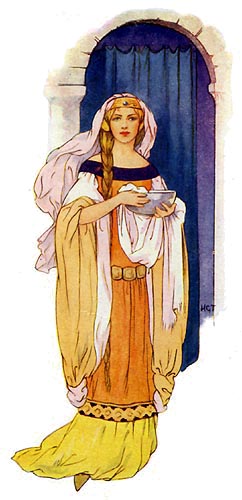
Queen Guinevere


Queen Guinevere - this reproduction © Nash Ford Publishinghttp://www.earlybritishkingdoms.com/bios/guinever.html(Born c.AD 490)(Welsh: Gwenhwyfar; Latin: Wenebara; English: Jennifer)
According to Sir Thomas Malory, King Arthur's wife, Guinevere, was the daughter of King Leodegrance of Cameliard (possibly Maelienydd in South-East Wales). His name comes from the Welsh, Lleudd-Ogrfan, for the traditions of that country call this man Ogrfan Gawr (Ogrfan the Giant) and locate his residences at Oswestry and Castell y Cnwclas (Knucklas Castle). Although, Geoffrey of Monmouth does not give him a name, he claims he was a  Roman nobleman and that Guinevere was raised in the house of Cador, Earl of Cornwall. 
One of the most beautiful maidens in Britain, Guinevere is usually depicted as meeting King Arthur after he helped expel King Ryonsfrom her father's kingdom. Naturally he fell in love with her at once and the two married soon afterward. They were given the Round Table as a wedding present by her father. In some accounts, they had a son namedSir Loholt.
Guinevere often appears in the Arthurian legends as the victim of abduction, a theme which is sometimes linked with a deified aspect of her origins. Her abductor is usually, Sir Meleagant (earlier known as King Melwas) who takes her to his stronghold at Glastonbury. She appears on the Modena Archivolt being rescued by Arthur and Gawain. Another early version has Arthur rescue her, aided by St. Gildas. However, in the most popular version, it is Sir Lancelot who is the hero of the day.
From the time of Geoffrey of Monmouth, Guinevere appears to have been something of a traitress, for he implies that she was a willing participant in Sir Mordred's rebellion; although the earlier Welsh Triads tell an otherwise unknown story that the Battle of Camlann at the climax of this conflict was caused by Mordred raiding Arthur's court and striking his Queen. Chrétien de Troyes mentions her infidelity, but it was the 13th century Vulgate Cycle of Arthurian tales, followed by Malory, which turned her into something of a latter-day Jezebel. She began a passionate affair with the young Sir Lancelot upon his arrival at court and yet banished him twice when she thought he had been deliberately unfaithful to her. Morgan le Fay discovered the affair, but failed in her attempts to warn Arthur. It was left to Sir Mordred to reveal the two lovers in flagrante delicto, an event which led to Guinevere being sentenced to burning at the stake. She was rescued by Lancelot, but captured by Mordred when Arthur pursued her lover abroad. As already indicated, in less sympathetic versions of the story, she was not sorry and even bore Mordred two children.
She is usually said to have spent the latter days of her life in a nunnery at either Caerleon or Amesbury. A particularly horrible version has her slain by Lancelot and entombed with Mordred who is forced to turn cannibal before he dies of starvation. In Scotland, Hector Boece recorded that she died a prisoner of Mordred's followers at Barry Hill in Strathmore. Local tradition adds that she was eventually torn to pieces by dogs and was buried at Meigle where her memorial can still be seen today. However she met her end, Guinevere's body is claimed to have made its way to join Arthur at Glastonbury Abbey. According to Giraldus Cambrensis, her body was found alongside him when the monks discovered his grave in 1191.
Although not mentioned by other writers, Giraldus goes on to tell how the inscription on the famous leaden burial cross, found there, recorded Guinevere as Arthur's 'second wife'. This may echo the story of the lady's half-sister, Guinevere the False (alias Guinevack), born to Leodegrance's lover on the same night as Guinivere. At one point she is said to have managed to exile the Queen and take her place. Alternatively, the Welsh Triads claim that Arthur was married, not twice, but three times, to ladies all named Guinevere: Gwenhwyfar daughter of Cywryd, Gwenhwyfar daughter of Gwythyr ap Greidiol and Gwenhwyfar daughter of Ogrfan Gawr. This may be due to confusion over his wife's parentage or indicate further the lady's origins in Celtic mythology, possibly as a triple aspect goddess.

Napoleon Rocks!


Napoleon Bonaparte

http://napoleononline.ca/about/napoleon-rocks/

These are my top five picks for why Napoleon rocks!
  1. The Original Spin Doctor and brilliant PR man – through creation of his own Bulletins, articles for the official press, campaign newspapers, medallions, and selected patronage of the arts, Napoleon was the first modern man to create and publicize the image he wanted portrayed. The effects of this calculated positive public image on events from 1796 onwards cannot be underestimated in contributing to his political and military success.
  2. Ended the French Revolution – after 10 years of civil strife, constant violence, topsy-turvy governments, revolution, counter revolution, counter-counter-revolution, economic instability and general uncertainty, the French people just wanted someone to bring stability to their nation on all these fronts. After the Coup d’Etat of 18 Brumaire, they finally had it.  Napoleon Bonaparte.
  3. Significant Civil reforms – in the span of just a few short years he accomplished what some nations take decades (or in some case centuries) to achieve.  Complete re-write of the legal code (Code Napoleon), created the Banque de France to restore financial stability, reformed the education system, instituted an extensive program of public works (building roads, bridges and canals, dredging harbours; and beautifying cities, especially Paris), centralized the governmental systems which is still in effect today in France, settled the dispute with the Catholic Church (Concordat)…the list goes on.
  4. Meritocracy – he implemented the ideals of the French Revolution (égalité) by promoting and advancing people from all ranks of society, including nobles.  The Légion d’honneur, the first order of merit, admitting men of any class. They were judged not by ancestry or wealth but by military, scientific or artistic prowess.
  5. Sowing the seeds of nationalism – the original purpose of Frances declaration of war in 1792 (War of the First Coalition) was to sow the seeds of a free democratic republic to those neighbouring countries who were mired in there own Ancien Régimes. By implementing reforms (Code Napoleon, reorganizing civil administrations, freeing the Jews, abolishing the discriminatory trade guilds etc.) in those realms where Napoleon had influence, he sowed the first seeds of nationalism that would eventually lead to the decline and fall of the archaic monarchies and the rise of legitimate governments.

Friday, February 14, 2014

Kingdom of Summer - Now Available on Audible!

The Second book in Gillian Bradshaw's HAWK OF MAY: DOWN THE LONG WIND series, tells the tale of King Arthur's England through the eyes of Gwalchmai's servent, Rhys ap Sion.  


Click here to view the title in Audible