Translate

Sunday, August 25, 2013

The Wars of the Roses and the Princes in the Tower


image: http://www.ancientfortresses.org/princes-in-the-tower.htm
BY , EDITOR
Henry VI was troubled all his life by recurring bouts of madness, during which the country was ruled by regents. The regents didn't do any better for England than Henry did, and the long Hundred Years War with France sputtered to an end with England losing all her possessions in France except for Calais. In England itself anarchy reigned. Nobles gathered their own private armies and fought for local supremacy.
The Wars of The RosesThe struggle to rule on behalf of an unfit king was one of the surface reasons for the outbreak of thirty years of warfare that we now call the Wars of the Roses, fought between the Houses of York (white rose) and Lancaster (red rose). In reality these squabbles were an indication of the lawlessness that ran rampant in the land. More squalid than romantic, the Wars of the Roses decimated both houses in an interminably long, bloody struggle for the throne. The rose symbols that we name the wars after were not in general use during the conflict. The House of Lancaster did not even adopt the red rose as its official symbol until the next century.
Edward IV
Henry VI was eventually forced to abdicate in 1461 and died ten years later in prison, possibly murdered. In his place ruled Edward IV of the house of York who managed to get his dubious claim to the throne legitimized by Parliament. Edward was the first king to address the House of Commons, but his reign is notable mostly for the continuing saga of the wars with the House of Lancaster and unsuccessful wars in France. When Edward died in 1483 his son, Edward V, aged twelve, followed him. In light of his youth Edward's uncle Richard, Duke of Gloucester, acted as regent.
The Princes in The Tower
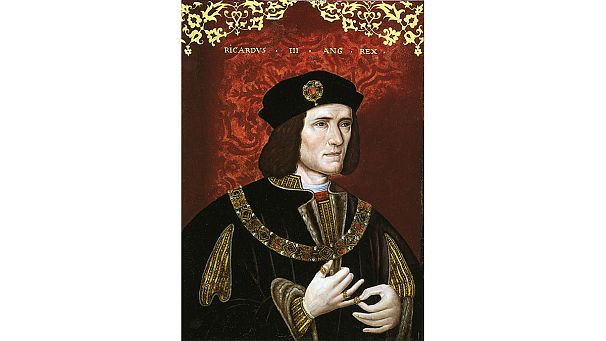
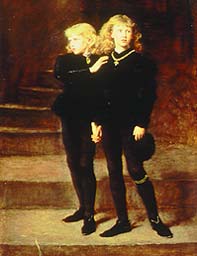
Traditional history, written by later Tudor historians seeking to legitimize their masters' past, has painted Richard as the archetypal wicked uncle. The truth may not be so clear cut. Some things are known, or assumed, to be true. Edward and his younger brother were put in the Tower of London, ostensibly for their own protection. Richard had the "Princes in the Tower" declared illegitimate, which may possibly have been true. He then got himself declared king. He may have been in the right, and certainly England needed a strong and able king. But he was undone when the princes disappeared and were rumoured to have been murdered by his orders.
In the 17th century workmen repairing a stairwell at the Tower found the bones of two boys of about the right ages. Were these the Princes in the Tower, and were they killed by their wicked uncle? We will probably never know. The person with the most to gain by killing the princes was not Richard, however, but Henry, Earl of Richmond. Henry also claimed the throne, seeking "legitimacy" through descent from John of Gaunt and his mistress. See a more in-depth article on the Princes in the Tower here.
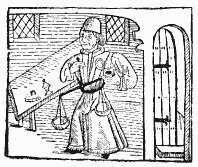
Medieval merchant
A prosperous merchant in 1475
The Battle of Bosworth Field 
Henry defeated and killed Richard at the Battle of Bosworth Field (1485). The crown is said to have been found hanging upon a bush, and it was placed on Henry's head there on the field of battle. Bosworth marked the end of the Wars of the Roses. There was no one else left to fight. It also marked the end of the feudal period of English history. With the death of Richard III the crown passed from the Plantagenet line to the new House of Tudor, and a new era of history began. 

Kings were gaining the upper hand in the struggle with the barons. They encouraged the growth of towns and trade. They took more advisors and officials from the new merchant middle class. 

This eroded the power of the land-based nobility. Further, kings established royal courts to replace local feudal courts and replaced feudal duties (which had been difficult to collect in any case) with direct taxation. They created national standing armies instead of relying on feudal obligations of service from vassals. Feudal kingdoms moved slowly towards becoming nations. 

Field Marshall von Blucher


http://www.theeuropeanlibrary.org/exhibition/napoleonic_wars/portraits.html

Lamorak and the Queen Morgause of Orkney (III)


http://oxfordinklings.blogspot.com/2010/04/lamorak-and-queen-morgause-of-orkney.html

When from the sea I came again to my stall
King Arthur between two queens sat in a grim hall,
Guinevere on his right, Morgause on his left
I saw in her long eyes the humanized shapes of the cleft.

She sat the sister of Arthur, the wife of Lot,
four sons got by him, and one not.
I heard as she stirred the seamews scream again
in the envy of the unborn bastard and the pride of canonical Gawaine.

I turned my eyes to the lords; they sat half-dead.
The young wizard Merlin, standing by me, said:
'Balin had Balan's face, and Morgause her brother's.
Did you not know the blow that darkened each from other's?

'Balin and Balan fell by mistaken impious hate.
Arthur tossed loves with a woman and split his fate.
Did you not see, by the dolorous blow's might,
the contingent knowledge of the Emperor floating into sight?

'Over Camelot and Carbonek a whirling creature hovered
as over the Adam in Eden when they found themselves uncovered,
when they would know good as evil; thereon it was showed,
but then they must know God also after that mode.'

(tbc)
Taliessin through Logres (1938)
Charles Williams

Saturday, August 24, 2013

Special things from the European Library


La Marseilles


A harem


A new patriotic song (by the British)


Buonaparte's soliloquy


The condition of Britain and Europe


La Colera de Napoleon


Spanish news


Lamorak and the Queen Morgause of Orkney (II)


http://oxfordinklings.blogspot.com/2010/04/lamorak-and-queen-morgause-of-orkney-ii.html

I had gone in summer at the king's word to explore
the coast of the kingdom towards the Pole; the roar
of the ocean beyond all coasts threatened on one hand;
on the other we saw the cliffs of Orkney stand.

Caves and hollows in the crags were filled with the scream
of seamews nesting and fleeting; the extreme theme
of Logres rose in harsh cries and hungry storms,
and there, hewn in a cleft, were hideous huge forms.

I remembered how the archbishop in Caerleon at a feast
preached that before the making of man or beast
the Emperor knew all carved contingent shapes
in torrid marsh temples or on cold crookt capes.

These were the shapes only the Emperor knew,
unless Coelius Vibenna and his loathly few,
squat by their pot, by the twisted hazel art
sought the image of that image within their heart.

Sideways in the cleft they lay, and the seamews' wings
everywhere flying, or the mist, or the mere slant of the things
seemed to stir them; then the edge of the storm's shock
over us obliquely split rock from rock.

Ship and sculpture shuddered; the crags' scream
mingled with the seamews'; Logres' convulsed theme
wailed in the whirlwind; we fled before the storms,
and behind us loosed in the air flew giant inhuman forms.
(tbc)

Taliessin through Logres (1938)
Charles Williams

Friday, August 23, 2013

Napoleonic Wars (1789 - 1816)


http://www.worldology.com/Europe/napoleonic_wars.htm

Revolutionary Ideals Spread, European Map Redrawn

Go to European History Interactive Map
Napoleonic Wars Interactive Map
Europe 1812 - Peak of French Empire
Beginning of French Revolution (1789): A meeting of the First Estate (the clergy), Second Estate (nobility) and Third Estate (everyone else) failed to produce any reform, leading to riots throughout Paris. An angry mob marched on the King’s palace, essentially making him a prisoner of the Revolutionary Government (National Constituent Assembly), which became the ruling force in France after anarchy replaced royal rule.
(Timeline Continued Below)

New French Constitution (1791): The Revolutionaries succeeded in creating a new constitution that limited monarch powers to the point where the king was primarily a figurehead.
Haiti Revolution Against French Rule (1791–1804): The French Revolution, and particularly the ideals regarding individual rights and abolitionism, spark revolution in the French Caribbean colony of Haiti. The black African slaves won independence, the only slave revolt in history to result in a sovereign nation. The loss caused Napoleon to reconsider the importance of France's American colonies.
End of French Monarchy (1792): The National Convention replaced the National Constituent Assembly, declaring France a republic, dissolving the monarchy altogether.
Prussia during Napoleonic WarsBeginning of French Revolutionary Wars (1792):Revolutionary France declared war on Austria, beginning the French Revolutionary Wars. Austria's emperor and other monarchs (cooperating with French nobles) threatened severe consequences if the king was not restored. Other kings and emperors throughout Europe were alarmed at the potential implications the movement could have in their own lands if left unchecked. This was seen as seen as a direct threat against France and its new government by extremist revolutionaries, many of whom desired to spread the revolution beyond the borders of France. France unsuccessfully attempted to invade the Austrian Netherlands, due to an untrained and disorganized army. Prussia invaded in response, galvanizing the French as they withstood the Prussians. This invasion strengthened the resolve of the army, which would quickly develop into an unstoppable fighting force, conquering most of Europe by 1812.

 Further Understanding:  Causes of the French Revolution
Bankruptcy: French kings had engaged France in a variety of expensive wars and conflicts, some of which proved to be ill-conceived, such as the French & Indian War (1754–63), which was devastating to the French colonial empire, its national psyche and its economy. The role of the French in the American Revolutionary War was also financially crippling. Plus, the king and his court continued to spend lavishly. Even during times of economic crisis, the spending continued. Especially in the years preceding the Revolution, France was no longer a trading power, compared to UK, Netherlands, Spain or Portugal, since it had lost most of its colonial empire. It had to rely on generating revenues internally, so it had to increase taxation. The non-aristocratic class (peasants, bourgeoisie, those in un-inheritable positions) carried the tax burden, as nobles/aristocrats had generally purchased their positions of privilege, and could not be legally taxed under their then-current system. The king was unwilling and unable to reform the system which heavily taxed the poor majority, while ensuring privilege for the aristocrats. As a result of this limited tax base, the government became bankrupt, and could no longer secure loans, as it had defaulted several times in recent decades.
Starvation: A colder weather pattern struck during the economic melt down, causing food to become even more scarce.
Social Inequity: France had a parliamentary system, which advised the king on governance, but it was still an absolute monarchy in practice. The king and aristocracy lived a life of great privilege, while the majority in the middle and lower classes were overtaxed, and even faced food shortages and starvation. During this age of enlightenment, and with the influence of the American Revolutionary War, the lower and middle classes were far from willing to accept of such an outdated and oppressive fate. The Roman Catholic Church (RCC) was also a target, since they successfully imposed their influence upon the king, maintaining Catholicism as the state religion. The RCC was highly favored, not subject to taxes, while collecting a required 10% from the non-aristocracy (adding to their excessive tax burden). Clergy also led a fairly lavish life compared to the middle/low classes, a fact not lost upon the general public.
Lack of Action: Despite the desperation of the situation, no effective measures were ever put into place to solve the worsening economic shipwreck which was France in the late 18th century.


English king Richard III remains divisive from the grave

16/08 16:17 CET
http://www.euronews.com/2013/08/16/discovery-of-english-king-richard-iiis-bones-under-car-park-sparks-row-over-rei/
English king Richard III remains divisive from the grave

He was one of the most reviled and divisive kings in English history.
And, more than 500 years since he was hacked to death on a British battlefield, he is continuing to split opinion.
In one corner are the descendants of Richard III, whose bones were discovered under a car park in Leicester, England, last year.
Opposing them is the University of Leicester, who led the mission to find, exhume and identify Richard’s remains – hailed as one of the most remarkable archaeological discoveries in English history.
The university had obtained permission to reinter the king at the cathedral in Leicester, which is close to where he died in Bosworth in 1485.
But in a ruling on Friday (Aug 16) High Court Judge Charles Haddon-Cave said there should have been wider consultation about the burial plan. He then granted permission to the Plantagenet Alliance, a group of descendants and enthusiasts who want to bury him near York, to initiate a judicial review into the issue. They argue he should be buried in the northern English city because that was where he had close links to during his life.
The judge wrote: “The archaeological discovery of the mortal remains of a former king of England after 500 years is without precedent.
“I would, however, urge the parties to avoid embarking on the (legal) Wars of the Roses Part 2. In my view, it would be unseemly, undignified and unedifying to have a legal
tussle over these royal remains.”
Richard, depicted by William Shakespeare as a deformed tyrant who murdered his two young nephews to strengthen his grip on power, died during the War of the Roses. The 30-year civil war was a dynastic power struggle between two rival Plantagenet factions. Richard’s death ended Plantagenet rule and heralded the start of the Tudor era under King Henry VII.