Maurer makes the very true point when starting
her book that the likes of Shakespeare have influenced
our understandings of Margaret as 'a vengeful and a
violent woman', 'a bitch, an adulterous she-wolf who
mocks her captive enemy, Richard, duke of York,
before killing him in cold blood'. More to the
point, Maurer insists that since Shakespeare, most
modern historians have generally agreed with his
verdict of Margaret, though recognising the
inaccuracies and exaggerations which plague
his play. Maurer laments that serious academics
have spoken of ‘the queen’s harsh determination’, her
‘unforgiving severity’ towards the Yorkists. One
cannot but agree with Maurer when she notes somewhat
ironically that this fails to take into consideration
Margaret’s incredible leadership and political abilities
at an unstable court. But there is a likely reason for
such harsh judgments persisting in relation to this late
medieval queen: ‘until quite recently all western history
was male-centered as a matter of course. The problem
that this poses for the inclusion and study of
anachronistically prominent women is that they have
had to be fitted into male standards and constructs, present
as well as past. The result too often has been judgment rather
than analysis’.
This, of course, is true in relation to other queens of
this period. Retha M. Warnicke critically notes that,
writing of Anne Boleyn, ‘in histories that treat men as
three-dimensional and complex personalities, the women
shine forth in universal stereotypes: the shrew, the whore,
the tease, the shy virgin, or the blessed mother’. Similarly,
Katherine Howard, who supposedly deviated from notions
of the ideal woman in early modern England, was condemned
as a whore and traitoress and suffered execution for it. I
n view of this, Maurer’s insistence that we utilise gender as a
central historical category of analysis is compelling: ‘just as the
addition of gender helps to make the political story clearer, so
the chaotic political history of the Wars of the Roses cast
the gender issues into high relief’.
In view of this, this article will attempt to survey the events
(diplomatic, political, social, factional) of Margaret’s life
through a gendered framework, paying critical attention
to the difference her sex made and notions of the female sex.
This is essential since ‘in order to move beyond the traditional
picture of Margaret’s activities (ie. which eventually condemn
her as an adulteress, a shrew and a she-wolf), the very real issue
of gender must be engaged’.
Born in March 1430 to René, duke of Anjou and his wife
Isabelle daughter and heir of Charles II duke of Lorraine,
Margaret was born into a prominent European royal family
during this period and thus, in the words of Diana E. S. Dunn,
‘destined her from birth to be a pawn in the complexities of
European diplomacy’. European politics governed
Margaret’s course of life, which must be considered from
both French and an English perspective. In terms of England,
Henry VI had acceded to the throne in 1422 aged just nine
months following the death of his renowned father Henry V,
who had brought prestige and glory to the English crown through
his military victories abroad and his claims to the crown of France.
This, however, provided a situation of conflict, crisis and factional
discontent, a common occurrence when a minor acceded to the crown.
Henry, having reached his majority, sought a bride in the early
1440s; an essential element of kingship was the fathering of a
male heir who could then succeed his father peacefully following
his father’s death. It is not surprising that Henry sought a
French princess as his bride – the majority of queens since the
Norman Conquest in 1066 had been of the French royal house.
Yet this did occur at a time when English dominance in France
was slowly fading, since the French had managed to recover some
English-held territory while attempts to achieve a settlement
between the powers failed.
In terms of Margaret’s perspective, the marriage alliance
with England represented a prestigious match for Margaret’s
father, while it also brought a fundamental source of influence
at the English court to the French monarch Charles VII. Margaret
was able to bring important links with parts of the French kingdom,
including the duchies of Lorraine and Bar, although her dowry was
‘meagre’. Yet the English desire to effect an alliance with France
probably dispelled any annoyance at the prospective queen’s
unremarkable dowry.
How Margaret felt about her prospective bridegroom, Henry VI,
we cannot tell. She may have held a negative opinion about his
father, Henry V, gained from stories of his exploits in France
and his undermining of the French kingdom during the early
fifteenth century. Nonetheless, the opportunity to become
queen of England was a significant and exciting one, and probably
the best match she was ever likely to make. In 1445, aged
fifteen – this youthful age was not seen as representing
particular problems; Isabella of France had wed Richard II
aged twelve, while Katherine Howard may have been only
around fifteen at marriage – Margaret arrived in England
and in May the king presented her with jewels fit for a queen,
before marrying Henry at Titchfield Abbey and being crowned
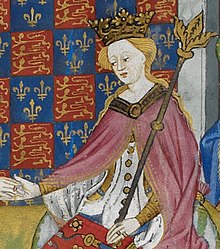
on 30 May in Westminster Abbey. Margaret was later
described as being ‘a most handsome woman, though
somewhat dark and not so beautiful’ as Bianca Maria Visconti,
duchess of Milan, although she had very long hair worn loose
at her coronation. Margaret was well aware of the duties
she was expected to fulfil as queen: namely, produce a male
heir in order to ensure the continuation of the Lancastrian
dynasty, and to bring political and social stability to a
faction-ridden and economically unstable kingdom. It is
unsurprising, in view of this, that there was considerable
hope and expectation at the royal wedding.
Margaret was granted 10,000 marks per annum as the
new queen of England by parliament in March 1446,
and estates worth £2000 per annum were settled on
her from the duchy of Lancaster. As has been noted
in relation to Anne Boleyn, Margaret’s elevated status
had meant she became a woman of considerable economic
power as a landowner and a source of patronage in the
English court. Margaret’s marriage was initially
successful, and she was a strong queen consort. However,
her inability in the early years of her marriage to Henry VI
to produce a son must have caused considerable concern
at the court. Whether or not this was Margaret’s fault is
impossible to discern. Viewing her life through a gendered
framework, it is plausible to argue that, by virtue of their
sex, failures in pregnancy were attributed to queens, as
seen in the case of Henry VIII’s queens. Despite this, she
was a strong figure, ‘a determined and effective distributor
of patronage, and a woman concerned for the welfare of her
household servants’. Evidence of her patronage exists in
her founding Queen’s College, Cambridge in 1448, shortly
after her husband’s foundation of King’s College. Her excellent
upbringing as a princess of the royal house of France undoubtedly
benefited her, allowing her to act in her role with dignity,
compassion and political sense. Yet unsettling events in
her adopted country were soon to threaten Margaret’s
stability as queen.
In April 1453, famously, Henry VI collapsed with a
very serious physical and mental illness, commonly
believed by historians to have been schizophrenia. This
was highly unfortunate, for Margaret had fallen pregnant
that year, and when in March 1454 her son Edward was born,
the king was unable to recognise him. In view of both
her son’s birth and her husband’s mental collapse, Margaret
‘was forced into the centre of the political arena, as control
of her husband and son became the focus of competing groups
among the nobility’. We therefore must reconsider our
interpretation of Margaret’s character and behaviour in
view of these events. The argument that she was a cold
and ruthless ‘she-wolf’ who ambitiously sought power
and political advantage for both herself and her ‘party’
at court is nonsensical in view of the events which occurred
in 1453-4. By stepping into the centre of power, Margaret
was acting logically and common sensically, determined
to preserve her lineage and ensure the position of her
husband the king was not undermined further. We should
recognise these actions as courageous and representative
of a strong woman acting on her own in a ruthless court
which viewed ruling women in a hostile manner. Of course,
contemporary gender beliefs among courtiers did not lead
to this view, and beginning with these events, Margaret
became increasingly unpopular. Her bid for the regency
failed, and Richard duke of York, later her enemy, filled
that position instead.
Margaret probably viewed York as a very serious threat to
her son’s position, for royal blood flowed in the veins of
York and his family. Yet it is unlikely that there had been
long-standing hostility and hatred between the two, as Dunn
makes clear. Of course, factional discontent intensified following
York’s appointment, culminating in the first Battle of St Albans
in 1455 whereby Margaret’s ally, the duke of Somerset, was
murdered, and York’s party emerged triumphant. However,
York was forced to resign the protectorate in 1456, allowing
Margaret to regain a sense of political authority within the
English court. She and Edward departed from London to take
up residence in Kenilworth, before being joined in August by
the king, who later recovered miraculously from his illness.
Margaret played a strong and active role in her son’s household,
controlling appointments to his council and ensuring that her
supporters within the Lancastrian monarchy filled vital roles.
A reconciliation between the Yorkists and Lancastrians was
sought by King Henry in 1458, known as the ‘Loveday’, where
the queen was to walk with her enemy York hand-in-hand in
a procession in the streets of London. However, it was nothing
but a sham, and factional discontent had worsened by spring 1459.
Further battles, in what became known as the Wars of the
Roses, occurred shortly afterwards, which Margaret was to
play a prominent role in – allegedly, she watched the battle
of Bloreheath from Mucklestone church tower, a story which
Dunn dismisses as false. Nonetheless, it does indicate
that Margaret had taken over the reins of the Lancastrian
government in this period of time following her husband’s
intermittent illnesses and his ever-present political
weaknesses and ineptitude. Following Henry’s capture
at Northampton in 1460, Margaret and her son fled to
Scotland, and following the Yorkists’ victory at Towton
in 1461, which culminated in the accession of Edward IV,
the Lancastrian royal family again fled to Scotland for safety.
The next 10 years saw Margaret attempting to regain the crown,
which she saw as rightfully hers. Contemporaries, who resented
powerful women in prominent government positions,
characterized her as scheming and ruthless, but a more
nuanced position allows us to view her efforts as commendable,
in a way similar to those of Katherine of Aragon’s some seventy
years later although in an entirely different context: she believed
that she and her husband were the rightful king and queen of
England, and she was determined to preserve her family’s
inheritance. While prominent nobles, such as Somerset,
Exeter and Pembroke remained loyal to the Lancastrians,
a lack of money and committed political backing severely
hampered Margaret’s efforts to regain the crown.
In 1462, Margaret and her son departed for France, perhaps
hoping for more effective aid there. A meeting with the
French king Louis XI was fairly successful: Margaret promised
to renounce Calais to the French in return for a loan of 20,000
francs. A mutual friendship was later signed. Yet the period
1463-1468 was a dismal failure for Margaret, as Louis renounced
his promises and the weakening of the Lancastrian cause.
However, the growing disaffection of Margaret’s enemy York’s
son Warwick, known as ‘the Kingmaker’, with the English king
meant a new development in Margaret’s condition. Although
Margaret initially refused to listen to Warwick when he journeyed
to France, she was later encouraged to listen to his promises,
agreeing to the marriage of her son Edward to Warwick’s
daughter Anne Neville. Later sailing to England, Margaret’s
cause fell irrevocably apart in 1471 following the brief return
of her husband to the kingship. Margaret was informed of
her son’s death in battle, something which must have meant
her world fell apart. She was later brought in a carriage as a
prisoner through the streets of London, followed by King
Edward in his triumphant procession through London.
Henry VI, her husband, was probably murdered that night
in May 1471 in the Tower. The fact that both her husband and
heir had died completely changed Margaret’s position, and
the grief and shock she must have experienced is unimaginable.
Not much is known about Margaret’s decade, but she died in August 1482, a tragic and obscure ending to an initially glittering career and eventual failure. She was buried in Angers Cathedral, neglected by her family, forced to renounce her claims to the Angevin inheritance by King Louis. Yet, as Dunn concludes, ‘of all medieval queens consort, Margaret has received some of the harshest criticism from both contemporary commentators and later historians’, which Maurer of course exemplifies through criticising conceptions of Margaret as a ‘bitch’ and ‘she-wolf’. Dunn’s conclusion is compelling: ‘... she was subsequently forced, by political circumstance and the weakness of her husband, to take on a much more active role in politics in order to protect both her own position and that of her son’. Yet, to most people, like Isabella queen of Edward II and Anne Boleyn, Margaret remains a ‘she-wolf’, an unnaturally ruthless and powerful queen consort who meddled in politics enthusiastically, a place not fit for a medieval woman. Surely we should alter our views of her and recognise her for what she was: a strong, intelligent, pragmatic woman who sought to preserve her family’s inheritance and retain stability within the English monarchy. Her husband’s madness and the factional discontent and corruption pervading the court can hardly be blamed on her. It is time to reappraise our views of this mysterious, but notorious, queen of England.