Translate

Thursday, March 28, 2013

Edward III’s Round Table

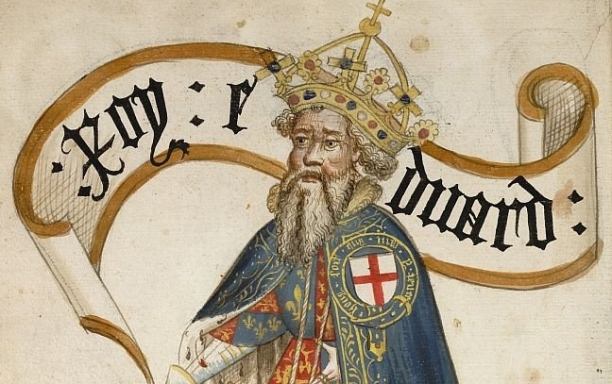
A mediaeval miniature of Edward III of England. The king is wearing a blue garter, of the Order of the Garter, over his plate armour.
By Richard Barber | Published in History Today Volume: 57 Issue: 8 2007 Richard Barber describes the discoveries he made when Channel Four’s Time Team uncovered Edward III’s huge circular building at the heart of Windsor Castle.
A mediaeval miniature of Edward III of England. The king is wearing a blue garter, of the Order of the Garter, over his plate armour.When Channel Four’s ‘Time Team’ obtained permission to dig simultaneously at Buckingham Palace, Windsor Castle and Holyrood House on the bank holiday weekend of 2006, to mark the Queen’s 80th birthday, there were high hopes that these sites, largely unexplored by archaeologists, might produce valuable new information about the royal palaces. On the advice of Oxford Archaeology, Time Team chose one of Windsor’s most mysterious structures, for their investigation. It was a building that was probably never completed, and was generally believed to have been abandoned when it was only partly built, because it was hopelessly over-ambitious. No trace of it remained, and there had been various theories as to where it had been sited. This was the House of the Round Table, which Edward III was supposed to have built in 1344. The only physical description of it was so extraordinary that it was difficult to believe: Thomas Walsingham, a usually reliable chronicler, tells us that it was 200 feet in diameter, larger than any circular medieval building, and larger than such wonders of the world as the Pantheon at Rome, and other sources indicated that it was to seat the 300 knights of Edward’s proposed Order of the Round Table. There was evidence, in the royal accounts, that work on this remarkable project had been undertaken on a massive scale, but what and where it was were unknown.
The chances that a building on this scale existed, and that it could be found, seemed fairly unlikely, so the investigation was broadened to cover a large area of the Upper Ward, a section of the castle which is usually seen by the public only from the windows of the state apartments and the path skirting the base of the Round Tower. The actual area for excavation was at the eastern end of the lawn in the Upper Ward, below the Queen’s private apartments, and the first operation was to carry out a ground radar survey, to highlight any features which might look promising. This was done at the beginning of August, and when Richard Brown of Oxford Archaeology sent the results, they proved dramatic. Across the corner of the Upper Ward, part of a huge circle appeared, and the question everyone immediately asked was: ‘What is the diameter of the circle?’ Careful measurement showed that it was around 198 feet. I had been asked to go to Windsor to comment on any possible finds relating to Edward III during the filming, and when the subject of the Round Table came up I looked at Walsingham’s description. My initial reaction was that it must be fictional, some kind of artificial calculation worked back from the space needed to seat the knights. If the survey was right, his figure was almost exactly accurate.
But seeing a line on a survey did not necessarily mean that we would find what we expected, and the first stages of the excavation seemed to progress at snail’s pace, as the careful observance of archaeological protocols was carried out. It was only after a day of preparation and a morning of excavator work that  Richard Brown and his team began the dig proper. When they had worked down some three feet, they came across a mass of rubble, consisting entirely of stone fragments. There was no brick, little sign of mortar, and very few actual objects or fragments of objects. As the edges of the rubble deposit were uncovered, it was clear that this was a trench, some two metres wide, which had been backfilled with the remains of a substantial building once the stone foundations had been ‘robbed  out’ and taken away to be used elsewhere.
Working on a television programme over three days, particularly as a minor bit player in the scheme of things, is often tedious; at Windsor we were fortunate to have the Chapter Library in the Lower Ward, which had a good collection of books on the castle. The discovery of the foundation trench led to long discussions on the nature of the building and what could be gleaned from the records to help us reconstruct it. The two huge volumes of Sir William St John Hope’s massive work Windsor Castle: an Architectural History published in 1913 were the obvious starting point. He had printed large extracts from the accounts which described the work on the Round Table building, and when Julian Munby and I started to look at these, we quickly turned to architectural historian Tim Tatton-Brown, who was working in the Lower Ward outside St George’s Chapel in search of Henry III’s great hall, to help us on the identification of the stones bought for the building. It was his comment that Stapleton stone was often used for plinths or capitals that really fired my enthusiasm for further research, because the quantity purchased indicated that the building could have had fifty-six pillars; only an assumption, of course, but it led to the idea that we might be able to make a plausible attempt at a reconstruction if we went through the material in detail.
There were other things besides accounts to be taken into consideration once we started. Perhaps the most enigmatic of these was a romance which had probably been written for Edward III’s father-in-law a few years earlier. Perceforest is the equivalent of a Hollywood prequel to the main Arthurian stories, an elaborate, long-winded but often entertaining account of how Britain was conquered by refugees from Troy, who were Arthur’s predecessors. After the death of Brutus, the first king of Britain, Perceforest succeeds him. His court is a glittering showcase of chivalry, but he falls ill, and as a result becomes lethargic and uninterested in deeds of arms. In due course Perceforest recovers, and during the feast in the palace garden to celebrate his return to health, strange noises come from the hall of the castle. The steward finds that the doors are bolted fast and it is only when the feast is ended that the king is able to gain access:

Then torches were lit and they set out towards the hall. But when they came to the doorway at the foot of the stairs, the king stepped forward and found the two doors shut tight; then he looked up and saw written on the arch above, in great and elegant letters of gold, the following: 

‘Let all men know that from this day
This is the door to the Franc Palais [Noble Palace]
Where honour on the worthy shall be bestowed
And the worthless shall dishonour know.’
When the king had read these letters he showed them to the ladies and knights in his company. They were astonished: several knew for certain that before sunset no inscription had been there, which made the king wonder who could possibly have written the letters so quickly ...
Then the king stepped forward and told the castellan to let them in, which he did, commanding a boy to open the doors. As soon as they were open, the king and all his company entered; and once the torches had been placed in the middle they could see the whole hall clearly. Now, so that you may better understand what we shall tell you in due course, you need to know what the great hall was like. Know, then, that it was on the first floor of a round tower of an amazing size: the diameter of the hall was more than two hundred feet. In the centre stood an enormous pillar that supported the vaulted ceiling; inside this pillar was a pipe running from a beautiful spring, and around it were twelve taps supplying water whenever it was needed.
Right around the hall curved a marble table, most beautifully made, standing quite high off the ground on pillars; and it ran so close to the windows that anyone sitting at the table would be resting his back against the tower wall. The two ends of the table finished in front of the hall’s main door, and such was its circumference that it could seat fully three hundred knights abreast  You cannot believe how beautiful this table was to behold, and it was smoother than any ivory. It was impossible to move it, but a good many more tables were set up in the hall on trestles, so that twelve hundred knights could dine there without impeding the servants.
The knights who sit at the round table in this hall are chosen mysteriously when their shields appear on the hooks around the wall, and one knight who attempts to sit at the table and to hang up his shield himself is killed by a thunderbolt. The king addresses the knights after this dramatic death and explains the principles behind the Order of the Noble Palace:

And because I wish it to be revealed without dispute which knights shall be worthy to sit at the table of the Franc Palais, I command all who wish to compete in the tournament and attain this high honour to have one of their shields brought here to the hall, as I shall bring my own, and then the hall shall be locked; for such is my faith in the power of the Sovereign God that I believe that, at the dinner after the tournament, those who are worthy will find their shields hung on the hooks, and thereby know where they are to sit.

The knights of Edward’s Order of the Round Table were not going to be selected on such magical principles, but the number of knights and the diameter of the hall for the Order of the Noble Palace are identical to Thomas Walsingham’s description of what Edward was proposing. Is it the model for the Windsor plans? Could it perhaps have been written immediately afterwards? All we can say is that there is a very strong connection.
Coming back to the real world, there was a mass of other material in the accounts which enabled us to make certain deductions about the nature of the House of the Round Table. The workers who were hastily assembled at Windsor in February 1344 were mostly masons, and large numbers of quarrymen and ‘banker masons’ (who would have roughly shaped the raw blocks before they were shipped) were employed in the quarries themselves. By contrast, there were relatively few carpenters, even if the master carpenter was the most distinguished of his craft, William Hurley, who had built the great lantern at Ely. The structure must therefore have been largely of stone. Other purchases indicate that it had a pair of doors, probably a great ceremonial entrance like the doors of a medieval college at Oxford or Cambridge.
The only circular building which offered an immediate parallel for something on this scale was Edward III’s fort at Queenborough, which has sadly left very little trace except for a drawing by Wenceslas Hollar now in the British Museum. But Julian Munby soon came up with an intriguing castle which was remarkably like the first attempts at reconstructing the House of the Round Table. This was Castell Bellver, at Palma in Majorca. It was built forty years earlier for Jaime II, King of Majorca,  and is slightly smaller, but more substantial, in that it is on two floors; the arcaded gallery on the ground floor is repeated on the first floor. Like the House of the Round Table, full accounts (in Catalan) for the building costs survive, and it would be interesting, if time-consuming, to compare the two sets of figures. Whether the designers of Edward’s building knew of Bellver, it is hard to say. There are connections between England and Majorca in the 1340s; Majorca was an independent kingdom struggling for survival, and the king of Majorca was attempting to form an alliance with Edward at this period, so it is far from impossible that eye-witness accounts of Bellver could have reached England.
Yet even here the House of the Round Table stands out as a unique creation: it is not a castle in itself, and has no defensive function. It is closer to the amphitheatre that Duke Theseus builds for the tournament between Palamon and Arcite for the hand of the lady Emily in Chaucer’s Knight’s Tale. And it is possible to argue that it was indeed an amphitheatre, in the theatrical sense.
At this point, we moved from archaeology and architecture to literature and history. Literature is of course the key to the idea of the chivalric round table, but the details and the exact concept behind this have rarely been explored by scholars. There is good work on the ideas of the poets who created Arthur’s original round table, and the Winchester Round Table has been thoroughly explored. But between the two, the imaginary and the actual object, there is another element: the ‘round table’ tournament. These date back to the kingdom of Cyprus in the 1220s, about the time when the fashion for Arthurian romances  was at its height and when new additions to the stories of Arthur and his knights were appearing at an extraordinary rate. We can trace round table tournaments through the next century-and-a-half until they peter out at the end of the fourteenth century.
In their simplest form, they seem to have consisted of a group of knights who sat at the round table, who were the defenders: that is, they announced a tournament at which they would hold the lists against all challengers. In historical terms, there are only casual mentions in chronicles of these, but there are a number of semi-historical poems which describe such festivals in more detail, and when these are put side by side – they occur from Austria to France to England – a picture of a kind of dramatic presentation linked to a tournament emerges. The Winchester round table could well have be a theatrical prop for this kind of occasion, for the use of the defenders. And there is a poem which might just possibly be a description of the scenario for the tournament there. It is by a Dutch author, writing around 1300, and either because it is half-imaginary or because his grasp of English events is not very certain, it is difficult to place it alongside real events. The poet tells that Edward acted the part of Arthur, and insisted – as in the romances – that he would not sit down to table until an adventure had occurred. Sure enough, a squire appears, covered in blood, and accuses the king of idleness while his men are fighting: the Welsh have rebelled, and he has been wounded in a skirmish. The king promises that he will avenge him; and the scene is repeated twice more, with reports of uprisings in Ireland, Cornwall and Leicester, which knights playing Lancelot,  Gawain and Perceval undertake to put down.
Other occasions were less political in their scenarios, and were generally based on the romances, with the knights vying for the attention of the ladies; this was the case at Le Hem in 1278, where Robert, Count of Artois played Yvain, the knight who befriends a lion. The entertainment includes a knight who has to be released from a cage, and maidens who have been taken prisoner while carrying messages summoning visitors to the tournament. For most ‘round tables’, however, we are lucky to get a bare mention of the characters, and for the monks who wrote the chronicles of the day, they are sinful and boastful occasions which ‘vanish away like the morning dew’. Edward III’s insistence at Windsor that he would revive the Round Table as it had been in the days of King Arthur needs to be set against this tradition of acting out the Arthurian romances, and goes far to explain the possible use of the round table building. The large central space was not big enough for actual tournaments – Chaucer makes his imaginary amphitheatre in The Knight’s Tale a mile across – but would be ideal for enacting these scenes, with the knights seated round the outside of the circle on the ground floor, and possibly an upper tier for ladies and other spectators. This must be speculation, of course, but I believe it is plausible speculation. The opening scene of the greatest of English medieval Arthurian poems, Sir Gawain and the Green Knight, contains just such a dramatic scene at court, with the arrival of the Green Knight offering to take a blow with his own axe from any of the knights, if they would take a return blow from him in a year and a day. Gawain beheads the challenger, but before the horrified court, the Green Knight picks up his head and warns Gawain that he must present himself as he has promised before riding off. We know from other evidence of play-acting at feasts that theatrical techniques were well advanced, and the skills to act out the scene and create an illusion of beheading were almost certainly available. This, I would argue, is the kind of thing that Edward had in mind for the House of the Round Table.
But there was also a more serious purpose behind the pomp and ceremony and lavish expenditure. Edward III was attempting to make good his claim to the French throne. His early efforts had ended in virtual bankruptcy for almost no results. He had assembled a grand alliance, and had invaded France from Flanders; but his allies were more interested in their pay than in fighting, and Edward had had to weather not only the disappointment of a hugely expensive stalemate and truce, but also a real crisis in England over the taxation that had been needed to fund the expedition. This was in 1341; less than three years later, he saw an opportunity to invade once more, this time in league with ­dissident Norman and Breton nobles. But he was reluctant to go back to Parliament for money, and ­waged a steady campaign to bring the great lords and the knights who had opposed him in 1341 round to his side. He embarked on a series of tournaments, trading on an already well-established chivalric reputation, of which the Windsor festival was the culmination; and the object was to recruit as many of the nobility, as well as knights from overseas, to join him in search of the lucrative spoils of war. The chroniclers noted that Philip VI of France (r.1328-50) was proposing to start a Round Table in competition with Edward for just this reason, though there is no real evidence to support this. Edward succeeded in raising his army, but in order to do so had to put a stop to the work on the House of the Round Table. It was two years before the campaign that culminated in the battle of Crécy (1346) began, and more than three years before the king was back at Windsor at the end of the siege of Calais (1347). He had won a victory that was all he could have hoped for, and he no longer saw the huge expense of the proposed order of the Round Table as the best way forward. Instead, he created the Order of the Garter, to reward his companions in arms who had led the army. It is the oldest and most distinguished of the orders of knighthood, and owes its longevity to the tightly limited number of its members. Its forerunner, the House of the Round Table and the order which was to use it as its headquarters were an ambitious dream; this spectacular building, almost without parallel in the Middle Ages, was demolished by William of Wykeham when Windsor Castle was rebuilt in the 1360s. All that was left for us to find was a trench filled with fragments of stone, which we could identify as the stones whose purchase was so carefully recorded in the royal accounts.
Further reading
  • Julian Munby, Richard Barber and Richard Brown, Edward III’s Round Table at Windsor (The Boydell Press, 2007)
  • Juliet Vale, Edward III and Chivalry, (Boydell Press, 1972)
  • Jonathan Sumption, The Hundred Years War: I. Trial by Battle (Faber & Faber, 1990)
  • W.H.St John Hope, Windsor Castle: an Architectural History (Country Life, 1913)
  • Ian Mortimer, The Perfect King: The Life of Edward III Father of the English Nation(Jonathan Cape, 2006)
  • Martin Biddle, King Arthur’s Round Table: An Archaeological Investigation (Boydell Press, 2000)
Richard Barber is the author of Legends of Arthur (The Boydell Press, 2001).

Wednesday, March 27, 2013

Sir Gawain: Patron's Place

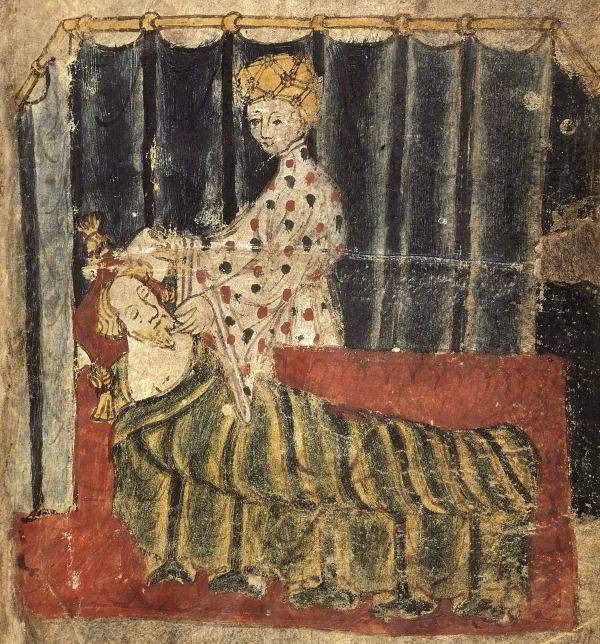
Gawain is visited by the lady of the castle. Illumination from the manuscript 'Cotton Nero A.X', c.1375-1400


Gawain is visited by the lady of the castle. Illumination from the manuscript 'Cotton Nero A.X', c.1375-1400
http://www.historytoday.com/nicholas-mee/sir-gawain-patrons-place
By Nicholas Mee | Published in History Today Volume: 62 Issue: 1 2012 
Sir Gawain and the Green Knight is a masterpiece of Middle English literature, which narrowly escaped destruction in the 18th century. Nicholas Mee examines the poem to discover both its secret benefactor and the location in which its drama unfolds.

On October 23rd, 1731 the terrified librarian Dr Richard Bentley fled into the street clutching the most precious of his many irreplaceable manuscripts. Fire had broken out in Westminster at the home of the greatest collection of books in Britain. The library had been amassed by the antiquarian and politician Sir Robert Cotton (1571-1631) and contained a wealth of books, many of which had been owned by the English monasteries before the Dissolution. A bust of a Roman emperor surmounted each bookcase in the Cotton Library and it was with reference to these that the manuscripts were catalogued. Many of these priceless tomes were lost in the fire but those that survived became part of the founding collection of the British Library.
One of the manuscripts that narrowly escaped the blaze is known to scholars as Cotton Nero A.X. It was the tenth manuscript on shelf ‘A’ of the bookcase beneath the bust of Nero. Its survival was extremely fortuitous, as two of the four poems it contains are acknowledged jewels of late medieval literature and all four are known solely from this one source. Referred to today as Pearl, Cleanness, Patience and Sir Gawain and the Green Knight, the poems are written in a northern Middle English dialect and are the work of an anonymous poet of the second half of the 14th century. Sir Gawain is a truly remarkable piece of literature by a highly sophisticated poet, deserving of its fame.
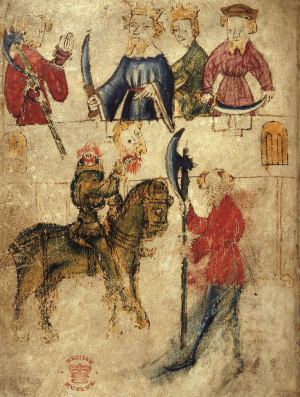
It is New Year and the court at Camelot is enjoying its Yuletide celebrations. King Arthur and his knights are about to tuck into a feast when Arthur declares that he will not eat until he has heard a fabulous tale or seen a strange marvel. On cue a mysterious knight enters the hall. He has long green hair flowing into his great green beard and down to his belt. Clothed in green he sits astride a handsome green horse. The huge knight holds a holly branch in one hand and a mighty axe in the other and proceeds to challenge the knights. He will allow one of them to strike off his head and in exchange he will return a similar blow. The knights are reluctant to take up the strange offer so Arthur himself prepares to perform the feat. Propelled by chivalry to spare his king the ordeal, one of his knights, Sir Gawain, gallantly steps forward in his place. Gawain raises the axe and severs the green knight’s head. But to Gawain’s alarm, the green knight retrieves his head from the floor and, holding it by the hair, tells Gawain that he will await him in a year’s time at the Green Chapel where Gawain must receive the return blow.
The year passes and, as the time approaches, Gawain anxiously prepares for his journey in search of the Green Chapel. He travels alone and, in the depths of winter, arrives in a rugged snow covered landscape. On Christmas Eve, just as he is wearying of his journey, he comes upon a beautiful castle. He is welcomed inside and joins the Christmas festivities. For four days the partying continues – then the guests leave. Gawain is also about to depart but the lord of the castle asks him to stay. Gawain explains that he must find the Green Chapel by New Year’s Day if he is to keep his word and complete his quest. The lord replies that the Green Chapel is less than two miles away so Gawain can remain a while longer without fear of breaking his promise. Gawain agrees. The lord then suggests that they should make a bargain to exchange whatever spoils they might win each day but that while he plans to go off hunting Gawain should stay in the castle to recuperate from his exhausting travels. Gawain accepts this unusual arrangement and goes off to bed.
In the morning the lord rises and sets out to hunt deer on the icy terrain. Meanwhile, his lady creeps into Gawain’s bedroom, banters with him seductively and offers herself to him. Gawain resists all temptations but agrees to kiss her as she persuades him that it is just an act of chivalry. In the evening when the lord returns he presents Gawain with the venison that he has caught and Gawain offers him the kiss in return. The following day, the same bargain is struck. Gawain receives two kisses from the lady and the lord succeeds in killing a wild boar, which he gives to Gawain when he returns and receives two kisses. On the third day, while the lord is out fox hunting, the lady wants to exchange a love token with Gawain. She offers him a ring but he declines because it is valuable. Then she offers him her green girdle. Gawain again refuses, but she tells him that it has magical powers. Whoever wears it cannot come to any harm. Gawain realises that this may be useful in his forthcoming ordeal so he accepts the girdle and agrees not to mention it to the lord. The lady also kisses Gawain three times. When the lord returns, Gawain gives him three kisses and in return the lord gives him the pelt of the fox that he has killed.
The following morning Gawain wraps the green girdle around his waist and sets off. Passing amid rugged cliffs, he eventually finds an overgrown cave in a gorge and realises that this must be the Green Chapel. He hears an axe being sharpened in the undergrowth across the gorge. Then the Green Knight appears, hops over a racing stream and confronts Gawain. Gawain bares his neck to receive the blow and the Green Knight swings his axe. But Gawain shrinks back and the Green Knight halts his stroke. Gawain steadies himself and promises not to flinch again. The Green Knight aims for a second stroke but again stops before striking Gawain. He says that as Gawain is now ready he will finally deliver the blow. The third stroke just nicks Gawain’s neck and as his blood springs from the cut he jumps up, thrusts his shield foward and tells the Green Knight that he has accepted the return blow and if the Knight attempts another, then Gawain will certainly defend himself. The Green Knight now explains that he is the lord of the castle and because Gawain was honest on the first two days of their agreement he left him unscathed with his first two blows but because on the third day Gawain kept secret the present of the green girdle he cut him with his third blow. However, he did not remove Gawain’s head because his dishonesty was not due to greed or lust but simply to preserve his life, which is understandable and a much lesser offence. Gawain returns to Arthur’s court and tells his tale. The knights agree that in future they will wear green girdles swathed across their chests in honour of Gawain’s adventure.
In 1330, half a century before the composition of Sir Gawain, King Alfonso XI of Castile (r.1312-50) had instituted the Order of the Band in imitation of the Knights of the Round Table. The insignia of the order was a band worn over the shoulder in the same manner as Gawain’s green girdle. This was the first order of knighthood to be established in medieval Europe and was widely emulated by other European monarchs. Alfonso and his knights launched aggressive campaigns to expand the borders of Castile and in 1343 the English knight, Henry of Grosmont (c.1310-61), fought for Castile in these campaigns. The following year Henry returned to England and the court of Edward III with tales of the chivalrous exploits of the Castilian knights. In 1348 Edward III (r.1327-77) established his own order of knighthood, the Order of the Garter. Each knight was assigned a wooden stall in St George’s Chapel at Windsor where, beneath their pennants and coats of arms, they would hear Mass and take Communion. The king held stall one. This stall is still reserved for the monarch today. In the original investiture Edward III’s eldest son, Edward the Black Prince (1330-76), held stall two and Henry of Grosmont (from 1351 Duke of Lancaster) held stall three.
The parallels between the Order of the Garter and Sir Gawain’s green girdle are quite clear, but this is confirmed at the very end of the manuscript where a scribe has written:Honi Soit Qui Mal Pense – a variant of the motto of the order: Hony soyt qui mal y pence(‘Shame on him who thinks this evil’). This suggests quite strongly that the patron of the poet was a Knight of the Garter with connections in northern England who flourished during the second half of the 14th century. One man stands out.
John of Gaunt was born on June 24th, 1340. He was the third surviving son of Edward III. His nickname is a reference to his birthplace – Ghent, but during his lifetime it would have been more usual to refer to him by one of his many titles, the first of which, bestowed on him at the age of two, was Earl of Richmond. Gaunt was invested into the Order of the Garter in 1361, in stall 14. He later transferred to stall two in 1377 after the death of his brother Edward the Black Prince. The most famous portrait of Gaunt includes the knotted belt of the order with its motto surrounding his coat of arms.
The Green Knight on horseback holds his severed head beside Sir Gawain, who stands with an axe, watched by King Arthur and Guinevere. Illumination from 'Cotton Nero A.X', c.1375-1400The Green Knight on horseback holds his severed head beside Sir Gawain, who stands with an axe, watched by King Arthur and Guinevere. Illumination from 'Cotton Nero A.X', c.1375-1400
In 1359 Gaunt married Blanche of Lancaster, daughter of Henry of Grosmont. When Henry died two years later John was invested as the new Duke of Lancaster and through his wife’s inheritance became the greatest landowner in northern England. In 1369, while in her early twenties, Blanche died and was buried in Westminster Abbey. Thirty years later John would be buried beside her. Blanche was lovingly commemorated in Geoffrey Chaucer’s first major literary work, The Book of the Duchess, which was written for John after her death. In it Chaucer plays on Blanche’s name with numerous references to the colour white. At the end of the poem there are cryptic allusions to two of the titles of Gaunt as ‘long castel’ (Lancaster) and ‘ryche hil’ (Richmond).
Many of Gaunt’s early adult years were spent campaigning in France and Spain. In 1370, during these campaigns, he was given the title Lord Bergerac and Roche-sur-Yon and this will be significant later. He fought for Pedro the Cruel, King of Castile and on September 21st, 1371 he took Pedro’s daughter Constance as his second wife.
It is certain that Gaunt offered his patronage to Chaucer (1343/4-1400), but might he also have given his patronage to a poet writing in a northern dialect? There are good reasons to suppose that he would. One of Gaunt’s favourite castles was Tutbury, in Staffordshire – the home of John’s first wife Blanche and her father Henry of Grosmont. He and his second wife visited often from the 1370s and John set up a guild for the northern minstrels and established an annual festival at Tutbury where musicians competed to be King of the Minstrels for a year. This festival is well documented and continued until the 18th century. It seems reasonable to suppose that Gaunt would not have been averse to hearing a good tale well told in his court.
There is also a connection between Gaunt and the theme of Sir Gawain and the Green Knight, which hints that it might have been written in his honour. Gaunt’s birthday, June 24th, was an important feast day on which the nativity of John the Baptist was celebrated. This was a popular summer festival in the Middle Ages and the preparations for the celebrations are recorded in Gaunt’s register. John the Baptist’s head was famously served up on a silver platter to Herod’s daughter Salome. A whimsical beheading story might have appealed to John who shared his birthday with the Baptist. It might also be significant that the Christmas festivities in the poem are centred around St John’s Day – December 27th.
If Gaunt was the patron of the poem then it should be possible to connect him to the sites of the action within it.
Sir Gawain offers the modern reader a number of mysteries. The story takes place in the castle inhabited by the lord who later reveals himself to be the Green Knight and reaches its dramatic climax at the Green Chapel. It would be in keeping with medieval literary practice if the drama took place in the domain of the patron of the poem.
Gawain journeys from Arthur’s court through North Wales, crosses the river Dee and reaches the Wirral. He then travels on to a rocky and desolate region in his search for the Green Chapel. The natural conclusion is that he arrives in the north-west Midlands of England, where the dialect of the poem has been located and where the rugged terrain of the nearby Pennines fits the scenery that it describes.
Eventually Gawain reaches a castle. Later we learn that the district is surrounded by harsh and precipitous scenery and is a great area for hunting. Peak Castle in Castleton, Derbyshire, fits the bill perfectly. This was the grand hunting lodge for the Royal Forest of High Peak. In the Middle Ages the royal forests were not simply wooded areas but had their own legal system and were governed by strict laws designed to prevent any cultivation of the land and to maintain the areas as undeveloped wildernesses overflowing with game. Strict laws punished poaching. High Peak was one of the favourite hunting grounds for the medieval English kings; its landscape was teeming with deer, as well as wolves and wild boar.
Today Peak Castle is a ruin. The keep shines like a broken tooth standing proud against the skyline above the town of Castleton on top of a steep triangular crag. On one side there is a precipitous drop into Cavedale. On the other is a steep narrow gorge.
In the poem Gawain finds the castle by chance and, as luck would have it, stumbles on the main entrance. He is confronted by the barbican on a mound surrounded by wooden palisades. The castle is enclosed by a double ditch and there is a deep moat. Beyond the barbican Gawain sees the keep and other towers of the castle shining brightly through the trees. Then he passes through the gate and across the drawbridge, where he is greeted by squires who stable his horse and welcome him in.
Today tourists reach Peak Castle up a steep path that zig-zags from the town below, but in the Middle Ages this was not the main entrance. When the castle was in use the main entrance was across the drawbridge that spanned the gorge next to the castle keep. Over the drawbridge from the castle were outbuildings enclosed by a wooden palisade with a gateway defended by a barbican tower. This area was protected by a ditch that can still clearly be seen on the hillside today. Also still visible is the track that leads away up the hill and beyond to the south. This would have been the route by which the poet describes Gawain’s approach to the castle.
So who owned Peak Castle in the second half of the 14th century? Edward III’s wife was Philippa of Hainault. On August 14th, 1369 Phillipa succumbed to the plague and her titles and estates reverted to the king. The estates included the Royal Forest of the High Peak. When Gaunt returned from his overseas campaigns he ceded the earldom of Richmond in Yorkshire to his father in order for the king to re-grant it to the Duke of Brittany as part of the price of his adherence to the Plantagenet cause. Gaunt was compensated with the lordship of High Peak and with it Peak Castle and royal estates in Yorkshire. The transaction was completed on June 5th, 1372. We can be sure that the royal family made use of their northern hunting lodge. In 1374 Gaunt’s 18-year-old son, the future Henry IV (r. 1399-1413), is recorded as having visited the Derbyshire village of Tideswell, the administrative centre of High Peak. While he was in Tideswell, Henry bought a greyhound from Benedick Tatton, probably for the purpose of hunting in the Royal Forest.
Peak Castle fits the poem in the following respects: it is in the area of the country identified with the dialect of the poem; it is situated in wild countryside that matches the description; it was a grandiose hunting lodge, which ties in with the hunting that takes place in the poem; and it was owned by a senior member of the Order of the Garter who patronised poets and minstrels. Furthermore an archaeological reconstruction of the castle seems to fit the poem’s description very well. But, if we are to take this identification seriously, then we must also find the site of the Green Chapel.
A number of contenders for the site of the Green Chapel have been suggested over the years. One candidate is Wetton Mill Cave in the Manifold Valley in Staffordshire. But the most popular suggestion is Lud’s Church, an overgrown crevasse in the rugged hills known as the Roaches on the Staffordshire-Derbyshire border. Lud’s Church is a very interesting and evocative place, thought to have been used as an open air chapel by Lollards in the late 14th century. However there are problems with identifying either of these sites with the Green Chapel. Neither is close to a castle, yet according to the poem the Green Chapel is less than two miles from one.
By contrast we do not have to look far to find a significant cave associated with Peak Castle. This is Peak Cavern and it is situated at the bottom of the steep narrow gorge once spanned by the castle’s drawbridge. Like the castle, the cave still belongs to the Duchy of Lancaster. Its entrance has a high domed roof similar to the nave of a church and is reputed to be the largest cave entrance in Britain. At the bottom of the gorge a stream races past the entrance to the cave. With the dimensions of a chapel and with the entrance overgrown with grass, trees and bushes, it answers very well to the description of the Green Chapel.  
Gawain describes the Green Chapel as an evil place and the most accursed church that he has ever seen. He imagines that it is the sort of place where the Green Knight would say his devilish devotions and concludes that the devil has tricked him into agreeing to this meeting. Peak Cavern has been associated with the devil for many centuries. It is referred to as the Devil’s Hole or Devil’s Cave and is now marketed to tourists as the ‘Devil’s Arsehole’.
The Green Knight appears out of the undergrowth, vaults the stream with his axe and confronts Gawain. Just in front of Peak Cavern is a small clearing next to the stream that precisely matches the description and would have been a great site for the Green Knight to wield his axe and behead Gawain. Of course Gawain only receives a nick on his neck and lives to tell his tale. But before he departs for Arthur’s court he asks the Green Knight to reveal his name. The Green Knight then admits that he is the lord of the castle and gives his name as: ‘Bercilak de Hautdesert’.
In keeping with the conventions of late medieval literature this name is probably a veiled reference to the patron of the poem, in the style of Chaucer’s allusions in The Book of the Duchess. I think that the cryptic puzzle can be cracked. Hautdesert is a pun. It can be interpreted as ‘highly deserving’, but it also means ‘High Wilderness’. ‘Desert’ was a term used for the royal forests. Within another nearby royal forest, Cannock Chase in Staffordshire, there remains a place that is still called Beau Desert, i.e. ‘beautiful wilderness’. Hautdesert or High Wilderness would certainly be an apt name for the Royal Forest of the High Peak. Could Bercilak de Hautdesert be a cryptic reference to two of Gaunt’s titles: Lord Bergerac of High Peak?
By the standards of medieval wordplay, Bercilak with a hard ‘c’ is not too far from Bergerac with a hard ‘g’. More convincing is Hautdesert, which is a perfect fit for the Royal Forest of High Peak. Pulling together all the clues it is easy to imagine the poem’s first recital during John of Gaunt’s Christmas festivities at his noble hunting lodge, Peak Castle.
Nicholas Mee is the author of Higgs Force: The Symmetry-Breaking Force that Makes the World an Interesting Place, published by the Lutterworth Press this month, see www.higgsforce.co.uk.
Further reading: 
  • J.J. Anderson (Editor), Sir Gawain and the Green Knight/Pearl/Cleanness/Patience(Everyman’s Library,1996)
  • Simon Armitage (trans), Sir Gawain and the Green Knight (Faber and Faber, 2009)
  • Sir Gawain and the Green Knight audiobook narrated by Bill Wallis (AudioGo, 2007)
  • W.R.J Barron, Trawthe and Treason: The Sin of Gawain Reconsidered (Manchester University Press, 1980)

Napoleon's Crown


The Crown of Napoleon created in the 19th century, called "Crown of Charlemagne".

The Kings’ Mother


http://www.historytoday.com/joanna-laynesmith/kings’-mother

Joanna Laynesmith examines claims that Edward IV was a bastard and tells the dramatic story of his mother, Cecily Neville, Duchess of York.

On August 8th, 1469, the Milanese ambassador in France reported a startling rumour – that Edward IV of England was a bastard. He explained that this would mean that Edward had no right to the crown and that the true king was consequently Edward’s younger brother, George Duke of Clarence. The source of the rumour was Richard Neville, Earl of Warwick, who was both the King’s cousin and the Duke of Clarence’s father-in-law. That summer Warwick had provoked rebellion against the King and by the end of July was holding Edward captive at Warwick Castle. Such allegations of bastardy among political rivals were nothing new, but what is enigmatic about the 1469 rebellion is the role played by the woman whose virtue had been besmirched: the King’s mother, who was the famously pious Cecily Neville, Duchess of York.

Back in June 1469, while Warwick’s men were mobilizing in the north, the Earl himself was planning his departure to Calais from where he would launch his rebellion. He had already obtained a papal dispensation for the marriage between his daughter Isabel and the King’s brother, the Duke of Clarence, despite the King’s opposition to such a match. Shortly before their departure the principal rebels were at Sandwich and were joined there by Cecily for five days. Why was she there? Michael K. Jones has argued that ‘Cecily’s part in [the rebellion] was central’. He claims that Edward really was a bastard and that, having fallen out with him, she most likely planned to acknowledge Edward’s illegitimacy publicly in order to make Clarence king.

Cecily has long been considered, to quote Charles Ross, ‘one of the most saintly laywomen of her generation’. Could she instead have been an adulteress whose fling with an archer in Rouen put a bastard on the English throne? Her behaviour in the months immediately following her rendezvous at Sandwich throws little light on her relationship with the plotters. When the rebellion failed Cecily invited both Edward and George to her London home to help to make peace between them. The reconciliation did not last long for the Duke of Clarence and his father-in-law were soon in rebellion again, ultimately achieving the brief readeption of the Lancastrian king Henry VI in 1470-71. On this second occasion there is again a contemporary account of Cecily’s efforts to make peace between her sons.

Whether Jones’ thesis is correct or whether the news of George’s rebellion and the accusation of adultery came as a terrible shock to Cecily, one of these sons had clearly offended her deeply. Yet Cecily was very much a political pragmatist. As the daughter of one of England’s great social climbers and wife of a would-be-king she had learnt to put political survival before emotion and knew the dangers of a house divided.

Cecily’s father was Ralph Neville, sixth baron Neville of Raby whose marriage in 1397 to John of Gaunt’s bastard daughter Joan Beaufort had helped him on the way to acquiring the earldom of Westmorland. J.R. Lander described the ambitious matches of their children and grandchildren as ‘the most amazing series of child marriages in English history’. Most were under sixteen, one as young as six, at the time of their unions with the scions of the wealthiest families in England. Cecily’s sister Eleanor was widowed and married for the second time before she was twelve. Their brother Edward’s wife was heiress to the barony of

Abergavenny, but ‘an idiot from birth’. However, Westmorland’s greatest coup was the acquisition of the wardship of the young Richard Duke of York in 1423. York had been orphaned when his father, Richard Earl of Cambridge was executed in 1415, the year of Cecily’s birth. Cambridge had been plotting to put his brother-in-law, Edmund Mortimer, on Henry V’s throne. Mortimer himself died in January 1425. The young Duke of York was heir both to Mortimer’s great estates and his disputed claim to the English throne. Before his own death in October of that year Westmorland had arranged a betrothal between his youngest daughter, Cecily (then aged ten), and the fourteen-year-old duke.

After Westmorland’s death the couple probably lived in the household of the child king Henry VI until York reached his majority. When York took up an appointment as King’s Lieutenant and Governor General of France in 1441 Cecily went with him to live in Rouen. In such cases wives more often remained in England to oversee their husbands’ estates but the appointment was for five years and Cecily had only just begun to bear children. Their daughter Anne was born in August 1439 at the family home of Fotheringhay in Northamptonshire. A son Henry was born in February 1441 but died within days. So it was important to Richard for his wife to travel with him and produce a healthy heir soon. Of the twelve children we know the couple had, only half were to reach adulthood. It was in Rouen that Cecily bore the future Edward IV.

An account of York’s attorney in England sheds some light on their lifestyle at this time. Among expenses incurred in London it records £608 spent on materials and clothing for Cecily. This included a dress of crimson velvet, lined with ermine and decorated with 325 pearls and 8½ oz gold. T.B. Pugh concluded from this that Cecily was a ‘spendthrift’ whose ‘craving for luxury’ was draining her husband’s resources. However, Pugh acknowledged that the dress was most probably commissioned for Cecily to wear when entertaining Henry VI’s new queen, Margaret of Anjou, on her journey to England. As such the dress cannot be seen as mere feminine extravagance. Richard Duke of York needed to impress upon the new queen his importance in the English political hierarchy and a conspicuous display of wealth was an inevitable part of this. Modelling that wealth was one of the few legitimate ways a woman such as Cecily could contribute to this power game.

A decade later, when the family were back in England, Cecily proved her willingness to manipulate acceptable feminine behaviour to political ends more explicitly. At this time Richard of York felt ostracized from the centre of power and especially resented the influence of Edmund Beaufort, Duke of Somerset. Cecily approached the Queen about this on at least two occasions. In the first instance Cecily spoke directly with Margaret shortly after the Queen had visited the Shrine of Our Lady of Walsingham, probably in the spring of 1454. On the second occasion she wrote a letter, reminding the Queen of their

earlier meeting. This letter draws parallels between the Queen’s role as intercessor with the King and the Virgin Mary’s intercession with Christ. By a mixture of such flattery and frequent references to her own fragile state due to ill health, Cecily obscured the political nature of her request that the King pay more attention to her husband’s advice. As it happened, Cecily’s negotiations were overtaken by events. That August Henry VI suffered a temporary mental collapse and the eventual response to the resulting power vacuum was to establish a protectorate with York himself as Protector.

After Henry VI’s recovery the power struggle among his principal lords became more intense and eventually came to a head at the battle at St Albans in May 1455. Despite the Duke of York’s victory on this occasion, by June 1459 he was again on the defensive and that October he brought troops to face the King’s army near Ludlow. Last minute defections forced York and his allies to flee to Ireland and Calais. Cecily, however, remained at Ludlow, having chosen to trust in the King’s chivalry and wait things out in England. From then on she repeatedly used the relative political immunity of her sex and her apparent vulnerability as a mother to work for the Yorkist cause. With her were her youngest sons, George, future Duke of Clarence and Richard, later Richard III. The family were probably placed in the custody of Cecily’s sister, Anne Duchess of Buckingham, but it was not a close imprisonment.

In November of 1459 a parliament gathered at Coventry to consider the fate of the Yorkist lords. Cecily arrived there to plead for her husband. One London chronicler believed that she actually persuaded Henry to promise a pardon if the Duke could turn up at the parliament within eight days. This did not happen, but Cecily did manage to rescue from York’s confiscated lands an annual grant of more than £600 a year to support herself and her younger children. In January 1460 Cecily visited Kent, possibly to assess attitudes to the Yorkist cause in the area. It was probably from her that Yorkists in Ireland were assured of Kentish sympathy and so the earls of Salisbury and Warwick, together with Cecily’s son Edward, decided to land there in June.

After the Yorkists defeated the King’s forces at Northampton in July, Cecily and her younger children moved to John Paston’s house in London. When the Duke of York  finally arrived in England in September 1460 he summoned Cecily to join him in a triumphal march on London bearing the royal arms before him. But York had misjudged popular and noble opinion. England was not ready to accept him as king instead of the anointed Henry VI. Eventually a compromise was reached in which parliament accepted him as Henry VI’s heir, disinheriting Margaret’s son Edward, Prince of Wales. Cecily was now queen in waiting. This status was clearly acknowledged by contemporaries such as the chronicler John Hardyng who commended a revised version of his English chronicle to Cecily on the grounds that she needed to know about the land over which she would soon have sovereignty.

But triumph swiftly turned to disaster. On December 30th, 1460, Lancastrian forces killed both the Duke of York and his second son Edmund at the battle of Wakefield. Six weeks later they also defeated the Earl of Warwick at St Albans. Cecily’s reaction to this news was risky and bold. She sent her youngest sons, Richard and George, to the court of Philip Duke of Burgundy. They were out of immediate harm’s way, but Burgundy had been trying to remain neutral in the face of French support for the Lancastrians. The arrival of the young Plantagenets forced him to commit to an alliance with the Yorkists that would have far-reaching effects on English politics.

Meanwhile, the tide had turned in favour of Cecily’s eldest son Edward. He had defeated a Lancastrian force at Mortimer’s Cross and then taken advantage of the Londoners’ unwillingness to admit Margaret of Anjou’s troops by marching triumphantly into the city himself. Cecily then moved to Baynard’s Castle on St Paul’s wharf and this became the Yorkist headquarters in London while Edward departed to face the King’s army in Yorkshire. The Lancastrians suffered a terrible defeat at Towton on Palm Sunday 1461. Edward IV’s place on the throne of England was consequently secure. When the news arrived at Cecily’s home, one of those present was Nicholas O’Flanagan, bishop of Elphin. The bishop wrote immediately to the papal legate Francesco Coppini advising him to send congratulations to the King and other lords: ‘write also to the duchess’ he urged, ‘who has a great regard for you, and can rule the king as she pleases.’

Cecily found herself in the unprecedented role of a king’s mother who had never been either queen or princess of Wales. The position she carved out for herself at Edward IV’s court was to serve as a model for the equally indomitable Margaret Beaufort in similar circumstances twenty-four years later. In the early years of Edward’s reign Cecily repeatedly appeared beside him on state occasions, presiding like the queen she had expected to be. Her initial influence over the nineteen-year-old king was probably significantly greater than it would have been over her husband. When Edward left London to tour Wales and the Marches in the autumn of 1461 he granted Cecily £1,700 to hold court in his absence. Cecily formally celebrated her change in status by revising her coat of arms to include the royal arms of England, implying that her husband had been the rightful king.

Inevitably Cecily’s position  changed when Edward married. Controversially the King had made a clandestine love-match with Elizabeth Woodville, the widow of a Lancastrian knight. He confessed to this in September 1464, provoking astonishment across Europe. It is perhaps a measure of Cecily’s continued importance that Edward at this time decided to build a new set of queen’s apartments at Westminster, presumably so that Cecily could continue to use those she had inhabited for the past three years. Nonetheless, Cecily felt some reinvention of her role was required. Hitherto her title had been simply ‘Cecily, the king’s mother’ but now she was to be referred to as ‘Cecily, the king’s mother and late wife unto Richard in right king of England and of France and lord of Ireland’. She wanted to make her own claim to queenship more explicit.

The King’s marriage changed other relationships too, most notably with his cousin, the Earl of Warwick, who believed Edward should have made an alliance with the French royal house. Warwick’s resentment at the political role of the Queen’s family was partly responsible for his eventual rebellion in 1469. Was a long-held family secret about Edward’s birth another motivation? Michael K. Jones has unearthed evidence that York was away from Rouen for more than a month at about the time Edward must have been conceived. On average, a child born on April 28th, 1442, as Edward was, would be expected to have been conceived about August 5th, 1441. York was away from mid-July until August 20th. Yet Edward could easily have been born either a fortnight early or late as many babies are today without ill effect. In fact it seems likely that Edward’s low-key christening in a mere castle chapel, rather than the impressive cathedral baptism arranged for his younger brother Edmund, is evidence that Edward was born before time, prompting fears for his survival, especially in the light of the short life of Cecily’s first son.

Allegations that kings were bastards and powerful women were adulteresses were a commonplace of political propaganda. Back in 1460 Warwick had reportedly accused Margaret of Anjou of committing adultery with men usurping Henry VI’s power. On another occasion Warwick is supposed to have claimed that Margaret’s son, Edward, was fathered by a wandering player. In the circumstances it seems most likely that Cecily’s adultery, too, was a figment of his lurid imagination. Perhaps it is no coincidence that the most enduring account of the great King Arthur’s court brought to ruin by the adultery of Queen Guinevere is generally believed to have been written by a knight in Warwick’s service, Sir Thomas Malory of Newbold Revell. This work was completed in 1471, the same year that Warwick was killed at Barnet and Henry VI mysteriously met his death in the Tower of London.

What then was Cecily’s role in the rebellion of 1469? Jones’ thesis that she had fallen out with Edward is not entirely convincing. In that year Edward had named his latest daughter after her and it is consequently most likely that Cecily acted as godmother. Edward’s actions on regaining his throne in 1471 also suggest close relations between mother and son. Having collected his wife and children from sanctuary at Westminster, Edward immediately took them to Cecily’s London home. A few months later Cecily accompanied the King and his brothers to Canterbury for the celebrations surrounding the resumption of the city’s charter. In l475 she took a principal role with the King, the Queen and the bishop of Lincoln in the ceremonial founding of the Luton Guild of the Holy Trinity. A painting commemorating the event emphasized her queenly status by depicting her in a cloak of the royal arms of England. Admittedly she did not attend the sumptuous reburial of her husband at

Fotheringhay in July l476. This may have been a matter of etiquette since kings and queens usually seem to have been absent from their spouses’ funerals at this period. Ill health must also be another possibility. At the time of her grandson Richard Duke of York’s wedding the following year she was accorded the title ‘Queen of right’.

If Cecily was still on good terms with Edward IV, her 1469 visit to Sandwich may actually lave been an attempt to dissuade her son and nephew from rebellion. However given King Edward’s initial lack of concern about the northern uprising it seems unlikely that Cecily could have known so much more than he about the political situation. What is more probable is that Cecily was not expecting rebellion but that she did know that Clarence planned to marry Isabel Neville in defiance of the King. Edward had already thwarted earlier advantageous marriage proposals for his younger brother, perhaps fearing what Clarence might do if Edward himself died leaving only daughters to inherit the throne. Cecily most likely wanted to further the interests of each one of her children. In hindsight her willingness to abet Clarence’s marriage with England’s greatest heiress might seem naive. Yet the swift failure of the rising indicates how poorly Warwick and Clarence had judged the political situation. In the circumstances Cecily had no reason to expect the marriage to lead to immediate rebellion.

But even if Cecily was no whore, as Warwick had alleged, she was not the angel some historians have implied either. Her modern reputation for piety rests on C.A.J. Armstrong’s interpretation of her will and of a document that purports to record her quasi-monastic daily routine within her household at Berkhamsted Castle. Crucially both documents were drawn up after the death in 1485 of her youngest son, Richard III, and therefore reflect the concerns of a woman who was no longer the King’s mother. Moreover, she was a woman who had now lost not only her husband but three of her sons to the violence of the Wars of the Roses. It would be unwise to assume that evidence of devotion at this period can be applied earlier in her life. It is also important to ask why such a record of her routine should have been made. Either Cecily or one of her household clearly wanted her pious behaviour to be recognized and consequently may have been exaggerating to impress readers. In the light of her sons’ reputations and the aspersions on Cecily’s own virtue it is unsurprising that she should seek to redeem the image of the House of York by setting herself up as an exceptionally devout widow.

For most of her life Cecily’s piety had been fairly conventional for a late-medieval noblewoman. She shared her husband’s interests in his family’s religious foundations and in the Bridgettine nuns at Syon. Most of her devotional acts as a widow also had dynastic importance. For instance, the patronage of churches on her estates was commemorated with images of her royal coat of arms which reminded worshippers of her generosity and of her status as ‘Queen of right’. Her role in the foundation of the Luton Guild of the Holy Trinity has already been mentioned. The Guildbook miniature celebrating this occasion is an explicit affirmation of Yorkist legitimacy with the Holy Trinity effectively present at Edward IV’s court. The accompanying text refers at length to Cecily’s husband’s claim to the throne. Besides this, Richard Marks has speculated that she had some influence on the refurbishment of the college at Fotheringhay where the glazing scheme and carvings provided a visual celebration of the Yorkist dynasty. In 1482 she helped the Carthusians of St Mary the Virgin without the walls of London in an appeal for funds to repair their buildings. A public papal letter on the subject made reference to her ‘singular devotion’ to the Carthusian order. Like the engraving of her coat of arms outside a church near her London home, this was very conspicuous piety.

Those close to the Duchess would also have witnessed her large collection of exquisite religious jewellery: crosses of diamonds or silver gilt and beryl, rosary beads of amber, coral and gold, engraved golden reliquary pendants some of which probably looked much like the recently discovered Middleham Jewel. At her household they would see great tapestries of religious scenes and a fabulous store of chapel furnishings and religious vestments in embroidered damasks, cloth of gold and velvets. Many of her religious books were also beautifully bound like the psalter she bequeathed to her granddaughter, Elizabeth of York, ‘with clasps of silver and gilt enameled covered with green cloth of gold’. Such material culture might seem at odds with New Testament Christianity but for a late medieval woman of status they were the natural way to indicate that her earthly treasure was invested in God’s service.

In the last decade of her extraordinary life Cecily Neville probably did take comfort in religion and in the books of saints’ lives and mystical visions that she lists in her will. At her death in 1495 she was buried with a papal indulgence tied around her neck to help her through the gates of the kingdom of heaven. But through most of her life her political ambitions for her husband, her sons and herself show that the kingdom of England was her primary interest. Her precise role in the 1469 rebellion will probably never be known for certain. However, the title she adopted in her will is telling
I, Cecily, wife unto the right noble prince Richard late Duke of York, father unto the most Christian prince my Lord and son King Edward IV.
Perhaps she was still protesting her innocence of the slanders of adultery. Certainly she was declaring her eternal loyalty to her son, the King she had once ‘ruled as she pleased’.

For Further Reading


  • Joanna Laynesmith has taught at the universities of Oxford, York, Reading and Huddersfield. She is the author of The Last Medieval Queens: English Queenship 1445-1503 (Oxford, 2004).

Tuesday, March 26, 2013

The Round Table - King Arthur and the Knights

The Round Table - king-arthur Fan Art
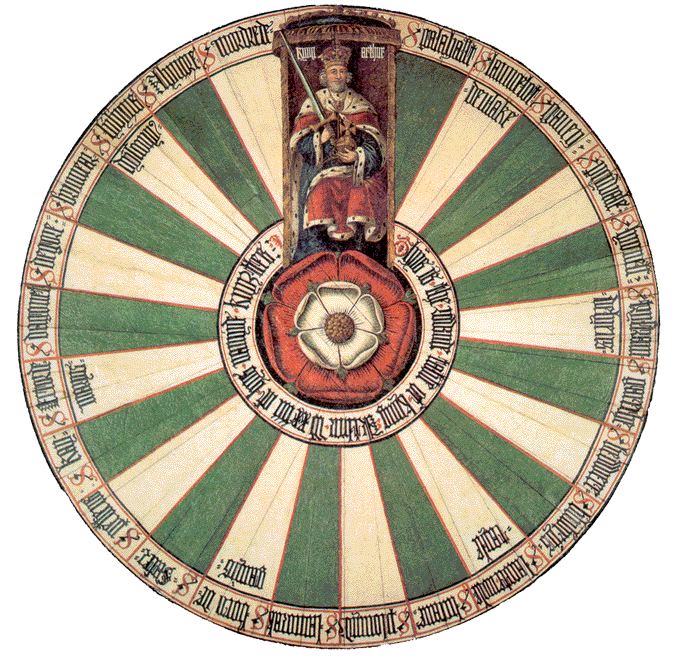
The King Arthur's Round Table has become a symbol for equality and just government.
Geoffrey of Monmouth makes no mention of a Round Table in his history of Arthur. It was the French monk Robert Wace, writing around 1155, who was the first to mention this piece of furniture in his Roman de Brut. Supposed Round Tables sites in Britain include in Bryn-Rhyd-yr-ArianCaerleonPenrithStirling, and Winchester.
Wace says that Arthur's knights sat around a round table while Arthur sat on a dais, above the Round Table. The idea here was that the knights were all equal but Arthur was still the king. Wace doesn't tell us how many knights sat around the table.
A few years later, an Englishman named Layamon in his chronicle places Arthur's court in London. The Round Table is portrayed the result of a chance meeting between Arthur and a Cornish carpenter, who offers to make for the king a table that could seat 1,600 men and be folded up and taken anywhere.
Robert de Boron tells us how Merlin ordered Uther Pendragon to construct the table based on his vision of the Last Supper Table and Joseph of Arimathea's Grail Table. Merlin instructed Uther to have the table accommodate 50 chairs; he also said to leave one chair blank, for the knight who would fulfill the Grail Quest. The Vulgate Cyclesays the Round Table sat 250 knights.
The Vulgate Cycle introduces the idea of the Siege Perilous, continuing the empty-chair theory but adding to it the caveat that anyone not anointed would perish after sitting there. Galahad, of course, was the only one able to sit there; it was he who fulfilled the Grail Quest.
The Siege Perilous is the seat (from the French siège) at the Round Table in which only the chosen Grail knight may sit without disastrous consequences. Malory tells us that it was made by Merlin ). When Galahad arrives at Camelot, his name appears on the seat destined for him.
Full references to more about The Round Table at the Rochester site.
It is unlikely that, even had it physically existed, that a wooden Round Table would have survived

The Battle of Towton: This Bitter Field


The ‘biggest, bloodiest and longest battle on English soil’ was fought at Towton in Yorkshire on Palm Sunday 1461. Its brutality was a consequence of deep geographical and cultural divisions which persist to this day, writes George Goodwin.
Battle of Towton, as depicted by Richard Caton Woodville (1856–1927)Battle of Towton, as depicted by Richard Caton Woodville (1856–1927)In his article Barriers to the Truth, published in the December 2010 edition of History Today, Ian Mortimer elegantly explained the difficulties caused by the fragmentary nature of medieval sources. However there are some vibrant gems from the later medieval period which instantly propel you back to the age of their creation. One such is William Gregory’s 15th-century Chronicle, full of the type of barbed jest that would please a newspaper columnist today. Take for instance his sneer at James Butler, 1st Earl of Wiltshire (1420-61) for deserting the Royal Standard at the First Battle of St Albans in 1455: ‘He fought mainly with his heels for he was called the most handsome knight in the land and was afraid of losing his beauty.’ In contrast to such jocularity there is the spiritually transcendent tone of John Blacman’s first-hand account of Henry VI (r. 1422-61; 1470-71), capturing, if unintentionally, the full extent of the king’s troubled mind.
The celebrated Paston Family Letters contain many vivid descriptions and one in particular attracted my attention when researching the disastrous first reign of Henry VI and its effective end with the slaying of most of the Lancastrian nobility at the Battle of Towton. In a letter to his elder brother John on April 4th, 1461, less than a week after the battle of March 29th, William Paston writes:
Please you to know and have wisdom of such news as my Lady of York has by a letter of authority, under the sign manual of our Sovereign Lord King Edward, which letter came to our said Lady this very day at 11 o’clock and was seen by me, William Paston.
Initially there was the thrill of knowing that here was a first-hand observation of a letter sent immediately after the battle by the victorious Edward IV newly acclaimed on March 4th, 1461 but not yet anointed and crowned, to his mother, Cecily, Dowager Duchess of York; but this was many times magnified when Paston goes on to reveal its contents. For he tells us of the fates of some of the enemy commanders: ‘is dead Lord Clifford, Lord Neville, Lord Welles ...’ and many more, including, by supposition, the Earl of Northumberland and the Lancastrians’ master tactician, ‘Sir’ Andrew Trollope. Paston then crucially reveals the full extent of the Lancastrian catastrophe: ‘with many others, gentle and commons, to the number of 20,000’. As a nugget of evidence it is pure gold. It not only ties in with surviving letters from Chancellor Bishop George Neville and two of his fellow bishops, which give the figure of 28,000 dead at the battle, but also with a despatch from Prospero di Camulio, the Milanese Ambassador to France, sent to his duke a mere fortnight after the event. In this he gives the figures for the dead Lancastrians as 20,000, matching the Paston Letter; and for the Yorkists, mistakenly still described as ‘Warwick’s side’, he gives 8,000.
English longbow archers in action, from the Beauchamp Pageant, contemporary with TowtonEnglish longbow archers in action, from the Beauchamp Pageant, contemporary with Towton
It all fits together and points to two possible explanations. Perhaps the 18-year-old Edward IV (r. 1461-70; 1471-83) was running a concerted propaganda campaign to inflate the figures, for reasons we can scarcely conjecture. If so, this was coordinated to such an extent that even Peter Mandelson might purr with admiration. Or perhaps the explanation is simpler: this was the accepted figure on the basis of being ‘as counted by the heralds’, the official appointees for such a role. It was also a figure given first-hand, or at least second-hand by notable people of the day, not by monastic chroniclers away from the action and out of context.
Is it credible? After all, with an estimated Anglo-Welsh population of around three million, such casualties would represent almost one per cent of the populace, or perhaps four per cent of males between 16 and 60, the normal expected ‘fighting age’ of men at the time. A total of 28,000 killed is far greater than for any other battle during the Wars of the Roses and more even than the 19,000 British troops who died on the first day of the Battle of the Somme on July 1st, 1916. Bearing in mind that at Towton medieval and not modern weapons were used, the death toll denotes an extraordinary number on the battlefield, in excess of the 75,000 – itself 10 per cent of the ‘fighting age’ men – that many historians claim as the likely upper figure? And, if 75,000 were to have fought, made up perhaps of 40,000 Lancastrians and 35,000 Yorkists, how is it possible that one side could see half its men killed?
For 75,000 men to fight and 28,000 to die on one day the two armies would have needed to be locked together for an exceptional amount of time and fighting with weapons of deadly efficiency. Both of these factors were present. Chroniclers are in agreement that this was an action of many hours from the early morning to late afternoon followed by a pursuit and rout off the battlefield – from Towton to Tadcaster and ten more miles to York – running into the night and through it. As for the weaponry, the devastating effectiveness of Anglo-Welsh archers, so successful at Crécy (1346) and Agincourt (1415), was now being used against their own countrymen. And many of these were ‘naked men’, so called because of their lack of effective defensive equipment and thus completely vulnerable to the razor-sharp arrowheads raining down on them. The devastation of the opening arrow storm was joined in the engagement itself by the ferocious power of the weapons of the trained men-at-arms – such as the hand-and-a-half sword and the poleaxe – and in the rout by the mace and well-named horseman’s hammer which were used on the unprotected heads and backs of men trying in vain to run for their lives.

There had to have been some additional elements in order to create such losses. How was it possible for one army to lose such a proportion of its men? Particularly as the Lancastrian army had all the advantages at the battle’s outset: it was on home ground and well provisioned from nearby York (then the second city of the country); it was against an enemy forced to march hundreds of miles towards it and with all the problems of movement and supply in hostile terrain, during the final week at least. More than that, the battlefield was on a plateau at the highest point between the Yorkists’ difficult crossing over the River Aire and their target city of York, thereby providing the Lancastrians with a seemingly invulnerable position. According to the theories of the greatest military writer of the Middle Ages, the Italian-born Frenchwoman Christine de Pisan (1363-c. 1430), they had one of the three chief requirements for success in battle and the one that was usually decisive – that is ‘high ground’: their opponents had to attack up the slope. It gave the Lancastrians all the advantages of movement, manoeuvre and visibility.
Furthermore, the Lancastrians had, in Sir Andrew Trollope (d. 1461), a great military mind directing operations. He had been knighted only a month previously by Henry’s VI’s seven-year-old son, Prince Edward, after the seemingly decisive Lancastrian victory at the Second Battle of St Albans. The delay was merely due to his humble birth, for he was described by the near-contemporary Burgundian, Jean de Waurin, as ‘un très soubtil homme de guerre’ and by another chronicler as ‘Magno capitaneo et quasi ductore belli’. Trollope was such a key member of the Lancastrian inner command that he felt able, as he was being dubbed for his knighthood, to joke with the little prince that, because he had been immobilised by a wound: ‘My lord I have not deserved it for I slew but 15 men, for I stood still in one place and they came unto me, but they still bode with me.’ He was the military adviser to the Duke of Somerset, the Lancastrian commander at Towton and his was the first name on the pre-battle Yorkist proscription list of those they wished to ‘effectually destroy and bring out of life’. The Yorkists knew his potential: as well as his contribution to victory at Second St Albans he had played a critical role in their rout at Ludford Bridge in October 1459 and in the defeat and death of their titular leader, Richard, Duke of York, at the Battle of Wakefield in December 1460.  
It cannot be doubted that the Lancastrians intended to hold up an exhausted and starving Yorkist army on the River Aire, about eight miles to the south, and that they then expected to fight the major battle at Towton in the place of their choosing. It is thus understandable why they would have protected their rear from an outflanking manoeuvre by destroying the bridges over the River Cock north-west of Towton and over the River Wharfe at Tadcaster. Certainly they had the advantage of ‘ground’.
They did not, however, have the second key factor of de Pisan’s criteria for battle success: the advantage of ‘wind’. A fierce wind, for or against, could make a difference of scores of yards in terms of a longbow’s range. Even the advantage of height favouring archers at the top of a slope shooting downwards could be negated, indeed reversed, by a gale. Such a reversal took place shortly after 9am, just before the battle’s opening archery duel. In addition, the storm blew stinging sleet into Lancastrian faces. Under the calm, professional command of Edward IV’s maternal uncle, William Neville, Lord Fauconberg (c. 1410-63), the Yorkists sent arrow after lethal arrow into the opposing ranks, while their blinded opponents shot volley after volley short of the enemy; only for their missiles to be picked up from the ground by the intended victims and shot back again. The Lancastrian forces could not withstand such slaughter: they were forced to lose their commanding position in order to engage the enemy and end the onslaught.
The third and last of de Pisan’s key attributes for battlefield success was ‘sun’. On such a ghastly English day of sleet and snow – which made conditions underfoot a combination of ice, slush, blood and bodies – there was no sun. Not in a literal sense, at least, but symbolically, for England had its own ‘Sun King’. He is known to us through the first lines of Shakespeare’s Richard III as ‘this sun of York’, Edward IV. The ‘sun in splendour’ was to become Edward’s favourite badge and it referred to a phenomenon just before his first great victory at Mortimer’s Cross in February 1461: one that showed this 18-year-old to be more than merely the new titular leader of the Yorkist cause following the death of his father, but rather a commanding figure blessed by providence. For on that February day in the Welsh Marches not one sun was seen in the sky but three. This was a parhelion, where the sun shining through ice crystals created the effect of a mirror and those below saw it twice reflected. The unexplained can cause dread but Edward, then known as the Earl of March, provided an explanation: the three suns represented the blessing of the Holy Trinity upon another trinity, that of himself and his two young brothers, George, later Duke of Clarence (1449-78) and Richard, later Duke of Gloucester and, later still, Richard III (r. 1483-85). It seems there was no such equivalent for the Lancastrian forces, commanded by Jasper Tudor (c.1431-95), Jasper’s father Owen (1400-61) and chronicler Gregory’s despised Earl of Wiltshire, who this time fled the field even before battle was joined. They were routed by their inspired Yorkist opponents.
Victory at Mortimer’s Cross had enabled Edward to take over command from his older more experienced cousin, Richard Neville, the 16th Earl of Warwick, ‘the Kingmaker’, who had been so badly mauled at Second St Albans. He had also been able to relieve London and had there been acclaimed as king at the beginning of March. Within days the small Yorkist army had split into three separate forces and left for the north. It may have been small on departure from London, but it was vast on arrival a few weeks later at Towton. The increase was due to the authority of a recognised king, who could recruit under Commissions of Array; to refuse the call to colours was treasonable, punishable by death. The recruitment could be extremely effective through its apparatus of administrative enforcement, from the great lords of the realm down to the humblest local official and by its physical enforcement by captains riding vast distances to call in subordinates who themselves recruited on a ‘pyramid’ basis that rippled across the counties. For the first time during the Wars of the Roses two competing kings were recruiting. They were each also, ironically, taking short-term advantage of their magnates’ power in the regions, because the official ‘crown down’ feudal system had been distorted by defensive baronial alliances into ‘bastard feudalism’, a system of retainers which encouraged the raising of armed men by the nobility and gentry. The numbers recruited on both sides were huge.

However, mere numbers at the battle do not explain its casualties. This was where the ‘Sun’ was so crucial, both for the length of the battle and for its horrific denouement. The Lancastrians may have been forced to leave their positions and advance on the Yorkists but their forces were still larger. The Yorkist lines buckled but they did not break. This, the chroniclers agree, was due to Edward. Every inch a king at 6ft 4ins and charged with vibrant energy, he was an imposing figure who now rallied the line at its weakest point. The battle continued for hours until, in early afternoon, desperately awaited Yorkist reinforcements under the Duke of Norfolk smashed into the left of the Lancastrian line. Both lines turned. Yet even now the battle was not over; much later, perhaps near dusk, one line broke. Soon the Lancastrians were, first in pockets and then in a free for all, trying to escape. Trying but, in vast numbers, failing. Their commanders’ opening position, protected to flank and rear, now in these unimagined circumstances made it incredibly difficult to get off the battlefield. Either the men were funnelled westwards in a sliding, slithering mass down Towton Dale into what is now known as Bloody Meadow and further down into the fast-flowing swollen waters of the River Cock; or they sought to flee up the slope, through their opening position and into open, cavalry country.
As the majority of the common soldiery struggled on, weighed down by ineffective and saturated ‘protective’ clothing, they were targeted by vengeful opponents, themselves exhausted but surging towards the Lancastrians at the direction of their leader, their adrenalin levels charged by the scent of victory. Years later Edward IV told the chronicler Philippe de Commynes that:
In all the battles he had won, as soon as he sensed victory, he mounted his horse and shouted to his men that they must spare the common soldiers and kill the lords, of whom few or none escaped.
Only the latter part of the statement had an element of truth; the first part was a lie. A later chronicler was in no doubt about Edward’s intentions of giving no ‘quarter’: ‘He [Edward] made proclamation that no prisoner should be taken, nor one enemy saved.’ Thousands died by arrow, hand-weapon or horseman’s hammer or by drowning in the rivers Cock or Wharfe. In place of the broken bridge over the River Cock arose another from the depths: a ‘bridge of bodies’, after which the spot is still named today.

This combination of strategy and circumstance can explain why so many may have fought and died at Towton. But it does not provide an adequate explanation for the appalling brutality of the ‘biggest, longest, bloodiest battle on English soil’.
The causes of the brutality were many and deep, but fundamental to it was the failure of Henry VI to fulfil his duties as a medieval monarch. The problem, as David Starkey puts it, was one of ‘kingship – or rather, as the king in question was Henry VI, its very present absence’. The adult medieval king had an array of institutions at his disposal to assist him in his responsibilities: for the waging of war, the administration of justice, the distribution of offices and patronage and the maintenance of the proper state and estate of a monarch. But the personal intervention of the king provided the oil that lubricated the machinery of government. Under commanding figures such as Edward III (r. 1327-77) and Henry V (r. 1413-22) the system worked well; vast areas of France were secured and, for a time, Henry ruled over the larger part of the kingdom itself. Even under poor active rulers such as the deposed ‘seconds’, Richard II (r. 1377-99) and Edward II (1307-27), there could be no civil war in England, as the nobility remained largely united against the ‘tyranny’ of monarchs who were perceived to have broken their coronation oath and thus to have offended against God. The problem with Henry VI was that, as a ‘nullity’, he was not considered to have broken that oath until just a month before Towton, when after Second St Albans he fell out of Yorkist hands and into Lancastrian ones: before that point he could not be removed.
Though it was believed that only Henry could reign, others could rule. After the pivotal year of 1450 – which had seen the effective loss of the English kingdom of France, the collapse of the Duke of Suffolk’s regime that had run the country on Henry’s behalf and a popular revolt that sacked London – there were two potential sources of effective administration. One centred around first the Duke of Somerset and then Henry’s French queen, Margaret of Anjou (1430-82); the other around Richard, 3rd Duke of York (1411-60), the country’s leading magnate. Both York and Margaret sought to act, in fact, if not in title, as regent with full kingly power. Margaret, following French rather than English precedent had assumed the role by 1459, though effectively acting on behalf of her son Prince Edward rather than Henry. After open warfare had broken out and following the Yorkist victory at Northampton in 1460, York, who was to die in the Battle of Wakefield in December that year, believed that he had been granted kingly power by Parliament’s Act of Accord, by which he, and not the prince, became Henry’s heir. Neither York nor Margaret, however, had a monarch’s authority and the nobility were split, if rather in Margaret’s favour. The vendettas resulting from six bloody battles and routs within the previous 18 months explain the merciless treatment of the Lancastrian knights and nobles at Towton. They do not account for the brutality of the predominantly southern Yorkist soldiery against their northern Lancastrian opponents, however.
Edward unleashed his troops with his command of ‘no quarter’ and they answered his call with a vengeance. Before 1996 their action was the stuff of folklore. But in that year a mass grave, just off the battlefield, was uncovered during building work and the skeletons within revealed a horror greater than any legend. The multitude of injuries inflicted on the skulls of disarmed Lancastrian men revealed a frenzy of blows that had smashed and distorted them. They were dehumanised in death because they had been dehumanised by Warwick’s Yorkist propaganda in life. Warwick, seeking desperately to rouse London and neighbouring counties against Margaret’s all conquering army in January and February 1461, had propagated the belief that the men from ‘north of the Trent’ were bent on rape and destruction. The message was taken up through word of mouth, song and parish noticeboard. It was highly effective, as shown by this letter home written by Clement Paston, a student in London:
In these parts, every man is well willing to go with my Lords here and I hope God shall help them, for the people in the north rob and steal and are set to pillage all this country and give away men’s goods and livelihoods.
Differences in dialect and diet – for instance Warwick’s Kentish ‘shock troops’ drank beer rather than ale – were magnified. By the time the two armies met in what was designed to be the decisive battle, each saw the other as composed of aliens. The actions that day helped to make the Trent a cultural as well as a geographical dividing line: one that, periodically highlighted by events as far removed as the Pilgrimage of Grace of 1536 and Margaret Thatcher’s reforms of the 1980s, has never fully disappeared.
After Towton there was a fundamental change in attitudes at the top of society as well as at the bottom. Henry VI, the broken old unworldly king ‘anointed by God’, had at last been replaced – and by a vigorous all-too-worldly young king ‘blessed by providence’. Yet the collective cohesion of the nobility was also shattered. Whereas Edward II and Richard II had been dethroned with near unanimous noble agreement, Henry VI’s incapacity had eventually caused a schism among powerful royal and baronial subjects who, for their own ends, had diverted the crown’s powers for the recruitment and maintenance of troops. As the final fate of Henry VI and those of Edward V (1470-83) and Richard III were to demonstrate, right of succession and/or divine anointment and coronation were no longer enough to maintain life, let alone position. It was a lesson that was still slow to be learned. But not by the adroit, rigorous and lucky Henry VII (r. 1485-1509). Richard II attempted to secure his throne through, in David Starkey’s words, ‘making himself the biggest bastard feudal lord of them all’. He failed. A century later Henry VII succeeded. The ceremonies of monarchy continued, indeed increased under the Tudors. Yet rites, even a king’s rights were no longer enough; they now had to be underpinned by raw power and, with that, England moved towards a new, imperial monarchy.
George Goodwin is the author of Fatal Colours: Towton 1461, England’s Most Brutal Battle(Weidenfeld and Nicolson, 2011).
Further reading: 
  • Helen Castor, She-Wolves (Faber, 2010)
  • Christopher Dyer, Making a Living in the Middle Ages (Yale, 2009)
  • Anthony Goodman, The Wars of the Roses (Yale, 2010)
  • Lisa Hilton, Queens Consort: England’s Medieval Queens (Weidenfeld and Nicolson, 2008)
  • David Santuiste, Edward IV and the Wars of the Roses (Pen and Sword, 2010)