Translate

Monday, July 30, 2012

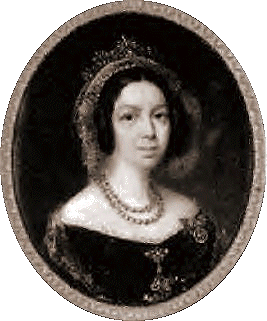
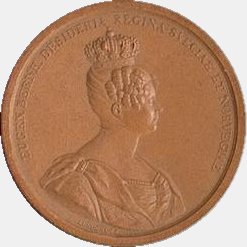
Portraits of Desiree´


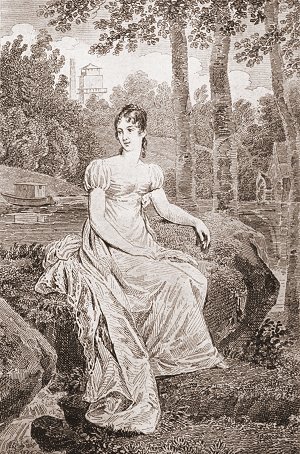
"Désirée Clary at Mortefontaine" by François Pascal Simon Gérard (Rome 1770 - Paris 1837). 


"Queen Desideria". Anonymous, XIXth century. 


"Désirée Clary" by François Pascal Simon Gérard (Rome 1770 - Paris 1837).


"Princess Desideria of Sweden". Miniature (1812) by Nicolas Jacques (Jarville 1780 - Paris 1844).


"Queen Desideria". Anonymous, XIXth century. 


Désirée at Mortefontaine, after the painting by Gérard (engraved version of original, which hangs in Royal Palace, Stockholm)

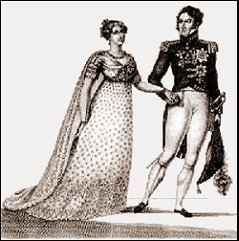
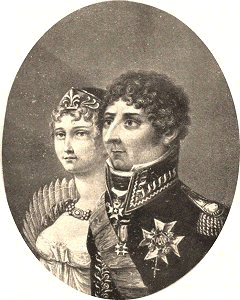
Désirée and Jean-Baptiste Bernadotte - old "fashion plate" engraving


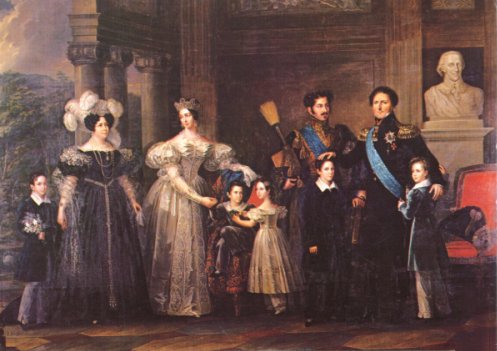
The Bernadotte Family, 1837, by Fredrik Westin (Gripsholm Palace)


                                        (Dowager) Queen Desideria , by Johannes Möller


Queen Desideria - from a tea caddy, Royal Palace, Stockholm


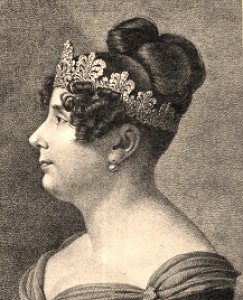
Queen Desideria - engraved version of "tea caddy" portrait


"Désirée Clary" by Robert Jacques François Faust Lefèvre (Bayeux 1755 - Paris 1830)


"Queen Desideria on her deathbed". Photograph taken in 1860


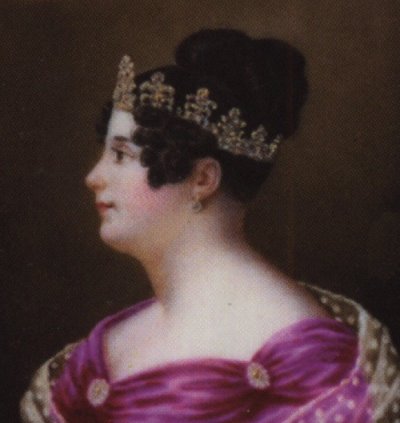
The image of a previously ‘un-identified’ sitter, in 1st Empire style dress, showing off a gold finger band and superb pearl earrings, seated on a green silk velvet bench, is one of the great works of art in the celebrated David Roche Collection of Regency/Empire furniture and decorative arts. It was recently published, as part of a 2008 Exhibition – Empires and Splendour, which was held at the Art Gallery of South Australia. The portrait, an oil on canvas signed lower left R Lefévre Fecit, will be displayed in the first exhibition to be held at the David Roche Gallery in Adelaide post Easter 2012. It has been suggested, by some in the know the sitter is Bernardine Eugénie Désirée Clary (1777 – 1860) former fiancée of Napoleon Bonaparte, and later Queen Consort of Sweden and Norway? If it does turn out to be proved to be Désirée, it will be yet another coup for this renowned Australian collector David Roche, whose amazing ‘cabinet of curiosities’ will be bequeathed to the people of South Australia. Preliminary examination and knowledge that both portraits reveal a small blemish/beauty spot to the left hand side of her nose, is surely an intriguing co-incidence. This image is a side on view, as opposed to the full frontal view of the work by Lefévre below, which is now in the Royal Domain at Drottingholm. Those familiar with Désirée may also recognize her inimitable hairstyle. BY CAROLYN MCDOWALL  MARCH 6, 2012


Napoleon Bonaparte's will


NAPOLEON. This 15th April, 1821, at Longwood, Island of St. Helena. This is my Testament, or act of my last will.

1. I DIE in the Apostolical Roman religion, in the bosom of which I was born more than fifty years since.
2. It is my wish that my ashes may repose on the banks of the Seine, in the midst of the French people, whom I have loved so well.
3. I have always had reason to be pleased with my dearest wife, Maria Louisa. I retain for her, to my last moment, the most tender sentiments-I beseech her to watch, in order to preserve, my son from the snares which yet environ his infancy.
4. I recommend to my son never to forget that he was born a French prince, and never to allow himself to become an instrument in the hands of the triumvirs who oppress the nations of Europe: he ought never to fight against France, or to injure her in any manner; he ought to adopt my motto: "Everything for the French people."
5. I die prematurely, assassinated by the English oligarchy and its tool. The English nation will not be slow in avenging me.
6. The two unfortunate results of the invasions of France, when she had still so many resources, are to be attributed to the treason of Marmont, Augereau, Talleyrand, and La Fayette. I forgive them--May the posterity of France forgive them as I do.
7. I thank my good and most excellent mother, the Cardinal, my brothers, Joseph, Lucien, Jerome, Pauline, Caroline, Julie, Hortense, Catarine, Eugene, for the interest they have continued to feel for me. I pardon Louis for the libel he published in 1820: it is replete with false assertions and falsified documents.
8. I disavow the "Manuscript of St. Helena," and other works, under the title of Maxims, Sayings, &c., which persons have been pleased to publish for the last six years. Such are not the rules which have guided my life. I caused the Duc d'Enghien to be arrested and tried, because that step was essential to the safety, interest, and honour of the French people, when the Count d'Artois was maintaining, by his own confession, sixty assassins at Paris. Under similar circumstances, I should act in the same way.
II.
1. I bequeath to my son the boxes, orders, and other articles; such as my plate, field-bed, saddles, spurs, chapel-plate, books, linen which I have been accustomed to wear and use, according to the list annexed
(A). It is my wish that this slight bequest may he dear to him, as coming from a father of whom the whole world will remind him.
2. I bequeath to Lady Holland the antique Cameo which Pope Pius VI. gave me at Tolentino.
3. I bequeath to Count Montholon, two millions of francs, as a proof of my satisfaction for the filial attentions be has paid me during six years, and as an indemnity for the loses his residence at St. Helena has occasioned him.
4. I bequeath to Count Bertrand, five hundred thousand francs.
5. I bequeath to Marchand, my first valet-de-chambre; four hundred thousand francs. The services he has rendered me are those of a friend; it is my wish that he should marry the widow sister, or daughter, of an officer of my old Guard.
6. Item. To St. Denis, one hundred thousand francs.

7. Item. To Novarre (Noverraz,) one hundred thousand francs.

8. Item. To Pielon, one hundred thousand francs.
9. Item. To Archambaud, fifty thousand francs.
10. Item. To Cursot, twenty-five thousand francs.
11. Item. To Chandellier, twenty-five thousand francs.
12. To the Abbé Vignali, one hundred thousand francs. It is my wish that he should build his house near the Ponte Novo di Rostino.
13. Item. To Count Las Cases, one hundred thousand francs.
14. Item. To Count Lavalette, one hundred thousand francs.
15. Item. To Larrey, surgeon-in-chief, one hundred thousand francs.--He is the most virtuous man I have known.
16. Item. To General Brayher, one hundred thousand francs.
17. Item. To General Le Fevre Desnouettes one hundred thousand francs.
18. Item. To General Drouot, one hundred thousand francs.
19. Item. To General Cambrone, one hundred thousand francs.
20. Item. To the children of General Mouton Duvernet, one hundred thousand francs.
21. Item. To the children of the brave Labedoyère, one hundred thousand francs.
22. Item. To the children of General Girard, killed at Ligny, one hundred thousand francs.
23. Item. To the children of General Chartrand one hundred thousand francs.
24. Item. To the children of the virtuous General Travot, one hundred thousand francs.
25. Item. To General Lallemand the elder, one hundred thousand francs.
26. Item. To Count Real, one hundred thousand francs.
27. Item. To Costa de Bastelica, in Corsica, one hundred thousand francs.
28. Item. To General Clausel, one hundred thousand francs.
29. Item. To Baron de Mennevalle, one hundred thousand francs.
30. Item. To Arnault, the author of Marius, one hundred thousand francs.
31. Item. To Colonel Marbot, one hundred thousand francs.--I recommend him to continue to write in defence of the glory of the French armies, and to confound their calumniators and apostates.
32. Item. To Baron Bignon, one hundred thousand francs.--I recommend him to write the history of French diplomacy from 1792 to 1815.
33. Item. To Poggi di Talavo, one hundred thousand francs.
34. Item. To surgeon Emmery, one hundred thousand francs.
35. These sums will be raised from the six millions which I deposited on leaving Paris in 1815; and from the interest at the rate of 5 per cent. since July 1815. The account thereof will be settled with the banker by Counts Montholon and Bertrand, and Marchand.
36. Whatever that deposit may produce beyond the sum of five million six hundred thousand francs, which have been above disposed of, shall he distributed as a gratuity amongst the wounded at the battle of Waterloo, and amongst the officers and soldiers of the battalion of the Isle of Elba, according to a scale to be determined upon by Montholon, Bertrand, Drouot, Cambrone, and the surgeon Larrey.
37. These legacies, in case of death, shall be paid to the widows and children, and in default of such, shall revert to the bulk of my property.
III.
1. My private domain being my property, of which I am not aware that any French law has deprived me, an account of it will be required from the Baron de la Rouillerie, the treasurer thereof: it ought to amount to more than two hundred millions of francs; namely,
1. The portfolio containing the savings which I made during fourteen years out of my civil list, which savings amounted to more than twelve millions per annum, if my memory be good.
2. The produce of this portfolio.
3. The furniture of my palaces, such as it was in 1814, including the palaces of Rome, Florence, and Turin. All this furniture was purchased with moneys accruing from the civil list.
4. The proceeds of my houses in the kingdom of Italy, such as money, plate, jewels, furniture, equipages; the accounts of which will be rendered by Prince Eugene and the steward of the Crown, Campagnoni.
NAPOLEON. (Second Sheet.)
2. I bequeath my private domain, one half to the surviving officers and soldiers of the French army who have fought since 1792 to 1815, for the glory and the independence of the nation, the distribution to be made in proportion to their appointments upon active service; and one half to the towns and districts of Alsace, Lorraine, Franche-Comté, Burgundy, the Isle of France, Champagne Forest, Dauphiné, which may have suffered by either of the invasions. There shall be previously set apart from this sum, one million for the town of Brienne, and one million for that of Méri. I appoint Counts Montholon and Bertrand, and Marchand, the executors of my will. This present will, wholly written with my own hand, is signed and sealed with my own arms.
NAPOLEON. (L. S.) List (A).


Napoleonic Era Political Caricatures - English

From the collection of the University of Washington Libraries:
ENGLISH CARICATURES

One notable difference is their propensity to ridicule his appearance, especially his size (which was not particularly small for his nationality and time). The more he threatened British and Russian interests, the greater the graphic indignities to which he was subjected, including, according to George, being “grilled and pitchforked, booted around, farted on, frozen, eaten alive by lions, bears, ogres and Cossacks.”  He shrank in size, from dwarf to imp, until he was almost snuffed out by his enormous plumed hat.


The English caricatures were generally published as a swift response to actual events, such as the Treaty of Tilsit or the Blockades of the 1806/07. They always portray Napoleon in his role as military commander, never as emperor since they did not recognize his claim as a legitimate ruler of France.


Finally, in the later prints as Napoleon began losing both battles and popular support, Death becomes his constant companion and he is often associated with the Devil.


Napoleonic Era Political Caricatures - French

From the collection of the University of Washington Libraries:
FRENCH CARICATURES


Talma, the figure shown with Napoleon, was an actor known for his success in Greek theater; the artist suggests that Napoleon needs lessons in how to act like an emperor.


During the debacle of Waterloo, Napoleon fled the battle field, ostensibly to return to Paris to organize its defense. This was a disastrous move. Afterwards, the Royalists wanted to make sure he was discredited for his, and used caricatures such as this to stress his flight 


In this print, he flicks fleas off his coat, dismissing his son's concerns by saying the vermin are only the fédéres (revolutionary ruffians who had staged a huge rally on Bastille Day 1790.)


                                                                         Et l'on revient toujours A ses premiers amours


The royalist artists also continued to remind the bourgeoisie of Napoleon's link to the revolutionaries, using prints such as this one that proclaims that “one always returns to one's first love”.


The strands of macaroni represent the many conscriptions that were necessary to replenish Napoleon's armies, and the bags of money show the resources that continued to be expended on the constant state of war.


In “La France Constitutionelle” the artist shows a gravely wounded France, being ridden by a victorious Napoleon. Papers spilling out of the cornucopia at her feet are labeled “forced loan, levy of 400 million…”

Sunday, July 29, 2012

Napoleonic Artifacts


Napoleonic artifacts

http://napoleonartifacts.com/Photos.html


18TH-CENTURY FRENCH CULINARY BOOKS AT THE SCHLESINGER (WITH RECIPES!)


Friday, July 13, 2012
French cuisine and French culture are practically synonymous, so we are celebrating 
Bastille Day (July 14) by highlighting some of Schlesinger’s culinary books from late-
18th-century France. Grain shortages and the consequent increase in bread prices were 
among the causes of the French Revolution, and the food supply was also a problem for 
the new government. The following publications offer insight into some of the disruptions 
and continuities of life in the First French Republic.
STAMPED WITH THE APPROVAL OF KING LOUIS XVI
Prior to the Revolution, books were approved for publication by royal 
censors and bore the phrase “Avec approbation et privilege du Roi” 
(With approval and favor of the King). The king could also order the publication 
of a work, as shown here in the 1789 Traité sur la culture et les usages des 
Pommes de terre, de la Patate, et du Topinambour (Treaty on the culture and 
use of the potato, sweet potato, and Jerusalem artichoke) by Antoine-Augustin 
Parmentierwhich was"published and printed by order of the King.”
Title page to Traité
[Title page from Treaty on the culture and use of the potato, sweet potato and J
erusalem artichoke by Antoine-Augustin Parmentier published in 1789 (by order 
of the King). Find the book in HOLLIS or read a full-text version online.]
The Faculté de Médicine de Paris had approved the potato for food in the early 
1770s, but people still had their doubts. In the forward to the Traité, Parmentier 
notes the recent bad weather and mediocre harvests that had forced people to 
reconsider the potato—especially since the potato seemed to do well when grain 
harvests were bad. Most of the book is about cultivation, with a small section on 
cooking potatoes and on potato bread.
Forword
[Foreword assuring the edibility of potatoes from Antoine-Augustin Parmentier's 
Treaty on the culture and use of the potato, sweet potato and Jerusalem artichoke.]
PUBLICATIONS OF THE NEW REPUBLIC
Originally published in the French Republican year III (1794/1795) and attributed 
to Madame Mérigot, La Cuisinière républicaine sought to teach simple ways of preparing 
and preserving potatoes. In the Schlesinger Library’s facsimile reprint, published in 1976, 
the introduction identifies this publication as the first cookbook of the Republic and the 
first collection of potato recipes.
Title page to La Cuisinière républicaine
[Title page from The female republican cook, that teaches a simple manner of 
preparing potatoes; with some advice on the steps necessary for preserving them
attributed to Madame Mérigot  and published in the French Republican year III (
1794/1795) Find the book in HOLLIS.]
Another culinary book published during the French Republican year III (1794) was 
Leçons élémentaires sur la choix & la conservation des grains by Louis Cotte, a 
former Father Superior who had renounced his vows during the deschristianization 
of France. Intended for the edification of “les bonnes Ménageres,” or good 
housewives, the book gives catechetical lessons on various aspects of grain 
production and bread making, including a section on potato bread (lesson 10) 
while actively encouraging a new Republican identity.
Title page to Leçons élémentaires
[Title page from Elementary lessons on the selection and conservation of 
grains, on the operation of mills and bakeries, and on the bread tax by 
Louis Cotte published in the French Republican year III (1794) Find the 
book in HOLLIS.]
RECIPES
ère républicaine:


Here are two recipes from La Cuisini[Potato salad recipe from La Cuisinière républicaine
"When the potatoes are cooked, cut them up and season them with oil, vinegar, fines herbes 
[parsley, chives, tarragon and chervil], salt and pepper; or, instead of oil, butter or cream: 
eat this salad hot or cold. Another way, with oil, vinegar, salt, pepper, yellow beets and sliced gherkins."]

Potato bread recipe from La Cuisinière républicaine

[Potato bread recipe from La Cuisinière républicaine:
 "Those who bake can mix potatoes in their 
bread, half or even more. Crush the potatoes still warm
with a rolling pin, then mix with the dough 
and knead together."]